History

Otto von Bismarck
Otto von Bismarck was a prominent statesman and diplomat who played a key role in the unification of Germany in the 19th century. Serving as the first Chancellor of the German Empire, he implemented a series of policies and strategies known as Realpolitik to strengthen and consolidate the newly unified nation. Bismarck's leadership and influence significantly shaped the course of European history.
Written by Perlego with AI-assistance
Related key terms
1 of 5
12 Key excerpts on "Otto von Bismarck"
 eBook - PDF
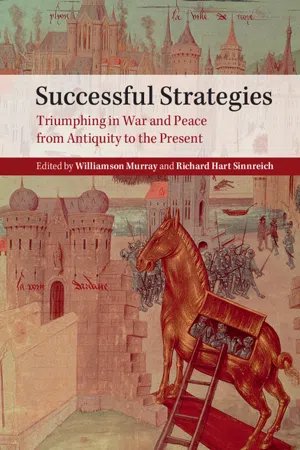
Successful Strategies
Triumphing in War and Peace from Antiquity to the Present
- Williamson Murray, Richard Hart Sinnreich(Authors)
- 2014(Publication Date)
- Cambridge University Press(Publisher)
But who can resist the temptation to relate such an outsized historical figure to the circumstances of his age and to understand his policies in the context that they did so much to create? No other individual in European history between Metternich and the First World War approaches the stature of Bismarck. Between 1866 and 1890, he guided the German-speaking lands of Central Europe to a destiny that many wished for, but few could clearly envision and no other could bring to pass. His own evolution as a statesman paralleled that of his country: if he railed against the forces of revolutionary change, nationalism, and liberalism 1 Thomas Mann, “Die Drei Gewaltigen,” Reden und Aufsätze, vol. I (Oldenburg, 1965), pp. 62–63; from Gordon A. Craig, “The Reich Stuff,” The New York Review of Books, 31 January 1991, p. 26. 214 early in his career, he later harnessed them skillfully to the cause of Prussian dominance over northern Germany and the growth of German power. In a lecture commemorating the anniversary of his death, the conservative German historian Arnold Oskar Meyer recounted how the great statesman had embodied the passage through the modern age of the Hegelian historical spirit, albeit with a distinctively Prusso-German character: “What [Bismarck] accomplished for his people is greater than that for which any other people in Europe can be thankful to a single man.” 2 After 1871, like a sorcerer’s apprentice, he struggled with increasing futility to control the forces he had helped to release and save the new German Empire from the strategic circumstances of its birth. The past century has seen innumerable attempts by historians to come to terms with Bismarck’s foreign and strategic policies. 3 To greater or lesser degrees and irrespective of the political orientation of the scholars in question, almost all focus intently on the towering personality of Bismarck, particularly on his intentions, expectations, decisions, and miscalculations. eBook - PDF
Bismarck and the Development of Germany
The Period of Unification, 1815-1871
- Otto Pflanze(Author)
- 2020(Publication Date)
- Princeton University Press(Publisher)
INTRODUCTION THE BISMARCK PROBLEM ITH the exception of Napoleon, no other /figure in modern European history has attracted as much interest as Otto von , Bismarck. Since the first serious studies of the man and his career appeared sixty years ago, the size of the bibliography has reached staggering proportions. 1 Still the flood of books and articles continues with no sign of abatement. Bismarck and na-tional unification have as great a fascination for Germans as do Lincoln and the civil war for Americans. To non-Germans as well, the personality and achievement of the Junker genius have a magnetic attraction. His political career of almost half a century was one of the longest in the annals of state-craft. For nearly three decades of that time he was the dominant figure in German and European politics. Unexplored nooks and crannies, even whole rooms, are still being discovered in the edifice of his career. The wide range of his interests, the complexity of his mind, and his almost incredible skill at political invention and maneuver have made the subject difficult to exhaust. By far the most important reason for continued interest, how-ever, is the need to reassess the German past in view of the terrible tragedy of the twentieth century. In a book of essays dedicated to this theme Hans Kohn remarked that the process of rethinking German history centers rightly around the appreciation of Bis-marck's work. Reviewing the German catastrophe, Friedrich Meinecke, the dean of German historians, wrote sadly in 1945, The staggering course of the first, and still more the second world war no longer permits the question to be ignored whether the seeds of later evil were not already present in the Bismarckian Reich. 2 1 Hajo Holborn, The Political Collapse of Europe (New York, 1951), p. 200. The best general survey of the literature is Walter Bussmann, Das Zeilalter Bis-marcks in Leo Just, ed., Handbuch der deutschen Geschichte, m/3 (Constance, 1955).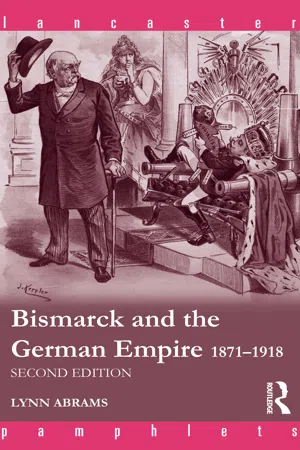 eBook - ePub
Bismarck and the German Empire
1871–1918
- Lynn Abrams(Author)
- 2007(Publication Date)
- Routledge(Publisher)
Otto von Bismarck was appointed prime minister of Prussia in September 1862. He was born on All Fools’ Day in 1815, the son of a Prussian Junker (member of the lesser nobility) and a mother from a successful family of civil servants. His background, combining liberal intellectualism on his mother’s side and traditional Prussian noble values from his father, is said to have gifted the young Bismarck a breadth of vision and an ability to understand diverse attitudes and ambitions. He was well educated in Berlin, a city he was said to hate, and after university in Göttingen he embarked upon a career as a civil servant. When he was still only 24 years old he resigned his post and returned home to the family estate in Pomerania, but boredom soon found him engaging in Prussian politics. From 1851, in his position as Prussian representative to the Federal Diet of the Confederation in Frankfurt, he fought to maintain Prussian supremacy in the face of the Austrian challenge. In 1859 he was moved to a new diplomatic posting in St Petersburg but he continued to champion the cause of Prussia within the Confederation. Until 1860, as a diplomat, Bismarck had been at the margins of power, but a constitutional crisis in Prussia, which saw open conflict between the sovereign and the parliament over the issue of the reorganization of the army, resulted in the recall of Bismarck from his then posting in Paris to head a new cabinet. Between 1862 and 1866 Bismarck ruled Prussia unconstitutionally, ignoring the parliament, illegally raising the necessary finance by taxation and pushing through the army reforms. In his new position as prime minister of Prussia, Bismarck sought to enhance the position of Prussia at every available opportunity. Just nine years later he had achieved his aim of securing Prussia’s position within Germany and setting her on the path of economic success and political dominance.Historians may disagree about Bismarck’s intentions, about his achievements and failures and his legacy, but few would deny the extent of his impact on German politics and the shape of the German Empire. This acceptance of the centrality of one man has prompted numerous biographical studies and personality assessments in an attempt to probe beneath the pugnacious façade. In his time as Prussian prime minister and German chancellor he created a ‘charismatic myth’ of indispensability which even present-day historians have found difficult to shake off, with Hans-Ulrich Wehler recently describing Bismarck as a charismatic leader with ‘devoted followers’, who inspired ‘fanatic enthusiasm’ and who hung on to power by manufacturing and then solving crises.23 As Katherine Lerman has stated, Bismarck’s ‘exceptional status’ is not in doubt, whether one judges him positively as a clever tactician or – more likely – critically as a man who saddled the new state with an immense problem.24 The negative view of Bismarck as an arch-manipulator presiding over a ‘Bonapartist dictatorial regime’ is today regarded as too trite a description of the man and his system, and historians are more apt to find some agreement with Bismarck’s own assessment of his place in German history when he said ‘I, at least, am not so presumptuous to believe that history can be made by the likes of us. It is my task to observe history’s currents and to steer my ship within them. I cannot guide the currents themselves, let alone create them.’25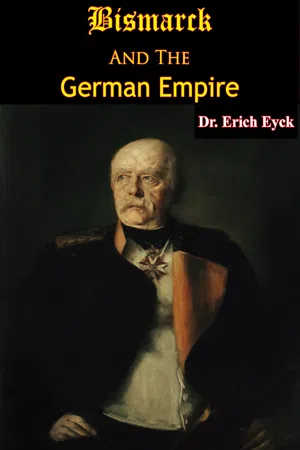 eBook - ePub
- Dr. Erich Eyck(Author)
- 2016(Publication Date)
- Normanby Press(Publisher)
CHAPTER IV—BISMARCK AS IMPERIAL CHANCELLOR
THE twenty years beginning with the foundation of the German Empire in January 1871 and ending with Bismarck’s dismissal by William II in March 1890, are known to historians as the “Age of Bismarck”, for, indeed, during these years he was the centre not only of German but of European politics. The majority of the German people looked at him as the hero of national unity, but statesmen in all other capitals of Europe considered him not only the unrivalled master of their craft, but the most important factor in every political calculation and combination. Nowhere was there a man bold enough to dispute his superiority, whether in London or St. Petersburg, let alone Paris or Vienna. Everywhere the leading statesmen, Disraeli or Gortchakoff, Andrassy or Thiers, looked to Berlin and to the Wilhelmstrasse or even to Varzin or Friedrichsruh, should the Chancellor happen to be on his estates, far from his office. In the seventies, in particular, Bismarck’s position was comparable only to that of Napoleon I during the Congress of Erfurt in 1808, when the Czar of Russia and all the German princes gathered round to do him homage. But while Napoleon continued to plunge into fresh wars, Bismarck never drew the sword again after defeating France. A few years after Erfurt Napoleon I was driven from his throne and from France; Bismarck remained in power for almost twenty years and his overthrow was due not to a foreign enemy but to his own Emperor.The years from 1871 to 1890 stand out in sharp contrast to the first period of Bismarck’s administration from 1862 to 1870. In this initial period he waged three wars, in 1864, 1866, and 1870, but in the later period not one. This, of course, by no means implies that his views on the admissibility of war as a means of solving political problems had changed. Before and after 1870 he considered military strength the real criterion of the importance of a state. But he did not wish to jeopardize in a new war what he had won for Prussia and Germany in three previous wars. In the earlier period he had changed the map of Europe completely. He had not only enhanced Prussia enormously and united the different German states under the Prussian crown, but he had also annexed to Germany two provinces which had belonged to France for two centuries and the inhabitants of which had most unwillingly become German subjects. Bismarck believed that Germany had now got all the territory that was good for her, that she was saturiert eBook - PDF
Bismarck's Shadow
The Cult of Leadership and the Transformation of the German Right, 1898-1945
- Richard Frankel(Author)
- 2004(Publication Date)
- Berg Publishers(Publisher)
Bismarck, as the mighty genius who forged the nation in the cauldron of war, stood as a perfect candidate for national icon. Supporting Bismarck meant supporting the nation and celebrating Bismarck brought people together and gave them a sense of belonging to a larger commu-nity of Germans. In doing so, it helped foster the dream of the Volksgemeinschaft , or national community, a common theme in Bismarckian rhetoric. What was also clear at this point was the way in which Bismarck united Germans: bringing some together through the exclusion of others. With the Kulturkampf as a central element of the 1875 celebrations, it was made quite clear just who was, and who was not, a member of the nation. If, at this point, the Catholics were the enemy, at other times it would be democrats, Poles, and even conservatives. In a similar fashion then to the issues of success and violence, the friend/foe dichotomy so central to the Chancellor’s political style would stamp itself deeply into the thinking, and thus the political culture, of the Right well into the next century. Bismarck’s continuance in office buttressed the legend, while his repeated dis-plays of diplomatic prowess served to refresh his charismatic qualities. From 1871 he began to weave a remarkable web of relationships between Germany and the other European powers. By 1879 he had revolutionized diplomacy with the signing of an alliance with Austria. Over the following decade Bismarck added country after country to an elaborate system of alliances and alignments until nearly every major European state was tied in some way to the Reich. Such displays strength-ened his charismatic position, which Germans acknowledged during his seventieth birthday celebrations. Germans marked April 1, 1885, in the grandest fashion yet. eBook - ePub
German History
Some New German Views
- Hans Kohn(Author)
- 2019(Publication Date)
- Routledge(Publisher)
Here one may well object that no serious opponent of Bismarck, able to carry through such a policy, came forward. Controversial historiography, though it has its rights like any other, should never lose from view the fact that Germany at that time had lived for many centuries in political decrepitude. The German Confederation did indeed constitute a new beginning, but it was not yet a living political organism. Metternich, on whom rests responsibility for the three decades of German history from 1815 to 1848, permitted political life in the individual states to go farther. It was certainly of great value that the German people got the habit of acting in accordance with free political forms in the legislatures of south and central German states. But 1848 was the penalty paid because only those who supported the national state solutions had set programmes. Austria’s leadership in fact signified stagnation and reaction. Bismarck was the only statesman who took energetic action; he opened the valve to release the accumulated energies. An immense conflict in German life now broke out again, to be decided once and for all—on the one side the House of Habsburg, which for centuries had found its profit in maintaining things as they were; and on the other Frederician policy brought back to life! The liberals joined Bismarck’s camp when he began to prove successful. The more they had previously placed their hopes upon Prussia and the Prussian monarchy, while rejecting Prussian methods, the longer was their resistance. The power of the personal factor in history was displayed with particular vigour in this regard. Yet the fact remains that the organization of Germany permitted of no delay, and that, in any event, whenever Austria would prove hesitant, Prussia would act.Although Bismarck was therefore able to drive German history along the road to disaster, clearly he did not shoulder sole responsibility. It was borne equally by those other German forces still in existence at the time which did not set up a rival leader of equal stature. He was far superior to his liberal adversaries, like Roggenbach* and Benningsen,† who wished to give a different constitution to the national state. One looks in vain in Prussia for a statesman of rank who would have been able to carry on the policy of peaceful dualism. In the middle-sized states there were no German princes as active on the grossdeutsch, federalist side as the Grand Duke of Baden was in the kleindeutsch, liberal camp; none was so popular as Duke Ernst of Gotha, the ‘sharpshooter Duke’. Even Windthorst did not have his king’s support; he was only an administrative minister and, when the hour of decision drew near, had once more been dropped from the ministry of state. In any case, we must look into the actual capacity of Count Beust‡ as a statesman who, in the years of the foundation of the Reich, was Bismarck’s leading opponent. Did he lose out to Bismarck because the Prussian statesman took a course of action which did not look far into the future, and so was much simpler and easier to follow? Because Bismarck opened the way for his policy, and followed it with no scruples of conscience, brushing aside violently considerations of law and justice? But it is still very doubtful whether the governing caste of the old Austrian monarchy would have permitted any statesman to carry through fundamental reorganization. It is true, of course, that Count Julius Andrassy,* who was certainly a statesman of scope, received a free hand for a foreign policy which differed very greatly from that previously in effect. The nationalities brought forth personalities like Deák,† who wished to guide nationalism along orderly channels. But, while Bismarck gave the example and brought on the decision, it was the Magyars who none the less were the essential driving force. The Czechs, on the contrary, hesitated for a while. At that time, there were important intellectuals among them. For a long time they endeavoured to achieve peaceful reorganization of the monarchy, they kept in sight the danger threatening them from the East. But, for much too long, the answer which was given in Vienna, and in Berlin as well, was that things would not be changed under any circumstances. Archduke Franz Ferdinand‡ eBook - PDF
The Quest for the Lost Nation
Writing History in Germany and Japan in the American Century
- Sebastian Conrad(Author)
- 2010(Publication Date)
- University of California Press(Publisher)
“Bismarck was part of . . . the anti-Hitler world.” 45 This conviction was mostly based on the assumption of a caesura between the nineteenth and twentieth centuries and thus on a strict division between Bismarck’s realpolitik and Hitler’s expansionism. Against this background, as we have seen in the example of Gerhard Ritter, the founding of the nation-state in 1871 continued to be viewed as the highlight of German his-tory. However, this was not a necessary conclusion. Not everyone who rejected the continuity thesis and espoused the “bridge to a better past” had to conform to the project of the nation-state. Alongside the Bismarck apologia of the national-conservative majority and its (likewise politically conservative) “Catholic” oppo-sition, the Bismarck controversy revealed yet a third approach whose interpretive direction is best illustrated with the lecture Hans Rothfels delivered in 1949 at the first postwar conference of the German Historians’ Association in Munich. Rothfels (1891–1976) had studied with Friedrich Meinecke in Freiburg. In 1926 Rothfels was named professor at the University of Königsberg, where he taught for eight years. Because of his Jewish background, in 1935 he was banned from teach- the origin of the nation · 41 ing and was forced to leave the country in 1938. He emigrated to the United States, where he was granted a professorship at Brown University (and at the University of Chicago after 1945). After the war, Rothfels was one of the few emigrants who took advantage of the opportunity to return to Germany. He became a full profes-sor in Tübingen in 1951 and was thenceforth one of the most influential historians in the early Federal Republic. This is documented not least by the frequent references to Rothfels’s writing by other historians. He had numerous students and provided central impulses for the still-young discipline of contemporary history, which he supported as the long-standing editor of the Vierteljahrshefte für Zeitgeschichte. eBook - ePub
Infamous Speeches
From Robespierre to Osama bin Laden
- Bob Blaisdell(Author)
- 2012(Publication Date)
- Dover Publications(Publisher)
Otto von BismarckChancellor of the German Empire
“A Plea for Imperial Armament” (“We Germans fear God, and nothing else in the world!”) Reichstag, Berlin February 6, 1888Otto Edward Leopold, Prince von Bismarck-Schonhausen (1815–1898) was a Prussian reactionary and royalist. A clever diplomat and political chess-player, he believed nevertheless in the superior effectiveness of “iron and blood.” Having helped bring about the unification of Germany in 1870 after the Franco-Prussian War, he was given the title “Prince” and named the Imperial Chancellor of the German Empire, an office he held until 1890. As Chancellor, he attempted to curb papal influence by placing restrictions on Roman Catholics, which led to the emigration of thousands of citizens. During his chancellorship, Germany partook in the detestable “Scramble for Africa.” He continually prepared Germany for war, but in the midst of the 1888 Bulgarian Crisis, made it clear he preferred to participate in or provoke only the ones it could win: “It is not fear which makes us peaceable, but the consciousness of our strength—the consciousness that if we were attacked at the most unfavorable time, we are strong enough for defense and for keeping in view the possibility of leaving it to the providence of God to remove in the meantime the necessity for war.”If I rise to speak today it is not to urge on your acceptance the measure the President has mentioned (the army appropriation). I do not feel anxious about its adoption, and I do not believe that I can do anything to increase the majority by which it will be adopted—by which it is all-important at home and abroad that it should be adopted. Gentlemen of all parties have made up their minds how they will vote and I have the fullest confidence in the German Reichstag that it will restore our armament to the height from which we reduced it in the period between 1867 and 1882; and this not with respect to the conditions of the moment, not with regard to the apprehensions which may excite the stock exchanges and the mind of the public; but with a considerate regard for the general condition of Europe. In speaking, I will have more to say of this than of the immediate question. eBook - PDF
Liberal Imperialism in Germany
Expansionism and Nationalism, 1848-1884
- Matthew P. Fitzpatrick(Author)
- 2008(Publication Date)
- Berghahn Books(Publisher)
A corrective perspective to this simply places Bismarck within the context of a complex web of power relations, that saw him forced, however unwillingly, into a series of symbiotic relationships with others within that web, ranging from the Kaiser and the Reichstag through to the press and public opinion. Bismarck did not exist, as Wehler suggests, at the apex of a power pyramid; indeed, the diffi culties he experienced since 1881 forced him to an understanding that “total rule at the zenith of the power pyramid” 36 was simply impossible, and that con-cessions to liberal policy and interests were a price he would necessarily pay if he wished to play any further role in the governance of a Germany that was increas-ingly marked by the hegemony of its liberals. 37 This also casts light on the notion of a “liberal capitulation” to Bismarck or that of a “bourgeois decay.” 38 The diminishing parliamentary dominance of the National Liberals (and the growing strength of the Left Liberals) was clearly not the result of an overarching Bismarckian master plan. Rather, as the National Liberals came to terms with the differences between being a focused movement of national unification, an oppositional mass movement (such as the National-verein ), and a party working for incremental change through compromise politics within the constraints of a semi-parliamentary setting, they faced an unsurprising The Colonial “ Umschwung ” | 123 Left–Right split within the party. Differences, such as that over what constituted political legitimacy, which had not been critical as long as liberals were an opposi-tional force, became pivotal as they rose to be a party with a stake in government. To place the blame for the growing internal contradictions amongst liberals, and their consequences, at the feet of Bismarck, is to suggest that the German liberals were so ideologically homogenous as to rule out any internal ruptures once their common task of national unification had been achieved.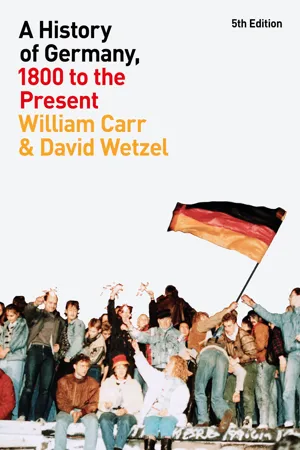 eBook - ePub
- William Carr, David Wetzel(Authors)
- 2023(Publication Date)
- Bloomsbury Academic(Publisher)
It was not possible to recreate the intimate friendship which had bound William’s grandfather to the chancellor for over a quarter of a century. A great psychological gulf separated the cantankerous old autocrat from the young prince of twenty-nine. As an impressionable boy of eleven, William trotted on his pony through the Brandenburg Gate when his grandfather returned as emperor from France. He had grown up in a noisy, ebullient and expanding Germany and was anxious to obtain for his country its rightful place in the sun. A man of great charm and with a quick mind and wide-ranging interests, a brilliant conversationalist and amiable companion, William was also a highly impatient and unstable personality. A restless individual with an insatiable appetite for activity, he played many parts with consummate skill—sometimes the soldier and lover of military pageantry, passionately devoted to his army; at other times the modern ruler, interested in social problems; at yet other times the intellectual, proud founder of the Emperor William Society for the Encouragement of Scientific Research. Unlike his grandfather, William would not stay in the background; he interfered in affairs of state, expressing his opinions in frequent after-dinner speeches much to the alarm of officials, whom he rarely consulted. Firmly convinced of his own infallibility, William threw caution to the winds on these occasions, declaring his intention of leading his people to a glorious future. Finally, he was a born autocrat with an exalted notion of his vocation and a contempt for the constitution, which he boasted he had never read—in short, a ruler unlikely to tolerate Bismarck’s monopoly on political power for long.The emperor was encouraged in his designs by close friends like General Alfred von Waldersee, whom he appointed chief of the German general staff on the retirement of Moltke in 1888. Waldersee was a prominent member of an influential group of extreme Conservatives, which included Stöcker, the court chaplain. These men were seeking to capture the mind of the young ruler and overthrow Bismarck. Bismarck had not scrupled in the past to use intermediaries to turn William against his parents; the intermediaries now turned the emperor against his chancellor, and as he spent most of his time on his estate at Friedrichsruh near Hamburg, he could do little to fight back.There was one simple and inescapable fact which, as Christopher Clark observers, Bismarck could never accept. For the first time in a quarter of a century, he now had a boss.The open breach between the emperor and the chancellor began over social policy. In 1889 William intervened dramatically in the Ruhr miners’ strike and settled the dispute by lecturing the employers on their responsibilities. With romantic visions of himself as a latter-day roi des gueux , William confidently believed that he could win over the working class by a modest extension of the social welfare system. Bismarck disagreed; he was deeply pessimistic about the future, had little faith in state socialism and believed that the forces of social anarchy could be kept at bay only by further repression. With this end in view, he proposed in 1889 to make the Anti-Socialist law permanent, including the clause that empowered municipal authorities to expel agitators from the towns. William was not against renewal for he, too, feared socialism. But he asked Bismarck to delete the expulsion clause, feeling that this was an unnecessarily harsh measure. Bismarck refused. In the end the Reichstag let him down. The Kartell eBook - PDF
Refugees of Revolution
The German Forty-Eighters in America
- Carl Wittke(Author)
- 2016(Publication Date)
Hecker, in 1865, was alarmed by the rise of Prussia but impressed by Bismarck's clear-headed program, and in a BISMARCK AND GERMAN UNITY 349 letter written in September 1866, rejoiced that reactionary Austria had been eliminated from German aflairs. He urged Prussia to put economic pressure on the smaller states to force them to join the movement for unification. He was certain that Germany was entering upon an age of enlightened despotism which would increase her self-respect and national pride, and he expected the period of absolutism to be brief. 7 The New Yorker Abendzeitung denounced the particularism and state pride of the German people, and pointed out that disunity among the rank and file must be overcome before ruling princes could be blamed for their reluctance to surrender power to a national sovereign. 8 Such discussions, the prelude to 1870 and 1871, suggest a gradual ac-ceptance, even by liberal German-Americans, of the march of events, and growing approval of the methods by which unification was being accomplished, although there was sober reflection about what a Bis-marckian Germany implied for civil rights in a nation dominated by a Prussian Junker aristocracy. In 1868 Carl Schurz revisited Germany and was royally received. Bancroft, the American minister, met him in Berlin, and the rebel of 1848 was able to spend more than an hour with Bismarck. The next day, when he was a guest of the Iron Chancellor at a dinner party, the two men talked long after the rest of the company had left. Schurz reported his observations and experiences for the St. Louis Westliche Post. Though lionized everywhere by the liberals, he was profoundly impressed by Bismarck as an extraordinary personality. Perhaps the feudal ideas inculcated in him persist, he wrote his friend Kinkel, but in a modern, industrial age, a feudal reaction in Germany would be impossible.
- David Calleo(Author)
- 1980(Publication Date)
- Cambridge University Press(Publisher)
With habits of com- 24 THE GERMAN PROBLEM RECONSIDERED promise and arts of conciliation so little cultivated, order and measure could be brought to public policy only through an authoritarian mediator. It would be foolish to lay these characteristics of German politics to Bismarck alone, for they obviously had broad causes. Perhaps the dynamic and unformed state of German politics and society would not have permitted anything other than his brand of authoritarian leadership to succeed. Nevertheless, by developing this style of government into a great art, and endowing it with his own success and prestige, Bismarck helped confirm his countrymen in their worst habits and handicapped their capacity to adapt to domestic and inter- national change. Bismarck, of course, had an aggressive style but a conservative foreign policy. His successors were often aggressive in policy as well as tone, not a winsome combination. But this aggressive policy, as I have been sug- gesting, seems implicit in the general direction of German and world economic development, an evolution apparent in Bismarck's own time. An economically expansive Ger- many was not going to remain locked up in its Central European box. Under these circumstances, the significance of style can easily be exaggerated. It is sometimes said that subtle cul- tural misunderstandings continually antagonized relations between British and German elites. More likely, they understood each other all too well. All great powers in the late nineteenth century were increasingly mercantilist and imperialist. Their domestic and foreign policies were not merely reactions to German initiatives. Even if all Germans had been well-mannered liberal constitutionalists, the other Great Powers would have been unlikely to make room gracefully for a politically united and economically dynamic Germany.
Index pages curate the most relevant extracts from our library of academic textbooks. They’ve been created using an in-house natural language model (NLM), each adding context and meaning to key research topics.

