History

Long and Novikov Telegrams
The Long and Novikov Telegrams were two important documents sent during the Cold War. The Long Telegram was sent by George Kennan, an American diplomat, to the US government in 1946, outlining the Soviet Union's aggressive intentions towards the West. The Novikov Telegram was sent by Soviet ambassador Nikolai Novikov to Moscow in the same year, warning of the US's aggressive intentions towards the Soviet Union.
Written by Perlego with AI-assistance
Related key terms
1 of 5
6 Key excerpts on "Long and Novikov Telegrams"
 eBook - ePub
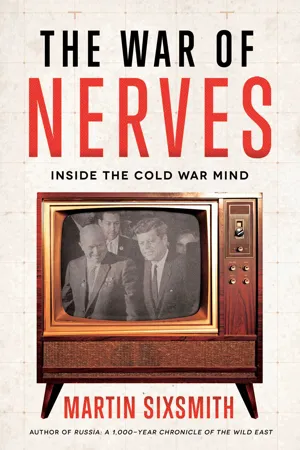
The War of Nerves
Inside the Cold War Mind
- Martin Sixsmith(Author)
- 2022(Publication Date)
- Pegasus Books(Publisher)
World communism is like malignant parasite which feeds only on diseased tissue… we must have courage and self-confidence to cling to our own methods and conceptions of human society. After all, the greatest danger that can befall us in coping with this problem of Soviet communism, is that we shall allow ourselves to become like those with whom we are coping.Kennan’s telegram was setting some key parameters for the coming clash of value systems. Democracy and communism were about to compete for global approbation. The winner would be the one who convinces the world of his nation’s superior values; the loser the one whose self-belief and moral resolve falters and weakens.It is not enough to urge people to develop political processes similar to our own. Many foreign peoples, in Europe at least, are tired and frightened by experiences of past, and are less interested in abstract freedom than in security. They are seeking guidance rather than responsibilities. We should be better able than Russians to give them this. And unless we do, Russians certainly will.Kennan’s words would have an impact way beyond his expectations. Henry Kissinger would later say that ‘George Kennan came as close to authoring the diplomatic doctrine of his era as any diplomat in our history’.5 The message of the Long Telegram gained political traction because it arrived at a tipping point in US attitudes, the moment when Washington was beginning to realise that there was no scope for civil diplomatic relations with the Soviets.In politics, as in most things, facts gain in importance when they chime with the mind-set of those interpreting them: Washington was finally ready to hear the message Kennan had been sending. It was not a changed reality that allowed George Kennan to influence history, but a changed perception of it.Less well known is another ‘long telegram’. This one was sent by Kennan’s opposite number, Nikolai Novikov, who in September 1946 was the Soviet ambassador in Washington. Asked by Moscow to assess US intentions in the dawning confrontation between the two blocs, Novikov sat down to give his considered view of American thinking. Like Kennan, he did his best to comprehend the psyche of the opposition, but he fell into a very Soviet form of confirmation bias. eBook - PDF
After the End of History
American Fiction in the 1990s
- Samuel Cohen(Author)
- 2009(Publication Date)
- University Of Iowa Press(Publisher)
His “Long Telegram” is widely credited as the source of the Truman Doctrine, and the Foreign Affairs article’s persuasive statement of an approach for dealing with what he saw as the fear-driven expansionist tenden-cies of the Soviet Union shaped the way containment went from policy to strategy. As he put it in the latter document: “Soviet pres-sure against the free institutions of the Western world is some-thing that can be contained by the adroit and vigilant application of counterforce at a series of constantly shifting geographical and political points, corresponding to the shifts and manoeuvres of Soviet policy, but which cannot be charmed or talked out of exis-tence ” (575–76). Other than NSC-68 (which Kennan did not approve of, as he did not approve of other interpretations of the Soviet Union as actively working to take over the world), this statement 122 how to tell a true cold war story of the way the U.S. should confront the Soviet threat — by applica-tion of a variety of countermoves, anywhere in the world — was the most influential of its kind. The passing of one of the century’s great political storytellers, a man who saw himself as a literary figure, is occasion for reflecting on the role his writing played in shaping U.S. conduct during the Cold War and also, more generally, on the role narrative plays in shaping the conduct of nations. Kennan constructed a powerful narrative that affected the way two generations of Americans saw themselves in the world, as a nation and as individuals. The deci-sion to view relations between the two great postwar superpowers as best managed by “the logic of force,” as he put it in the “Long Telegram,” resulted in forty years of military, political, and eco-nomic interventions. The collapse of the Soviet Union was seen by many as the end of this story, as vindication and closure for Ken-nan’s tale of two superpowers. eBook - ePub
The Dissent Papers
The Voices of Diplomats in the Cold War and Beyond
- Hannah Gurman(Author)
- 2012(Publication Date)
- Columbia University Press(Publisher)
48The Long Telegram firmly established Kennan’s status as a diplomat-writer in the executive branch. “If none of my previous literary efforts had seemed to evoke even the faintest tickle from the bell at which they were aimed,” Kennan would later write, “this one, to my astonishment, struck it squarely and set it vibrating with a resonance that was not to die down for many months.” With the Long Telegram, explained Kennan, “My reputation was made. My voice now carried,” and “My official loneliness came in fact to an end.”49 The Long Telegram also brought career bureaucrats and administration appointees together in what Robert Messer has called a “symbiotic” relationship, which initiated and fueled a consensus between the State Department and the president that had not existed for more than two decades.50Kennan returned to Washington in May, where audiences in and outside the diplomatic establishment latched on to and fostered the moral-ideological thread of his analysis. In July, after reading the Long Telegram, special counsel to the president Clark Clifford sent Kennan a report on U.S.-Soviet relations that he was preparing for Truman. Invoking Moscow’s sense that a conflict with the capitalist world was inevitable, the report called for the United States to oppose every effort of the Soviets to encroach into areas vital to American security. Unwilling to risk his newfound status, Kennan did not take issue with the report’s emphasis on Marxist-Leninist ideology and instead framed his few qualifications to the report as minor emendations. The same month, the State Department sent Kennan on a six-city speaking tour, during which he continued to play up the moral-ideological aspect of his analysis. “Boy, you missed your calling,” remarked one minister in his hometown of Milwaukee.51 eBook - PDF
The World Island
Eurasian Geopolitics and the Fate of the West
- Alexandros Petersen(Author)
- 2011(Publication Date)
- Praeger(Publisher)
In 1946, prior to sending the five-part message that was to become known to history as the Long Telegram, Kennan enumerated a set of “rules” to underpin his arguments about how Soviet-American relations ought to be conducted from the American perspective. They were illustrative of all his subsequent thinking. a. Do not be chummy with them. b. Do not assume a community of aims which does not exist. c. Do not make fatuous gestures of goodwill. d. Make no requests of the Soviets for failure to grant which we are not prepared to make our displeasure felt. e. Take up matters on a normal level and insist that the Russians take full responsibility for their actions on that level. f. Do not encourage high-level exchanges unless coming at least 50 percent on Russian initiative. g. Do not be afraid to use heavy weapons for what seems to us minor matters. h. Do not be afraid of unpleasantness and public airing of differences. i. Coordinate as far as possible American government and private activities involved with the Soviet Union. j. Strengthen and support American representation in Russia. These prescriptions constituted only the final part of the telegram. Kennan used the first four parts to describe what he thought were the real intentions and capabilities of the Soviet leaders, their modus operandi, and the background to these things. According to Soviet notions, there could be no permanent peaceful coexistence between the capitalist and Communist countries. There were internal conflicts in the capitalist system, insoluble by peaceful means, and at their greatest intensity between England and the United States. Non-Communist left-wing politicians in capitalist countries were the most dangerous and damaging elements for the Soviet agents to monitor. However, Kennan stressed that these extreme views did not represent the natural outlook of the Russian people. eBook - PDF
- John Hollitz(Author)
- 2016(Publication Date)
- Cengage Learning EMEA(Publisher)
Editorial review has deemed that any suppressed content does not materially affect the overall learning experience. Cengage Learning reserves the right to remove additional content at any time if subsequent rights restrictions require it. mindset already fixed by the late 1940s, the ability to demonstrate ideological purity was more important than skill at fashioning political compromises. Thus, in their own ways, Wallace and Byrnes were two of the early victims of the long Cold War. • P R I M A R Y S O U R C E S • Source 1: George F. Kennan, “ The Long Telegram ” (1946) As an attaché at the American embassy in Moscow, George F. Kennan cabled his “ long telegram ” to the State Department in Washington, D.C., in February 1946. His analysis of the Soviet gov-ernment and its behavior in foreign affairs was widely read in the Truman administration and did a great deal to shape the administration ’ s foreign policy toward the Soviets. What are Kennan ’ s views of the Soviets? What are the implications for American policy? Which of Kennan ’ s points would Wallace and Byrnes agree or disagree with? [W]e have here [in the Soviet Union] a political force committed fanatically to the belief that with U.S. there can be no permanent modus Vivendi * that it is desirable and necessary that the internal harmony of our society be disrupted, our traditional way of life be de-stroyed, the international authority of our state be broken, if Soviet power is to be secure. This political force has complete power of disposition over energies of one of world ’ s great-est peoples and resources of world ’ s richest national territory, and is borne along by deep and powerful currents of Russian nationalism. In addition, it has an elaborate and far flung apparatus for exertion of its influence in other countries, an apparatus of amazing flexibility and versatility, managed by people whose experience and skill in underground methods are presumably without parallel in history. eBook - ePub
Woodrow Wilson and Harry Truman
Mission and Power in American Foreign Policy
- Anne Pierce(Author)
- 2017(Publication Date)
- Routledge(Publisher)
It needn't be checked by direct confrontation, but by building societies which, through strength and self-confidence, would become impervious to Moscow's influence. Because Soviet propaganda stated that conflicts between capitalist states "hold out great possibilities for advancement of socialist cause," cohesion among capitalist countries was essential: "Every courageous and incisive measure to solve internal problems of our own society, to improve self-confidence, discipline, morale and community spirit of our own people, is worth a diplomatic victory over Moscow worth a thousand diplomatic notes and communiques." 3 Although Kennan would soon modify these views in favor of a more cooperative approach, the policies Truman and the State Department formulated were imbued with the analysis of the Long Telegram. As he did with Kennan's analysis, Truman tended to agree with Clark Clifford's and George Elsey's analysis of U.S.-Soviet relations as put forth in the "Clifford Memorandum." The Clifford Memorandum, like the Long Telegram, began with the assumption that Soviet leaders had rejected the possibility of an understanding with the West and that they believed war with capitalistic nations to be inevitable. Like Kennan, Clifford and Elsey placed the blame on the impasse in Soviet—American relations entirely on the Soviets. They rejected diplomatic means of dealing with the Soviets because they assumed that the Soviets had done so. 4 Clearly, the rejection of diplomacy can be juxtaposed with Roosevelt's hope that the United States and Russia could maintain a constructive relationship. And yet, Roosevelt's goal of cooperation remained. Because Clifford and Elsey placed the blame for antagonistic relations on the Soviets, they could claim that the "main goal" of U.S
Index pages curate the most relevant extracts from our library of academic textbooks. They’ve been created using an in-house natural language model (NLM), each adding context and meaning to key research topics.

