History

Machine Politics
Machine politics refers to a system of political organization characterized by strong party control over local government, often involving corruption and patronage. This term is commonly associated with the late 19th and early 20th centuries in the United States, particularly in urban areas where political machines wielded significant influence through the distribution of jobs and services in exchange for political support.
Written by Perlego with AI-assistance
Related key terms
1 of 5

8 Key excerpts on "Machine Politics"
- Kenneth F. Warren(Author)
- 2008(Publication Date)
- SAGE Publications, Inc(Publisher)
385 M Machine Politics and Political Bosses THE ERA OF boss rule, when powerful men could sway voters one way or the other through their con-trol of a political machine, has largely come to an end. But this does not mean that Machine Politics, under-stood as using control of government to provide favors in exchange for political support, is disappearing. Machine Politics has thrived at the same time that cen-tralized political machines controlled by a boss have become nearly extinct. Machine Politics is the antithesis of ideological politics where voters are motivated by ideas about the proper role of government and public policies. Machine politicians are notorious for refusing to take stands on controversial political issues. They concen-trate instead on rewarding their political friends, and sometimes punishing their political enemies. Machine Politics uses specific material rewards, such as jobs or contracts, to motivate political supporters. The rewards have to be specific enough that they can be withdrawn if the recipient fails to reciprocate with political support. Public goods, such as a new bridge, provide material benefits for voters, but they are not the same as patron-age. People cannot be blocked from using a bridge if they fail to provide the promised political support. On the other hand, the jobs to build the bridge can be handed out as patronage. If the workers fail to provide political support, they can be fired. Often, political machines are fractionalized, with no one person in charge. Historically, when one person dominated the political machine, he was called a boss; when several people controlled it, they were known as a ring. Boss-controlled political machines were common in the late 19th and early 20th centuries. The Tweed Ring in New York City, the Pendergast machine in Kan-sas City, the Cox machine in Cincinnati, and the Hague machine in Jersey City are good examples of centralized political machines. No longer available |Learn more
Aspects of the Orange Revolution II
Information and Manipulation Strategies in the 2004 Ukrainian Presidential Elections
- Bohdan Harasymiw, Oleh S. Ilnytzkyj, Bohdan Harasymiw, Oleh Ilnytzkyj(Authors)
- 2007(Publication Date)
- Ibidem Press(Publisher)
ASPECTS OF THE ORANGE REVOLUTION II 225 M ACHINE P OLITICS : S UBSTANTIATING A F UZZY C ONCEPT The applicability of the concept of “Machine Politics” to the parties and other political organizations of the former Soviet Union has been noted by several scholars, constructing an analogy with late 19 th and early 20 th century urban America. 3 The terms political machines and Machine Politics refer to the in-formal functioning of elections: “A political machine is a business organization in a particular field of business—getting votes and winning elections.” 4 In this very broad interpretation, a political machine is an organization, headed by a single boss or a small autocratic group, which controls enough votes to sus-tain political and administrative control of a city, county, or state. This all-embracing definition allows subsuming various kinds of strategies leading to electoral success under the label of Machine Politics . When applied to the post-Soviet states in this way, the concept has occasionally been stretched too far, rendering it indistinct and increasingly hollow. In order to understand the functioning, effectiveness and limits of electoral machinations, it is crucial to draw more precise lines between particular strategies. There-fore, I will present the original concept of Machine Politics as formulated by James C. Scott and others and supplement it with strategies that we com-monly encounter in the post-Soviet context. Scott disregards fraud in the narrower sense, but differentiates between al-ternative ways of mobilizing votes. In his view, patterns of electoral corruption playing field: they had much less access to material and administrative resources. 3 Examples include: Paul D’Anieri, “The Last Hurrah: The 2004 Ukrainian Presidential Elections and the Limits of Machine Politics,” Communist and Post-Communist Studies 38.2 (2005): 231-49; Henry E. eBook - PDF
- John R. Heilbrunn(Author)
- 2014(Publication Date)
- Cambridge University Press(Publisher)
43 A “machine” is defined as that kind of political party which sustains its members through the distribution of material incentives (patronage) rather than non-material incentives (appeals to principle, the fun of the game, sociability, etc.). “Patronage” is customarily used to refer to all forms of material benefits which politicians may distrib- ute to party workers and supporters. . . . “Patronage jobs” are all those posts, distributed at the discretion of party leaders, the pay for which is greater that the value of the public services performed. This “unearned increment” permits the machine to require that the holder perform party services as well. 44 A party machine that predicates its actions on clientelist networks is itself a gatekeeper to individuals and firms that seek economic benefits. Ideology is secondary to the economic relationships that fund the political machine. Individuals work for the organization and support a boss or big man, who also operates in a pyramid headed by the leader of his political party. Second, patrons are brokers who possess information about access to powerful officials and opportunities. Third, patrons use a party machine to internalize informa- tion costs within the network. This information has value that the patrons control. Politicians employ clientelism as a strategy to overcome deficits in credibility about electoral promises; the political machine distributed jobs and benefits as long as it won elections. 45 Leaders of political machines used their distribution of benefits to enhance their claims to having control of contracts and opportunities. They were thereby able to attract clients, which furthered their political influence.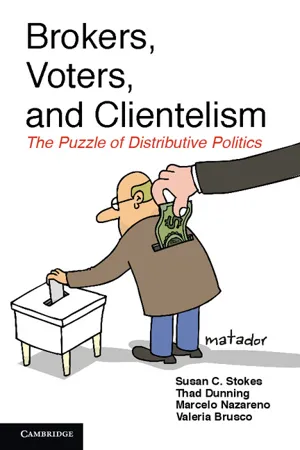 eBook - PDF
- Susan C. Stokes, Thad Dunning, Marcelo Nazareno, Valeria Brusco(Authors)
- 2013(Publication Date)
- Cambridge University Press(Publisher)
85 Today, party machines are a thing of the past. The welfare state in twenty- first-century America is, generally speaking, thoroughly rule-bound, bureau- cratized, and insulated from to partisan manipulation. Research into distribu- tive politics in contemporary United States discerns programmatic politics, as when a change of partisan control of congress changes spending patterns in ways predictable from the parties’ ideologies; pork-barrel politics, as when spending on sports and recreation facilities rises with the electoral vulnerabil- ity of the assemblyman or woman; and nonconditional benefits to individuals, as when spending on food stamps rises with the incumbent party’s vote share in a congressional district. 86 But no clientelism. That said, Machine Politics left deep imprints in American politics, some observable still. Both major parties rely on nonpartisan organizations that work hard to turn voters out and to shape their electoral choices. Their efforts include “walking-around money,” presumably paid to campaign workers. In Baltimore, even as late as the 1970s, “on election day, DiPietro’s precinct work- ers will arrive at the polls early and hand out $15 to each worker, as payment for such chores as distributing sample ballots . . . ” 87 Churches also influence voters and work to boost turnout: evangelicals on the Republican side, black churches alongside of labor unions on the Democratic side. Nominally nonpar- tisan civic organizations link these churches even more closely to the parties, a leading example being the Moral Majority or Family Research Council’s role as nexuses between the Republican Party and evangelical churches. What’s more, parties command highly detailed information, down to the individual voter (and individual small donor). eBook - PDF
Experts and Politicians
Reform Challenges to Machine Politics in New York, Cleveland, and Chicago
- Kenneth Finegold(Author)
- 2020(Publication Date)
- Princeton University Press(Publisher)
At the same time, it provides a moral order that defines what is good, and thus who should get what, and why. 34 Several of the scholars associated with the study of urban political econ-omy have joined with urban historians to advance a new interpretation of the American political machine as the basis for one kind of urban regime. This rethinking represents a second wave of revisionism about Machine Politics. The earliest students of the machine were themselves reformers; for James Bryce, Moisei Ostrogorski, Lincoln Steffens, and Gustavus Myers, to analyze the machine was to demonstrate its corruption and its violation of a universal public interest. 35 Robert K. Merton's functionalist analysis of the machine replaced the reform view as the standard approach within American political science. 36 Merton used the example of the ma-chine to illustrate his fundamental distinction between manifest func-tions, intended and recognized by participants, and latent functions that were neither intended nor recognized. The patronage, graft, and elec-toral operations noted by reform-minded observers were the manifest functions of the machine. The latent functions of the machine, which ex- Machine Politics AND REFORM POLITICS 11 plained its survival, were to centralize power despite the fragmentation of formal city government, and to provide personalized services (and oppor-tunities for individual mobility) to the needy. If support for machine poli-tics was based on the provision of services, then assumption of those services by the national government, with its superior resources, made the machines superfluous. Mertonian functionalism thus fit well with what became known as the Last Hurrah thesis, after the novel that con-veyed it more vividly than any social scientist: the argument that the New Deal led to the death of the machine. 37 Mertonian functionalism also fit well with Hays's revisionist analysis of reform.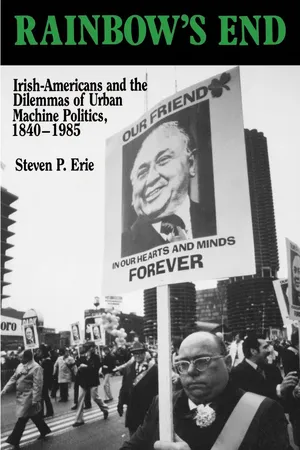 eBook - PDF
Rainbow's End
Irish-Americans and the Dilemmas of Urban Machine Politics, 1840-1985
- Steven P. Erie(Author)
- 1990(Publication Date)
- University of California Press(Publisher)
Here its function was largely informational, putting the needy in contact with the appropriate social agency. Yet the ma-chine successfully claimed credit for the stream of welfare-state benefits to the poor, the organization's most loyal supporters. Notwithstanding the general usefulness of an exchange model of Machine Politics, the approach needs to be broadened in two ways. First, although the conventional wisdom views machines as single-purpose institutions, relentlessly pursuing vote maximiza-tion to the exclusion of all other goals, the bosses in fact serviced multiple actors in the political marketplace—voters, party func-tionaries, state and federal leaders, particular ethnic groups. Each Machine Building, Irish-American Style 2.2.1 made demands on the organization's scarce resources. A revised theory needs to specify the terms and tradeoffs of these multiple transactions. Second, exchange theory views distributional decisions as cen-tral to Machine Politics. Yet allocational choices were made in the broader context of resource and demand management. An ade-quate account of Machine Politics must analyze how the bosses created resources and how they managed the demands of multiple constituencies, not merely how they allocated portions of the pie to various claimants. The bosses were chefs and maitre d's as well as servers. The Machine's Decline The machine's demise has also generated considerable controversy. Two general theories of machine decline have been advanced. Re-source theories look at what the bosses offered to political sup-porters, for example, patronage jobs, welfare services, and club-houses. In this view, diminished control over benefits hastened the end of the big-city machines. Demand theories look at what po-litical supporters wanted from the machines. In this view, the as-similation of the machine's traditional ethnic supporters into the public-regarding middle class sounded the death knell of boss rule. eBook - ePub
Migrants and Machine Politics
How India's Urban Poor Seek Representation and Responsiveness
- Adam Michael Auerbach, Tariq Thachil(Authors)
- 2023(Publication Date)
- Princeton University Press(Publisher)
Tulsi Nagar’s party workers illustrate one important and historically common pathway of inclusion through party machines. A venerable literature documents such machines as marked by three distinctive features. The first is their hierarchical, pyramid-shaped structures that link political elites (“patrons”) to voters who support them (“clients”). These linkages are typically facilitated by intermediaries (“brokers”) like Rajesh, who are entrenched in neighborhoods and forge face-to-face ties with voters. 18 Second, machines are arranged geographically, with brokers controlling neighborhoods that are nested within the larger electoral domains of their patrons. 19 Third, machines rely on the distribution of material spoils to win support—not lofty ideologies or policy promises. 20 These benefits can range from jobs, electricity connections, and access to hospital beds; to election-time handouts of cash and food; to local public goods like paved roads, sewers, and schools. Many of the earliest examples of party machines come from cities of the United States, particularly during a period stretching from the Gilded Age (the last quarter of the nineteenth century) through the Second World War. From New York and Philadelphia to Kansas City and Chicago, machine bosses generated electoral support among poor European migrants by doling out jobs and public services eBook - PDF
Organizing Democracy
Reflections on the Rise of Political Organizations in the Nineteenth Century
- Henk te Velde, Maartje Janse, Henk te Velde, Maartje Janse(Authors)
- 2017(Publication Date)
- Palgrave Macmillan(Publisher)
255 © The Author(s) 2017 H. te Velde, M. Janse (eds.), Organizing Democracy, Palgrave Studies in Political History, DOI 10.1007/978-3-319-50020-1_13 CHAPTER 13 The Domestication of a Machine. The Debate About Political Parties Around 1900 Henk te Velde The library is full of books about particular political parties in Europe, but histories of the emergence of ‘the party’ as a general phenomenon are rare. The general history of the emergence of party organizations and their critics has not often been the subject of historical research. 1 This is strange because modern party organizations struck contempo- raries as something new and puzzling already at the end of the nineteenth century itself. It was then still too early to write a proper ‘history’ of what was happening, but a number of scholars went to great pains to get the information they needed to write comprehensive contemporary surveys. Organization as such was not new in politics, of course, but now, extra-parliamentary forms of organization were included in the defini- tion of formal politics for the first time. Until then, extra-parliamentary H. te Velde (*) Leiden University, Leiden, The Netherlands 256 organizations could be part of civil society but not of what was regarded as politics proper. Even if many historians today regard single-issue move- ments as political movements, contemporaries thought differently. For the first time, something that scholars and also members of the govern- ment or parliament saw as ‘politics’ was happening outside the state and outside parliament. Earlier forms of organization, such as single-issue movements, had already changed the conception of politics, but they were considered as attempts at influencing politics from without, not as part of the state. Now, the state and the established political system itself seemed to be changing.
Index pages curate the most relevant extracts from our library of academic textbooks. They’ve been created using an in-house natural language model (NLM), each adding context and meaning to key research topics.
