History

Maroon Societies
Maroon societies were communities of escaped slaves who formed their own independent settlements in the Americas, particularly in the Caribbean and Latin America. These societies were often located in remote and inaccessible areas, and they played a significant role in resisting and disrupting the institution of slavery. Maroon communities were known for their resilience, resourcefulness, and their ability to maintain their freedom despite the challenges they faced.
Written by Perlego with AI-assistance
Related key terms
1 of 5

10 Key excerpts on "Maroon Societies"
 eBook - PDF
- Joseph K. Adjaye(Author)
- 1994(Publication Date)
- Praeger(Publisher)
9 Jamaican Maroons: Time and Historical Identity Joseph K. Adjaye The history of slavery in the Americas is replete with the story of Maroons or Maroon Societies: individuals or groups who escaped from the horrors of slavery to establish their own independent communities. "Marronage," therefore, meant flight from slavery, and the runaways cre- ated communities that varied from tiny bands that soon disappeared in history to large, powerful, and more permanent centralized societies. 1 Although two types of marronage can be generally identified — petit marronage, that is, temporary escape or truancy, usually to visit the city or relatives, and the large-scale, more permanent type — use of the word "Maroon" in this chapter will be confined to the latter variety. Marronage was at the core a reaction to slavery, and, therefore, Maroon Societies were as ubiquitous as the institution of slavery itself was throughout the Americas. Their widespread existence has been well documented. 2 Known variously as palenques or cumbes in the Spanish territories, quilombos or mocambos in Brazil, and "Bush Negroes" in Guyana, Maroon Societies were established across the length and breadth of the "New World" from Brazil across the Caribbean to the American South and from the Bahamas to Mexico. However, nowhere was the Maroon experiment in the creation of independent, self-sustaining soci- eties as viable and successful as alternatives to slave systems as it was in Suriname and Jamaica, where some communities have survived to the present. 162 TIME IN THE BLACK EXPERIENCE The recorded history of marronage in Jamaica is almost simultaneous with the very beginnings of the Spanish occupation of the island under Juan d'Esquivel in 1509. In the next several centuries, the landscape of the country came to be punctuated by the establishment of a number of Maroon towns until after emancipation (1834), when the raison d'etre of marronage, flight from servitude, disappeared. eBook - PDF
General History of the Carribean UNESCO Vol.3
The Slave Societies of the Caribbean
- NA NA(Author)
- 2019(Publication Date)
- Palgrave Macmillan(Publisher)
5 MAROON COMMUNITIES IN THE CIRCUM-CARIBBEAN Silvia W. de Groot, Catherine A. Christen and Franklin W. Knight M A ROO N societies consisted of runaway slaves and their offspring who sequestered themselves in the circum-Caribbean wilderness. 1 The existence of Maroons manifested the opposition of some Mrican slaves to their enslavement and a persistent desire to create a free society of their own. In the Western hemisphere, Maroon Societies.emerged virtually whenever and wherever a slave population existed. None the less, at any given time, Maroons comprised no more than a tiny fraction of the local Mro- Caribbean community. The survival of Maroon Societies depended on a combi- nation of circumstances, not only the local geography, but also the local social, political and military resources of the Maroons and neighbouring slaveholders. As early as 1520 the economy of the more settled Caribbean colonies - Hispaniola, Puerto Rico, Jamaica and Cuba - was gradually shifting from mining to market gardening, ranching and tobacco cultivation. Imported Mrican slaves increasingly replaced local Amerindians as the predOminant form of coerced labour for the Spanish colonizers, although the Caribbean islands qUickly became only marginal components of the vast Spanish American empire. Nevertheless, by the mid-seventeenth century several other nations had developed their central colonial holdings in the Caribbean archi- pelago and the adjacent Guianas, where they concentrated on plantation and trading economies, especially based on sugar, cotton and coffee production. An expanding population of Mrican slaves provided the labour. This con- stant supply of imported slaves resulted in increasing marronage and a pro- liferation of Maroon Societies. Marronage represented part of a spectrum of forms of resistance to slavery. eBook - PDF
In the Shadow of Slavery
Africa’s Botanical Legacy in the Atlantic World
- Judith Carney(Author)
- 2011(Publication Date)
- University of California Press(Publisher)
Survival depended on their ability to evade de-tection and capture, or to wage battle—but also on the skills and knowledge that could wrest reliable supplies of food from the harsh surroundings. Wherever maroon communities gained a toehold, colonial authorities in- evitably recruited armed militias to seek them out, destroy their redoubts, and capture the inhabitants. They often met fierce resistance. Palmares—the most famous maroon settlement of Brazil’s early history—ably defended itself from repeated military attack for nearly the entire seventeenth century. 2 Otherwise, paramilitary forces managed to reduce most enclaves, but not all. In some areas the numbers of maroons were so large and defensive tactics so effective that the colonies negotiated treaties granting some groups their freedom, as occurred re-peatedly in Dutch Guiana in the seventeenth and eighteenth centuries. 3 Other maroon communities evaded destruction by retreating to more clandestine areas until emancipation by the state made their freedom a fact. The Amazon Basin sup-ported many such refugee communities, as did mountainous regions of Brazil, Hispaniola, Jamaica, Cuba, and the French Caribbean. Today, Maroon Societies continue to occupy some of these remote locales, and one can still discern a dis-tinctive culture whose agricultural practices and plants reveal unmistakable links to Africa. Even vanquished maroon settlements speak to us through the accounts and maps left by the expeditions sent against them. From all of these sources, we learn of the fundamental importance of the agricultural systems that supported subsistence, and the crops that sustained the maroon struggle for freedom. Agriculture shaped the lives of the majority of Africans landed in the Amer-icas. Subsistence practices and food preferences of slaves offer one way to see man-ifestations of the African botanical legacy in the New World. Another is through the subsistence strategies developed by maroons. eBook - PDF
Claims to Memory
Beyond Slavery and Emancipation in the French Caribbean
- Catherine Reinhardt(Author)
- 2007(Publication Date)
- Berghahn Books(Publisher)
Debbash’s claims are in line with the colonialist perspective that slaves were so in-nately inferior and uncivilized that they could not possibly harbor the lofty ideal of liberty. Only Europeans could instill such sentiments in the barbaric Africans. Even beyond the debate surrounding the historical causes of marronnage, the figure of the maroon is profoundly ambigu-ous. Marginal to the plantation economy, maroons nonethe-less maintained a relationship with plantation slaves in order to secure basic food items and tools for their survival. Their re-jection of colonial order was therefore never as complete as represented through mythicization. In particular, their negoti-ation of treaties with colonial authorities—particularly in Ja-maica and Suriname—undermined the very symbol of liberty for which they stood. Willing to hunt down and turn in future fugitives in exchange for the guarantee of freedom and au-tonomy, established maroon bands ended up aiding the colo-nial regime rather than contributing to its overthrow (Burton 1997: 33). Nonetheless, the very idea that slaves could escape the do-minion of slaveholders was, and continues to be even today, a powerful symbol of subversion. The Guadeloupean thinker Alain Yacou (1984: 92) points to the political, social, eco-nomic, and cultural potential of maroon communities: In Cuba, as in other countries of plantation America, these ma-roon societies have through their very existence constituted an 64 Catherine Reinhardt important factor of subversion of colonial order by offering a sure refuge and a sanctuary of liberty to fugitive slaves. They constituted a basis for collective military, political, socioeconmic, and cultural resistance to the oppression of the slave regime. It is this subversive potential that dominates eighteenth-century literary representations of the maroon. eBook - PDF
- C. Winks(Author)
- 2009(Publication Date)
- Palgrave Macmillan(Publisher)
Far from “discovering” their magic cities as the seekers of El Dorado had hoped to do while wandering around in the out-there-somewhere of terra incog- nita, the maroons had to deploy imagination, skills, and a labor that for the first time in many of their lives was aimed at constructing and preserving a space of liberty. In this anti-Plantation, privations and constraints were endured because the people felt closer to a remembered or never-before-experienced home, at once reconstructing and founding a Wagadu that, though constantly on the verge of vanishing as a result of the clash of weapons and the noise of battle, yet maintained a delicate balance between human and natural ecologies suitable to “small military-centered societ[ies] living in a state of almost perpetual crisis.” 11 At the same time, during periods of war most Maroon Societies could never completely emancipate themselves from some level of economic dependency on the Plantation, which Price terms “the Achilles heel of Maroon Societies throughout the Americas” 12 while acknowledging that maroons often benefited from “collusion by members of almost all social classes with the rebels, when- ever it served their individual self-interest.” 13 As shown in César Leante’s novel Capitán de cimarrones, such suppliers could also serve as intermediaries between the colonial government and the rebels, and thus were probably seen as less trustworthy than, say, the pirates and smugglers who had their own reasons for steering clear of officially constituted authority. Finally, maroon settlements did not only exist in rural areas; the phenome- non of urban marronage, extensively documented in the various wanted posters circulated by owners searching for their escaped domestic slaves, was wide- spread during the eighteenth and nineteenth centuries in cities like Havana and Kingston. eBook - PDF
Fictions of Land and Flesh
Blackness, Indigeneity, Speculation
- Mark Rifkin(Author)
- 2019(Publication Date)
- Duke University Press Books(Publisher)
Marronage condenses potentially disjunctive understandings of resistance to enslavement and its racializing legacies. Derived from the Spanish cimar-rón , which originally referred to runaway animals (with strong connotations of wildness), the term maroon was adapted to designate escaped slaves. 1 Neil Roberts observes, “Marronage conventionally refers to a group of persons iso-lating themselves from a surrounding society in order to create a fully autono-mous community,” and as Alvin O. Thompson notes, “Maroon communities emerged where those who fled from slavery finally stopped running.” 2 How, though, do we approach the relation between the parts of this compound concept/phenomenon—running and landed autonomy? The previous chapter addressed tensions between flight and collective emplacement, but as a critical- political trope, marronage contains them both within one figure, in what might be called the maroon matrix . Maroon communities arise out of literal fugitivity from enslavement and are maintained through an ongoing refusal to 4 the maroon matrix the maroon matrix 169 be subjected to the plantation system and its legacies of racial capitalism, pri-vate property, and incarceration. If fugitivity signals a refusal to be contained within the categories and geographies of the dominant political and economic system, the concept of marronage also points toward communal forms of placemaking, governance, and resource distribution that have been and might be generated by people of African descent in the Americas.
- Bernard E. Powers, Bernard E. Powers, Jr.(Authors)
- 2020(Publication Date)
- University of South Carolina Press(Publisher)
If caught, maroon leaders were frequently beheaded, and those who escaped fled even further into the interior. Maroons continued to exist, however, and to fight for their freedom. Incidents such as those in Ashepoo in 1816, Williamsburg County in 1819, Georgetown in 1820, and Jacksonborough in 1822 all produced the same results. Maroons and militiaman fought, with the latter winning each time. Even so, maroons continued to exist. These activities continued even during the Civil War, when a maroon community attack near Marion in June 1861 demonstrated the existence of maroons up until emancipation. CATHERINE FITZGERALD Aptheker, Herbert. “Additional Data on American Maroons.” Journal of Negro History 32 (October 1947): 452–60. ———. “Maroons within the Present Limits of the United States.” Journal of Negro His-tory 24 (April 1939): 167–84. Berlin, Ira. Many Thousands Gone: The First Two Centuries of Slavery in North America. Cambridge: Belknap Press of Harvard University Press, 1998. Franklin, John Hope, and Loren Schweninger. Runaway Slaves: Rebels on the Planta-tion. New York: Oxford University Press, 1999. 11 Resistance and Survival in a Slave Society, 1670–1865 Johnson, Michael P. “Runaway Slaves and the Slave Communities in South Carolina, 1799 to 1830.” William and Mary Quarterly, 3d ser., 38 (July 1981): 418–41. Morgan, Philip D. Slave Counterpoint: Black Culture in the Eighteenth-Century Chesa-peake and Lowcountry. Chapel Hill: University of North Carolina Press, 1998. Olwell, Robert. Masters, Slaves, and Subjects: The Culture of Power in the South Carolina Low Country, 1740–1790. Ithaca, N.Y.: Cornell University Press, 1998. Price, Richard, ed. Maroon Societies: Rebel Slave Communities in the Americas. 3d ed. Baltimore: Johns Hopkins University Press, 1996. CAESAR (Cesar) (ca. 1682–ca. 1754). Slave, medical practitioner. eBook - PDF
Rituals, Runaways, and the Haitian Revolution
Collective Action in the African Diaspora
- Crystal Nicole Eddins(Author)
- 2022(Publication Date)
- Cambridge University Press(Publisher)
The linkages created or exemplified by runaway groups, and their ongoing contact with plantations – via raids, hideouts, recruiting, or kidnapping – fostered an oppositional consciousness that may not neces- sarily have manifested itself in an immediate sense, but unfolded over time. Chapter 7 will further engage micro-level and aggregate patterns of marronnage within the historical context to identify factors that contrib- uted to, or hindered, escapes. 182 Rituals, Runaways, and the Haitian Revolution 5 Marronnage as Reclamation Marronnage, in many ways, was about enslaved people reclaiming pos- session of themselves and other intangible and tangible resources that enslavers stole from them. Colonial society aimed to nullify enslaved Africans’ identities and sever ties to their cultural heritages. Enslavers commodified enslaved people, extracted their labor power for no com- pensation, dominated enslaved people’s time, and denied them access to any form of capital. Maroons upended these conditions through various acts to reclaim themselves, their time, and their resources, representing a “dialectical response to the capitalist plantation system whose imperative was to reduce them to units of labor power – to dehumanize them,” as Sylvia Wynter has argued (n.d.: 73–74). Maroons’ actions reflected their oppositional consciousness, which is defined as a “set of insurgent ideas and beliefs constructed and developed by an oppressed group for the purpose of guiding its struggle to undermine, reform, or overthrow a system of domination” (Morris 1992: 363). In reversing the conditions of dispossession, maroons’ acts of reclamation at the micro-level were foundational for revolutionary tactics and eventually expanded to the larger project of socio-political reclamation of the nation Ayiti/Haiti (Roberts 2015). The current chapter attempts to detect an oppositional consciousness among enslaved African descendants and maroons in the years before the Haitian Revolution.
- Harilaos Stecopoulos(Author)
- 2021(Publication Date)
- Cambridge University Press(Publisher)
Eugene Genovese exemplifies this attitude when he recognizes the existence of maroons in the U.S. South but quickly dismisses them, arguing that they “huddled in small units and may be called ‘maroons’ only as a courtesy,” since “[t]hey occupied unfavorable terrain with only min- imum security and rarely had an opportunity to forge a viable community life.” 8 While histories of marronage often privilege those communities that numbered sometimes in the hundreds and engaged in sustained, outright warfare with colonial powers, we would do well to consider the implica- tions of marronage untethered from a teleology of revolutionary fulfill- ment. It is especially generative to consider acts of marronage in the context of the kinds of “everyday resistance” to slavery elucidated by scholars such as Stephanie Camp. 9 Marronage’s first geographic complication addresses the geography of the United States itself, particularly a sectionalized geographic imaginary that depends upon the Mason–Dixon line as a stable demarcation between slavery and freedom. 10 The fact that many enslaved people became 7 Neil Roberts, in Freedom as Marronage (University of Chicago Press, 2015), argues that maroons represent “a total refusal of the enslaved condition” (13). 8 Eugene D. Genovese, From Rebellion to Revolution: Afro-American Slave Revolts in the Making of the Modern World (Baton Rouge: Louisiana State University Press, 1979), 77. 9 Stephanie M. H. Camp, Closer to Freedom: Enslaved Women & Everyday Resistance in the Plantation South (Chapel Hill: University of North Carolina Press, 2004). 10 Martha Schoolman, Abolitionist Geographies (Minneapolis: University of Minnesota Press, 2014). Maroons and Marronage in African American Literature 159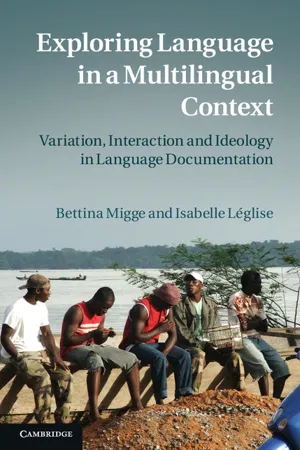 eBook - PDF
Exploring Language in a Multilingual Context
Variation, Interaction and Ideology in Language Documentation
- Bettina Migge, Isabelle Léglise(Authors)
- 2012(Publication Date)
- Cambridge University Press(Publisher)
From the 1970s onwards, more schools and health centres as well as government-based The social structure of the Maroon community 101 work opportunities were set up in the interior boosting schooling rates and slowly improving living conditions in the traditional villages. Coupled with the wider availability of outboard motors that provided easier access to the coast, all Maroons, and not just men, in the traditional villages like those who had migrated to town were suddenly increasingly exposed to what Maroons refer to as bakaa libi ‘western or European lifestyles’. From the perspective of the national government, Maroons were ‘modernizing’ – often referred to by the Dutch term ontwikkel ‘develop’ – and at least in part or on the surface assim- ilating and integrating into the coastal mainstream. This process was severely curtailed following the 1980 military coup d’état in Suriname. Maroons were soon cast as a threat to the newly formed Republic of Suriname (1975) and eventually pursued outright by the government. These destructive policies, which were aimed at exterminating Maroons and Maroon cultures, eventually led to the civil war which pitted Maroons against the Surinamese government (Price 2001; Buddingh’ 1999). This set in motion the mass exodus of Maroons from their traditional territories to Paramaribo and French Guiana and from Paramaribo to French Guiana and/or the Netherlands (Map 3.4). 35 The war also destroyed vital infrastructure such as schools, health centres and work opportunities in the interior of Suriname. The slow reconstruction of the infrastructure started only in the late 1990s and at the end of the first decade of the twenty-first century facilities are still a far cry from what is required to give Maroons and Maroon children in particular access and a fair chance in a rapidly changing and globalizing world.
Index pages curate the most relevant extracts from our library of academic textbooks. They’ve been created using an in-house natural language model (NLM), each adding context and meaning to key research topics.

