History

Muller v Oregon
Muller v. Oregon was a landmark U.S. Supreme Court case in 1908 that upheld an Oregon law limiting the working hours of women. The decision marked the first time the Court recognized the legitimacy of labor laws specifically aimed at protecting women's health and safety. This case set a precedent for future labor legislation and was a significant victory for the women's labor movement.
Written by Perlego with AI-assistance
Related key terms
1 of 5

10 Key excerpts on "Muller v Oregon"
 eBook - ePub
- Joyce Appleby, Eileen Chang, Joanne Goodwin(Authors)
- 2015(Publication Date)
- Routledge(Publisher)
Part 3 Documents Passage contains an image
Excerpts fromMuller v. Oregon (1908)In a landmark ruling for women workers, the U.S. Supreme Court upheld a 1903 Oregon law that limited the workday of women laundry workers to ten hours. The case involved a laundry owner named Craig Muller (referred to below as the “defendant”), who had been fined $10 for requiring a female employee to work more than ten hours. The conviction was upheld by the Oregon Supreme Court, and Muller appealed the case to the U.S. Supreme Court. His attorneys argued that the ten-hour limit was unconstitutional, because it deprived both laundry owners and women employees of their Fourteenth Amendment guarantees of “life, liberty and property.” The rights of employers and employees to agree upon a labor contract are both a liberty and a property right that may not be infringed. But the justices ruled to the contrary, holding that the state’s interest in the health of women as potential mothers overrides the right and freedom of a business owner to hire and make contracts with employees. This case ushered in protective labor laws—based on sex—and legitimated different treatment for men and women.
Passage contains an image
Excerpts fromMuller v. Oregon (1908)In a landmark ruling for women workers, the U.S. Supreme Court upheld a 1903 Oregon law that limited the workday of women laundry workers to ten hours. The case involved a laundry owner named Craig Muller (referred to below as the “defendant”), who had been fined $10 for requiring a female employee to work more than ten hours. The conviction was upheld by the Oregon Supreme Court, and Muller appealed the case to the U.S. Supreme Court. His attorneys argued that the ten-hour limit was unconstitutional, because it deprived both laundry owners and women employees of their Fourteenth Amendment guarantees of “life, liberty and property.” The rights of employers and employees to agree upon a labor contract are both a liberty and a property right that may not be infringed. But the justices ruled to the contrary, holding that the state’s interest in the health of women as potential mothers overrides the right and freedom of a business owner to hire and make contracts with employees. This case ushered in protective labor laws—based on sex—and legitimated different treatment for men and women.Decided February 24, 1908
MR. JUSTICE BREWER delivered the opinion of the court. . . . The single question is the constitutionality of the statute under which the defendant was convicted so far as it affects the work of a female in a laundry. . . .Constitutional questions, it is true, are not settled by even a consensus of present public opinion, for it is the peculiar value of a written constitution that it places in unchanging form limitations upon legislative action, and thus gives a permanence and stability to popular government which otherwise would be lacking. At the same time, when a question of fact is debated and debatable, and the extent to which a special constitutional limitation goes is affected by the truth in respect to that fact, a widespread and long continued belief concerning it is worthy of consideration. We take judicial cognizance of all matters of general knowledge. eBook - ePub
Women and Work
A Handbook
- Sonia Carreon, Amy Cassedy, Kathryn Borman, Paula J. Dubeck(Authors)
- 2013(Publication Date)
- Routledge(Publisher)
The first legal challenge to the protective legislation in the United States Supreme Court came during the "Progressive" period, in 1908. Curt Muller, the owner of a laundry in Portland, Oregon, was convicted of violating the state's ten-hour law for women in manufacturing, laundries, and mercantile establishments. His conviction, sustained in the Oregon tribunals, was appealed to the Supreme Court of the United States. On the state's side, the services of Louis D. Brandeis, Harvard law graduate and Boston attorney, were secured by Florence Kelley and Josephine Goldmark on behalf of the National Consumers League (Mason 1946).The brief that Goldmark researched and Brandeis submitted to the Supreme Court was unusual. There were only three pages of legal precedents and more than one hundred of medical and scientific data attesting to the deleterious impact of long hours of labor upon women's health; the purpose of these materials was to demonstrate a relationship between the state's police power to protect the health of women and maximum hour legislation. "Liberty of Contract," a concept that the Court had read into the due process clause of the Fourteenth Amendment to the Federal Constitution, could be restricted if there were a rational basis for the maximum-hour statute, a nexus between the state's authority to protect health and the law at issue.In 1908, when Muller v. Oregon was decided by the Supreme Court, the tribunal was composed primarily of social conservatives averse to state interference in business. The Court, however, unanimously upheld the constitutionality of the Oregon maximum-hour law. "Her physical structure," wrote Justice David Brewer, "and a proper discharge of her maternal functions—having in view not merely her own health, but the well-being of the race—justify legislation to protect her from the greed as well as the passion of men" (208 U.S. 412 [1908]).The minimum-wage legislation did not fare as well in the Supreme Court. The state statutes that regulated women's wages were often either unenforced or ineffective, partly because of concerns that these laws interfering with liberty of contract could not be justified on the basis of health or morals. In 1923, after the passage of the woman's suffrage amendment, the District of Columbia statute came before the Court in Adkins v. Children's Hospital. eBook - ePub
Social Feminism, Labor Politics, and the Law
Women, the Law, and the Workplace
- Sybil Lipschultz(Author)
- 2013(Publication Date)
- Routledge(Publisher)
State v. Muller, 48 Ore. 252, 258, 85 Pac. 855 (1906).102 Crusader, 143–55.103 See Baer, 59–61.104 Muller v. Oregon, 208 U.S. 421.105 Brief for Defendant in Error, Muller v. Oregon, 208 U.S. 412 (1908).106Ibid., 22, 33, 35, 36–42, 49–55, 61.107Ibid., 33, 35, 38, 42, 49, 59.108Ibid., 20, 33, 42, 48–51, 93, 97.109 Brief for the State of Oregon at 10, 12, 14, 19, Muller v. Oregon, 208 U.S. 412 (1908).110Ritchie v. People, 155 I11. 98 (1895), discussed in text accompanying notes 43–68 supra.111 Brief for Plaintiff in Error at 16, Muller v. Oregon, 208 U.S. 412 (1908, hereinafter cited as Muller's brief).112 Muller's brief, 19.113Ibid., 24. Thus the brief writer. med to recognize that what we today would call “sexual stereotyping” might underlie the law. See Orr v. Orr, 440 U.S. 268 (1979).114Muller's brief, 14. For the analogy of race discrimination to sex discrimination in Bradwell, see Bradwell v. Illinois, 83 U.S. 130, 135–36 (1872).115 Muller's brief, 19–20. See also 26.116 Muller v. Oregon, 208 US. 412 (1908).117 Harlan, White, Holmes, and Day dissented. 198 U.S. at 65–76.118 Holden v. Hardy, 169 U.S. 366 (1898), discussed in text accompanying notes 70–73.119 Muller v. Oregon, 208 U.S. 412, 419 note 1.120 Bradwell v. Illinois, 83 U.S. 130, 139 (Bradley, J., concurring).121Muller v. Oregon, 208 U.S. 421, seeming to paraphrase State v. Buchanan, 29 Wash. 602 (1902), quoted at text accompanying note 88 supra.122Muller v. Oregon, 208 U.S. 421, paraphrasing Commonwealth v. Beatty, 15 Pa. Super. 5 (1900), quoted at text accompanying note 79 supra.123 Muller v. Oregon, 208 U.S. 422–23.124See Cooley, note 30 supra.125 Muller v. Oregon, 208 U.S. 423.126See text accompanying note 84 supra.127 Muller v. Oregon, 208 U.S. 423. Passage contains an image
PROTECTION OF WOMEN WORKERS AND THE COURTS: A LEGAL CASE HISTORY
ANN CORINNE HILLThe issue of protective labor legislation for women has been at the center of many discussions of the proposed Equal Rights Amendment to the United States Constitution. Advocates of the amend—ment have argued that protective legislation that applies only to women is discriminatory, that the effect of such laws is too often to restrict women's employment opportunities rather than to “pro—tect” them on the job. In contrast, opponents of the amendment often take the position that it will fly in the face of a century—long struggle for the protection of women workers by eliminating labor laws that are necessary and beneficial.1
- Michelle D. Deardorff, James G. Dahl(Authors)
- 2016(Publication Date)
- Palgrave Macmillan(Publisher)
A History of Pregnancy and the Workplace 19 in the occupation of a baker. There is no contention that bakers as a class are not equal in intelligence and capacity to men in other trades or manual occu- pations, or that they are not able to assert their rights and care for themselves without the protecting arm of the state, interfering with their independence of judgment and of action. They are in no sense wards of the state.” 31 The state of New York and workplace reformers saw the case as destroying the working indi- vidual’s right to protect himself or herself through the legislative process from an employer’s unfair demands; in fact, this case endangered 21 states’ maximum hours legislation. 32 Within three years, protective legislation assumed a more limited direction. The 1908 case of Muller v. Oregon marked the beginning of protective labor leg- islation for women. By arguing that women are a unique class requiring special legislative protections unlike the men in Lochner, maximum hours legislation pertaining to female employees was found exempt from the Lochner reason- ing. Muller was based on an Oregon statute that proscribed the employment of women in factories, laundries, and other “mechanical establishments” for longer than ten hours a day. In his famous “Brandeis Brief ” before the court, Louis Brandeis argued that there was a compelling state interest in limiting a woman’s freedom of contract. In fact, over one hundred pages of his brief are dedicated to demonstrating the ways in which Oregon’s legislation would pro- tect women’s health. Justice Brewer’s majority opinion wrestled with the ques- tion of whether the Lochner decision applied to women. He determined that the difference between the sexes justified a separate rule regarding the restrictions of the hours of labor. eBook - ePub
People's Lawyers
Crusaders for Justice in American History
- Diana Klebanon, Franklin L Jonas, Diana Klebanow(Authors)
- 2020(Publication Date)
- Routledge(Publisher)
The National Consumer’s League secured the services of Brandeis, and the Oregon authorities agreed to put him in charge of the Muller case. He decided to document as thoroughly as possible the harm done by excessive hours to female workers and, as a result, to society at large. The legal reasoning in his brief took up less than three pages. The remainder of the brief, comprising more than 100 pages, consisted of factual data.Among the facts presented were the laws limiting the working hours of women that had been enacted by eighteen states and five European nations. The brief also excerpted many reports by legislative communities, bureaus of statistics, and other official agencies, all of which indicated that long hours of labor were harmful to women. (Brandeis would later characterize his Muller brief as “what everyone knows.”)Speaking through Justice David Brewer, the Court, in a unanimous ruling, found the Oregon law constitutional. Mentioning Brandeis by name (a rarity in Supreme Court decisions), Brewer observed that his brief had demonstrated that many legislators and officials believed that the health and morals of woman workers were injured when their hours of toil were excessive. Moreover, the difference between the sexes in physical structure, according to Brewer, justified a difference in legislation. “She is properly placed,” he wrote, “in a class by herself and legislation for her protection may be sustained, even when like legislation is not necessary for men and could not be sustained.”Ritchie v. Wayman (1910)224 111. 508
In 1895, the Supreme Court of Illinois in People v. Ritchie declared invalid the law limiting to eight hours the workday of female manufacturing workers. The Illinois court found that the eight-hour statute was in conflict with both the state constitution and the Fourteenth Amendment to the U.S. Constitution.After the Muller decision, however, Illinois and several other states enacted new maximum hour legislation for women. In September 1909, an Illinois court issued an injunction against the enforcement of the state’s new ten-hours law. It was W.C. Ritchie, the same man who had successfully challenged the eight-hours act of the 1890s, who had obtained the court order and was now challenging the constitutionality of the new law. eBook - PDF
- Judith A. Baer(Author)
- 2020(Publication Date)
- Temple University Press(Publisher)
Louis D. Brandeis for the defendant in error” with its “very copious col-lection of all these matters.” 53 Lochner had no equivalent brief. The four Loch-ner dissenters remained on the court three years later, but so did four mem- bers of the majority. To urge a reversal of Lochner would have been a risky strategy. Oregon did not use it. While the Brandeis brief contained abun-dant evidence that working long hours was dangerous for women, it would not pass muster in an undergraduate methods course today. The brief did not compare women who worked outside the home to women who stayed home; nor did it compare working women to working men. The latter comparison 46 / CH APTER 3 would have been futile, since working men and women had different oc-cupations, and most women’s hours were (even) longer and conditions (even) worse than most men’s. 54 Physiological differences between men and women were safer and easier grounds on which to rest the decision. The progressives’ hope that Muller would encourage judicial rethinking of general-hour legislation was realized within ten years. 55 But the long-run effects of Muller were disastrous for women’s rights, in general, and their work opportunities, in particular. The decision’s impact extended far beyond labor law. It was cited in cases “upholding the exclusion of women from ju-ries, differential treatment in licensing various occupations and the exclusion of women from state supported colleges.” 56 The phrase “Sex is a valid basis for classification” came to express the constitutional doctrine laid out in Muller . When special labor laws for women morphed into a tool for labor unions to reserve good jobs for men, courts took no notice. The International Union of Hotel and Restaurant Employees had opened the bartending trade to women during World War II, but the organization lobbied the Michigan legislature for a law prohibiting most women from this work that was enacted in 1945 and took effect in 1947. eBook - PDF
Women's Rights
Documents Decoded
- Aimee D. Shouse(Author)
- 2013(Publication Date)
- ABC-CLIO(Publisher)
Still again, history discloses the fact that woman has always been dependent upon man. He established his con- trol at the outset by superior physical strength, and this control in various forms, with diminishing intensity, has continued to the present. As minors, though not to the same extent, she has been looked upon in the courts as need- ing especial care that her rights may be preserved. Educa- tion was long denied her, and while now the doors of the schoolroom are opened and her opportunities for acquiring knowledge are great, yet, even with that and the consequent Supreme Court Ruling in Muller v. Oregon 7 Though limitations upon personal and contractual rights may be removed by legislation, there is that in her dispo- sition and habits of life which will operate against a full assertion of those rights. The Muller decision was eventually nullified when Congress passed the Fair Labor Stan- dards Act in 1938, but the cultural standard detailed in Muller, of prioritizing the role of motherhood for women over all other roles they may play, is still evident in today’s politi- cal and social environments. She will still be where some legislation to protect her seems necessary to secure a real equality of right. Doubtless there are individual exceptions, and there are many respects in which she has an advantage over him; but, looking at it from the viewpoint of the effort to maintain an independent position in life, she is not upon an equality. Differentiated by these matters from the other sex, she is properly placed in a class by herself, and legislation designed for her protection may be sustained even when like legislation is not necessary for men, and could not be sustained. It is impossible to close one’s eyes to the fact that she still looks to her brother, and depends upon him. eBook - ePub
A Woman's Wage
Historical Meanings and Social Consequences
- Alice Kessler-Harris(Author)
- 2014(Publication Date)
- The University Press of Kentucky(Publisher)
9The response might have been louder because the decision was apparently so unexpected. Fifteen years earlier, in Muller v. Oregon, the Court had accepted the principle that women’s health was a proper subject of state concern and therefore of state regulation.10 In the wake of that decision, most industrial states had taken it upon themselves to regulate the hours and working conditions of women and minors. These laws, quintessentially progressive in that they attempted to redress the imbalances of rapid industrial growth, had withstood many legal challenges and, just a year after Adkins, were to survive another. Though states were more cautious when it came to regulating wages, thirteen states and the District of Columbia had enacted minimum wage laws before 1923. Each was grounded in the assumption that the needs of working women for food, clothing, and shelter could be accurately determined and in the desire to maintain women’s health and protect their morals by establishing wages at a level “adequate to supply the necessary cost of living.”11Minimum wage laws varied. Some set wage levels. Others established regulatory commissions to determine appropriate wages. Some provided legal penalties for violators. Others relied on public exposure to inhibit transgression. They had weathered many challenges in state courts. And, in 1917, the U.S. Supreme Court, in an equally divided vote, affirmed an Oregon Supreme Court decision to uphold its minimum wage law.12 These successful defenses of minimum wage laws led one commentator to note in 1921 that “no successful attack can be anticipated upon the principle of these laws in view of the absolute uniformity with which they have been maintained in the different states when pressed to a decision in the court of last resort.”13 Moreover, they were popular. Even after Adkins, states like Massachusetts and Washington continued to enforce their statutes, hoping to evade legal challenges; others, like New York, passed new laws.14 eBook - ePub
At the Boundaries of Law (RLE Feminist Theory)
Feminism and Legal Theory
- Martha Albertson Fineman, Nancy Sweet Thomadsen, Martha Albertson Fineman, Nancy Sweet Thomadsen(Authors)
- 2013(Publication Date)
- Routledge(Publisher)
Muller v. Oregon, declared one lawyer, would never have been successful if it hadn't been premised on women's inequality. By upholding women's employment statutes, the court “did create legal inequalities in respect of sex” (Kane, 1922; Pound n.d.; Pound, 1922; Borchard, 1922).Felix Frankfurter, the Consumers’ League lawyer, who would argue Adkins before the Supreme Court, was one of the staunchest opponents to women's equality, in part because he was such an advocate of women's labor laws. To his legal mind, that meant stressing women's inequality. Declaring that the law must account for diversity in women's “nature,” Frankfurter insisted laws should treat females sometimes as “persons” and other times as “women.” Although social feminists often discussed women's diversity, they never saw it as a matter of nature; they instead viewed social roles and labor conditions as impediments to women's equality. Frankfurter's distinction between women and persons was a far cry from social feminists’ claims of “women first” as an approach to women's predicament, but it also mirrored feminist ambivalence about sameness and difference (Hicks, 1927; Frankfurter, 1922).Protective laws relied on separate treatment of men and women, and this both reflected earlier social ideals of womanhood and encouraged behavior that reinforced this ideal in the economic sphere. Lawyers who wrote on equality, even those who supported women's labor laws, expressed the dominant legal view in these matters. Separate treatment, legally, meant inequality. In part, hours restriction had been successful because American social feminism had been in accord with these legal principles and broader social outlooks. Although social feminists did not advocate women's inequality, they did stress women's separateness and difference. In so doing, they were able to gain women's labor laws. After suffrage, social feminism and the ideology of industrial equality were at odds with legal ideology.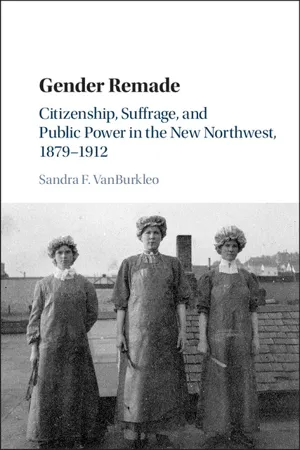 eBook - PDF
Gender Remade
Citizenship, Suffrage, and Public Power in the New Northwest, 1879–1912
- Sandra F. VanBurkleo(Author)
- 2015(Publication Date)
- Cambridge University Press(Publisher)
Justice Herman Crow’s majority opinion spoke to the triumph of law over politics, especially in economic life, since at least the 1870s. It turned on Muller, emergent due-process jurisprudence, and still-current common law doctrines that barred divisions of sovereign authority and valorized masculine control of sites of public judgment. Crow also wielded “common knowledge” – an amalgam of social and gender practices and findings, some derived from cutting-edge social science – to support constructions of women as a vulnerable class of citizens incapable of self-government beyond 1 Victoria Saker Woeste, in Robert Gordon and Morton Horwitz, eds., Law, Society, and History: Themes in the Legal History of Lawrence M. Friedman (New York, 2011), p. 45. Emphasis added. 288 marital estates or polling places. In contrast, the young lawyers on Somerville’s side mobilized a small mountain of systematically gathered facts about box makers in Washington State, the testimony of physicians, and legal texts explaining relations between property rights, the ballot, and self-determination. They heaped scorn on the antediluvian law of coverture and relied on a second line of constitutional argument, epitomized by Lochner v. New York, affirming the capacity of individual men to assume risk and strike up their own workplace bargains without state interference. Women, they argued, similarly were self- governing individuals, a “law unto themselves,” co-sovereigns and law givers alongside husbands and fathers. But, as it turned out, the box maker could only lose, less because Muller controlled the case than because the two sexes no longer occupied sovereign ground jointly and severally. “the right to command and be obeyed” In Washington Territory, as we have seen, women had approached co- sovereignty as well as legal-political equality and agency by 1883.
Index pages curate the most relevant extracts from our library of academic textbooks. They’ve been created using an in-house natural language model (NLM), each adding context and meaning to key research topics.

