History

Northern Rebellion
The Northern Rebellion, also known as the Rising of the North, was a failed uprising in 1569 against Queen Elizabeth I of England. It was led by Catholic nobles who opposed the Protestant reforms and religious policies of the queen. The rebellion aimed to replace Elizabeth with Mary, Queen of Scots, but it was swiftly suppressed, leading to severe consequences for the rebels.
Written by Perlego with AI-assistance
Related key terms
1 of 5
9 Key excerpts on "Northern Rebellion"
 eBook - ePub
Empire Imagined
The Personality of American Power
- Giselle Frances Donnelly(Author)
- 2022(Publication Date)
- SUNY Press(Publisher)
3
THE Northern Rebellion
As a military event, the Northern Rebellion of 1569 merits nothing more than the tiniest mention. The largest engagement, the “battle” near Naworth Castle of February 20, 1570, was little more than a small and apparently poorly planned and executed ambush of royal forces by the followers and tenants of Lord Leonard Dacre, a “warlord” of the borderlands between Scotland and England who was not even the leading rebel. Precipitously attacking the troops of Henry Carey, Baron Hunsdon, cousin to Queen Elizabeth, Dacre’s footmen charged and were crushed, with perhaps three hundred killed. Dacre was particularly rash in that a reinforcing force of fifteen hundred Scots—as many troops as Hunsdon had—was about a day’s march away.1At the same time, the larger story of the rebellion—the conditions and the conspiring that led to the revolt, the government’s response and the rebellion’s consequences—is a kind of microcosm of Elizabethan strategy-making, touching on almost every aspect of the regime’s strategic architecture: the political effects of the confessional divides occasioned by the Reformation; the stability, durability, and legitimacy of the queen’s rule in England itself, particularly in its northern “marches”; the unending need for action in the British “near abroad,” particularly in Scotland; England’s position in the European balance of power; and the profound shift in priorities that saw Spain, for a century, displace France as the primary great-power threat. The inherently complex crisis was further complicated by the intrigues and entanglements of the queen’s council, court, and most powerful nobles; policy was intertwined with personality, not least including that of Elizabeth herself.Much of the contest and crisis revolved around religion and how faith intertwined with politics, be it personal, domestic, or international. Elizabethan Protestantism was a quicksilver phenomenon, a doctrinal mishmash, institutionally weak and a subject of continuous definition and debate across all classes of Englishmen, many of whom were well informed about the European religious debates of the previous fifty years. As Patrick Collinson has written, the Elizabethan era was one of “abortive reform. In the event the renewal of religious life, the formation of a ‘godly preaching ministry’ and a profoundly moral transformation of society was to come not through legislation and the overhaul of institutions but by the religious force of Protestantism itself in its apostolate at the grass roots.”2 eBook - ePub
Rebellion and Riot
Popular Disorder in England During the Reign of Edward VI
- John A. Andrew, III, John A. Andrew(Authors)
- 2000(Publication Date)
- The Kent State University Press(Publisher)
4Rebellion played a smaller role during the reign of Elizabeth, but even Gloriana felt the sting of revolt in 1569 when the earls of Northumberland and Westmorland restored the Latin mass at Durham Cathedral, called for the arrest of Sir William Cecil, the queen’s leading adviser, and demanded the restoration of Roman Catholicism. Less threatening than the mid-Tudor rebellions, the rising of the northern earls revealed the deep-rooted discontent of the aristocracy and its tenants. The last rising of the Tudor era took place in 1601, only two years before the death of Elizabeth, when the Earl of Essex, frustrated by his loss of royal favor, led 200 supporters up Fleet Street, London, in a desperate and futile attempt to restore his political ascendancy.5 A survey of Tudor rebellions leads to the inescapable conclusion that every rebel captain whether artisan or earl and every popular cause — religious, political, or economic — suffered defeat. What is remarkable and usually overlooked by historians is the courage of generations of Tudor rebels to resist oppression and go down to defeat in the face of overwhelming odds.Although popular disorder was endemic throughout the sixteenth century, the pattern of rebellion and riot was extremely diverse. The rebellion of Henry Tudor in 1485 began as a royalist conspiracy against the Yorkists, and the dynastic interests of the Courtenays and Mary Stuart played important roles in later risings. When political opposition to the Tudors was not dynastic, it usually included conflict between court and country. For example, the northern aristocracy in 1536 and 1569 and the western gentry in 1549 vigorously opposed policies emanating from the court. The leadership of Thomas Cromwell and William Cecil aroused regional discontent; remote counties feared centralizing reforms of all kinds; and in 1549 the western gentry saw the Edwardian Reformation as little more than the program of court politicians supported by a clique of heretical clergy. After Henry VIII’s break with Rome in the 1530s, religion emerged as a divisive issue that fired political and social instability. Only under Edward VI did Catholics and Protestants rise at the same time. Religious unrest during the reigns of Henry VIII and Elizabeth came primarily from Catholics opposed to the royal supremacy, the monastic dissolution, and innovations in the church, while Mary’s opponents were exclusively Protestant. Real or imagined social and economic grievances played a part in many rebellions, particularly the Cornish Rebellion of 1497, the Pilgrimage of Grace, and Kett’s Rebellion in Norfolk. Riots almost always stemmed from economic issues; frequently heard grievances concerned rent payments, food prices, enclosure, and property rights. eBook - PDF
- Brendan Kane, Valerie McGowan-Doyle(Authors)
- 2014(Publication Date)
- Cambridge University Press(Publisher)
This historiographical distinction – be it implicit or explicit – does not accord with the views of the monarch herself and as such serves to sep- arate the queen’s realms from one another and to drive an anachronistic wedge between the actions and motivations of their residents. Third and finally, then, Elizabeth’s views highlight the domestic aspects of even the most violent of Irish affairs: they can be studied alongside other instances of unrest in the realms and, thus, they demonstrate the con- tinuing phenomenon of internal rebellion throughout the entire Tudor period. It is a historiographical commonplace, though not a historical fact, that Elizabeth’s reign experienced fewer rebellions than did those of her predecessors. What is a matter of historical record, of course, is that the incidence of rebellion in England fell off dramatically during her monarchy, the only major episode being the Northern Rebellion (or Elizabeth on rebellion in Ireland and England: semper eadem? 263 Rising, as it is sometimes called) of 1569. Much historical freight has been attached to this stunning pax Elizabeth, namely the triumph of the modernising/centralising state over the centripetal, local powers of a medieval aristocracy. Key to this interpretation was the work of Mervyn James, who saw in the Northern Rebellion the last of the regional risings that had characterised monarch–noble relations for centuries. 2 To James, however, the true ‘end of an era’ was the tragi-comic Essex Rebellion: the lack of popular support in London that it garnered, and the ease with which it was quashed and its principals punished, demonstrated clearly the inability of aristocratic principles to challenge a regnant, Protestant monarch for either practical power or the people’s hearts and minds. 3 The end of rebellion, in short, meant the coming of the modern, an era in which the mobilisation of state forces was undertaken primarily for external theatres. eBook - PDF
The Northern Rebellion of 1569
Faith, Politics and Protest in Elizabethan England
- K. Kesselring(Author)
- 2007(Publication Date)
- Palgrave Macmillan(Publisher)
The rebels’ destruction of Protestant fittings and reerection of altars remains one of the better known features of the revolt, and has received at least passing mention even in accounts that minimize or dismiss the popular and religious aspects of the rising. 70 Northern Rebellion of 1569 During the revolt, rebels and their sympathizers destroyed Protestant books in seventy-three Yorkshire churches and in at least twelve in county Durham; in the latter, the number may well have been higher, as other churches are known to have hosted religious services under the old rites. 74 (See Map 2.2.) This came, furthermore, after the concerted push by the authorities to rid the north of its idolatrous monuments of superstition in the late 1560s. When the rebels burned Protestant books, they reacted to recent changes, dramatically imposed. Northumb. Durham Yorks N/R York Yorks E/R Map 2.2 Known Sites of Catholic Activity The Rebellion in the North 71 Sedgefield offers some examples. In southern Durham, east of Darlington, Sedgefield had witnessed religious tensions of its own. So far as we know, the authorities had ordered no public burnings of Catholic items in the parish itself, but they had turned their atten- tion to the recalcitrant parishioners who had failed to comply willingly with the bishop’s various directives. The Ordinary arrived in September of 1567 to supervise the dismantling of the old altar and erection of a new communion table. One parishioner declared the Ordinary “a hinderer and no furtherer of God’s service.” Others took more direct action and within two months a group of the churchwardens “forcibly, contemptuously, and rashly” removed the new communion table. Other residents presented them to the bishop’s officials, however, and the table was restored. 75 The religious changes had divided the community, but the people of Sedgefield seemed to come together during the revolt.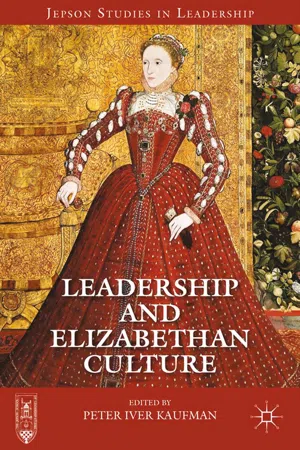 eBook - ePub
- P. Kaufman(Author)
- 2013(Publication Date)
- Palgrave Macmillan(Publisher)
C H A P T E R F O U R Mary Queen of Scots and the Northern Rebellion of 1569K. J. KESSELRINGThe deposition of Queen Mary of Scotland in 1567 proved that even in a monarchical system of inherited status, leadership was a matter not just of position but also of process and practice. Mary’s flight to England in May 1568 painted this lesson even more starkly for Elizabeth, her “sister queen.” Her continued presence in the country tested Elizabeth’s ability to put this lesson into effect. Some thought Mary’s claim to the English throne stronger than that of Elizabeth, and many more thought her at least the heir apparent to succeed their present, childless Queen. Her Catholicism made her, in some eyes, an even more compelling candidate. But it was not just Mary and her supporters who challenged Elizabeth’s abilities: her opponents did, too.Mary continued to test Elizabeth’s political acumen and agility until—and, indeed, even after—the moment the Scottish queen went to her death in 1587. The period from Mary’s arrival to the Duke of Norfolk’s execution in 1572 for his part in plots on her behalf marked a particularly acute period of stress, with the Northern Rebellion at its apex. In November 1569, the Earls of Northumberland and Westmorland raised their banners and a force of some 6,000 men in an attempt to bring about England’s return to Catholicism. They failed, but only after stoking serious fears about the security of the regime. The intensity of those fears showed in the savagery of Elizabeth’s response: exacting perhaps the highest judicial death toll seen in any of the rebellions in sixteenth-century England, she had some “600 odd” participants killed under martial law.1 Some commentators, Elizabethan and more recent, have assumed that the rebels planned to replace their Protestant Queen with her Catholic cousin Mary Stewart. A few go further and suggest that Mary was complicit in the revolt.2 In such accounts, the Northern Rising of 1569 becomes one of the first items on Mary’s long list of plots against Elizabeth. But what, if any, part did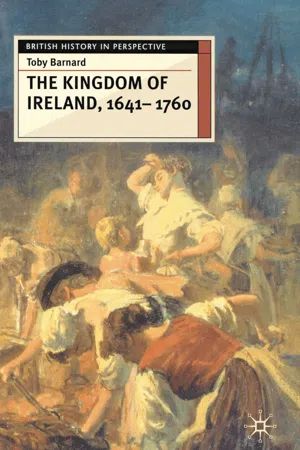 eBook - ePub
- Toby Barnard(Author)
- 2017(Publication Date)
- Bloomsbury Academic(Publisher)
Chapter 2: Rebellions and Reconquests, 1641–1691 The Uprising of 1641 Late in October 1641, Catholics in Ulster killed Protestant neighbours, ejected more from their homes and seized the settlers’ properties. The insurgents had intended to synchronize their actions with the capture of the English governors in Dublin. Once they controlled the government, it was expected that mastery of all Ireland would soon follow. But the Dublin plot was forestalled. Despite this reverse, others throughout the kingdom soon joined the bands in Ulster. The insurrection was not suppressed until early in 1653. Immediately questions propose themselves. Why did Ireland rebel? Why did the revolt last so long? The readiest answer is that the insensitive measures imposed by England estranged the indigenous political élite (or substantial sections of it). Provocations worsened in the 1630s, particularly under Charles I’s abrasive deputy in Dublin, Sir Thomas Wentworth. Yet, the rebels were not as one either in their timing or intentions. The trouble spread quickly beyond small groups of disgruntled landowners, lawyers and priests, to a wider constituency, sometimes disparaged as ‘the rascal multitude’. 41 In time it would be convenient to blame the uprising on those outside conventional politics. Many more Catholics than MPs, landowners, lawyers and office-holders joined the struggle. Desperation, arising from physical privations, helps to explain the widespread activism. Undoubtedly there were tangible resentments: loss of lands, livelihoods and status to the newcomers. Debts bred discontents. Then, too, late in the 1630s, bad weather depressed already modest means, bringing more to – and over – the brink of destitution eBook - PDF
The Irish Brigade, 1670–1745
The Wild Geese in French Service
- D. P. Graham(Author)
- 2019(Publication Date)
- Pen and Sword Military(Publisher)
Chapter 3 Rebellion 1641–1651 A n exhaustive analysis of the significant and far-reaching events in Ireland during the 1640s would demand many volumes. However, it is pertinent in this instance to outline the key events and thus set a context for the unfolding drama. The English Civil War, and its links to events in Scotland and Ireland, provided the crucible for the destabilisation of a monarchy and the death of a king. The early years of the seventeenth century had seen upheaval and displacement amongst the Irish in Ulster, through the combination of plantation and the new political and socio-economic environment. After the Flight of the Earls and the transplanting of settlers to the lands of the erstwhile Gaelic lords, most Irish tenants were, in turn, transplanted to more mountainous or less fertile areas. In the end the move to ‘plant’ had been a political one, an attempt to exorcise the threat of rebellion and invasion and to seize the initiative after the departure of so many of the Irish ruling classes. The new planters and settlers had become established. The plantation had, however, still fallen short of one of James’s ultimate aims. The Reformation and Protestantism had shown little hope of taking root in Ireland, at least not in the way that he had hoped for. Indeed, Scots Presbyterianism was having the opposite effect to a large extent, creating stronger divisions rather than promoting a fundamental change of religious bias. The 1630s saw a series of national incidents which created tension and growing discontent. Native Irish indebtedness to the settlers, centralised government, failed harvests and an increasingly poor economy had their inevitable negative effect on the bulk of the native populace. 1 The decade not only witnessed growing frustration in Ireland, but across the three Stuart kingdoms, a series of events that would unleash an unprecedented war across the British Isles. eBook - PDF
Ireland's History
Prehistory to the Present
- Kenneth L. Campbell(Author)
- 2013(Publication Date)
- Bloomsbury Academic(Publisher)
8 Most of the depositions taken after the rebellion were given by Protestants, so we know more about Catholic atrocities than we do about Protestant ones. As for the course of the rebellion, the rebels needed to win some victories beyond Ulster if they were going to place themselves in a strong position for negotiations with the king. Some rebels marched west to Leitrim and Mayo, while others went south toward Dublin. The southbound force besieged Drogheda in late November. Yet, even as they sought to expand the rebellion beyond Ulster, they never gained complete control of Ulster itself, thanks to intervention from the Scots. Meanwhile, the murderous attacks on Protestants and the stories of other atrocities, both real and imagined, had inflamed not only the Protestants of Ireland but also Protestant sentiment in England. Ireland was about to become embroiled in a much larger contest that would bring about entirely unforeseen consequences. The “three kingdoms approach”: Ireland and the British Civil Wars When word of the outbreak of the Irish rebellion reached England, it came in the midst of perhaps the gravest political crisis of England’s long history. 6 A Bloody Battell: Or the Rebels Overthrow, and Protestant Victorie (1641). London: Joseph Greensmith. http://bluehawk.monmouth.edu:2213/openurl?ctx_ver Z39.88-2003&res_id xri:eebo&rft_id xri:eebo:image:125544. 7 Ethan Shagan (1997), “Constructing Discord: Ideology, Propaganda, and English Responses to the Irish Rebellion of 1641.” Journal of British Studies , 36, 8. 8 Deposition of William Clarke, 7/1/1642. http://www.1641.tcd.ie/index.php. IRELAND’S HISTORY 120 During his so-called Personal Rule , Charles I ruled without Parliament from 1629 to 1640. He had alienated some of his subjects because of the increased intrusion of royal government into local affairs. eBook - ePub
- J.E. Neale(Author)
- 2014(Publication Date)
- Chicago Review Press(Publisher)
Meanwhile, disturbing news had been coming in from the north, where the countryside had been swept by rumour, picked up at the fairs, spread from mouth to mouth, as pervasive as the wind and as elusive. Who its authors were, what substance was behind it, the authorities could not discover. It followed the fortunes of the Duke of Norfolk, reporting that the naming of a successor was in hand again, the Duke home to his country, other noblemen to theirs, and the realm would soon be in a hurly-burly. One of these nights there would be a rising in favour of Mary and religion; and Protestants were warned by their friends to beware. The Earl of Sussex, who was President of the Council in the North, sent for the Earls of Northumberland and Westmorland. They spoke him fair words; and then rumour died down as mysteriously as it had arisen. Their plans had been thrown into confusion by Norfolk’s return to Court and by messages from him, Mary, and the Spanish ambassador, warning them not to rise.Sussex was for letting well alone, but Elizabeth could not allow sedition to breed and gather renewed confidence from her inactivity. If trouble was to come, better now than at a later time, more propitious for the enemy. She therefore summoned the two northern earls to Court. As the messenger left Topcliff after delivering the Queen’s command to Northumberland, the bells of the village were rung backwards, and when he inquired the reason, his guide sighed and answered that he was afraid it was to raise the country. Treason was a dreadful word to men of lineage and property, and gladly would the two Earls have drawn out of the enterprise. But their hot-headed friends and followers were there to persuade, nay compel them; and their wives, too. ‘We and our country were shamed for ever,’ my Lady of Westmorland exclaimed, weeping bitterly, ‘that now in the end we should seek holes to creep into’. A servant told Northumberland that he could not choose but proceed. ‘Then,’ answered he, ‘if it be so, have with you!’ Old Richard Norton was there, with his reverend grey head; a man of seventy-one, sheriff of Yorkshire, one of the Council in the North, and Governor of Norham Castle. He bore the cross and a banner on which were painted the five wounds of Christ—an echo of far-off days and the Pilgrimage of Grace. Seven of his eleven sons rose with him.
Index pages curate the most relevant extracts from our library of academic textbooks. They’ve been created using an in-house natural language model (NLM), each adding context and meaning to key research topics.

