History

Peasants Revolt
The Peasants' Revolt was a major uprising in medieval England in 1381. It was sparked by widespread discontent among the peasant population due to oppressive taxation and social inequality. Led by figures like Wat Tyler and John Ball, the revolt resulted in violent clashes and demands for political and economic reforms, ultimately shaping the course of English history.
Written by Perlego with AI-assistance
Related key terms
1 of 5
11 Key excerpts on "Peasants Revolt"
 eBook - PDF
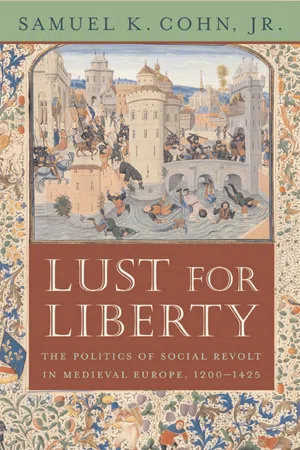
Lust for Liberty
The Politics of Social Revolt in Medieval Europe, 1200–1425
- Samuel K. Cohn Jr., Samuel Kline COHN(Authors)
- 2009(Publication Date)
- Harvard University Press(Publisher)
Despite chroniclers’ preference for the affairs of ruling elites, noble armed conflict, and intrigues involving members of their own social classes, they were not oblivious to peasant uprisings or opposed to passing them down to posterity. Compared with a mere handful of peasant revolts against feudal or urban landlords reported by chroniclers—few of which arose explicitly from disputes over economic exploitation at that—no fewer than fifty-seven peas-ant revolts can be fished from the chronicles in which economic oppression was not the immediate cause, and landlords—capitalist or feudal—were not the targets. This figure does not include the many other revolts by villages or small market towns, composed mostly of rustics, against a city-state in which the sources do not clarify who the rebels were. For instance, the chronicler Michele da Piazza reported numerous terrae (rural districts) revolting against local counts or royal power in the 1350s but did not reveal who led or formed the ranks of these revolts. 25 Furthermore, recent historiography ascribes such uprisings primarily to the more rural economies north of the Alps; in fact, three-fourths of them (42 of 57) erupted in the urban-dominated zones of late medieval central and northern Italy. 26 To be sure, all peasant revolts were not equal in duration, geographical scope, numbers of combatants, and the terror they inflicted on local commu-nities, heads of state, and the chroniclers who recorded them. The three most important revolts by these standards were three of the most important peas-ant revolts in Western European history—the revolts in Flanders 1297–1304 and 1323–1328 and the Jacquerie of the Île de France, Picardy, the Beauvai-sis, and neighboring villages further afield in May 1358. All three (along with the English Peasants’ Revolt) were north of the Alps. eBook - PDF
Class Conflict and the Crisis of Feudalism
Essays in Medieval Social History
- Rodney Hilton(Author)
- 1985(Publication Date)
- Hambledon Continuum(Publisher)
In order to place this peasant discontent in its proper perspective, before indicating the evidence for it in the period to which I refer, it will be necessary to make some general remarks about the economic and social position of the English peasantry in the Middle Ages. This will seem to many a well-trodden field, and I am conscious of the risks in attempting to reassess the work of such eminent workers as Seebohm and Vinogradoff, or, to come to contemporary scholars, Professors Postan and Homans. What was it in the agrarian relations of feudal society that made peasant revolts, as Marc Bloch implied in the quotation I have set at the head of this article, inevitable ? In order to answer this question, we must simplify the broad outlines of that society by (for the moment) ignoring such important intermediate social strata as the burgesses and certain of Peasant Movements in England Before 1381 123 the free tenants. Is not feudal society after all fundamentally determined by the relations between a landowning military aristocracy on the one hand, and a vast class of peasant-producers, working individual family holdings but also organised in village or hamlet communities, on the other? I am aware that there have been many important modifications made to this simple picture, 2 but I maintain that the picture remains fundamentally true even for economies of widely differing character, in so far as it describes the basic social relations between the two main classes of feudal Europe. I must, however, further define these social relations as they affected the majority of the peasants and the feudal lords. The fact that the peasants were organised in an organic community and that they were in effective possession of their own means of subsistence is of the greatest importance. This fact contradicts, as it were, the legal claim of the landowners to the monopoly and free disposal of the arable, the meadow, the pasture, the woods, the rivers and the waste.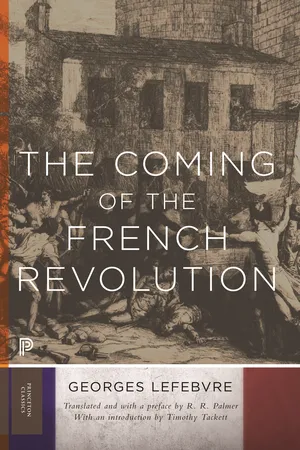 eBook - PDF
- Georges Lefebvre, R. R. Palmer(Authors)
- 2019(Publication Date)
- Princeton University Press(Publisher)
PA R T I V T H E PE A S A N T R EVO LU T I O N Chapter 9 The Peasantry There was scarcely any ques-tion of the peasants before July 14 . Yet they formed at least three quarters of the population of the kingdom, and we realize today that without their adherence the Revolution could with difficulty have succeeded. Their grievances had been disregarded in the drafting of the bailiwick petitions, or had at best received little emphasis. Their complaints were by no means uppermost among the interests of the National Assembly, in which there were no peasant mem-bers. Then suddenly they too revolted, taking their cause into their own hands and delivering a death blow to what was left of the feudal and manorial system. The peasant uprising is one of the most distinctive features of the Revo-lution in France. The Peasants and the Land In 1789 the great majority of the French peasants had been free for many generations, i.e., they could move about and work as they wished, possess property and bring suit in the law courts. Some “serfs” could still be found, principally in Franche-Comté and the Nivernais, but they were no longer really attached to the soil, and in 1779 the king had even abolished the right of pursuit, which had allowed the lord to make good his claims over the serf wherever the latter might go. The main characteristic of serfdom in France was lack of freedom in disposing of goods. The serf was a mainmortable or man under a mort-main; if, at his death, he did not have at least one living child residing with him, all his possessions reverted to the lord. In France the serf was far better off than in central and eastern Europe, where the peasantry was left under the nobleman’s arbitrary jurisdiction. In France the king’s justice protected the rights and person of both serf and free man. eBook - ePub
Religion, Politics and Social Protest
Three Studies on Early Modern Germany
- Peter Blickle, Hans-Christoph Rublack, Winfried Schulze, Kaspar von Greyerz(Authors)
- 2021(Publication Date)
- Routledge(Publisher)
90 The economic consequences of resistance can also be demonstrated. Peasant resistance led to a decrease in agrarian productivity and was closely connected with the transition from feudal services to paid work.Finally, I should like to emphasise that peasant revolts in the early modern period played an important part in the political and economic development of the European countries, in as much as they influenced the speed of modernisation in state and economy. Governments’ new judicial institutions and legal procedures developed regulating mechanisms in response to peasant rebellions. Privileges were abolished and attempts made to discipline the aristocracy. Peasant rebellions also led to a reform of the legal status of peasants and of land ownership. Francis Bacon’s tract ‘On sedition and troubles’ provides an excellent illustration of these results. Under the heading of ‘remedia praeservativa ’, he discusses substantial reform measures such as the encouragement of industry and commerce, taxes against luxury goods, moderate taxation, the establishment of a numerical balance between nobility and common people, a reduction in the number of clerics and the prevention of monoplies and huge estates, ‘for the surest way to prevent sedition (i.e. the times to bear it) is to take away the matter of them’. Bacon’s tract seems to be a fairly reliable account of the issues which concerned the European ruling élites.91 They were under the impression that, as the cameralist Johann Jakob Becher put it,92 one rebel was worse than ten external enemies.A comment made by Emperor Leopold II gives a clear impression of the range of the peasant movements’ potential effects. In 1778 as Grand Duke of Tuscany, he investigated new measures to protect the peasants in Bohemia and wrote to his mother:and so a mass uprising by the peasants will be of use to the state by humbling the rulers and making them treat their peasants justly and fairly. The peasant class is as much a part of the monarchy as that of the landlords and they must all be protected and supported by, the government.93 eBook - PDF
- Peter Campbell(Author)
- 2005(Publication Date)
- Red Globe Press(Publisher)
There appears to be a growing tension in rural France in the late ancien régime that needs a great deal more attention from historians. 239 INTRODUCTION The great majority of the French people who lived during the years of revolution were peasants, and historians have formed the most diverse views of the part those peasants played. For Albert Soboul, France’s peasants were a major source of radicalism: “The peasant and popular revolution was at the very heart of the bourgeois revolution and carried it steadily forward.” 1 Georges Lefebvre identifies the target of the peas-ants’ revolutionary actions: “Against the aristocracy the peasants had far more substantial grievances than the people of the cities, and it is natural, therefore, that they took it upon themselves to deal the blow by which the aristocracy was laid low.” 2 Rather than a social class whose grievances drove the Revolution forward, George Taylor urges us to see peasant “docility.” 3 Donald Sutherland’s portrait, however, suggests neither docility nor radicalization: “In the end, therefore, the vast weight of ancient peasant France imposed itself upon the government at the expense of many of the ideals of 1789.” 4 Four distinguished historians in so few words manage to express so many differences. The peasants are one of the engines of revolution and the peasants are the major brake on revolution. The peasants are active and the peasants are docile. The peasants act on their own behalf and the peasants act together with the urban popular classes to move the bourgeoisie’s revolution forward. The diversity of their actions makes it easy to understand how histo-rians have characterized the impact of the peasants on the Revolution in so many different ways. eBook - PDF
Pathways of Power
Building an Anthropology of the Modern World
- Eric R. Wolf(Author)
- 2001(Publication Date)
- University of California Press(Publisher)
Some of the conditions are social: reduction in the ability or willingness of kinsmen and neighbors to extend help; reduction in the ability of the peasant to predict the behavior of kinsmen and neighbors along traditional lines; reduction in the rewards of status won through traditional social participation in Peasants and Revolution 233 community affairs, in favor of rewards, including monetary rewards, that count in the world beyond the community; growing involvement in an outside world through migration, military service, or wage labor. Some of the conditions are political: increased movement in a larger world brings peasants into contact with power figures whom they can-not control but who control them, frequently to their detriment. All of these conditions have consequences that are cognitive: they increase the number and kinds of unpredictable events, hence increase also the sense of a prevailing disorder and a willingness to see existing institutions as disorderly and, therefore, illegitimate. Yet peasants will revolt under some conditions, but not under others; in some societies and not in others (see Moore 1966). The probability of peasant revolution is maximized where significant local power re-mains in the hands of landowners, but where this agrarian elite is unable to form a viable national coalition with a rising class of industrial and commercial entrepreneurs. The landowners fail to exert leadership in the transition to industrialization; the merchants, on the other hand, tie their fate to sources of capital outside the society—directly in a colonial context, indirectly in what has been called “neocolonialism.” They form a comprador bourgeoisie. Where there is such a split of elites at the top, contradictions will appear also in the hinterland. The activities of the commercial entrepreneurs undermine social re-lations in the countryside, without at the same time changing the tech-nology of agriculture and raising agricultural productivity.
- William B. Taylor(Author)
- 1979(Publication Date)
- Stanford University Press(Publisher)
32 Similar grievances, especially over revised schedules of clerical fees and labor drafts, as we shall see, were associated with what appear to be religious rebellions in eighteenth-century Mexico. As Davis suggests, the range of ruler-subject relationships must be considered, in addition to the people’s perceptions of their conditions and their assumption of the mantle of holy mission, if we are to account for the timing and location of these revolts.TABLE 18 . Comparison of Village Uprisings and Agricultural Crises in Central Mexico, 1703–1811A more common explanation of Latin American peasant movements centers on “structural contradictions,” especially a combination of subordinate-group, economic deprivation, and elite intransigence.33 This explanation places the causes of revolt completely outside the villages themselves. A recent example of this approach applied to colonial Mexico is the work of Raymond Buve.34 He sees the principal “contradiction” in the land system, which he describes in terms of landed Spanish overlords and landless Indian country folk. According to Buve, this unequal relationship on the land, plus the colonial government’s oppression of peasants in defense of the landed elite, created the conditions for peasant revolts. But this hypothesis fails to fit a good deal of the evidence both for Mexico and for other parts of Latin America. Barrington Moore, among others, has noted that peasant unrest is not simply the result of massive poverty and exploitation or of the elite’s commitment to mindless repression. There are too many revolts that do not seem to follow on a period of worsening material conditions and too many rural societies living through increasing poverty without showing an increase in social violence to hazard any universal statements about economic deprivation, elite intransigence, and peasant unrest. If anything, rebellions seem to have been more common in regions and communities of Latin America that are less poverty-stricken and isolated.35 eBook - ePub
England in the Age of Chivalry . . . And Awful Diseases
The Hundred Years' War and Black Death
- Ed West(Author)
- 2018(Publication Date)
- Skyhorse(Publisher)
HAPTER NINEThe Peasants’ RevoltO n June 21, 1377, the guild masters of London rode into the Black Prince’s former palace at Kennington just across the Thames from London, and swore their loyalty to the new king, his ten-year-old son Richard of Bordeaux.A boy on the throne was a problem, and within weeks the French threatened to invade. Richard II’s reign began with a series of military failures, and from the start it was ridden with division and the crown was bankrupt. Richard would become famous as a Shakespearean lunatic, but he had inherited a terrible mess and his enemies were mostly a dreadful bunch.The most powerful was his uncle John of Gaunt, who had in the last years of his father’s reign inherited the title of Duke of Lancaster from his father-in-law Henry (Lancaster was a county palatinate and therefore virtually self-governing). Gaunt was universally hated, and, in 1376, a London mob had almost killed him, while the common people believed all sorts of rumors circulating around, such as he poisoned his first wife, which is unlikely (divorce wasn’t a big issue at the time because the chances were one spouse would die of some ghastly disease before too long).To pay for the war, a new levy was imposed called a ‘poll tax.’ There had never been a universal tax before, and they soon learned why, for, in 1381, rural anger erupted into the biggest popular uprising in English history. The peasants were revolting.Although the word was only coined in 1776 by Adam Smith, the social system at the time is generally known as feudalism, from feodum eBook - PDF
Peasants in Russia from Serfdom to Stalin
Accommodation, Survival, Resistance
- Boris B. Gorshkov(Author)
- 2018(Publication Date)
- Bloomsbury Academic(Publisher)
According to Karl Marx, peasants do not constitute a revolutionary class. Yet in the case of the Russian revolutions of 1905, and February and October 1917, Russian peasants, in pursuit of desired political and economic changes, were enthusiastic actors in these revolutions. Peasants had aspirations to improve their lot through active involvement in politics and the revolutionary movement. Many became members and active supporters of political parties which developed at the beginning of the twentieth century. The period between 1905 and April 1918 witnessed remarkable peasant activism. Peasants created their associations, formed various committees, and convened congresses at the local and national levels. The revolutionary turn in 1917, however, ultimately brought about the Red Terror and civil war, leaving peasant aspirations for the time being only partially fulfilled: the early 1918 land law (to be discussed below) did pass the land to the peasants but then the state, faced with hunger in the cities, confiscated the produce of the land, often leaving peasants in a state of starvation. This chapter will explore the revolutions and developments associated with them, focusing on peasant experiences, various political parties’ agrarian programs, and state policies regarding peasants. The beginning of the twentieth century was marked by truly dramatic events: continuing economic reforms, industrialization, and calamities. Russia was undergoing a full-scale economic and industrial modernization. These processes were uneven and caused sharp social dislocations in the countryside and in the cities. Peasants used all legal channels to force the imperial, the provisional, and then the Soviet governments to hear their voices. Peasants in the communes and factories wrote petitions to the state authorities telling them that their rights were being violated by conditions in the factories and by the financial toll the redemption payments and taxes were taking on them. eBook - PDF
The Moral Economy of the Peasant
Rebellion and Subsistence in Southeast Asia
- James C. Scott(Author)
- 1977(Publication Date)
- Yale University Press(Publisher)
This explanation for the absence of revolt—for peasant passivity—assumes a fatalistic acceptance of the so-cial order or what Marxists might call mystification. One may claim, on the other hand, that the explanation for passivity is not to be found in peasant values, but rather in the relationships of force in the coun-tryside. It is probably safe to assume that no one would claim that the absence of defiance, taken by itself, is sufficient evidence that rural class relations are harmonious. Even the colonial officials assessing the claims of land-lords in Lower Burma in the 1930s were prepared to admit that agrarian 68. Aware of this problem, the Viet Cong took every precaution to maintain the legal status of peasants who helped them so as to minimize the threat to their security. 69. See, for example, Gerrit Huizer, Peasant Mobilization and Land Reform in In-donesia, (The Hague: Institute of Social Studies, Occasional Paper, June 1972). 228 THE MORAL ECONOMY OF THE PEASAN I REVOLT, SURVIVAL, AND REPRESSION 2J*9 cence was broken dramatically by a large-scale rebellion which began shortly after the victory of the left-wing United Front in the statewide elections of 1969. What appears to have happened is that the electoral campaign encouraged peasants to believe that a coalition favorable to their interests had taken power. The United Front talked openly of dispossessing landlords and appointed as Minister of Land and Revenue a communist from its most radical wing. Peasants moved spontaneously to occupy the land not only in Naxalbari but elsewhere in West Bengal under the assumption that, for the first time in memory, the police and administration were on their side and would support their claim to land. After a few confrontations led to peasant victories, the conflagration spread so quickly as to rule out any possibility that peasant organizers had, in the meantime, demystified the rural poor. eBook - PDF
Issues in the Contemporary Politics of Sub-Saharan Africa
The Dynamics of Struggle and Resistance
- G. Harrison(Author)
- 2002(Publication Date)
- Palgrave Macmillan(Publisher)
These two tasks have yielded a complex picture, but we can highlight a number of key points. • Peasants are neither passive nor traditional, but are part of modern social systems, acting and reacting from a position of relative weak- ness. • Peasant society is internally differentiated but has not followed any linear path towards the formation of a landed and landless class. • Peasant society is defined by its resilience and flexibility in the face of external forces. • A key feature of postcolonial agricultural ‘development’ has been the extraction of resources from the peasantry by state insti- tutions. • State elites have been antagonistic towards the plurality and ‘tra- dition’ of their peasant societies. • Any policy or programme from a state or international agency must negotiate a set of local circumstances. • Peasants have elaborated a series of responses and strategies to these externally contrived circumstances including: avoiding and bypass- ing the state, subverting the effects and purpose of state action, ‘capturing’ the state at the local level, and selectively engaging with it where it is advantageous to do so. This chapter serves to re-engage considerations of agency and struggle for the majority of Africa’s people. In the chapters that follow, we will be prepared to consider how peasants have reacted in the face of two important contemporary processes, namely economic reform and democratization. 48 Contemporary Politics of Sub-Saharan Africa Further reading A readable and theoretically engaged overview of peasantries in Africa (and elsewhere) is Bryceson, Kay and Mooij (2000). Brass (1997) pro- vides a subtle engagement with perceptions of peasants and broader intellectual trends, which makes interesting reading in conjunction with Chambers (1983) who also analyses the engagement between peasants and intellectuals from a more pragmatic standpoint.
Index pages curate the most relevant extracts from our library of academic textbooks. They’ve been created using an in-house natural language model (NLM), each adding context and meaning to key research topics.

