History

Political Clubs
Political clubs were organizations formed during the French Revolution to promote political ideas and activism. They were often associated with specific political factions and played a significant role in shaping the course of the Revolution. The most famous of these clubs was the Jacobin Club, which became the dominant political force in France during the Reign of Terror.
Written by Perlego with AI-assistance
3 Key excerpts on "Political Clubs"
 eBook - PDF
Organizing Democracy
Reflections on the Rise of Political Organizations in the Nineteenth Century
- Henk te Velde, Maartje Janse, Henk te Velde, Maartje Janse(Authors)
- 2017(Publication Date)
- Palgrave Macmillan(Publisher)
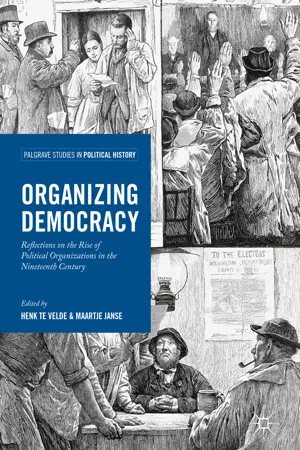
42 In this view, the Parisian clubs were not only a representation or reflection of the French population but even a direct echo of the ‘voice of the people’. The clubs announced a new form of citizenship, which promised the political partici- pation of all adult, male citizens. 43 ORGANIZING IN A MOMENT OF MADNESS: POLITICAL MEETINGS AND CLUBS... 112 In the experimental phase between February and April 1848, it was self-evident that all clubs would be accessible for every citizen, provided that he was trustworthy and loyal to the new republic. 44 For a proper, democratic citizen, visiting a club was even a duty, as the founders of the moderate republican Club des Hommes Libres stated in their founding manifesto: ‘be it to mutually enlighten oneself about the scope of one’s rights and one’s duties, and about which choice to make in the next elec- tions, be it to draw the attention of national assemblies to the great social issues that are currently at stake, be it finally (and that is the most essential point) to establish a popular forum where the reforms of political institu- tions, which have diverted from their true destination, will be discussed’. 45 Political participation on a large scale was needed to shape the new era that dawned. The clubs can be seen as an institutionalization of the rostrum, and as a ‘popular forum’, catering to the need to discuss politics. The accessible and broad nature of this forum should lead us to think of the clubs as ‘institutionalized popular assemblies’, rather than associations in the sense of the limited and more defined voluntary associations that had emerged in Europe in the previous decades. These (mostly middle- class) associations had explicitly excluded specific groups or individuals through their rules or their high membership fees. In 1848, following practices in the United Kingdom, the concept of ‘association’ on the continent acquired the character of a political, broadly accessible form of organization. eBook - PDF
The historian between the ethnologist and the futurologist
A Conference on the Historian Between the Ethnologist and the Futurologist, Venice, April 2–8, 1971
- Jerôme [Ed.] Dumoulin, Conference on the Historian Between the Ethnologist and the Futurologist(Authors)
- 2018(Publication Date)
- De Gruyter Mouton(Publisher)
Here political history as a special discipline within the sciences dedicated to the study of societies is in its legitimate sphere. Political history always asks when and where and how in a given society of a specific historical type decisions of historical relevance came about. It will, of course, always remain a matter of dispute, in which spheres of the social process the vital decisions are located. Are they located in the political organisations exercising power in the narrow sense of the term, more or less legitimated by a legal system, or are they found in the economic sphere or perhaps even at a much more elementary level, involving, for example, biological factors such as population movement. Political history will have to pay attention to this question and will have to develop a new outlook to enable it to integrate these diverse aspects of social change in historical dimensions into its conceptual framework. On the other hand, not only political history, but all history depends on the assumption that in any given situation the historical process was open and that the future, at least to a certain degree, is given into the hands of purposeful, acting groups. The excitement which is evoked by any historical work of any distinction derives from the knowledge that there were alternatives for the acting groups concerned, and that the respective 148 Political history in crisis political courses decided upon had immense consequences, which affected indirectly or even directly our own social and political reality or our consciousness. What is meant by this can perhaps be illustrated somewhat more clearly by turning to a historical phenomenon of outstanding relevance to our own historical-consciousness revolutions, especially political revo-lutions. The term revolution nowadays is used by historians, social scientists, and the general public as well with the most diverse meanings. eBook - PDF
- Richard S Katz, William J Crotty, Richard S Katz, William J Crotty(Authors)
- 2006(Publication Date)
- SAGE Publications Ltd(Publisher)
In his study of political reform clubs in New York, Chicago, and Los Angeles in the 1950s and early 1960s, James Q. Wilson (1962: 167–8) recounted what one Los Angeles leader told him: ‘The club movement is not basi-cally a social movement ... My social friends are not in the clubs. I don’t go to the homes of the people I know in the clubs and they don’t come to mine.’ Club meetings, Wilson (1962: 168) argued, were ‘long and often dull in the extreme, with a seemingly endless agenda and interminable speakers’. Seyd and Whiteley (2002: 98) found that a bare majority of Labour Party members who were not at all active (40 percent of the sample) thought membership was a good way to meet ‘interesting people’; 75 percent of active and 84 percent of very active party members agreed that party membership helps establish social ties, but active members constitute just 25 per-cent of party members. Meetings of strongly ideological parties in Europe often degenerated into hostile debates between the in-group clique and new members who might not be as strongly committed, driving out all but the most dedi-cated (Ware, 1992: 82; Kitschelt, 1989: 126–7). It is hardly surprising to find that the most active party members find friends in the organi-zation. It also makes sense that these strong activists take an active role in other organiza-tions. They are, after all, the most dedicated par-tisans. Are party members more likely to be civic activists more generally? The 1996 American National Election Study asked about member-ship in parties, labor unions, and other groups (business, veterans, church, other religious, elderly, women’s, political, civic, ideological, children, hobby, community, fraternal, service, educational, cultural, and self-help). There was a moderate correlation ( r = 0.198) between membership in parties and political groups, and modest correlations with service and cultural groups (0.13 each).
Index pages curate the most relevant extracts from our library of academic textbooks. They’ve been created using an in-house natural language model (NLM), each adding context and meaning to key research topics.

