History

Rajput Kingdoms
The Rajput Kingdoms were a collection of Hindu kingdoms in medieval India, known for their warrior traditions and valor. They emerged in the 6th century and played a significant role in Indian history, resisting foreign invasions and preserving Hindu culture. The Rajput rulers were known for their chivalry, martial prowess, and patronage of art and architecture.
Written by Perlego with AI-assistance
Related key terms
1 of 5

10 Key excerpts on "Rajput Kingdoms"
 No longer available |Learn more
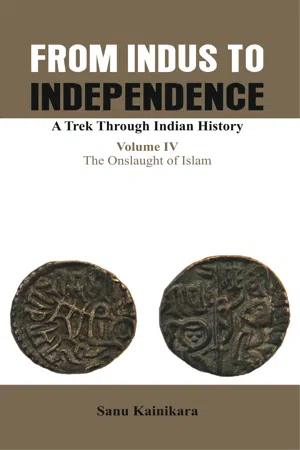
From Indus to Independence
A Trek Through Indian History (Vol IV The Onslaught of Islam)
- Dr. Sanu Kainikara(Author)
- 2016(Publication Date)
- VIJ Books (India) Pty Ltd(Publisher)
Over centuries these clans intermarried, creating customs and traditions that became unwritten rules governing such unions. More importantly they created and extensive network of blood relations between the clans that gradually came to be recognised as sub-castes within the broader ‘Rajput clan’. This was a process that started in the mid-6th century and took a long time to become acknowledged norms.The clan spirit also produced personalised political structures and the adaption of a semi-feudal form of governance. The tendency was to split rather than merge, which was good for conservation of a status quo but difficult to effect a combination when required. The six centuries following the death of Harsha Vardhana and the rule of the Rajputs in the north and central India was an age of chivalry and tuneful ballads but also one of political division and societal inertia. This was the primary reason for the fall of the Rajput Kingdoms to the Turkish onslaught.Their actual points of origin, whether foreign or indigenous, is displeasing to the great Rajput clans. Therefore, they claim descend from a Brahmin-assisted orthodox Hindu pedigree—from the Sun, Moon or the sacrificial fire pit—which is more in tune with the illustrious Hindu kings of the past. It is also perhaps justified considering the brave and chivalrous kings that the Rajput clans produced and the valiant heritage to which they can honestly lay claim to, in the process becoming more Indian and Hindu than any other ruling class and the epitome of all that the traditional Kshatriya class of the ancient land had always strived to become. Passage contains an image
Chapter 2
EARLY Rajput Kingdoms
T eBook - ePub
The Many Lives of a Rajput Queen
Heroic Pasts in India, c. 1500-1900
- Ramya Sreenivasan(Author)
- 2015(Publication Date)
- University of Washington Press(Publisher)
c . 1660) is particularly revealing of the diverse contexts from which anti-imperial polemics could emerge in the seventeenth century, and of their differing hues.Kings, Chiefs, and Queens: Rajasthan c . 1500–1750The Rajput Kingdoms of Rajasthan witnessed increasing attempts to consolidate monarchical power from the sixteenth century. The inherited rights and entitlements of the major lineage chiefs were frequently incompatible with new assertions of royal authority. Elite polygyny provided an alternative to rulers in this period: military resources and a network of alliances, to be used both against refractory chiefs and in the service of Mughal imperial expansion. Throughout the period, however, these structural features of Rajput polity threatened its ruling lineages as much as Mughal expansion did.When the Rathors of Marwar initially established their control over Jodhpur in the mid-fifteenth century, the ruler’s “sons and brothers . . . were allowed to occupy the various territories [they] conquered” as their “estates” (thikana ), under the practice of bhai-bant (division among brothers).9 In the mid-sixteenth century, the Jodhpur ruler renegotiated his relationships with his clansmen and chiefs. Seeking to assert that a chief “was dependent for his position on the good-will of the Raja rather than on his inherent rights,” he began the practice of assigning land-revenue grants (patta ) to the chiefs in exchange for service. The assignment of new lands to chiefs, in a period of territorial expansion through conquest, had contradictory consequences. On the one hand the chiefs were more willing to accept their new, contractual relations with the king because of the immediate gains. On the other hand the extended kinship network was implicated in the kingdom’s territorial expansion, and kinship ties continued to guarantee status and access to entitlements.10 The new revenue grantees still belonged to the monarch’s extended clan and still claimed rights over patrimonial domains.11 eBook - PDF
The Congress Party in Rajasthan
Political Integration and Institution-Building in an Indian State
- Richard Sisson(Author)
- 2023(Publication Date)
- University of California Press(Publisher)
Feudalism in History (Princeton: Princeton University Press, 1956), PP- '33-'5°- 5. Sir Alfred Lyall, Asiatic Studies: Religious and Social (London: John Murray, 1882), pp. 207-219. See also the Rajputana Gazetteer, Vol. 1 (Cal- cutta: Office of the Superintendent of Government Printing, 1879), pp. 59-60; and Anil Chandra Banerjee, Lectures on Rajput History (Calcutta: Firma K. L. Mukhopadhyay, 1962), pp. 1 1 0 - 1 1 3 . 6. J. Sutherland, Sketches of the Relations Subsisting Between the British Government in India and the Different Native States (Calcutta: G. H. Hutt- man. Military Orphan Press, 1837), p. 179. 22 THE CONGRESS PARTY IN RAJASTHAN states as having been originally invested in the hands of a sover- eign prince who granted jagirdari rights to members of his clan, his caste, and to commoners either as a reward for service rendered or as an ijara—the right to collect rents with a fixed amount being surrendered to the treasury of the central darbar. This conception was most persuasively documented and argued in the case of Jaipur State by the late C. U. Wills. 7 Yet another view proposes that the princely states evolved with the assertion of power by a dominant chief over surrounding territories which then assumed tributary status. None of these different views, irrespective of their historical merit, was commonly accepted by the princes and their sardars either before or during the British period. Conflict over the exercise of authority in practice, however, was resolved in favor of the ruling houses with the extension of British suzerainty over the states of Rajputana and the development of the doctrine of paramountcy. Treaties signed by the British East India Company and the Rajputana states during the first two dec- ades of the nineteenth century committed the British to the resto- ration and perpetuation of a quasi-feudal system of authority. eBook - PDF
Nomadic Narratives
A History of Mobility and Identity in the Great Indian Desert
- Tanuja Kothiyal(Author)
- 2016(Publication Date)
- Cambridge University Press(Publisher)
The second, was through their relationship with Anglo-Saxon traditions, as against upstarts like Marathas. In the nineteenth century, the East India Company had to engage with several groups like Sikhs, Marathas, Afghans, Gorkhas, Hyder Ali and Tipu Sultan of Mysore, and the talukedars of Awadh, among others. The Rajput states of Rajputana are the interesting absence in this list. The treaties with the Rajput states were not military treaties forced after wars, but treaties that were carefully negotiated after long deliberations. Yet, in the larger discourse of martiality, where groups are identified on the basis of their martial characteristics, Rajputs were the foremost entry, as the most martial of the martial races. The discourse of martiality was parallel to the discourse on criminality, as both were seen as inbred characteristics. 184 In case of Rajputs, warriorhood along with traits like chivalry and loyalty were seen as their innate characteristics, which as Tod tried to demonstrate could be a result of their old Scythian origins. 185 It is in Tod’s work that a new genealogical orthodoxy can be seen as emerging, as Tod obsessively treads the racial terrain. He researched and put together a corrected list of genealogies of ‘thirty six royal races’. 186 Racial purity along with resistance to Muslim domination became the standard for adjudging the hierarchy of Rajput clans, as also ‘Rajputhood’. This is apparent in his Annals, which he begins with Mewar, declaring, “with exception of Jessulmér, Méwar is the only dynasty that has outlived eight centuries of foreign domination”. 187 His castigation of Kachchwahas of Amber for making a marital alliance is scathing, “the name of Bhágwandas is execrated as the first who sullied Rajpoot purity by matrimonial alliance with the Islamite”. eBook - PDF
- Henri J. Claessen, Peter Skalnik, Henri J. Claessen, Peter Skalnik(Authors)
- 2011(Publication Date)
- De Gruyter Mouton(Publisher)
Thus it is in the late fifteenth century that so many of the genealogical 'founders' of Rajput houses are located, and in the sixteenth to seventeenth centuries that lord-client relationships begin rapidly to replace those of kinship as the basis of social organization, causing simultaneously a shift in the structural character of landed rights. 'By the early 17th century...we see the first true Rajput states...in the sense that there was a defined and institutionalized locus of power...', while the 'process of transforming relationships on the land also included the increasing bureaucratization of these relationships as administrative pro-cedures became more sophisticated in these local kingdoms' (Ziegler 1978: 223ff.). What we detect beneath all this -which Ziegler sees as fostered by delegations of Mughal authority to local rulers — is the peasantization of extensive tracts beyond the old nuclear-settled areas. The simultaneity of these developments with those which occurred independently to the south is particularly significant. In the mid-seventeenth century Shivaji's kingdom slowly takes form, and it is significant, in the light of Habib's theory (Section 3 above), that Shivaji and other powerful warrior families claimed rajput ancestry. While grants of ostensibly temporary, fiscal rights over assigned territories, issued by the Mughal and sultanate courts, served as a means to absorb and stabilize these local princelings, they were simultaneously the instrument whereby more localized political orders evolved. What Ziegler sees as a shift towards localization of political power and of extended control over access to land, must also be seen as the development of that social infrastructure of economy and society in terms of which local exercise of power and control of land became meaningful. eBook - PDF
Hinduism and the Ethics of Warfare in South Asia
From Antiquity to the Present
- Kaushik Roy(Author)
- 2012(Publication Date)
- Cambridge University Press(Publisher)
The Persian chroniclers categorize them as zamindars. Most of these chieftains of north India fell under the generic term ‘Rajput’. Some of their principalities stretched over hun- dreds of kilometers. The number of cavalry commanded by some of them exceeded the strength of cavalry commanded by the highest grandees of the empire. Since these chieftains were not united, they posed only local threats to the empire. Many of them were coerced to join the Mughal Empire as mansabdars. Many chieftains were also enrolled in the man- sabdari service after being defeated in battles. 207 To an extent, the recruitment of the Rajput chiefs into the Mughal army under Akbar was a reaction to the defeat of Humayun at the hands of the Afghans. 208 S. Inayat A. Zaidi asserts that Akbar followed a coher- ent policy towards the Rajput chiefs that represented a complete break 203 M. Athar Ali, ‘The Religious Environment under Shah Jahan and Aurangzeb’, in Ali, Mughal India, p. 207. 204 M. Athar Ali, ‘Political Structures of the Islamic Orient in the Sixteenth and Seventeenth Centuries’, in Ali, Mughal India, p. 100. 205 Jos J. L. Gommans and Dirk H. A. Kolff, ‘Introduction: Warfare and Weaponry in South Asia: 1000–1800 AD’, in Gommans and Kolff (eds.), Warfare and Weaponry in South Asia, p. 23. 206 Michael P. Birt, ‘Samurai in Passage: The Transformation of the Sixteenth-Century Kanto’, in Kleinschmidt (ed.), Warfare in Japan, p. 338. 207 Ahsan Raza Khan, ‘Akbar’s Initial Encounters with the Chiefs: Accident versus Design in the Process of Subjugation’, in Habib (ed.), Akbar and His India, pp. 1–24. 208 Zaidi, ‘Ordinary Kachawaha Troopers Serving the Mughal Empire’, p. 57. Hindu Militarism under Islamic Rule 195 from the policy followed by the previous Islamic Turkish rulers of India. The conventional policy was to subjugate a local chief, exact a heavy sum of peshkash (offering or tribute) and then leave him free in his domain.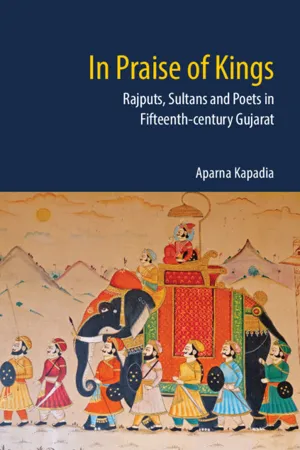 eBook - PDF
In Praise of Kings
Rajputs, Sultans and Poets in Fifteenth-century Gujarat
- Aparna Kapadia(Author)
- 2018(Publication Date)
- Cambridge University Press(Publisher)
This symbolic but very real power allowed the bardic group to play key roles in the functioning of western Indian society until the early nineteenth century. Inevitably, the linguistic wares of these godly poets were fiercely protected, as they both 23 Singhji, The Rajputs of Saurashtra, 239. 24 6HH 6KDK DQG 6KURII µ7KH 9DKƯYDQFƗ %ƗUR৬V RI *XMDUDW¶ ± 7KLV VWXG\ E\ 6KDK DQG Shroff is a seminal work on these genealogists whose traditions still remain neglected in contemporary scholarship. 140 In Praise of Kings legitimised and perpetuated rule in many of the chieftaincies, and served important diplomatic and martial purposes. The bards’ hold over the ruling houses of the region thus posed a significant challenge to the authority of the colonial administration’s financial, territorial, and legal aims. In the early years of colonial rule, the British systematically delegitimised their duties, curtailing their administrative functions, and rendered them redundant to the new political order. 25 By the time that Forbes started working in Gujarat, the role of bards, an institution that was once crucial to the identity and authority of the Rajput chieftains, was on the decline. 5ƗV 0ƗOƗ and its Making 5ƗV 0ƗOƗ begins with a description of what Forbes considers to be Gujarat’s natural boundaries, and in the first section, tells the story of the early medieval (eighth- to thirteenth-century) dynasties of Patan and Kathiawad. The second book is an account of the ‘Mohumeddan’ period in Gujarat, but true to Forbes’s own agenda, it focuses mainly on the Rajput chieftains, their clans, and their political relations with the regional sultans during the fourteenth to the sixteenth centuries. In the third book, which covers the eighteenth and early nineteenth centuries, Forbes writes of the Maratha empire, and then the beginning of British rule in India.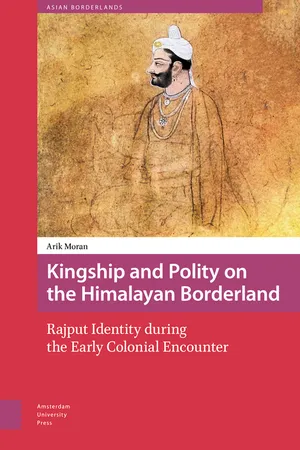 No longer available |Learn more
Kingship and Polity on the Himalayan Borderland
Rajput Identity during the Early Colonial Encounter
- Arik Moran(Author)
- 2019(Publication Date)
- Amsterdam University Press(Publisher)
Subjected to intense research during the Victorian Age, the kingdoms’ pasts gradually transformed into the Sanskritic domain of Kshatriyas that is familiar today, and that distinguished the Pahari rulers from (and reflected back upon) their Rajasthani peers. By the 1930s, the historians who committed the 93 In the 1820s-30s, Begam Samru’s jagir at Sardhana (a few days ride south of Ambala) yielded 500,000 rupees per annum, approximately ten and five times the income of Sirmaur and Bilaspur, respectively (Alavi 1995, 220-5, Fisher 2010, 13-77). For an eyewitness account of ‘four Sikh ladies’ passing days on end in fir ing ‘great guns’ from neighbouring turrets in the plains near Handur, see Eden (1988,160). 196 KINGSHIP AND POLITY ON THE HIMALAYAN BORDERLAND annals of the hills to writing had reduced the ranis’ conquests to three short paragraphs about the ‘twin sisters’ of the raja of Sirmaur – a curious factoid in the long history of Pahari Rajput kings. Epilogue In November 2017, the long-standing Chief Minister of Himachal Pradesh Virbhadra Singh stood for re-election. While the candidate’s track record spanned decades of state, national, and international level politics that bolstered his credentials for the job, within the state he was most popularly known as ‘rajaji’ in reference to his inherited position as the head of the ruling dynasty of the erstwhile kingdom of Bashahr in the inner highlands. In classical sociological terms, this seasoned politician illustrated the fruitful combination of components outlined by Weber as integral to the practise of authority, supplementing personal charisma with institutional (elected) and traditional (inherited) facets of power; it is the creation and reformulation of the latter sphere that this book has explored. eBook - PDF
Jaipur 1778
The Making of a King
- Monika Horstmann(Author)
- 2014(Publication Date)
- Harrassowitz Verlag(Publisher)
Chapter 1 The Kingdom of Jaipur 1.1 Jaipur up to 1778 The Kachv ā h ā dynasty ruled over Jaipur for centuries. In the early eleventh century, the Kachv ā h ā s had begun to supersede the former territorial lords, notably the M īṇā s. Prior to this, their first stronghold had been Daus ā , to the west of Jaipur. From there they expanded to Ā mer, where they built a fortified base, and later on a palace. 40 From 1562 the Kachv ā h ā rulers had been subject to the suzerainty of the Mughal emperors, but by the late eighteenth century, the Mughal emperor had become powerless, notwithstanding the fact that the claimant powers of the period, notably the Marathas and the Rajput kings, formally acknowledged his suzerainty. By that time, almost any act of arrogation of power, usurpation and suppression perpetrated by the various claimants to overlordship could be passed off as endorsed by the emperor. Into the colonial period, the Mughal emperor remained the symbol of paramount power. As the empire declined, regional successor powers ascended. One of these was the Kachv ā h ā kingdom. Under Sav āī Jaisingh (r. 1700–43), this kingdom grew into a major state, both in territory and political influence. By building a new residence, (Sav āī ) Jaipur, and shifting his capital from Ā mer to Jaipur, he expressed his claim to chief political power in symbols pointing to Hindu models of governance, despite maintaining the loyalty due to a vassal of the emperor. Through the eighteenth century, Ā mer remained important, especially as a site where royal ritual was performed, whereas Jaipur had come to form the new political centre, this too strengthened by powerful religious symbols. The most expansive and persistent power fighting to overthrow the Mughals were the Marathas. 41 Their notorious raids to levy taxes for ‘protection’ of certain territories against incursions from other powers extended over almost the whole of India. eBook - PDF
Negotiating Mughal Law
A Family of Landlords across Three Indian Empires
- Nandini Chatterjee(Author)
- 2020(Publication Date)
- Cambridge University Press(Publisher)
And that is perhaps where we should leave this analysis; reminding ourselves that Kāyasth, Rajput and Maratha have not been insular categories from the early modern period until now. The story of this family, and of the many regimes they have inhabited, served and utilised, shows us that claiming entitlement and dominion in this corner of Malwa required travelling boldly between such different identities. 223 Conclusion
Index pages curate the most relevant extracts from our library of academic textbooks. They’ve been created using an in-house natural language model (NLM), each adding context and meaning to key research topics.

