History

Samurai Culture
Samurai culture refers to the way of life, values, and traditions of the Japanese warrior class during the feudal period. It is characterized by a code of honor known as Bushido, which emphasized loyalty, self-discipline, and ethical behavior. Samurai were skilled in martial arts and played a significant role in shaping Japan's history and society.
Written by Perlego with AI-assistance
Related key terms
1 of 5

6 Key excerpts on "Samurai Culture"
 eBook - PDF
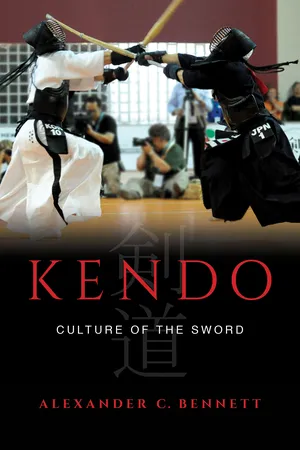
Kendo
Culture of the Sword
- Alexander C. Bennett(Author)
- 2015(Publication Date)
- University of California Press(Publisher)
The sword came to represent Japanese spiritual culture—an association that has survived to this day. c h a p t e r 3 The Fall and Rise of Samurai Culture kenjutsu’s nationalization Men of Satsuma, behold the blade that hangs on this warrior of the east; see for yourselves—is it dull or is it sharp? ya m a k awa h i rosh i, A izu wa r r ior , 1845–98 Th e Fa ll a n d R ise of Sa m u r a i Cu lt u r e • 87 During this period, kenjutsu transitioned from a form of culture largely associated with a particular social class to one that the entire nation could embody. In this way, kenjutsu as a legacy of traditional Samurai Culture was adopted in the process of inventing a new, nationalized cultural identity. According to Eric Hobsbawm, coeditor with T. O. Ranger of the 1983 book that brought the concept into prominence, “invented traditions” are “set[s] of practices, normally governed by overtly or tacitly accepted rules and of a ritual or symbolic nature, which seek to inculcate certain values and norms of behavior by repetition, which automatically implies continuity with the past.” 2 As Japan strived to modernize itself, certain elements of its traditional culture were shed for the sake of social and economic advancement. In 1873, the imperial government established a modern conscript army, and kenjutsu and the other martial arts gave way to modern methods of warfare. Nevertheless, centuries of sword worship could not be so easily done away with: the sword’s symbolic potency continued to make it irresistible. After a short lapse in popularity, swordsmanship was reinstated in society on an even greater scale than before, catalyzed by a number of fortuitous conjunctures, such as the advent of fencing shows ( gekiken-kōgyō ) and the introduction of kenjutsu into the police force and later the national edu-cation system. 3 The evolution of the culture of swordsmanship was facilitated by a paradigm shift as to who owned it. eBook - ePub
The Taming of the Samurai
Honorific Individualism and the Making of Modern Japan
- Eiko Ikegami(Author)
- 1997(Publication Date)
- Harvard University Press(Publisher)
In the meantime, some samurai, in particular those who lived in prosperity far from Kyoto, acquired a greater sense of confidence about their own military lifestyle. And their distinctive culture, based upon their identity as military specialists, sometimes made a good impression on the people in the capital city. Even though their manners were simple and unpolished, these samurai with their culture of honor appeared to be men of principle, at least compared with the crafty and underhanded courtier-politicians.An important asset of the Samurai Culture was a distinct military achievement-oriented attitude, brought into late ancient Japan through the samurai’s military professionalism. In contrast, the ancient Japanese state, centering around the emperor’s court, did not fully adopt a meritocratic system of recruiting elites, as had its Chinese model. Instead, the higher governmental positions continued to be occupied by men born into the limited bloodlines of the aristocracy. Conversely, though samurai houses were also largely considered hereditary, the very nature of military professionalism, which required constant demonstration and improvement of military efficacy, prevented the samurai from taking their inherited positions for granted.In general, Konjaku monogatari contains many descriptions of the lively atmosphere of the samurai’s yakata (residence house), implicitly contrasting it with the bland, passive existence of the aristocracy in Kyoto.52 The samurai are usually described as uncomplicated, energetic, straightforward men who would risk their lives in order to keep their good name as warriors. For example, as Konjaku monogatari recounts, a mighty samurai, Taira no Koremochi, usually called Yogo, when on the verge of defeat by an unexpected attack did not run for the hills as his retainers advised him to do. Yogo said to them, “It would be the shame (haji) of my descendants,” and sprang to his feet with determination. His unexpected courageous counterattack routed his enemies. Yogo thereafter increased his reputation and was renowned as the strongest samurai in the eastern region.53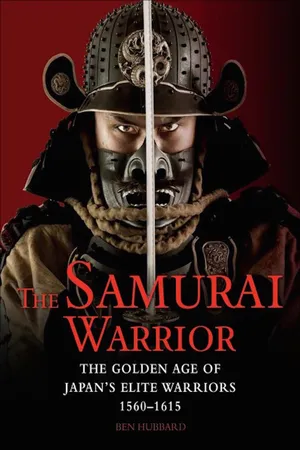 eBook - ePub
The Samurai Warrior
The Golden Age of Japan's Elite Warriors 1560–1615
- Ben Hubbard(Author)
- 0(Publication Date)
- Amber Books Ltd(Publisher)
In this way, the whole notion of bushidō, even among those legendary warriors who valiantly beheld its virtues, is riddled with contradictions. Simply, there were no guarantees that those cultivated samurai, well-versed in etiquette and tradition, would actually behave honourably. Honour was one of the key virtues of the bushidō code, but it often gave way to ambition and self-interest. The codes of bushidō were also sometimes inconsistent in their messages about honour. Those considered the best warriors, for example, were the ones who had put the conditions of warfare to their advantage. Samurai were encouraged to be opportunists in war – such as fighting with the sun at their back so it would blind their opponent – but they were also paradoxically expected to conduct a fair fight.Arquebuses were notoriously clumsy to fire and reload. Well-organized armies employed assistants to help with gunpowder and ammunition.Loyalty was another elusive ideal, although in theory it was the pre-eminent quality of the samurai, prized above all else. Any worthy warrior would follow his master into death or lay down his life for him. But loyalty to whom, or what, was another question. The Emperor was considered to be the most important man in Japan, until the provincial clans decided they did not want to serve him. He was then replaced with a Shōgun, or regent. But Shōguns, too, were capable of disloyalty. Samurai would follow their Shōgun or clan leader to the ends of the earth, but their fidelity was often rewarded with death or betrayal. Loyalty to one’s clan was thought an essential, but brothers would not hesitate to kill each other to better their position.Samurai warriors were expected to die an honourable death by the sword. Those defeated in battle could retain their honour by committing seppuku.The stories of the greatest samurai heroes are therefore parables of loyalty to one’s clan, one’s Emperor, one’s master and oneself, which don’t reflect the darker reality. It is the complex relationship with this topmost bushidō virtue that defined the legacies of these samurai, but their actions often confuse rather than clarify the ethos of bushidō.Takeda Shingen was among the last of the old guard of samurai gentlemen. He is seen here (top centre) in a war council with his generals.
- Karl F. Friday(Author)
- 2004(Publication Date)
- Routledge(Publisher)
A samurai's reputation, honor and pride were almost tangible entities that took precedence over all other obligations. As a thirteenth-century commentary enumerating the “seven virtues of a warrior” concludes, “To go forth to the field of battle and miss death by an inch; to leave behind one's name for myriad generations; all in all, this is the way.” Slights to reputation or honor were often catalysts to belligerence and bloodshed. Warriors might refuse orders from their superiors, risk the loss of valuable retainers, and even murder men to whom they owed their lives, all for the sake of their reputations. 4 Honor – or conversely, shame – could reach beyond the warrior himself, and even beyond his lifespan. Bushi could prosper through the inherited glory of their ancestors or suffer the stigma of their disgrace. Thus, even a warrior's life could be of less consequence to him than his name and image, and we find in accounts of battles numerous sketches of warriors choosing to sacrifice themselves in order to enhance their reputations or those of their families. 5 One must, however, be careful not to make anachronistic or ethnocentric assumptions about the nature of honor, or about the sort of battlefield conduct it might be expected to have engendered. For, while honor and shame were central to the self-perception of early bushi, honor turned on a warrior's military reputation, which turned first and foremost on his record of victories. Early medieval Japanese concepts of honor and of honorable conduct in battle were flexible enough to permit successful warriors to rationalize almost any sort behavior. Expediency, self-interest, and tactical, strategic or political advantage proved to be much more powerful determinants of early medieval Japanese military conventions than abstractions such as honor. 6 Stolid pragmatism and a detached, professional approach to their calling seem, in fact, to have been the dominant tenets of bushi personality eBook - PDF
A History of Japan
From Stone Age to Superpower
- K. Henshall(Author)
- 2012(Publication Date)
- Palgrave Macmillan(Publisher)
Descriptions of bushido ¯ from this period that are still popular today include Hagakure (In the Shadow of Leaves) of 1716 and Gorin no Sho (The Five Rings) of around 1643. However, one of the most interesting was written by Yamaga Soko ¯ (1622–85), who was himself a ro ¯nin. He had also been a teacher of one of the Forty-Seven Ro ¯nin. Yamaga was perhaps the first to see bushido ¯ as a comprehensive philos- ophy. 26 In his various writings he stressed aspects of it such as loyalty and self-discipline, as well as the importance of learning and cultivation of the arts and the rounded development of the whole man. Knowing one’s role in life, and knowing how to properly conduct relations with others, are particularly stressed. But he also struck a defensive note in his justification 62 A History of Japan of the samurai’s apparent lack of functional usefulness to the society of the day. Yamaga argued that the samurai’s freedom from occupation proper allowed him to concentrate on perfecting his moral virtue and thus to serve as a model for the rest of society, disciplining the imperfect if necessary: 27 The samurai dispenses with the business of the farmer, artisan, and merchant, and confines himself to practising this Way; should there be someone in the three classes of the common people who transgresses against these moral prin- ciples, the samurai summarily punishes him and thus upholds proper moral principles in the land. There is here a reference to morality, but it is a different morality from the western concept. It is still not a question of good and evil, but of doing the expected thing in the context of social relations and orderli- ness. Step out of line, and one is summarily punished. Yamaga’s account also has a heavy Confucian tone. Confucianists were very much concerned with knowing one’s place, honouring relation- ships, respecting order, and doing one’s duty. Because of these values, Confucianism was revived and promoted by the Tokugawa sho ¯ gunate. eBook - PDF
- Sabine Frühstück, Anne Walthall, Sabine Frühstück, Anne Walthall(Authors)
- 2011(Publication Date)
- University of California Press(Publisher)
He begins his argu-ment with the following: “Chivalry is a flower no less indigenous to the soil of Japan than its emblem, the cherry blossom; nor is it a dried-up specimen of an antique virtue preserved in the herbarium of our history. It is still a living object of power and beauty among us; and if it assumes no tangible shape or form, it not the less scents the moral atmosphere, and makes us aware that we are still under its spell.” 8 The Yamato spirit, he claims, is in its essence an “original, spontaneous outgrowth of our clime” Empowering the Would-be Warrior / 73 (1). Nitobe attributes the foundation and flourishing of the national soul to samurai ancestors. He writes, “What Japan was she owed to the samurai. They were not only the flower of the nation but its root as well. All the gracious gifts of Heaven flowed through them” (159 – 60). Having planted the seeds of Japan’s prosperity in bushid ö , Nitobe argues that these knightly values still thrive, housed in the bodies of mod-ern Japanese citizens. Once a doctrine of the elite samurai class, bushid ö spirit now manifests itself corporeally in all Japanese citizens. Through the fuzzy logic of biological inheritance, the ethos of the samurai is “passed down” in the bodies of all citizens irrespective of their previous status affiliations or the temporal break with the past. Outwardly the power-ful samurai code is invisible, but it remains, nonetheless, “a law written on the fleshly tablets of the heart” (5). “Scratch a Japanese of the most advanced ideas,” Nitobe writes, “and he will show a samurai” (189). In a trickle-down system, bushid ö acts “as leaven among the masses, furnish-ing a moral standard for the whole people” (163). Thus, the ancestors are passed on through Japanese bodies, regardless of status, class, or gender, and the legacy of their spirit resides in living flesh. Bushid ö , however, does more than simply uplift the common people and unify the country.
Index pages curate the most relevant extracts from our library of academic textbooks. They’ve been created using an in-house natural language model (NLM), each adding context and meaning to key research topics.

