History

Kamakura Shogunate
The Kamakura Shogunate was a feudal military government established in Japan in 1185 by Minamoto no Yoritomo. It marked the beginning of the shogunate system, with the shogun holding real power while the emperor's role became largely ceremonial. The Kamakura period was characterized by a decentralized feudal system and the emergence of samurai as a dominant social class.
Written by Perlego with AI-assistance
Related key terms
1 of 5
10 Key excerpts on "Kamakura Shogunate"
 eBook - PDF
- (Author)
- 2019(Publication Date)
- Columbia University Press(Publisher)
III The Age of the Military Houses BY H. PAUL VARLEY 6 2 Η. PAUL VARLEY The Kamakura Shogunate The year 1185 marks the transition from ancient to medieval Japan. The medieval epoch (until 1568) was distinguished by such fundamental developments as: the dispersal of political power to regions outside the Kyoto area, especially to the eastern provinces; the spread of culture and learning to the provinces, which came to participate in the creation of new modes of artistic and intellectual expression strongly influenced by the growing warrior ethos of so-ciety; the founding of simpler and more universally appealing sects of Buddhism; the decline and disappearance of the estate system of landholding, paralleled by formation of the fief and more direct rela-tions between warrior proprietors and peasant producers; and the evolution of a largely self-governing peasant village, which provided the foundation for extraordinarily stable rural conditions by the Tokugawa period (1600-1867). Minamoto Yoritomo called his· new government in Kamakura the bakufu, a term usually rendered in English as shogunate. The found-ing of this military government, while epoch-making, had much about it that was fully within the scope of traditional political prac-tice. Like leaders of prominent families in the past, Yoritomo sought to justify his assumption of power as a delegation from the throne, ultimately (in 1192) securing for himself the title of seii taishögun (usually abbreviated, for convenience, to shogun). This title had first been held by the great Tamuramaro in the late eighth and early ninth centuries. In imitation of the house governments of the Fujiwara and other court families, Yoritomo adopted typically family-type offices for his shogunate: an Administrative Board ( Mandokoro ), a Board of Re-tainers (Samuraidokoro) , and a Board of Inquiry (Monchüjo).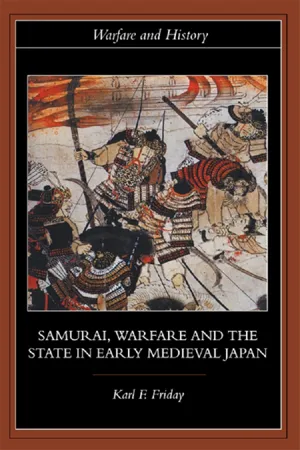
- Karl F. Friday(Author)
- 2004(Publication Date)
- Routledge(Publisher)
As it happened, the powers-that-were in the court were just as unhappy with Yoritomo's enemies – the Taira, and Minamoto Yoshinaka – as they were with him. In contrast to the circumstances prevailing during previous warrior uprisings, the events of the 1180s left the court with no more palatable choice available to send as champion against Yoritomo, making rapprochement with him the least of several evils.The resulting Kamakura Shogunate was in effect a government within a government, at once a part of and distinct from the imperial court in Kyoto. Dominated after Yoritomo's death by the Hōjō family, who established a permanent regency over a succession of figurehead shoguns, the regime exercised broad administrative powers over the eastern provinces, and held special authority over the warriors, scattered nationwide, whom it recognized as its formal vassals (gokenin ). After the Jōkyū War of 1221, an ill-fated attempt by a retired emperor, Go-Toba, to eliminate the shogunate, the balance of real power shifted steadily toward Kamakura and away from Kyoto. By the end of that century, the shogunate had assumed control of most of the state's judicial, military and foreign affairs.In the meantime, gokenin across the country discovered that they could manipulate the insulation from direct court supervision Kamakura offered them in order to lay ever stronger and more personal claims to lands – and the people on them – which they ostensibly administered on behalf of the powers-that-were in the capital. Through a ratcheting process of gradual advance by fait accompli , a new warrior-dominated system of authority absorbed the older, courtier-dominated one, and real power over the countryside spun off steadily from the center to the hands of local figures.24By the second quarter of the fourteenth century, this evolution had progressed to the point where the most successful of the shogunate's provincial vassals had begun to question the value of continued submission to Kamakura at all. The regime fell in 1333, as the result of events spawned by an imperial succession dispute. eBook - ePub
China's Economic Rise
Lessons from Japan’s Political Economy
- Sangaralingam Ramesh(Author)
- 2020(Publication Date)
- Palgrave Macmillan(Publisher)
made use of the Heian Period dual system of governance, by side lining the aristocracy and the Emperor to religious duties in Kyoto while running the country from his powerbase in Kamakura as Shogun. This title, Yoritomo, was bestowed by the imperial court in 1192 AD recognising his authority as head of the Bakufu or military government of Japan. However, while the Bakufu nominally had more power than the imperial court, both systems of power charted their own course until there was a conflict between the two in 1221 AD when the Bakufu finally won its ascendancy over the Emperor and the imperial court.The aftermath of the Gempei War of 1180 AD to 1185 AD left several problems for the founding father, Minamoto Yoritomo , of the Kamakura Bakufu to solve.14 The first problem was to bring peace and stability to the country. The second problem was to strike a balance between the needs of the aristocracy in the imperial capital of Kyoto and the needs of the rising class of warriors in Japan ’s provinces.15 The third problem was how to enrich but control the warriors who had helped to facilitate the victory for Yoritomo while achieving a balance with the aristocracy and the imperial court in Kyoto. To achieve a solution to these problems at the same time, Yoritomo devised two key innovative solutions.16 Firstly, the administrative structure of the country was split in such a way that the imperial court in Kyoto and the Bakufu would have responsibility for managing different areas of interest to the Japanese economy . In this case, the Bakufu would be responsible for its own citizens, whereas the imperial court in Kyoto would be responsible for matters associated with land rights.17 Furthermore, Bakufu warrior or officer types were either the Shugo or the Jito . The main business of the Bakufu was to resolve legal disputes which revolved around the Jito.18 In order to achieve a resolution of legal disputes, the Bakufu developed a robust legal system which was to become the second key innovation of the Kamakura period.19 Legal problems arose with the Jito because while they were administrators for the Bakufu and enjoyed certain privileges income , a home and authority, they were immune from the disciplinary authority of those who administered the land, the Shoen .20 However, the Bakufu would have encouraged lawlessness in the country from its own officials and warriors had it not accepted and adjudicated legal complaints brought against them by offended parties.21 Therefore, the application of the principle of impartiality and the utilisation of a robust judicial system represented the cornerstone of governance for the Kamakura Bakufu.22 However, the state of this governance was impacted in 1221 AD with the Jokyu War . This was especially in the context of the dual administrative structure of Kyoto and the Bakufu as well as the judiciary system.23 Moreover, the Jokyu War also resulted in the unequal distribution of warriors between the west and the east of Japan, and the landowning elite gaining an upper hand over the aristocracy and the imperial court in Kyoto.24 The death of Minamoto Yoritomo led to a decline in the fortunes of the Minamoto clan.25 The third Minamoto Shogun was assassinated and replaced as Regent by a member of the Hojo clan.26 The latter realised that the title of Shogun ‘belonged’ to the Minamoto clan and did not use it but in its place used the title of Regent. In this case, the Shogun was now in between the imperial court and the Regent from the Hojo clan and as a result was a puppet to the Hojo clan who maintained their grip on the Regency until the end of the Kamakura period in 1333 AD.27 The military government of Japan was then under the direct control of the Hojo Regency from 1203 AD to 1333 AD, the period encompassing the years 1274 AD and 1281 AD in which the Mongols of the Yuan dynasty of China tried to invade and conquer Japan.28
- Simon Kaner, Brian Ayers, Richard Pearson, Oscar Wrenn, Simon Kaner, Brian Ayers, Richard Pearson, Oscar Wrenn(Authors)
- 2020(Publication Date)
- Archaeopress Archaeology(Publisher)
Summary In addition to their commercial importance, a significant aspect of medieval towns and cities is their political and administrative role. This paper by Oka Yōichirō treats the early medieval eastern political centre of eastern Japan, Kamakura, in the most significant period of its history, from 1180 to 1225. It deals with some of the structural and architectural changes which occurred as it came to rival the power of Kyōto, the ancient capital from the 8th century. Oka compares texts from the Azuma Kagami , the diary chronicle of the shogunate, the feudal military government, which was located in Kamakura, written after 1266, with the archaeological record. Kamakura was a centre of some importance before the 12th century. In 1073 the clan shrine of the Minamoto clan, the Tsurugaoka Hachimangū, was founded. In the 1170s Minamoto Yoritomo, descendant of the Minamoto clan, exiled from Kyōto, married into the powerful local Hōjō family, regents for the shoguns, who were often replaced and sometimes were very young. Yoritomo arrived in Kamakura in 1180 and set about to establish a regional civil government from heterogeneous groups of local powers as a kind of independent kingdom in the east, known in Japan as Tōgoku (Shinoda 1960:62-63, Mass 1982:125). Gradually Kamakura changed from the centre of a local polity to an integral part of the Japanese polity centred in Kyōto. By 1185, the shogunate was in a transitional form, neither purely feudal nor yet a national institution (Shinoda 1960:137, Hurst 1982:5). Three regents ( shikken ) ruled on behalf of the shogun, from 1199 to 1242. Hōjō Tokimasa became the regent for Yoritomo’s young heir in 1199. The second regent was Hōjō Yoshitoki (r. 1205 to 1224), He was followed by Hōjō Yasutoki who ruled from 1224 to 1242. By the time of the third regent, a kind of consultative board of councilors ( hyōjōshū ) was part of the Kamakura administration (Goble 1982: 168). eBook - PDF
- Marius B. Jansen, Marius B. Jansen(Authors)
- 2009(Publication Date)
- Belknap Press(Publisher)
Japan entered a period of warrior rule from which it did not emerge until the fall of the Tokugawa in 1868. That period was nevertheless one of constant development and change. The first line of Minamoto shoguns—from whom the Tokugawa were to claim descent, albeit on dubious grounds—established a line of military au-thority that supplemented, and in time overshadowed, that of the imperial court. It forced from the court permission to appoint stewards to private es-tates throughout the land, and constables or military governors in the prov-inces to serve as officials of the new system of justice that was established. Although the Minamoto line itself soon ended, a line of regents, hereditary in the Ho ¯jo ¯ family, carried on its functions. At the imperial capital the wishes of emperors, who frequently abdicated to exercise greater influence from mo-nastic establishments, counted for much less. An attempt by a retired emperor to challenge Kamakura dominance was quickly snuffed out and led to more forceful measures by the Kamakura leaders. Shadow shoguns dealt with shadow emperors, and Kamakura institutions remained an overlay on those of the court. Gradually provincial and local interests came to count for more. The tenuous balance was brought to an end by the great invasions launched by the Mongol overlords of China in 1274 and 1281. Japan emerged from this crisis with its sovereignty intact, but its leaders had conquered no new lands with which they could reward their men. By 1333 a discontented emperor was 4 The Making of Modern Japan able to rally enough discontented warriors to bring the Kamakura Shogunate to its final crisis. The second shogunal line, that of the Ashikaga, chose to establish its head-quarters in the imperial capital of Kyoto. eBook - PDF
Japan
History and Culture from Classical to Cool
- Nancy K. Stalker(Author)
- 2018(Publication Date)
- University of California Press(Publisher)
79 The late twelfth to the late sixteenth century is considered Japan’s medieval age. Over these centuries the warrior class accumulated power and wealth and was able to gain a large degree of independence from the court. The transfer of power from the court to the warrior elites began in the late twelfth century with the establishment of the first warrior government, the bakufu (tent government) or shogunate, established by Minamoto no Yoritomo ( 1147–99 ) in the eastern city of Kamakura in 1185 . Yoritomo earned the warrior class the ability, granted by the court, to tax all public and private estates in return for keeping law and order. By receiving the title of Shogun from the emperor, he was designated the military protector of court privileges. Nevertheless, the warrior class began to siphon off the wealth and privileges of both the court and the Buddhist monasteries. The Mongol invasions of the thirteenth century, however, impoverished the Kamakura regime and disrupted its authority, leading eventually to the establishment of the Ashikaga shogunate, also known as the Muromachi bakufu, in Heian-kyo – (hereafter referred to as Kyoto, its current name) during the fourteenth and fifteenth centuries. The idea of vassalage emerged under these warrior governments. Bushi , or samurai, a term derived from the verb meaning “to serve,” were warriors who fought in return for mate-rial reward and personal advancement—in essence, mercenaries. The Minamoto extended their powers by offering military families lucrative posts or control over land. Vassals did not follow their leaders out of an abstract sense of loyalty or honor, but for concrete benefits. As the warrior elite ascended within the social and political order, they sought to develop religious and cultural capital in keeping with their status as rulers. They became patrons of Zen Buddhism, which in turn influenced the aesthetics of different art forms that emerged during the medieval era. eBook - PDF
- Conrad Schirokauer, David Lurie, Suzanne Gay, , Conrad Schirokauer, David Lurie, Suzanne Gay(Authors)
- 2012(Publication Date)
- Cengage Learning EMEA(Publisher)
Cengage Learning reserves the right to remove additional content at any time if subsequent rights restrictions require it. 92 Part Two ■ Aristocrats, Monks, and Samurai W ITH THE Kamakura Shogunate’s demise, Japan entered the second half of the medieval period, a time of cultural and economic growth amid po-litical turbulence. After an interval of warfare, the political ascendancy of warriors, so long in the making, was realized with the founding of a new shogunate in Kyoto. The name of the period, Muromachi, is derived from the area of Kyoto where the new bakufu was located. The period’s cultural efflorescence, however, owed much to aristocrats and commoners as well. During these centuries, many elements basic to Japanese culture were perfected, including tea, ink painting, flower arrangement, linked verse, and Noh theater. Economically, an agricultural boom encouraged population increase and commerce. Also notable in this era were organized movements of commoners, rural and urban, for political and reli-gious goals. Women’s status declined, especially in property ownership and in-heritance. Although the Muromachi shogunate ceased to have governing power after 1568, its position as a national authority, never fully realized, had come to an end much earlier, in 1467, with the O ¯ nin War. For many decades thereafter, political fragmentation pervaded Japan. The Kenmu Restoration (1333–1336) Between the Kamakura and Ashikaga shogunates, there was a brief interlude of political experimentation. The Kenmu Restoration of Emperor Go-Daigo (1288–1339) was an attempt to reassert the prerogatives of the throne similar to the earlier efforts of Emperor Go-Toba in 1221. Because it confronted a much-weakened shogunate, this restoration had initial success. Even after Kyoto was lost, there was sufficient momentum to sustain a government in exile, which for more than half a century provided a potential rallying point for Ashikaga opponents. eBook - PDF
- Yoshio Sugimoto(Author)
- 2020(Publication Date)
- Cambridge University Press(Publisher)
The core of the bilateral connection lay in the exchange between the samurai’s remunerative indebtedness and provi- sion of military services to the shogunate. Meanwhile, the economic foundation of the Kamakura Shogunate covered mainly the sh¯ oen estates in the Kant ¯ o region and did not deviate significantly from the system of the Heian period. Yet, this was the first time that the political center emerged and solidified in eastern Japan, distant from Kinai. As a sea-girt nation, Japan was subject to foreign naval attacks. The Mongolian Empire tried to invade Japan twice in the latter half of the thirteenth century, crossing the Sea of Japan with naval forces from Korea and China. Though the shogunate weathered the attempted assaults, serious financial difficulties ensued. The samurai class was impoverished as a result, and some of them took the opportunity to form new regionally based groups to compete with the central power. Their moves led to an eventual instability involving power struggles between a variety of old and new forces, resulting in the downfall of the Kamakura Shogunate in 1333. VI DISINTEGRATION: THE WARRING STATES PERIOD 1 The ascendancy of daimy ¯ o Out of these conflicts, warlord Ashikaga Takauji achieved a final victory and established the Muromachi Shogunate in Kyoto in 1338, shifting the power center once again. Soon thereafter, however, the imperial house was split into the Southern Court and the Northern Court, though they were reunited half a century later. The Muromachi period was plagued by a number of civil wars and rebellions over the subsequent two centuries, including lengthy years of hostilities among warlords from the mid-fifteenth to the mid-sixteenth century, an era referred to as the Warring States period. At this point the pendulum swung towards disinte- gration and decentralization. eBook - PDF
Japan to 1600
A Social and Economic History
- William Wayne Farris(Author)
- 2009(Publication Date)
- University of Hawaii Press(Publisher)
The Revival of Growth, 1280–1450 Reshaping the Polity under Warrior Hegemony The Collapse of the Kamakura Dyarchy The policies designed by Kamakura to thwart the Mongols had the paradox-ical effect of strengthening the bakufu vis à vis Kyoto while placing new strains on Kamakura’s finances and manpower. On the one hand, Kamakura demanded and received rights to collect dues and raise troops in western Japan, extending its reach and denying courtiers and religious complexes much-needed tribute items and labor dues. On the other hand, increased resources were necessary to pay for expanded responsibilities, as the fear of a Mongol invasion continued un-abated until the early fourteenth century. The added financial burden incurred preparing for another attack weakened the shogunate, as did its inability to re-ward warriors adequately for slaughtering some of the invaders during mop-up operations. Many long-time Kamakura supporters became more willing to sever their bonds with the shogunate, now over a century old, and try something new. In addition, beginning in 1285 the bakufu was rocked by internal dissension caused by growing H j autocracy. Loyal subordinates were assassinated and the H j appointed outsiders to run the bakufu and act as provincial officials. They also enacted a series of laws appearing to aid impoverished warriors but in effect giving their family more power over military courts, vassal property, and loans taken out by samurai. 1 In many provinces, the H j took for themselves positions once held by other warriors. The problems of long-time Kamakura vassals were particularly vexing. Many had become indebted to usurers and merchants, as they struggled to adapt to the increasingly monetized economy. Until 1300, most families still practiced partible inheritance, and, as a result of improved rates of survival, members of each gen-eration received smaller and smaller pieces of property. eBook - PDF
- Suzanne Gay(Author)
- 2001(Publication Date)
- University of Hawaii Press(Publisher)
Their application of existing warrior legal conventions to a broader social spectrum was also a significant factor in their ability to administer the city. 19 Eventually the Muromachi shogunate came to adjudicate disputes not involving warriors: two aristocrats, for example, or an aristocrat and a temple might turn to the shogunate as the only entity whose authority carried enough weight to decide a dispute. 20 By the early fifteenth century the shogunate, like the imperial court in earlier times, was recognized as the city’s administrator. the setting 20 Thus the Ashikaga, founders of the Muromachi shogunate, fulfilled well their warrior mandate as defenders of the state, within the kenmon order. By the late fourteenth century the imperial court had lost most of its administrative authority over commerce, and over the city as a whole, to the Muromachi Bakufu. 21 The shogunate adopted a stance toward the court and aristocracy that was more protective than confrontational, if sometimes deliberately negligent. One of its earliest actions was to order that their Kyoto lands, which aristocrats had abandoned or been driven from in the fighting of the 1330s between the northern and southern court factions, be returned to them. 22 Offices of the ancient civil government continued to exist and to be filled, but increasingly as no more than hered-itary sinecures providing income on a private basis. This is not to say that the court and aristocracy were powerless: as one segment of the ruling class, their continuing prominence was based both on their expertise in cultural matters and on their real, though declining, ability to command economic resources—namely, landed and commercial sources of income. But in Kyoto the court’s administrative authority was limited largely to official appointments and ceremonials. The late medieval fate of the imperial accession ceremony, the daij ō e , provides an important example of how the shogunate dominated the im-perial court.
Index pages curate the most relevant extracts from our library of academic textbooks. They’ve been created using an in-house natural language model (NLM), each adding context and meaning to key research topics.

