History

Remilitarisation of the Rhineland
The remilitarization of the Rhineland refers to the 1936 decision by Nazi Germany to send military forces into the demilitarized zone along the Rhine River, in violation of the Treaty of Versailles and the Locarno Treaties. This move was a significant breach of international agreements and marked a key step in Adolf Hitler's expansionist ambitions, leading to increased tensions in Europe.
Written by Perlego with AI-assistance
Related key terms
1 of 5
5 Key excerpts on "Remilitarisation of the Rhineland"
 eBook - PDF
Anglo-French Relations Before the Second World War
Appeasement and Crisis
- R. Davis(Author)
- 2001(Publication Date)
- Palgrave Macmillan(Publisher)
The record instead shows a man far from sure of himself and only too eager to allow his interlocutors to settle the issue for him. In putting the question before the British no one in Paris can have been under the least illusion that a request for support for a military move into the Rhineland would not be met. Nevertheless, well before 7 March Paris was already looking to use any remilitarization of the Rhine- land as a means to win a greater commitment from London to the defence of France. The Ministry of War argued that remilitarization would free Britain's hands from the `awkward impartiality' imposed by Locarno and would allow her, `without hindrance', to sign a treaty of mutual assistance with France backed up by a military agreement. In this way the loss of the `no-man's-land' along the Rhine would be compensated by the formation of a solid Anglo-Belgian-French bloc. They were not, however, altogether blind to the difficulties of achieving this. They would, it was argued, have to `strike while the iron was hot', 4 otherwise, with the passing of the initial crisis, the British would be tempted to accept a new Locarno which would maintain the disadvan- tages of the old Locarno without the advantages of the Rhineland clauses. The important word in all this was compensation, for it was this, and not the desire for an impossible promise of British support against any encroachment by Germany into the demilitarized zone, that was behind the French requests to London. At the same time as Laval and Flandin were seeking a clarification of the British position, the British Government was itself putting much the 152 Anglo-French Relations same questions to Paris. Neither the French Chiefs of Staff, the Quai d'Orsay nor the Cabinet showed any inclination to provide an answer. The Government in London was equally reluctant to give an unequi- vocal statement of their intentions. eBook - PDF
The Challenge of Grand Strategy
The Great Powers and the Broken Balance between the World Wars
- Jeffrey W. Taliaferro, Norrin M. Ripsman, Steven E. Lobell(Authors)
- 2012(Publication Date)
- Cambridge University Press(Publisher)
If Rhineland demilitarization was bound to provoke 55 Statement by Sir Austen Chamberlain to the Imperial Conference, October 30, 1926, F.O. 371, 4 (emphasis added). See also Foreign Office Memorandum, “The Foreign Policy of His Majesty’s Government,” April 15, 1926, F.O. 371/11848, 3–4. 56 D’Abernon, Diary of an Ambassador, August 11, 1925, 186 (emphasis added). 57 Minutes of the 195th Meeting of the Committee of Imperial Defence, 114. 58 In a Reichstag speech in May 1935, Hitler put other European states on notice that Germany’s treaty compliance, which was “an unheard-of hardness for a sovereign State,” depended on other parties remaining faithful to the pact. Here, Hitler is setting the stage for a challenge to the Locarno order, which he eventually argued was justified by what he called the illegal Franco-Soviet defensive relationship that emerged in 1935. Hitler speech to the Reichstag, May 21, 1935, in Berber, Locarno, 152. 86 Scott A. Silverstone a German reaction and actually make armed conflict more likely, the British impulse was to negotiate it away in exchange for other constraints on German power. While jarring and illegal, the actual magnitude and character of the German move in the Rhineland in no way posed an immediate threat to either Belgium or France, so it was judged by British leaders not to be a violation of Locarno so flagrant that it was an act of aggression. Therefore, an immediate allied military reaction to drive German forces back across the Rhine River was neither justified by the treaty nor strategically necessary. And most important, the British gov- ernment firmly restated its 1925 treaty pledge to defend Belgium and France should Germany actually attack their territory. Contrary to what the conventional wisdom holds, Britain did not fail to uphold its treaty obligations or fail to fulfill its long-standing strategic intent on Rhineland demilitarization. eBook - PDF
- Bradley Naranch, Geoff Eley, Bradley Naranch, Geoff Eley(Authors)
- 2015(Publication Date)
- Duke University Press Books(Publisher)
FIFTEEN The Rhineland Controversy and Weimar Postcolonialism Brett M. Van Hoesen In 1919, as a result of defeat in World War I and ratification of the Treaty of Versailles, Germany relinquished military control over the Rhineland terri-tory. 1 In accordance with the treaty’s provisions, Germany’s western territory was significantly reduced: Alsace and Lorraine were returned to France, small northern territories were ceded to Belgium, and the Saar Basin was put under international control, its future national affiliation to be determined by pleb-iscite. The remainder of the Rhineland was to remain under Allied control for fifteen years. Although sections of this considerable region spanning the length of the Rhine had long been under dispute between France and Prussia/ Germany, by the start of the 1920s this territory had become a border of great domestic concern and then international scandal authored and perpetuated by the politics of race. 2 In 1920, at the behest of Georges Clemenceau, the French occupational presence along the Rhine was augmented by the addi-tion of colonial troops. This decision, which prompted immediate protests in Germany, inextricably linked the territory with the propagandistic catchphrase “ die schwarze Schmach ” (the black disgrace). Germans retaliated by launching an equally racist propaganda campaign—singling out troops from North Af-rica, particularly soldiers from Senegal, as violent rapists and sources of moral corruption. While criminal acts did occur on the part of French forces, there were numerous exaggerations and attempts to spur international attention on behalf of German national and local governments as well as a host of private interest groups. The Rhineland controversy has long served as a ripe arena for examining eBook - PDF
World War II
A New History
- Evan Mawdsley(Author)
- 2020(Publication Date)
- Cambridge University Press(Publisher)
Further steps were taken from the moment the NSDAP came to power, in 1933. But it was open German rearmament in early 1935 that began the period of ‘active revision’ in Europe. The immediate response was the Franco-Soviet Treaty of Mutual Assistance, a five- year pact under which France and Russia promised to aid each other in the event of unprovoked aggression by another state. Hitler in turn used the ratification of this treaty by the French Chamber of Deputies in February 1936 to justify sending elements of his army into the Rhineland, the region of western Germany (either side of the Rhine) which had been demilitarised under Versailles. The Rhineland was strategically crucial. Unless German troops garrisoned the Rhineland, Germany, and especially the vital Ruhr indus- trial region, was defenceless against attack. The Reich now devoted considerable resources to laying out a stout defensive zone here, known as the Westwall or ‘Siegfried Line’. In 1944–5, Hitler would deploy the last scraps of his forces for a defence of the Westwall and the Rhineland, this time against American armies. Meanwhile, looking at the situation from the perspective of Germany’s 1936 opponents, military forces based on territory west of the Rhine posed a direct threat to the Netherlands, Belgium, and northern France (as they had in 1914 and would again in May 1940 and December 1944). The Rhineland crisis is sometimes portrayed as the great missed opportunity to stop what Winston Churchill later called the ‘unnecessary war’. Germany was indeed militarily weaker in 1936 than it would be in future. But a number of factors worked against a vigorous response by the states that feared Germany. The NSDAP had been in power for three years, and the new Wehrmacht was already strong enough to make outside military intervention much more of a challenge. Only the French Army could take direct action, and the London government refused to support Paris.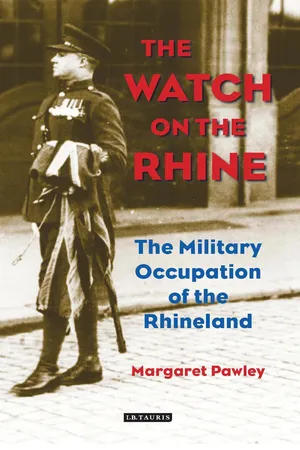 eBook - PDF
The Watch on the Rhine
The Military Occupation of the Rhineland
- Margaret Pawley(Author)
- 2007(Publication Date)
- I.B. Tauris(Publisher)
SEPARATISM IN THE RHINELAND (1918–24) 57 conference and occupying powers; to the German president, Frederich Ebert, and to the prime minister, Philipp Scheidermann. The designs of the Rhenish Republic were stated as: To make the Rhenish people benefit by the uni-versally recognized privilege of transacting their own business. To save from ruin and Bolshevism the healthy portion of the German people and to give the other portion an example of their loyalty and desire for peace To secure future peace by fighting the influence of the Prussian spirit in Germany. Dorten and a handful of followers entered the govern-ment building in Wiesbaden on 1 June 1919 (assisted by Colonel Pinot, French liaison officer there). He announced himself as president of a new buffer state; posters appeared all over the town. A general strike was declared and for five days disorder reigned until the putsch was allowed to peter out. German police tried to arrest Dr Dorten, protected as he was by French troops. Later, Clemenceau recalled General Mangin and General Gérard to Paris. Their armies, the 10th at Mainz and the 8th at Landau, merged into the French Army of the Rhine under General Degoutte on 21 October 1919. Harry E. Nadler 10 points out that the greatest failure of the French military and occupation authorities was their refusal to believe their own intelligence on the nature of the Rhenish movement and that it was not pro-French, but THE WATCH ON THE RHINE 58 anti-Bavarian and anti-Prussian. This failure of intelligence was, as suggested earlier, shared by the British in relation to the development of the Nazi movement. Among British high commission papers are undated ‘Notes on the present situation as regards the movement towards a Rhineland Republic in the Occupied Zone’. They can be abridged as follows: Since the proclamation at Wiesbaden on l June of a 7. General Degoutte, commander of the French army occupying the Rhineland.
Index pages curate the most relevant extracts from our library of academic textbooks. They’ve been created using an in-house natural language model (NLM), each adding context and meaning to key research topics.

