History

Rosenbergs
The Rosenbergs were a married couple, Julius and Ethel Rosenberg, who were convicted and executed in 1953 for passing atomic secrets to the Soviet Union during the Cold War. Their case became a symbol of the anti-communist hysteria and fear of espionage in the United States during that time. The Rosenbergs' trial and execution sparked widespread controversy and debate about the extent of their guilt and the fairness of their trial.
Written by Perlego with AI-assistance
Related key terms
1 of 5
10 Key excerpts on "Rosenbergs"
 eBook - PDF
No Respect
Intellectuals and Popular Culture
- Andrew Ross(Author)
- 2016(Publication Date)
- Routledge(Publisher)
As most people know, the Rosenbergs were tried and convicted on charges of espionage in 1951, and then executed in 1953 after numerous appeals to the judi- ciary and a worldwide campaign for clemency that had failed to budge the presidential resolve of, first, Truman, and then Eisenhower. In his sentencing speech, Judge Irving Kaufman opined that the Rosenbergs had "altered the course of history to the disadvantage of our country." Invoking the spirit of Cold War antagonism—"this country is engaged in a life and death struggle with a completely different system"—he concluded that the Rosenbergs' alleged crime of atom espionage was Reading the Rosenberg Letters 17 "worse then murder." In fact, he held them directly responsible for "the Communist aggression in Korea with the resultant casualties exceeding 50,000 and who knows but what that millions more innocent people may pay the price of [their] treason," a conclusion with which Eisenhower was soon to concur when he refused to grant clemency on the grounds that the Rosenbergs "may have condemned to death tens of millions of innocent people all over the world." Most commentators have agreed that neither the megadeath scale of these accusations nor the severity of a death sentence (for espionage) seem to fit well with the flimsy allegations produced at the trial of U.S. vs. Rosenbergs and Sobell. To this day, no hard evidence of the Rosenbergs' guilt has ever been produced, in spite of the long and exhaustive FBI investigation of an alleged espionage ring for which Julius Rosenberg was the alleged master spy. The release of thousands of FBI files on the case under the Freedom of Information Act (1974) helped to reaffirm what had long been an article of faith for the American left—that the Rosenberg trial was a rather awkward frame-up, staged by J. Edgar Hoover and President Truman because such a trial was needed to "ex- plain" the Soviet possession of an atomic bomb. eBook - ePub
Imagining Russia
Making Feminist Sense of American Nationalism in U.S.–Russian Relations
- Kimberly A. Williams(Author)
- 2012(Publication Date)
- SUNY Press(Publisher)
As a result of this conflation, anyone who strayed from the conservative Christian agenda—including liberals, radicals, Jews, immigrants, leftist artists and intellectuals, and labor, civil, and women's rights activists and organizations—became suspect and were effectively rendered “communist” in U.S. popular and political culture. This led not only to ruined careers and public ostracism, but also to the eventual implosion of the political left as a result of internal disagreements and self-imposed censorship. But regardless of the truth of their guilt or innocence, the Rosenbergs were swept up in the summer of 1950 into a discursive maelstrom in which every identity by which they could possibly have defined themselves was in direct opposition to the accepted norm of that historical moment. Both Ethel and Julius were active members of the Communist Party in the era of McCarthy, HUAC, and the Korean War, and the war framed their arrest, trial, and execution. 26 They made their lives and raised their children in Manhattan's Lower East Side, a well-known center of Jewish life and culture in the United States. They were working class during the arguably rhetorical ascendance of middle-class prosperity. They were the Jewish children of Russian immigrants living in a country with an overwhelmingly white, Christian body politic at a time of increased paranoia concerning the domestic “infiltration” of foreigners and the concomitant conflation of Jews with communist ideology. 27 The predominant national/ist narrative of post-war America required significant adjustment to accommodate the anathema that the Rosenbergs represented eBook - PDF
McCarthyism and the Red Scare
A Reference Guide
- William T. Walker(Author)
- 2011(Publication Date)
- ABC-CLIO(Publisher)
For additional information see Edward R. Murrow and the Birth of Broad- cast Journalism by Bob Edwards (New York: Wiley, 2004) and Edward R. Murrow: An American Original by Joseph Persico (New York: Da Capo Press, 1997). Rosenberg, Julius (1918–1953) and Ethel Rosenberg (1915–1953), Julius and Ethel Rosenberg were arrested, tried, convicted, and executed for conspiring to commit espionage when they reportedly relayed infor- mation on the atomic bomb to the Soviet Union. The Rosenberg case constituted one of the defining moments of the first decade of the Cold War and polarized American society during the McCarthy era. Access to Soviet archives and sources has supported the guilty verdict against Julius Rosenberg, but some still doubt the level of guilt that should be assigned to Ethel Rosenberg. Julius Rosenberg was born in New York on May 12, 1918, and was educated in New York public schools. By the mid-1930s, he was active in the Young Communist League; in 1936, he met Ethel Greenglass at a League meeting. Ethel Greenglass was born on September 28, 1915, and wanted to pursue a theatrical career; her hope was never realized and, in the depressed economy of the 1930s, she worked as an administrative assistant. In 1939, Julius Rosenberg graduated from the City College of New York and married Ethel Greenglass. During the next year, he entered the U.S. Army Signal Corps and worked on the development of radar. Julius Rosenberg began his activities as a Soviet spy in 1942 and began to transfer secret technical information to the Soviet Union; he also assisted in recruiting others, including William Perl and Morton Sobell, to work Biographies 123 for the Soviets. Rosenberg’s brother-in-law, David Greenglass, worked as a machinist in Los Alamos, New Mexico, on the Manhattan Project in the development of the atomic bomb. eBook - PDF
- Robert A. Ferguson(Author)
- 2008(Publication Date)
- University of Chicago Press(Publisher)
more than “one of those who have offended against the laws of our land”; he had joined a growing legion “who have dedicated themselves to the destruction of our country,” and that difference made mere offense heinous. 43 Crucial in executing the Rosenbergs, the added insinuation of a rise in domestic Communism was also patently false. Historians and government experts have shown that “by the close of the 1940 ’s Communism was a defeated ideology in the United States” and that “by 1950 or thereabouts the Communist Party was essentially neutralized.” 44 A clever narrator in the spotlight of a high-profile trial can turn false-hood into acceptable, even popular judgment without the recipients quite realizing the steps taken. An audience filling in narrative gaps brings its own faculties into play and is held in place by its own enjoyment of belonging to the larger narrative. Conjecture about the real meaning Killing the Rosenbergs 249 1 2 3 4 5 6 7 8 9 10 11 12 13 14 15 16 17 18 19 20 21 22 23 24 25 26 27 28 29 30 31 32 33 34 35 36 37 38 [249], (17) Lines: 142 to 1 ——— 0.0pt PgVa ——— Normal Page PgEnds: T E X [249], (17) of what has been said gives interactive dynamism to a story in much the same way that speculation during a murder mystery is the reader’s real interest. The logic imposed by the narrator becomes the recipient’s story through anticipation of its progression before fulfillment. 45 In the Rosenberg case, the interactive appeal in condemnation depended on pa-triotic reflexes in American thought, and the crowning touch, the final gap filled, would come in Irving Saypol’s decision to rename the defen-dant’s crime in a way that would insure their deaths. The Rosenbergs were convicted of conspiracy to commit espionage, but they were vilified in court and in the press as traitors. The prosecu-tion referred to the Rosenbergs as spies, as it had to, but far more often it labeled them traitors performing treasonable acts.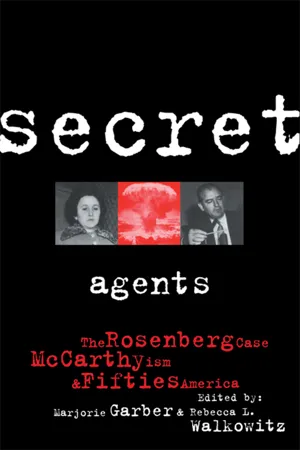 eBook - ePub
Secret Agents
The Rosenberg Case, McCarthyism and Fifties America
- Marjorie Garber, Rebecca Walkowitz, Marjorie Garber, Rebecca Walkowitz(Authors)
- 2013(Publication Date)
- Routledge(Publisher)
PART TWOAgents
Senator Joseph McCarthy. (AP/Wide World Photos) Passage contains an image
9
Passage contains an image
9Before the Rosenbergs
Espionage Scenarios in the Early Cold War Ellen SchreckerJulius and Ethel Rosenberg were typical victims of the McCarthy era, unique only in the severity of the sentence imposed on them. They were or had been Communists and their trial and execution were the culmination of an intensive five-year campaign to root Communism and all the individuals, ideas, and organizations associated with it out of American life. Whether or not the Rosenbergs were spies, most of their fellow citizens thought they were and assumed that their punishment, though extreme, was justified.That consensus has long since disappeared. Instead of having perpetrated the so-called crime of the century, the Rosenbergs became its victims—convicted on rather meager evidence and sentenced to death by a judge who colluded with the prosecution. No one, not even the most vocal advocates of the couple's guilt, believes that their trial was fair. It was, as Ronald Radosh and Joyce Milton put it, “a grave miscarriage of justice.”1 Among the leading culprits were J. Edgar Hoover, Roy Cohn, Judge Irving Kaufman, and an anti-Communist consensus that allowed the Rosenbergs to be killed and thousands of other political undesirables to be fired, jailed, deported, or otherwise punished.That consensus did not evolve spontaneously. It had been carefully nurtured and orchestrated by a network of anti-Communist activists. The most important member of that network was, of course, Hoover. Whatever his sexual orientation, there was nothing closeted about J. Edgar Hoover's commitment to anti-Communism. It was his lifelong mission. And he pursued his crusade against Communism with the same passion and brilliance that he devoted to building up the FBI and his and its reputation.2 eBook - PDF
100 Americans Making Constitutional History
A Biographical History
- Melvin I. Urofsky, Melvin I. (Irving) Urofsky(Authors)
- 2004(Publication Date)
- CQ Press(Publisher)
In fact, Judge Kaufman in his sentencing statement pointedly noted that she was the eldest—she was seven years older than David and almost three years older than Julius. The image of a mature, ideologically committed woman dedicated to the cause and manipulating family members was, and is, the image painted by the government. To critics of the government, the decision to execute Ethel Rosenberg was not based on credible evidence. Her sons contend that their mother was probably not directly involved, but approved of their father’s activities. For these crit-ics, her approval did not and does not support the execution. Personal confessions and archival revelations continue to stimulate comment and controversy about the Rosenbergs fifty years after their executions. They were the first and only indi-viduals executed for conspiracy to commit espionage. Did both of them pass on information about the atomic bomb? Were their actions with regard to military electronic secrets, their reluctance to cooperate with the government, and their intent to commit atomic espionage sufficient to justify the punish-ment? What is the evidence of Ethel Rosenberg’s involvement? In her last letter to her sons, she ends with these words: “Always remember that we were innocent and could not wrong our con-science.” Were they innocent, and whose conscience did they wrong? Harvey Rishikof * B I B L I O G R A P H Y Alavi, Atossa M. “The Government Against Two: Ethel and Julius Rosenberg’s Trial.” Case Western Reserve Law Review 53 (2003): 1057. Radosh, Ronald, and Milton Joyce. The Rosenberg File: A Search for the Truth. Second edition. New Haven: Yale University Press, 1997. VENONA Project, at http://nsa.gov/docs/venona. *The views expressed in this essay are my own and do not reflect Department of Defense positions, views, or policy. Dred Scott Fight for Freedom from Slavery “A subordinate and inferior class of beings” Dred Scott v.
- Bernadette Longo(Author)
- 2015(Publication Date)
- ACM Books(Publisher)
Sobell was convicted of espionage along with the Rosenbergs, but received a 30-year prison sentence instead of death. In 2008, at the age of 91, Sobell admitted that he and Julius Rosenberg stole classified, non-atomic information on radar and artillery devices and passed it along to Russian contacts. 43 He explained, “I helped an ally (admittedly illegally) during World War II. I chose not to cooperate with the government in 1950. The issues are now with the historians.” 44 Facing the need to decide whether to grant the Rosenberg’s plea for executive clemency, Eisenhower decided against clemency, stating publicly that their crime “far exceeds that of the taking of the life of another citizen; it involves the deliberate betrayal of the entire nation and could very well result in the death of many, many thousands of innocent citizens.” 45 In a private letter to a friend who was in favor of commuting the sentence to life imprisonment, Eisenhower explained more about his views regarding the need for a stronger stance against Communism: As to any intervention based on consideration of America’s reputation or standing in the world, you have given the case for one side. What you did not suggest was the need for considering this kind of argument over and against the known convictions of Communist leaders that free governments—and especially the American government—are notoriously weak and fearful and that consequently subversive and other kinds of activity can be conducted against them with no real fear of dire punishment on the part of the perpetrator. It is, of course, important to the Communists to have this contention sustained and justified. . . . The action of these people has exposed to greater danger of death literally millions of our citizens eBook - PDF
- John Neville(Author)
- 1995(Publication Date)
- Praeger(Publisher)
The article showed the Worker's resolve to lay the Rosenbergs' convictions to long-standing political and religious hatred. 78 The Press and the Rosenbergs The whole judicial proceeding against them has been a terrible mockery. They were tried by headlines and hysteria. The fight to save the Rosenbergs is the fight to keep America free from Buchenwalds and Dachaus. We must win this fight not only for the sake of the Rosenbergs, but for the sake of our children. Snuffing out the lives of Ethel and Julius Rosenberg would hasten the reign of the brute in America. A spinal cord of decency would snap in the electric chair with them. 3 Coincidentally, 1952 was the fiftieth anniversary of Emile Zola's death. 4 The Daily Worker, which ignored William Reuben's references to Zola in 1951, now reprised Zola's stirring "J Accuse" speech. 5 Sillen asked American writers and artists to "take up the cudgels" of justice for the Rosenbergs "in the thunderous accents of Emile Zola." The death sentences eventually would elevate the Rosenberg case into an international political obsession. For the time being, though, Rosenberg supporters debated about how best to frame the case for public and media consumption. Communist Party members in the United States also wanted to continue demanding a new trial. The Rosenberg Committee also wanted a new trial for the Rosenbergs, but its board members realized the chances of staging a mass movement based solely on an appeal for a new trial were slim. Instead, the committee decided on a two-pronged strategy. It would first advocate a movement to save the Rosenbergs from death in the electric chair, then promote a new trial. This decision was nicely tied to the Rosenberg legal appeals, which would draw automatic coverage in the news media, especially the press. Controversial executions usually command national news-media attention.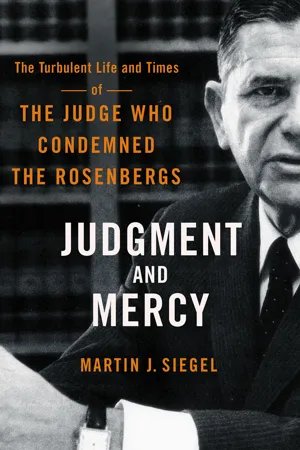 eBook - ePub
Judgment and Mercy
The Turbulent Life and Times of the Judge Who Condemned the Rosenbergs
- Martin J. Siegel(Author)
- 2023(Publication Date)
- Three Hills(Publisher)
10The clerk read the indictment—a jumble of legalese that boiled down to the government’s accusation that Julius and Ethel, David Greenglass, a radar expert named Morton Sobell, and their absent Soviet handler Anatoli Yakovlev had conspired to violate the 1917 Espionage Act during wartime by transmitting national security information to the USSR. It didn’t matter that Russia had been an American ally during the war; the law covered information given to any “foreign power.”Attention then turned to selecting a jury from among the three hundred people called in for the job. The process was remarkable mostly for the absurdly long list of groups and publications Judge Kaufman read to them to determine political bias—over 150 in all. Most were on Clark’s list of subversive organizations. Several potential jurors expressed opposition to capital punishment and were immediately excused, though Kaufman reiterated that he was the one who would decide any sentence.As the hours ground on and selection continued, Manny Bloch hit what would become a recurring note throughout the case: that no one should get the strange idea that communism was on trial. When a potential juror confessed that he couldn’t give the same credence to testimony from a communist as from someone else, Bloch rose to “dissipate any misimpression … that the question of membership in the Communist Party is involved.” Puzzled, Kaufman asked whether Bloch wouldn’t want to know if a juror was biased against his clients. It was a sensible question. As one writer put it after the trial, how was a potential juror supposed to keep an open mind when “almost every newspaper, magazine, television or radio commentator, church sermon, employer’s speech, government spokesman, had done so much to fill his mind with fear and loathing of anything connected with communism?”11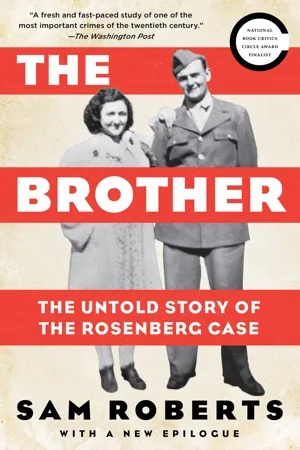 eBook - ePub
The Brother
The Untold Story of the Rosenberg Case
- Sam Roberts(Author)
- 2014(Publication Date)
- Simon & Schuster(Publisher)
conspiracy he had summoned up when he had opened his case. But he methodically stripped away the layers of legal arcana, theatrically building to a stem-winding finale:I have said that there is much about this that we have not disclosed or that we do not know, but there is one part of the scheme that we do know about. You know about it because it was disclosed right before you. We know that these conspirators stole the most important scientific secrets ever known to mankind from this country and delivered them to the Soviet Union. We know that Julius Rosenberg and Ethel Rosenberg infected Ruth and David Greenglass with the poison of communist ideology. We know that Julius Rosenberg and Ethel Rosenberg were engaged in a continuing campaign to enlist recruits for the Soviet cause through the Communist Party. And we know that in 1944 Julius and Ethel Rosenberg carried their campaign one step further and persuaded David Greenglass to steal atomic bomb secrets for the Rosenbergs to be turned over to the Soviet Union.Making few apologies for David and Ruth, Saypol rebutted the defense’s rationale point-blank:There is no condonation for the activities of the Greenglasses in 1944 and 1945. David Greenglass is a confessed member of the Rosenberg espionage ring. You heard his testimony and you observed him. You heard him confess his guilt. You heard him describe in detail his participation in this conspiracy. By his own plea of guilty, by his own voluntary act, without weaving a web of lies in an attempt to deceive you, he has made himself liable to the death penalty, too. The spurious defense that Greenglass or the Greenglasses, in order to satisfy a business grudge, a business dispute against the Rosenbergs has concocted a story about espionage . . . is as much of a concoction as the story of the defendants that Greenglass went to his worst enemy, Julius Rosenberg, for help when he wanted to flee the country.
Index pages curate the most relevant extracts from our library of academic textbooks. They’ve been created using an in-house natural language model (NLM), each adding context and meaning to key research topics.

