History

Cambridge Five
The Cambridge Five refers to a group of British spies who passed information to the Soviet Union during the Cold War. The members included Kim Philby, Donald Maclean, Guy Burgess, Anthony Blunt, and John Cairncross. They infiltrated various government institutions and provided classified information to the Soviets, causing significant damage to Western intelligence efforts.
Written by Perlego with AI-assistance
Related key terms
1 of 5

4 Key excerpts on "Cambridge Five"
 eBook - ePub
Spy and Counterspy
Secret Agents and Double Agents from the Second World War to the Cold War
- Ian Dear(Author)
- 2013(Publication Date)
- The History Press(Publisher)
3
The Cambridge Five andTheir Soviet Handlers
The Cambridge Five were known to their Moscow spymasters as ‘The Five’, and later – after the success of the 1960 film The Magnificent Seven – as the ‘Magnificent Five’. They were Kim Philby, Anthony Blunt, Guy Burgess, Donald Maclean and John Cairncross. The Soviet foreign intelligence service (First Chief Directorate) that controlled them was part of a security organisation that had various names before it was renamed the KGB (Committee for State Security) in 1954. Here, for the sake of simplicity, the NKVD (People’s Commissariat for Internal Affairs) will be used throughout.In the decades following the defection to Moscow of Burgess and Maclean in 1951, a number of books were published about the exploits of The Five, and others appeared after the head of the KGB, in September 1990, ordered its archives be used to create a more positive image of the agency by publicising ‘its more celebrated cases’. These later publications included summaries of documents selected from the archives of the First Chief Directorate, though the archives themselves remained closed. After the collapse of the Soviet Union in December 1991, these summaries were made available to certain ex-KGB officers who collaborated with western authors to produce books that contained new information about The Five, or about Soviet agents connected with them whose names had not been previously published.1 One of the latter was the English-born Kitty Harris – previously known only by her codenames (ADA, NORMA, GYPSY) – which made public new revelations about her relationship with Donald Maclean.2These publications made it clear that it had not been the outstanding organisational skills of Soviet intelligence that had protected the Cambridge spies from discovery for so long. In fact, for much of the 1930s and the early 1940s the Russian secret services were thrown into turmoil by Stalin’s purges, which badly affected their efficiency. One commentator has calculated that between 1937 and 1951 the Cambridge ring were out of touch with Moscow for about seventy-two months, or nearly 50 per cent of the time, mostly because their Soviet controllers in London had severed contact with them for one reason or another.3 So badly was the organisation affected that figures published in 1999 showed that of the NKVD’s staff of about 24,500 in 1936, by January 1938 nearly 6,000 had been dismissed, arrested, transferred – or executed.4 eBook - ePub
'Buster' Crabb
Ian Fleming's Favourite Spy, The Inspiration for James Bond
- Don Hale(Author)
- 2011(Publication Date)
- The History Press(Publisher)
CHAPTER TWENTY-TWO COLD WAR WARRIORS The Cold War lasted for more than four decades and eventually became a battle of wits between the Secret Intelligence Service (SIS), Naval Intelligence, the Russian KGB and the American Central Intelligence Agency (CIA). The aim was for each to outsmart the other by gaining access to confidential information. Soldiers were exchanged for spymasters and if Communism hadn’t collapsed in the late 1980s, many of today’s spy stories may never have seen the light of day. Anthony Blunt was probably one of Russia’s most accomplished double agents. He headed the infamous ‘Cambridge Five’, a collection of some of the most notorious Soviet agents ever to penetrate the British Secret Services, particularly MI6. I managed to obtain an interesting insight into the activities of Anthony Blunt, Guy Burgess, Donald Maclean, and Kim Philby from some recent Federal Bureau of Investigation (FBI) documents released during 2006. The documents confirmed Blunt was under suspicion of being a Communist agent way back in 1949, and long before. Moreover, the FBI was also ‘giving consideration’ to interviewing him during his American lecture in Louisville, and in Cleveland, Ohio, in March 1956. The documents said Blunt would be staying at the Brown Hotel in Louisville. And strangely, this same town was mentioned in some other secret intelligence papers, when evidence was accidentally revealed at the British Embassy in Cairo. Initially the FBI files referred to a ‘remarkable coincidence’, as Blunt was about to give a lecture in Louisville during March 1956 – which strangely was at the exact same time the intelligence services were planning Crabb’s final dive. The file mentioned an article in the Louisville Courier & Journal from their Washington reporter dated 16 March. The piece claimed that the British Secret Service was investigating their entire Embassy staff in Cairo in an effort to track down a Russian agent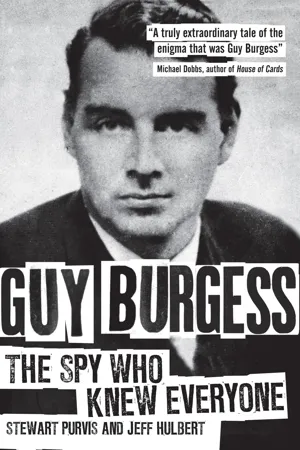 eBook - ePub
Guy Burgess
The Spy Who Knew Everyone
- Stewart Purvis, Jeff Hulbert(Authors)
- 2016(Publication Date)
- Biteback Publishing(Publisher)
They continued the checks on one of what were to become known as the Cambridge Five, Kim Philby, but suspended for a time those on another, Anthony Blunt. In one file it was properly pointed out that he was by now ‘the Keeper of the King’s pictures’. MI5 also sent the Special Branch a list of ten people, including Philby and Blunt, they wanted watching for any sign that they tried to leave the country during the summer. 33 The bulk of the work had been simply talking to people. By July, the internal scoreboard showed thirty-four known friends and relations had been interviewed by MI5 and twelve on their behalf by the FBI. There were over eighty other ‘miscellaneous reports and rumours’ followed up by various services. Perhaps more fruitful were the interrogations of those closest to Guy Burgess, in which MI5 tried to list as many of his circle as they could. One lover, Jack Hewit, gave them the names of Spender, John Lehmann, Rees, Isherwood, Auden, Tom Wyllie and Brian Howard. Hewit said these men ‘used to foregather at Chester Square for long and earnest discussions on political affairs’. MI5’s interrogator, Jim Skardon, found Hewit ‘a loathsome creature’ and ‘was glad when the interview was over’. 34 Another lover, Peter Pollock, added the names of the art critic Ellis Waterhouse, Isaiah Berlin and Victor Rothschild, and talked of the ‘Bentinck Street ménage’ of Burgess, Tess Mayor and Pat Rawdon-Smith
- Richard J. Aldrich(Author)
- 2005(Publication Date)
- Routledge(Publisher)
106 they became the victims rather than the creators of historical change.This chapter has begun to address the question of the use of these very British defectors in Cold War propaganda which contributes to our understanding of their historical significance. A research agenda has emerged, which consists of four questions: what role did Burgess, Maclean and Philby play in the formulation of Soviet propaganda towards Britain and possibly the USA? Were the British journalists justified in their fears that the defectors improved the effectiveness of Soviet propaganda? Did Soviet propagandists and/or the KGB conduct a covert campaign about the defectors either to play with the perceptions of British and American intelligence services or to ensure that information about the defectors became public knowledge? Lastly, what role did official British propagandists play in countering the Soviets? Some aspects of these questions may well have to await the opening of archives in both Britain and the Soviet Union.Burgess, Maclean and Philby illustrate an odd, deviant, tragic and occasionally humorous aspect of British history.107 In 1968 Hugh Trevor-Roper tried, unsuccessfully, to forestall the developing Philby cult by exposing Soviet propaganda, and by stating that ‘Philby, Burgess and Maclean are now altogether irrelevant. They are the fossils of the past’. Thirty years later Philby, Burgess and Maclean seem irrelevant to the awesome problems facing Soviet leaders today, but they are not yet fossilized. Significantly, Philby has recently been commemorated on a Soviet stamp, so perhaps at last this process has now begun.108Notes
- Most of the books appraise the significance of Burgess , Maclean and Philby as spies; much less has been written about them as defectors, see especially R. Cecil, A Divided Life: A Biography of Donald Maclean (London: Bodley Head, 1989); R. Cecil, ‘The Cambridge Comintern’, in C. Andrew and D. Dilks (eds) The Missing Dimension (London: Macmillan, 1983); S. Kerr, ‘NATO's First Spies: The Case of the Disappearing Diplomats’, in R. O'Neil and B. Heuser (eds) Securing Peace in Europe, 1945–1982
Index pages curate the most relevant extracts from our library of academic textbooks. They’ve been created using an in-house natural language model (NLM), each adding context and meaning to key research topics.

