History

Gunpowder Plotters
The Gunpowder Plotters were a group of English Catholics who conspired to blow up the Houses of Parliament in 1605, with the aim of assassinating King James I and restoring Catholic rule in England. The plot was foiled when one of the conspirators, Guy Fawkes, was discovered guarding the explosives. The event is commemorated annually in the UK on November 5th with bonfires and fireworks.
Written by Perlego with AI-assistance
Related key terms
1 of 5
10 Key excerpts on "Gunpowder Plotters"
 eBook - PDF
- Anne James(Author)
- 2017(Publication Date)
- University of Toronto Press(Publisher)
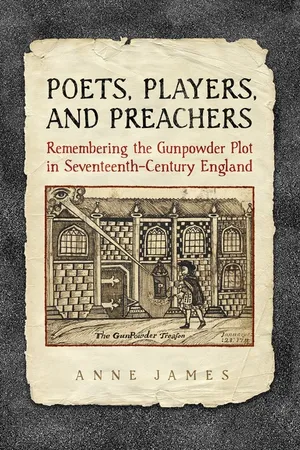
1 Introduction: Writing the Gunpowder Plot 1.1 Preface Over four hundred years after its discovery, the Gunpowder Plot still sparks the imaginations of writers and readers, regardless of the event’s meagre results. No explosion on 5 November 1605 destroyed the English Houses of Parliament, and only thirteen alleged conspirators, a few supporters of the Midlands revolt, and two Jesuit priests lost their lives, most either killed resisting capture or exe-cuted by the crown. 1 Objectively, the plot was a failure, a non-event, but it has seldom been discussed objectively. Annual commemoration, both voluntary and enforced, ensured it a deep and lasting place in the collective memory and his-torical consciousness of the English people. Nevertheless, its meaning has never been stable, shifting with the winds of political, religious, and social change. This book explores how the literature that celebrated, chronicled, and critiqued the plot and its discovery from 1605 to 1688 both participated in and re fl ected these changes. In doing so, it queries both the role of literature in public events and the role of public events in literary history, negotiating the boundaries between imagination and memory, literature and history, fi ction and reality. From the beginning, both polemical imperatives and the desire to create a coherent narrative out of fragmentary, and frequently con fl icting, evidence shaped Gunpowder narratives. The one provided by of fi cial contemporary sources, and still current in many popular histories, tells of a conspiracy by a small group of Catholic gentlemen, impoverished by the Elizabethan penal laws, further embit-tered by their new king’s failure to rescind them, and seduced by Jesuit doctrine and the personal magnetism of their leader, Robert Catesby. eBook - ePub
- Bernadette Meyler(Author)
- 2019(Publication Date)
- Cornell University Press(Publisher)
2
Emplotting Politics /
James I and the “Powder Treason”
In the early hours of November 5, 1605, a man who called himself John Johnson was discovered lurking about the Palace of Westminster, the seat of the English Parliament, scheduled to meet there the next day.1 Rapidly apprehended and subsequently tortured, this individual later identified himself as Guido Fawkes, and is known to posterity as Guy Fawkes. Through the information extracted from him, the state confirmed the existence of a Catholic plot to demolish Parliament, its members, and King James I at the opening of the new parliamentary session. This conspiracy soon came to be designated the “Powder Treason,” since it relied for its accomplishment on thirty-six barrels of gunpowder placed in the vault underneath the Parliament building. Many of the corresponding “Powder Men”—the plotters—fled London upon learning they had been discovered, and a few fell victim to the explosion of their own ammunition. The rest were brought to trial—also in Westminster Hall—on January 7, 1606.Sir Edward Coke, then attorney general for King James, addressed the Lords Commissioners and urged them to judge those who had intended such a revolutionary treason; in a second trial linked with the Gunpowder Plot, he likewise subsequently adjured them to condemn Henry Garnet, a Jesuit who had remained secretly in England, despite James’s prohibition against Catholic priests.2 The case against Garnet rested solely on the fact that the priest had received knowledge of the conspiracy through the confession of one of the participants—and that he possessed a book alternatively titled A Treatise of Equivocation and A Treatise against Lying and Fraudulent Dissimulation eBook - ePub
- Alan Dures, Francis Young(Authors)
- 2021(Publication Date)
- Routledge(Publisher)
From the government’s perspective the main problem was a Catholic threat, especially in the Welsh borders; the bishop of Hereford, Robert Bennet, was convinced that disturbances in the area in May 1605 were the beginnings of a Catholic rebellion. The Catholic earl of Worcester who, as lord lieutenant of Monmouthshire, was sent to quell the disturbances, thought they were riots. The king appears to have thought them more serious and in a speech to the judges in Star Chamber allegedly told them that the trouble in Herefordshire was ‘rebellious’ and it was ‘needless any longer to spare their blood’. The wiser counsel of Worcester appears to have prevailed and little more is heard of the troubles. However, in the years 1604–5 England seemed a long way from James’s oft-stated ideal of ‘a general Christian union in religion’. November 1605 would prove that point to a striking degree.The Gunpowder Plot
The Gunpowder Plot was directly linked to James’s failure to grant some form of toleration to Catholics. The five earliest plotters swore an oath of conspiracy after the proclamation of February 1604, and the digging of the tunnel under the Palace of Westminster began after the collection of recusancy fines in November 1604. The origins of the plot, however, go back beyond the issues of 1604. Bossy saw the plot ‘as the last fling of the Elizabethan tradition of a politically engaged Catholicism’. He argued that ‘one must surely recognize in the mind of Robert Catesby, its moving spirit, a garbled version of political themes which had been enunciated by pro-Spanish Catholics in the reign of Elizabeth’ (Bossy, 1973 : 95). Although we have stressed the widespread support both in Europe and among English Catholics for the accession of James, there were individuals who opposed him, and not just those in the Bye, Main, and Grey plots. In June 1603 both Guy Fawkes and John Wright, Robert Catesby’s agent, were still lobbying the Spanish, despite the fact that in February the Spanish Council had advised Philip III not to back a Spanish succession to England. Guy Fawkes tried to convince the Spaniards that revolt was simmering among English Catholics, and that hostility between the English and Scots would produce trouble regardless of religion [Doc. 10, p. 126–7]. But Philip III’s ambassador in London warned his king not to trust the analysis of Fawkes and his supporters: ‘In matters of importance that hold so many risks, I assure your Majesty that I would not dare to trust these people in question, although I believe them to be very sincere Catholics’ (Loomie, 1971 : 132). As the constable of Castile warned, ‘[English Catholics] do not want foreigners, especially the Spanish, to come in here, out of fear for their own power’ [Doc. 11, eBook - ePub
History of the English People, Volume V
Puritan England, 1603-1660
- John Richard Green(Author)
- 2007(Publication Date)
- Perlego(Publisher)
If James had come to his new throne with dreams of conciliation and of a greater unity among his subjects, his dream was to be speedily dispelled. At the moment when the persecution of Bancroft announced a final breach between the Crown and the Puritans, a revival of the old rigour made a fresh breach between the Crown and the Catholics. In remitting the fines for recusancy James had never purposed to suffer any revival of Catholicism; and in the opening of 1604 a proclamation which bade all Jesuits and seminary priests depart from the land proved that on its political side the Elizabethan policy was still adhered to. But the effect of the remission of fines was at once to swell the numbers of avowed Catholics. In the diocese of Chester the number of recusants increased by a thousand. Rumours of Catholic conversions spread a panic which showed itself in an act of the Parliament of 1604 confirming the statutes of Elizabeth; and to this James gave his assent. He promised indeed that the statute should remain inoperative; but rumours of his own conversion, which sprang from his secret negotiation with Rome, so angered the king that in the spring of 1605 he bade the judges put it in force, while the fines for recusancy were levied more strictly than before. The disappointment of their hopes, the quick breach of the pledges so solemnly given to them, drove the Catholics to despair. They gave fresh life to a conspiracy which a small knot of bigots had been fruitlessly striving to bring to an issue since the king's accession. Catesby, a Catholic zealot who had taken part in the rising of Essex, had busied himself during the last years of Elizabeth in preparing for a revolt at the Queen's death, and in seeking for his project the aid of Spain. He was joined in his plans by two fellow-zealots, Winter and Wright; but the scheme was still unripe when James peaceably mounted the throne; and for the moment his pledge of toleration put an end to it. But the zeal of the plotters was revived by the banishment of the priests; and the conspiracy at last took the form of a plan for blowing up both Houses of Parliament and profiting by the terror caused by such a stroke. In Flanders Catesby found a new assistant in his schemes, Guido Fawkes, an Englishman who was serving in the army of the Archduke; and on his return to England he was joined by Thomas Percy, a cousin of the Earl of Northumberland and a pensioner of the king's guard. In May 1604 the little group hired a tenement near the Parliament House, and set themselves to dig a mine beneath its walls.The Gunpowder Plot.As yet however they stood alone. The bulk of the Catholics were content with the relaxation of the penal laws; and in the absence of any aid the plotters were forced to suspend their work. It was not till the sudden change in the royal policy that their hopes revived. But with the renewal of persecution Catesby at once bestirred himself; and at the close of 1604 the lucky discovery of a cellar beneath the Parliament House facilitated the execution of this plan. Barrels of gunpowder were placed in the cellar, and the little group waited patiently for the fifth of November 1605, when the Houses were again summoned to assemble. In the interval their plans widened into a formidable conspiracy. It was arranged that on the destruction of the king and the Parliament the Catholics should rise, seize the young princes, use the general panic to make themselves masters of the realm, and call for aid from the Spaniards in Flanders. With this view Catholics of greater fortune, such as Sir Everard Digby and Francis Tresham, were admitted to Catesby's confidence, and supplied money for the larger projects he designed. Arms were bought in Flanders, horses were held in readiness, a meeting of Catholic gentlemen was brought about under show of a hunting party to serve as the beginning of a rising. Wonderful as was the secrecy with which the plot was concealed, the family affection of Tresham at the last moment gave a clue to it by a letter to Lord Monteagle, his relative, which warned him to absent himself from the Parliament on the fatal day; and further information brought about the discovery of the cellar and of Guido Fawkes, who was charged with its custody. The hunting party broke up in despair, the conspirators, chased from county to county, were either killed or sent to the block; and Garnet, the Provincial of the English Jesuits, was brought to trial and executed. Though he had shrunk from all part in the plot, its existence had been made known to him by way of confession by another Jesuit, Greenway; and horror-stricken as he represented himself to have been, he had kept the secret and left the Parliament to its doom. eBook - PDF
Dreaming the English Renaissance
Politics and Desire in Court and Culture
- C. Levin(Author)
- 2008(Publication Date)
- Palgrave Macmillan(Publisher)
Searching the man he had arrested, Knyvett also found fuses to be used to cause an explosion. This, of course, was the Gunpowder Plot 4 —one of the most famous failed conspiracies of history, and Guy Fawkes and Thomas Percy were two of the conspirators. Had this plan succeeded, it would have been a seventeenth-century night- mare of terrorism similar in scope and intent to our own 9/11. Recent sci- entists estimate that such a blast would have obliterated the Palace of Westminster, Westminster Hall, Westminster Abbey, as well as the surround- ing streets. The king himself told the Venetian Ambassador “had the scheme been carried out thirty thousand persons would have perished at a stroke, the city would have been sacked, and the rich would have suffered more than the D r e a m i n g t h e E n g l i s h R e n a i s s a n c e 10 poor; in short, the world would have seen a spectacle so terrible and terrify- ing that its like has never been heard of.” 5 People at the time were terrified at the thought of what would have hap- pened had the explosion occurred. An anonymous ballad composed soon after described in nightmarish terms how it would have been: . . . royal and noble shapes Blown up in the whisking air— Here arms, there legs, dissevered quite, Lie mangled everywhere. . . . And every street be purplefied With gores coagulate. 6 The King’s chaplain, William Hubbard, argued that the conspirators intended “to destroy root, and branch: and fruit, parent, and child in one day: to kill dam and young in one nest.” The nightmare metaphor was suggested in the anonymous The Returne of the Knight of the Post from Hell, which refers to the conspirators as “monsters and monstrous men,” which sounds like those whom one might meet in a horrible dream. Five days after the plot was dis- covered, on November 10, William Barlow, bishop of Rochester, also described the event in rhetoric that suggested terrifying dreams: “the short- ness of time . eBook - PDF
Towers of Deception
The Media Cover-up of 9-11
- Barrie Zwicker(Author)
- 2006(Publication Date)
- New Society Publishers(Publisher)
Fawkes and those not killed where they are tracked down (one dies in prison) are later found guilty of treason in a trial lasting less than a day. The are hanged, drawn and quartered. The following Sunday, November 10, the King James version of the plot begins to be broadcast from the pulpits of the Church of England — the 1605 equivalent of television. William Barlow, Bishop of Rochester, thunders at Paul’s Cross church that “the enemy from below is satanic in its wicked-ness.” The king, their hoped-for victim, “is an unqualifiedly good man, the archetype of the good man, virtually a Christ-figure,” writes Nicolson. All pulpits echo the palace version. Ten years later “the energy of loathing was undiminished.” The palace version becomes historical truth for humankind. Until 1959, it was against the law in Britain not to celebrate Guy Fawkes Day. But Nicolson and others have now cast serious doubt on that version. Many anomalies concerning the events have surfaced. The Royal Chancellor, the wily Robert Cecil, had an efficient network of spies seeded among Roman Catholic dissidents. The authorship of the letter by which the King learned of the plot is murky. The gunpowder was of an inferior nature, unlikely to have achieved much result, if any. Some of the handwrit-ing on Fawkes’ confession differed from the rest. There was no tunnel. Ignored until recently is a book by Jesuit historian John Gerard (1564-1606), What Was the Gunpowder plot: The Traditional Story Tested by Original Evidence, finally published in 1897. Gerard writes: “When we examine into the details supplied to us as to the progress of the affair, we find that much of what the conspirators are said to have done is well-nigh incredible, while it is utterly impossible that if they really acted in the man-ner described, the public authorities should not have had full knowledge of their proceedings.” 3 Overall the evidence points to a false flag operation. eBook - PDF
Early Modern Spectacles
Journal for the Study of British Cultures, Vol. 25, No. 2/2018
- Susanne Gruss, Lena Steveker(Authors)
- 2020(Publication Date)
- Königshausen & Neumann(Publisher)
As a rhetorical strategy and public relations move, James’s reframing of the Gunpowder Treason Plot is as ingenious as it is risky. With less than three years on the throne and in the midst of an all-time low public approval rating, James had no choice but to rebrand himself as his kingdom’s pro-verbial and literal fire-master. 3 As anyone living in early modern England 2 On 26 October 1605, an anonymous source sent William Parker, 4th Baron Monteagle, a Catholic loyalist and member of the House of Lords, a cryptic letter warning him not to attend the opening of parliament on the grounds that the coun-cil “will receive a terrible blow” ( The Monteagle Letter 1605 SP14/216/2). The let-ter’s author misjudged Monteagle’s response to the letter; instead of staying quiet about the Plot, Monteagle passed the letter on to government officials, including James’s most trusted advisor – Lord Robert Cecil. Cecil’s official line is that he didn’t know what to make of the vague threat articulated in the document, and so, for several days, he did pretty much nothing. Eventually he delivered the letter to James who, in the king’s own telling, successfully decoded the message and initiated the sequence of events that led to the discovery of Guy Fawkes. 3 James survived two usurpation plots within the first year of his reign. In October 1604, the new monarch ruffled the feathers of some of his English subjects when he acquired the title ‘King of Great Britain’ by royal proclamation instead of by statute. 190 Jana Mathews surely would tell you, you play with fire (to use an appropriate pun) when you make firework shows a signifying agent of your authority. The power of this spectacle as a marker of political power lies in the ability of the ob-ject to be controlled, which conversely only can be demonstrated by expos-ing one’s proximity to the loss of that control. eBook - PDF
Violent London
2000 Years of Riots, Rebels and Revolts
- C. Bloom(Author)
- 2010(Publication Date)
- Palgrave Macmillan(Publisher)
The impetus to riot was usually instigated by a discontented lord whose base never extended much beyond his immediate followers and from the aristocracy or gentry who were associated with them through family relations. Indeed, few of the common people wanted to be associated with such dangerous and high politics, a situation which was to change 44 Violent London completely in the next century. If a monarch should lose their head in the cause of Protestantism then another must take their place and the order of the world restored. Plots by Protestants and Catholics pepper the reigns of Elizabeth and James, none were successful and all collapsed, but in their mach- inations the ground of discontent shifted to religious rebellion. The political and secular manoeuvring of Mary’s reign seemed to give way to religious intolerance and religion as a form of politics. This, of course, was to culminate in the Gunpowder Plot of 1605. The ques- tion of who would follow the ageing Elizabeth tested both sides of the political divide: a Catholic monarch who tolerated Catholics or a Catholic monarch who winked at Protestantism. James VI of Scotland was favourite to inherit, but others such as Arabella Stuart and Isabella of Spain were candidates too. Either way, factions grew and one led by the Earl of Essex became a seditious movement. Robert Devereux, Earl of Essex had been a favourite of the queen, but a disastrous campaign in Ireland had ruined his rep- utation, although it must be said did not seem to dent his ego or ambition. Essex returned secretly to England and threw himself on the mercy of the queen who unceremoniously banished him to his London home, known as Essex House, a large complex of over forty bedrooms, picture gallery, chapel and banqueting hall which stood on the Strand and which had originally been built by the Earl of Leicester in 1575 next to the Middle Temple.
- Thomas Lathbury(Author)
- 2010(Publication Date)
- Perlego(Publisher)
The conspirators were in and near London, Fawkes alone, as the individual who was to fire the train, taking his post in the cellar, or the adjoining house, as Catesby’s servant. The parties were very cautious in all their proceedings, so that they met together secretly, whenever a meeting was necessary. As the powder and the wood were deposited in the cellar, and nothing remained to be done in London, the conspirators hovered near, leaving Fawkes to manage the firing of the train. They were full of sanguine expectations respecting the event, and busied themselves at this period, in forming plans for securing the young princes, and for carrying their ulterior designs into execution. Their attempt was, however, frustrated by an overruling providence! Footnotes: [9] “In piercing through the wall nine foot thick,” says Fuller, “they erroneously conceived that they thereby hewed forth their own way to heaven. But they digged more with their silver in an hour, than with their iron in many daies; namely, when discovering a cellar hard by, they hired the same, and the pioneers saved much of their pains by the advantage thereof.”—b. x. p. 35. They were led to believe, from this circumstance, that God was evidently favourable to their design. [10] Book x. 35. CHAPTER IV. THE JESUITS PRIVY TO THE PLOT. THE NARRATIVE CONTINUED DOWN TO THE PERIOD OF THE DISCOVERY OF THE TREASON. Before the narrative is carried further, it will be desirable to allude to those clerical individuals who were privy to this conspiracy. The actors were, as has been seen, laymen; but there were some priests of the church of Rome, and members of the order of Jesuits, who were no less implicated in the design than those who actually worked in the mine. Garnet, Gerard, and Tesmond, were Englishmen by birth; and yet, for the sake of advancing the interests of the church of Rome, they hesitated not to enter into the plot eBook - ePub
Globe
Life in Shakespeare's London
- Catharine Arnold(Author)
- 2015(Publication Date)
- Simon & Schuster UK(Publisher)
8
GUNPOWDER, TREASON AND PLOT
When the hurly-burly’s done, When the battle’s lost and won.Macbeth , Act 1 Scene 1For Londoners, indeed for all who lived under the sovereignty of Elizabeth, the turn of the century would prove a freakish time of dire combustion and confused events. The first decade alone was to be marked by two sensational attempts to overthrow the monarchy, both ending in despair for their protagonists. The Earl of Essex’s failed rebellion and the doomed Gunpowder Plot would provide an exciting but hazardous backdrop for the players at the Globe and a dangerous environment for writers. In another development, the writers themselves would be at loggerheads, in a dispute dubbed ‘the war of the theatres’ and best summed up by Guildenstern’s verdict that ‘there has been much throwing about of brains!’1At the end of the chapter about Shakespeare’s history plays, I concluded with Richard II’s reflection upon the fate of kings. ‘Some . . . deposed, some slain in war . . . some poisoned by their wives, some sleeping killed – all murdered.’ Shakespeare was aware of the essentially fleeting nature of royal power. ‘Not all the water in the rough rude sea can wash the balm off from an anointed king’, but power is transitory. Ultimately, Death trumps all kingship; Death pricks the bubble of life in the hollow crown and the monarch is gone. Farewell, king!2This chapter is about two attempts to destroy the monarchy, in the form of the Essex rebellion and the Gunpowder Plot, and the impact these seismic events had upon Shakespeare, his contemporaries and the Globe. For one, mercifully brief, moment it looked as though the Lord Chamberlain’s Men might be flung into gaol, or make one last appearance not upon the scaffold of the stage but upon the scaffold of the gallows.In May 1599, Shakespeare made a rare topical allusion to the Earl of Essex’s campaign in Ireland, drawing flattering comparisons with Henry V’s magnificent return from Agincourt. Shakespeare confidently predicted a victory procession for Essex ‘the conquering hero’, promoted to general, ‘from Ireland coming, Bringing rebellion broached on his sword’.3
Index pages curate the most relevant extracts from our library of academic textbooks. They’ve been created using an in-house natural language model (NLM), each adding context and meaning to key research topics.

