History

Popish Plot
The Popish Plot was a fictitious conspiracy in 17th-century England that alleged a Catholic plot to assassinate King Charles II and overthrow the government. The plot was fabricated by Titus Oates, a discredited clergyman, and led to widespread anti-Catholic hysteria, resulting in the execution of numerous innocent people and the passage of harsh anti-Catholic laws.
Written by Perlego with AI-assistance
Related key terms
1 of 5
7 Key excerpts on "Popish Plot"
 eBook - ePub
- T.A. Birrell, Jos Blom, Frans Korsten, Frans Blom, Jos Blom, Frans Korsten, Frans Blom(Authors)
- 2020(Publication Date)
- Routledge(Publisher)
1CATHOLIC ALLEGIANCE AND THE Popish PlotA study of some Catholic writers of the Restoration period ** Originally delivered as an inaugural lecture on 16 March 1950 on the occasion of Birrell’s appointment as Reader in English Literature at the Catholic University of Nijmegen (now Radboud University Nijmegen).I have chosen to speak this afternoon on the subject of Catholic Allegiance and the Popish Plot of 1678, a subject which involves the study of some Catholic writers of the Restoration period. The writers with whom I propose to deal are Roger Palmer, Earl of Castlemaine, Dom James Maurus Corker, monk of the English Congregation of the Order of St Benedict, and Fr John Warner, Provincial of the English Province of the Society of Jesus. You may reasonably wonder why, out of the wide variety of topics which English Literature presents, I should have chosen a subject with which the majority of you are, I imagine, totally unfamiliar. You may even doubt whether the works of the writers with whom I am about to deal are entitled to the name of literature at all for you will find none of them mentioned in such a repository of orthodox critical opinion as the Cambridge History of English Literature.To the charge of irrelevance and obscurity, I would make two answers. Firstly, that this is a Catholic University, and that here, if anywhere, we should be interested in the study of Catholic writers of other countries, and of how they, as individuals, reacted to a given political situation. The Popish Plot was the last nationwide persecution of Catholics in England.Secondly, I would call your attention to the present topical significance of the situation with which English Catholics were confronted nearly two hundred years ago. In Eastern Europe at the present time, many millions of Catholics are having to decide which things are, and which things are not Caesar’s, and the outcome of their decisions is, for many of them, literally a matter of life and death. Now the number of martyrs in the Popish Plot persecution was, in contrast with some modern persecutions, comparatively small. Between 1678 and 1681 twenty-five1 priests and laymen died on the scaffold, and more than a dozen others are known to have died in prison.2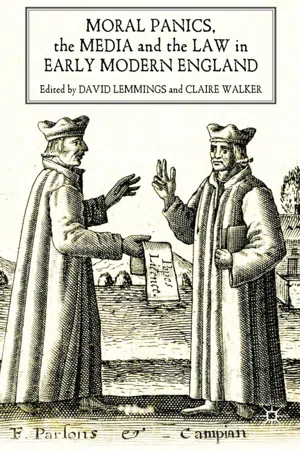
- D. Lemmings, C. Walker, D. Lemmings, C. Walker(Authors)
- 2009(Publication Date)
- Palgrave Macmillan(Publisher)
17 With an issue like the Popish Plot, which tapped into long-held fears about the Catholics’ aims to overthrow the Protestant church and state, the conditions were right for the Whigs to press for some of their political goals. The tide of propaganda spon- sored by those with Whig sympathies suggests that they clearly intended to manipulate public opinion to their advantage. However, as Tim Harris has observed adroitly ‘a propagandist cannot run counter to the assump- tions and prejudices of the audience he is seeking to convert’. 18 What is more, the propagandists keen to identify Catholics as the bogeymen had a veritable national treasury of stories and images with which to make their point. Indeed, as Alexandra Walsham has commented, ‘Protestant polemi- cists … made the repeated interventions of the Almighty in English history the centrepiece of an enduring and chauvinistic national myth. Fusing anti-Catholic providentialism with patriotism, they invented a tradition of prejudice which … took firm root in the imagination and the culture of the populace’. 19 However fantastic Oates’ changing evidence was, he ‘convinced an audience already primed to believe such tales through decades of anti- Catholic propaganda’. 20 The anxiety engendered by popery resulted in sporadic panics throughout the seventeenth century. Robin Clifton’s analysis of scares preceding the civil wars noted at least eight earlier waves of paranoia in between 1596 and 1636, leading him to comment that rather than being representative of any actual Catholic threat they reveal ‘a very basic political attitude in the mass of the 122 The Popish Plot and the Construction of Panic Protestant nation, an attitude brought into play by specific and recurring circumstances’. 21 Some kind of political crisis was often the trigger. eBook - PDF
- John Gibney(Author)
- 2008(Publication Date)
- Palgrave Macmillan(Publisher)
2 The Popish Plot in Ireland, September 1678–May 1679 Ireland had a role to play in the Popish Plot from the outset. Amongst many other things, Titus Oates had claimed that the Catholic arch- bishop of Tuam, James Lynch intended ‘to procure some Persons to dispatch the king’. 1 Furthermore, there were plans to facilitate ‘the French king’ s landing in Ireland ... the Irish Catholics were ready to rise, in order to which, there was forty thousand black bills pro- vided, to furnish the Irish soldiers withal’. 2 The Jesuits were also implicated: Peter Talbot, the Catholic archbishop of Dublin, had sup- posedly claimed that ‘the fathers of the society in Ireland were very vigilant to prepare the people to arise, for the defence of their liberty and religion, and to recover their estates’. 3 Emissaries were sent to Ireland to lay the ground for a rebellion, and within months the Irish were reportedly ready to rise. Ormond was supposedly ‘in a great per- plexity, to see Catholic religion thrive so well’, and there were many who, at the behest of the Jesuits, ‘resolve to cut the Protestants throats again, when once they rise’. 4 Ormond was to be murdered by four Irish Jesuits, which would be the signal for the rebellion to begin. Should this attempt on the viceroy’s life fail, ‘Dr Fogarty’ (who was alleged to have orchestrated the Southwark fire of 1676 and secured the services of four Irishmen to murder the king) would deal with him. 5 The Catholic Church had given permission to the Irish to swear the oaths of allegiance and supremacy, a Papal legate was now alleged to be in Ireland, and garrisons across the country had been infiltrated, all of which were intended to facilitate ‘the design of the Jesuits; which was, to raise a rebellion in the three kingdoms, and to destroy the king’. 6 28 The Popish Plot in Ireland 29 The implication that the Protestants in those kingdoms were also to be destroyed hardly needed restating.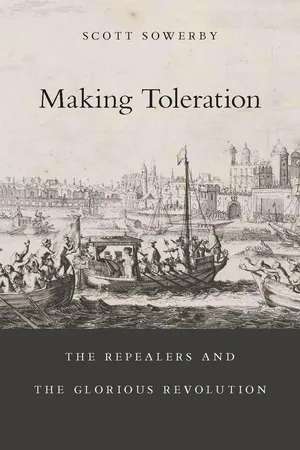 eBook - PDF
Making Toleration
The Repealers and the Glorious Revolution
- Scott Sowerby, Scott Sowerby(Authors)
- 2013(Publication Date)
- Harvard University Press(Publisher)
as duke of York, James had urged his friends not to focus on “the imaginary dangers of Popery.” 2 He was concerned about anti- popish fears in part because they had nearly deprived him of his crown before he had been able to assume it. the Popish Plot crisis of 1678–1681 had been provoked by the unsolved murder of Sir Edmund Berry Godfrey. as an atmosphere of crisis took hold, the nascent whig party formed and engaged in a failed effort to pass a bill through parliament excluding James from the succession on the grounds of his catholi cism. Many of the whigs argued that there was a catholi c plot to place James on the throne by having his older brother, charles, assassinated. there was in fact no such plot, but the fears and rumors coursing through london helped to destabilize charles’s government and lent urgency to the cause of exclusion. the exclusionists were beaten back in part by charles’s savvy use of his prerogative powers to call and dismiss parlia-ments and in part by a broad-based loyalist reaction against what was seen as whig overreaching. Historians often contend that by the time of James’s accession in 1685 the political crisis surrounding the Popish Plot had largely passed and that any resumption of the crisis thereafter was primarily the king’s fault. 3 it is true that James’s accession was widely celebrated in england, even though the new king was a catholi c. But “fears and jealousies” of popery had not dissipated by 1685.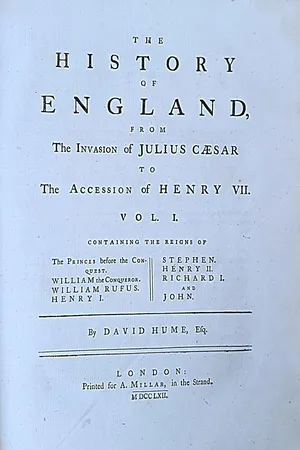 eBook - ePub
- David Hume(Author)
- 2019(Publication Date)
- Laurus Book Society(Publisher)
It is remarkable, that the only resource of Spain, in her present decayed condition, lay in the assistance of England: and, so far from being in a situation to transport ten thousand men for the invasion of that kingdom, she had solicited and obtained English forces to be sent into the garrisons of Flanders, which were not otherwise able to defend themselves against the French. The French too, we may observe, were at that very time in open war with Spain, and yet are supposed to be engaged in the same design against England; as if religious motives were become the sole actuating principle among sovereigns. But none of these circumstances, however obvious, were able, when set in opposition to multiplied horrors, antipathies, and prejudices, to engage the least attention of the populace: for such the whole nation were at this time become. The Popish Plot passed for incontestable: and had not men soon expected with certainty the legal punishment of these criminals, the Catholics had been exposed to the hazard of a universal massacre. The torrent, indeed, of national prejudices ran so high, that no one, without the most imminent danger, durst venture openly to oppose it; nay, scarcely any one, without great force of judgment, could even secretly entertain an opinion contrary to the prevailing sentiments. The loud and unanimous voice of a great nation has mighty authority over weak minds; and even later historians are so swayed by the concurring judgment of such multitudes, that some of them have esteemed themselves sufficiently moderate, when they affirmed, that many circumstances of the plot were true, though some were added, and others much magnified. But it is an obvious principle, that a witness who perjures himself in one circumstance is credible in none and the authority of the plot, even to the end of the prosecutions, stood entirely upon witnesses. Though the Catholics had seen suddenly and unexpectedly detected, at the very moment when their conspiracy, it is said, was ripe for execution, no arms, no ammunition, no money, no commissions, no papers, no letters, after the most rigorous search, ever were discovered, to confirm the evidence of Oates and Bedloe. Yet still the nation, though often frustrated, went on in the eager pursuit and confident belief of the conspiracy: and even the manifold inconsistencies and absurdities contained in the narratives, instead of discouraging them, served only as further incentives to discover the bottom of the plot, and were considered as slight objections, which a more complete information would fully remove. In all history, it will be difficult to find such another instance of popular frenzy and bigoted delusion.In order to support the panic among the people, especially among the citizens of London, a pamphlet was published with this title: “A narrative and impartial discovery of the horrid Popish Plot, carried on for burning and destroying the cities of London and Westminster, with their suburbs: setting forth the several consults, orders, and resolutions of the Jesuits concerning the same: by Captain William Bedloe, lately engaged in that horrid design, and one of the Popish committee for carrying on such fires.” Every fire which had happened for several years past, is there ascribed to the machinations of the Jesuits, who purposed, as Bedloe said, by such attempts, to find an opportunity for the general massacre of the Protestants; and, in the mean time, were well pleased to enrich themselves by pilfering goods from the fire.The king, though he scrupled not, wherever he could speak freely, to throw the highest ridicule on the plot, and on all who believed it, yet found it necessary to adopt the popular opinion before the parliament. The torrent, he saw, ran too strong to be controlled; and he could only hope, by a seeming compliance, to be able, after some time, to guide and direct and elude its fury. He made, therefore, a speech to both houses; in which he told them, that he would take the utmost care of his person during these times of danger; that he was as ready as their hearts could wish, to join with them in all means for establishing the Protestant religion, not only during his own time, but for all future ages; and that, provided the right of succession were preserved, he would consent to any laws for restraining a Popish successor: and, in conclusion, he exhorted them to think of effectual means for the conviction of Popish recusants; and he highly praised the duty and loyalty of all his subjects, who had discovered such anxious concern for his safety. eBook - ePub
The History of England in Three Volumes, Vol. I., Part F.
From Charles II. to James II.
- David Hume(Author)
- 2006(Publication Date)
- Perlego(Publisher)
Thus came to a period a parliament which had sitten during the whole course of this reign, one year excepted. Its conclusion was very different from its commencement. Being elected during the joy and festivity of the restoration, it consisted almost entirely of royalists; who were disposed to support the crown by all the liberality which the habits of that age would permit. Alarmed by the alliance with France, they gradually withdrew their confidence from the king; and finding him still to persevere in a foreign interest, they proceeded to discover symptoms of the most refractory and most jealous disposition. The Popish Plot pushed them beyond all bounds of moderation; and before their dissolution, they seemed to be treading fast in the footsteps of the last long parliament, on whose conduct they threw at first such violent blame. In all their variations, they had still followed the opinions and prejudices of the nation; and ever seemed to be more governed by humor and party views than by public interest, and more by public interest than by any corrupt or private influence.During the sitting of the parliament, and after its prorogation and dissolution, the trials of the pretended criminals were carried on; and the courts of judicature, places which, if possible, ought to be kept more pure from injustice than even national assemblies themselves, were strongly infected with the same party rage and bigoted prejudices. Coleman, the most obnoxious of the conspirators, was first brought to his trial. His letters were produced against him. They contained, as he himself confessed, much indiscretion: but unless so far as it is illegal to be a zealous Catholic, they seemed to prove nothing criminal, much less treasonable against him. Gates and Bedloe deposed, that he had received a commission, signed by the superior of the Jesuits, to be Papal secretary of state, and had consented to the poisoning, shooting, and stabbing of the king: he had even, according to Oates’s deposition, advanced a guinea to promote those bloody purposes. These wild stories were confounded with the projects contained in his letters; and Coleman received sentence of death. The sentence was soon after executed upon him.[*] He suffered with calmness and constancy, and to the last persisted in the strongest protestations of his innocence.Coleman’s execution was succeeded by the trial of Father Ireland, who, it is pretended, had signed, together with fifty Jesuits, the great resolution of murdering the king. Grove and Pickering, who had undertaken to shoot him, were tried at the same time. The only witnesses against the prisoners were still Gates and Bedloe. Ireland affirmed, that he was in Staffordshire all the month of August last, a time when Oates’s evidence made him in London. He proved his assertion by good evidence; and would have proved it by undoubted, had he not most iniquitously been debarred, while in prison, from all use of pen, ink, and paper, and denied the liberty of sending for witnesses. All these men, before their arraignment, were condemned in the opinion of the judges, jury, and spectators; and to be a Jesuit, or even a Catholic, was of itself a sufficient proof of guilt. The chief justice,[**] in particular, gave sanction to all the narrow prejudices and bigoted fury of the populace. Instead of being counsel for the prisoners, as his office required, he pleaded the cause against them, browbeat their witnesses, and on every occasion represented their guilt as certain and uncontroverted. He even went so far as publicly to affirm, that the Papists had not the same principles which Protestants have, and therefore were not entitled to that common credence, which the principles and practices of the latter call for. And when the jury brought in their verdict against the prisoners, he said, “You have done, gentlemen, like very good subjects, and very good Christians, that is to say, like very good Protestants, and now much good may their thirty thousand masses do them;” alluding to the masses by which Pickering was to be rewarded for murdering the king. All these unhappy men went to execution, protesting their innocence; a circumstance which made no impression on the spectators.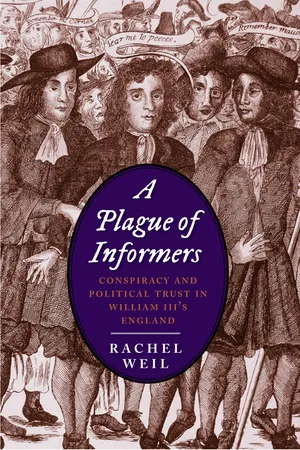 eBook - PDF
A Plague of Informers
Conspiracy and Political Trust in William III's England
- Rachel Weil(Author)
- 2014(Publication Date)
- Yale University Press(Publisher)
3 Representing the Revolution Defining the Assassination Plot broadly made it possible to rewrite recent history. In hindsight, the Assassination Plot discovery lent credence to the Lancashire Plot. Clues to the connection were eagerly awaited and reported. Luttrell, for example, noted in his diary in June, “Mr. Knightly, prisoner in Newgate, has given some light into the conspiracy as also the Lancaster Plot.” A True History of the Horrid Conspiracy , published sometime in June, eagerly reported that “one of the evidences . . . made such a discov-ery as did in a great measure confirm the Lancashire Plot; which the disaf-fected party had so much labored to ridicule.” Two longer and more reflective histories of the plot, James Abbadie ’s History of the Late Conspiracy (1696) 251 a s s a s s i n a t i o n p l o t and Richard Kingston’s True History of the Several Designs and Conspiracies (1698), wove the Lancashire Plot (as Lunt had described it) into a seamless narrative culminating in the Assassination Plot. 4 England’s currency woes were another one of the government’s embar-rassments that could be reinterpreted in light of the plot discovery. Abbadie reminded readers of his History of the Late Conspiracy that Titus Oates’s rev-elations of 1678 had been reckoned a fable because they contained “some things which were looked upon as incredible, by reason of the enormity of the crimes.” Among these allegations was one that conspirators had adulter-ated money and exported currency. Now, said Abbadie, “later experience has convinced us that they were really true; especially what relates to trade, exportation of species, and the debasement of money.” 5 Defining the Assassination Plot broadly also helped to enhance the affec-tive appeal of the regime. Paul Monod’s work has rightly called attention to the openly sentimental side of Jacobitism.
Index pages curate the most relevant extracts from our library of academic textbooks. They’ve been created using an in-house natural language model (NLM), each adding context and meaning to key research topics.

