History

Rye House Plot
The Rye House Plot was a failed assassination attempt on King Charles II and his brother James, Duke of York, in 1683. The plot was led by a group of Whig politicians who were unhappy with the King's pro-Catholic policies and wanted to replace him with his Protestant brother. The plot was discovered and the conspirators were arrested and executed.
Written by Perlego with AI-assistance
Related key terms
1 of 5
3 Key excerpts on "Rye House Plot"
 eBook - ePub
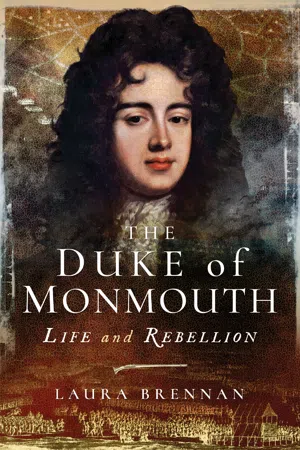
The Duke of Monmouth
Life and Rebellion
- Laura Brennan(Author)
- 2018(Publication Date)
- Pen & Sword History(Publisher)
The Rye House Plot brought the Duke of Monmouth close to the fate of some of his friends; it was his wife whom he had cheated on and was virtually estranged from, who would beg for his life with his father, the king. It is fair to surmise that this was the point where Monmouth’s relationship with his father had completely changed; Monmouth was no longer on the pedestal Charles had put him on, he had lost his father’s admiration and respect, and was no longer a court favourite. The foiled plot would also seal York’s unfavourable opinion of his nephew and consequently this would set Monmouth firmly on the road to his doom.The plot takes its name from the location where the assassination should have taken place. Rye House was a manor located in the southern county of Hertfordshire and at the time of the plot, it was being rented by a former Parliamentarian and supporter of Cromwell, Richard Rumbold. In the lead up to the would be assassination, Rye House, a solid property surrounded by a moat, was being prepared with supplies, weapons and men. During the planning, both the insurrection and assassination were discussed, but not all in the group were happy to commit or be part of regicide. Rye House’s location was excellent for such a plot as it was just far away from Tory-held London and remote enough for the plotters to hope that their dastardly plan had a better chance of being kept secret and succeeding.The detail of the plot was to assassinate Charles and the Duke of York on their way back to Whitehall after attending the races at Newmarket. The plot was spoiled when the royal party left Newmarket just over a week earlier than planned, following a major fire that broke out in the town. The fire was reported in the London Gazette at the time:Newmarket March 23. Last night between nine and ten a clock a fire happened here which began in a stable yard and burn so violently the wind being high, that in a few hours above half the town was laid in ashes. Their majesties removed to earl of Suffolk’s house.44
- John Spurr(Author)
- 2016(Publication Date)
- Routledge(Publisher)
Chapter 10Shaftesbury and the Rye House Plot
Philip MiltonFew episodes in Shaftesbury’s career have been quite as controversial as his apparent involvement in the conspiracies that have come to be known as the Rye House Plot. His death five months before they were uncovered meant that he was never put on trial, but the government was sure of his guilt. At Thomas Walcot’s trial in July 1683, the Attorney General told the jury that during the previous October ‘a noble lord, that is gone now to his own place’ had supplied the conspirators with considerable sums of money for assassinating the King.1 He undoubtedly meant Shaftesbury, and the jury would have known this. In the official account of the plot, written by Thomas Sprat on the instructions of Charles II, Shaftesbury was described as ‘the chief Author, and supreme Manager of all these Trayterous Contrivances against his Majesties Crowns and Life’.2None of Shaftesbury’s biographers have believed him wholly innocent. Martyn and Kippis accepted his involvement in the insurrection plot, adding that ‘other and more violent designs’ – the assassination plot – had been ‘entertained by some of those whom Shaftesbury had admitted into his counsels’.3 Christie thought it ‘undisputed’ that Shaftesbury, Monmouth and Russell had ‘entered into serious consultations for a rising against the King’.4 Brown seems to have taken much the same view.5 Haley was more cautious. Although willing to concede that Shaftesbury had probably advocated the use of force, he thought that there was insufficient evidence that ‘anything was in existence which could be called a plan for a rising at any date’ and he dismissed the evidence of Shaftesbury’s involvement in the assassination plot as ‘far too slender to accept’.6 eBook - ePub
- Tim Harris(Author)
- 2017(Publication Date)
- Bloomsbury Academic(Publisher)
The Rye House conspiracy, which was revealed in the late spring of 1683, failed to come to anything because the conspirators could not agree when the time was right to launch their planned insurrection; it was becoming clear, even to them, that by late 1682/early 1683 the right time had passed. Instead, the country celebrated deliverance from the plot with bonfires and loyal addresses; even Taunton, ‘lately esteemed one of the most disloyal and factious places in England’, saw ‘great outward expressions of joy … by ringing of bells, beating of drums, bonfires, feasting etc.’, prompting the local under-sheriff to conclude ‘the populace are undeceived to admiration’. 123 The eventual succession of the Catholic heir in February 1685 went more smoothly than anyone could have predicted. There were loyal addresses from all over the country, public rejoicings at the declaration of the new king, and the general elections of the spring produced a parliament that was overwhelmingly Tory in sympathy, with only 57 Whigs returned to a Commons of 513, and with the Tories even doing extremely well in the more open constituencies. 124 Although the Duke of Monmouth did launch a rebellion in the west country in the summer, the support it attracted proved extremely disappointing, and it was soon put down. Again, the kingdom celebrated its deliverance with bonfires. 125 III We have seen, then, that Charles II and his advisers rose to the challenge posed by the Whigs during the Exclusion Crisis by joining the battle for public opinion. They self-consciously sought to appeal to the multitude or the vulgar, developed strategies for communicating their political views and justifying their actions to the broadest possible cross-section of the population, and deliberately sought to promote (both indirectly and directly) mass political activity in support of the crown (in the form of petitions, addresses and demonstrations). Moreover, the strategy served its purposes extremely well
Index pages curate the most relevant extracts from our library of academic textbooks. They’ve been created using an in-house natural language model (NLM), each adding context and meaning to key research topics.

