History

Cominform
Cominform, short for Communist Information Bureau, was an organization established in 1947 by the Soviet Union and its Eastern European satellite states to coordinate communist activities and policies. It aimed to promote unity among communist parties and counter the influence of the United States and its allies during the early Cold War period.
Written by Perlego with AI-assistance
Related key terms
1 of 5
5 Key excerpts on "Cominform"
 eBook - ePub
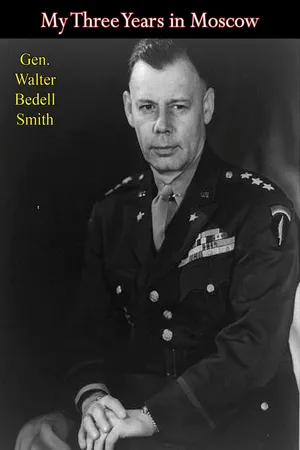
- Gen. Walter Bedell Smith(Author)
- 2018(Publication Date)
- Eschenburg Press(Publisher)
I am glad to report that neither of these steps came as a surprise to the Embassy or to the United States Government. Much as we were deliberately isolated from original sources of information in the Soviet Union, it is inevitable that when one lives there long enough to become thoroughly steeped in Russian history, Stalinist ideology and Communist double-talk, he develops a fairly accurate “sixth sense” for what the Kremlin is going to do and why.Moscow had, for some time, been showing an inclination to tighten the bonds between the Communist parties throughout the world and, for this purpose, had adopted the procedure of organizing what were really big international Communist meetings around important national Communist congresses. Thus I find notes in my diary early in 1947, which were reflected in my reports to the State Department, to the effect that the British Communist Party conferences held in London at that time seemed to be the occasion for a secret, rather large-scale Comintern meeting. Visiting delegates of considerable importance in the Communist world were to be present from practically all countries in Europe and the Near East. We felt that this revived international Communist activity was probably a prelude to the overt re-establishment of an international Communist agency.Furthermore, the recapture of the initiative by the West through the Truman and European reconstruction programs had put the Kremlin on the defensive and called for some dramatic new action. Consequently, while the actual time and place of the Cominform meeting in Poland was a carefully guarded secret to which we were not privy, it was no surprise when Pravda , on October 5, 1947, announced that the conference of Communist Party leaders from nine countries had taken place.Actually, the public establishment of the Cominform probably added very little to the thoroughness or the effectiveness of the Kremlin’s international organization which had been constantly and continuously in existence under cover. However, organization is not everything. The struggle for Europe is to a large degree a struggle for the minds and for the allegiance of men.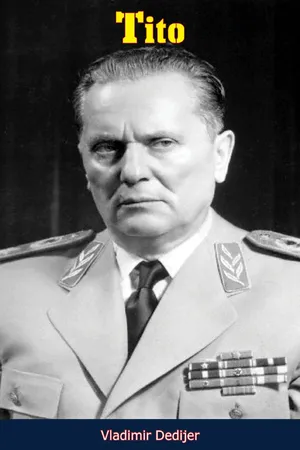 eBook - ePub
- Vladimir Dedijer(Author)
- 2018(Publication Date)
- Eschenburg Press(Publisher)
It was realized that there was no guarantee that Tito would return alive from such a meeting. The Yugoslav Communists were familiar with the methods of invitations to “consultation” used by Stalin and Molotov for those who disagreed with them. In 1937 the whole Politburo of the Ukrainian Party was opposed to Stalin’s Greater-Russian policy. Molotov arrived at Kiev on Stalin’s orders and went to the Politburo meeting. He failed to persuade a single member that the Ukrainians were wrong. Then Molotov convened the Plenum of the Central Committee, but its majority also declared itself for the Politburo. Several days later an invitation arrived from Stalin asking the Ukrainian Politburo to consultations in the Kremlin. They responded and set out for Moscow. As they entered the Kremlin, the N.K.V.D. arrested them all and Stalin later had them shot.Finally Tito informed Souslov of the Central Committee decision not to send a delegation to the Cominform meeting.The Russians reacted on May 22. Their letter was extraordinarily typical of them. It clearly confirmed they had founded the Cominform not as a consultative body for the exchange of views between Communist Parties, but as a weapon with which to impose their will upon the other Parties, especially the Yugoslav.Here are several passages from the letter:“Comrades Tito and Kardelj write that they feel ‘in such an unequal position that they find it impossible to consent to discuss this matter before the Informburo and moreover permit themselves to suggest that the Central Committee of the Soviet Communist Party has brought the Yugoslav leaders to such an unequal position.“The Central Committee of the Soviet Communist Party considers that there is not a grain of truth in this assertion. There is no inequality nor can there be for the Yugoslav Communist Party in the Informburo of nine Communist Parties. Everyone knows that during the organization of the Informburo all the Communist Parties were guided by the indisputable view that each Party should submit reports to the Informburo just as every Party has the right to criticize other Parties. It was this principle that the conference of nine Communist Parties had in view, when it heard the reports of the Central Committees of all the Communist Parties in September, 1947, without exception. The conference of the nine Communist Parties was guided by the equal right of every Party to criticize every other Party when it subjected the work of the Italian and French Communist Parties to severe Bolshevik criticism. eBook - ePub
Power And Persuasion
Ideology And Rhetoric In Communist Yugoslavia, 1944-1953
- Carol S Lilly(Author)
- 2018(Publication Date)
- Routledge(Publisher)
The impact of CPY rhetoric on the Yugoslav population during this period is difficult to assess. For as in the immediate postwar era, contemporaries of the time have described the atmosphere from mid-1948 to 1950 as either exciting and hopeful or repressive and frightening, depending on their individual experiences and political affiliation. In either case, it seems that the confusion of the era generated a degree of public activism previously lacking. Whether manifested as support for or opposition to the regime, such activism served to revitalize state-society relations.Two Steps Backward
Attacks on the Opposition
One of the most immediate and tangible consequences of the June 1948 Cominform split was the party's increased reliance on force in dealing with political and ideological opponents. The party apparatus not only persecuted those members of the party and society who openly or secretly supported the Cominform resolution (known as Cominformists), but also applied blatantly coercive measures to all potential opponents of the party leadership both in and outside the CPY. The purpose was not only to squelch pro-Soviet elements within the country but to reemphasize the party leadership's dominant position. Consequently party leaders now renewed their attacks on many old opponents—including prewar party factionalists, the clergy "kulaks," and other "class enemies." As in 1945, numerous purges of "enemy" youth were conducted in the universities. The ground for increased repression against potential opponents outside the CPY had been prepared in the immediate pre-split period when party leaders openly admitted their socialist intentions and increased official emphasis on their guiding Communist ideology. The dramatically heightened rhetoric, arrests, and trials, however, came only after the split and focused first on real or suspected Cominformist agents within the party.8 eBook - ePub
Red Adriatic
The Communist Parties Of Italy And Yugoslavia
- Eric R. Terzuolo(Author)
- 2019(Publication Date)
- Routledge(Publisher)
3 The Cominform Campaign, 1948–1954In the years after the Cominform Resolution appeared, most of the world's Communist parties conducted extensive propaganda campaigns directed against Tito's Yugoslavia. The Cominform parties also sent operatives into Yugoslavia to gather information and foment discontent, supported opposition forces within Yugoslavia and generally did anything possible to undermine Titoist power.One can take either a position of strict principle or a relativistic stance in discussing a given party's participation in these Cominform efforts. Coming from the former position, the fact that the PCI approved the various Cominform Resolutions and participated in "work in the direction of Yugoslavia" is the only relevant fact. Relativists, on the other hand, would regard differences in participation and enthusiasm as significant. Togliatti, by both temperament and intellectual predilection, was well disposed to a relativistic perception, and this perception still informs Italian Communist interpretations of Cominform history. But even Fernando Claudín, who spares no criticism of the Western Communist parties, adopts a relativistic approach.1 Comparisons between parties in terms of their support for and participation in the Cominform campaign seem significant and apt to result in meaningful distinctions.The PCI as a Hesitant Accuser
Although matters of degree are rather difficult to document, one has a definite impression that the PCI was hesitant to be cast as a major accuser of the KPJ. To take one example, the documents published in preparation for the October 1948 congress of the PCI Federation of Udine, where the dispute ultimately took on relatively bitter tones, do not even mention the Yugoslav conflict with the Cominform.2 a certain slowness in starting the campaign may have resulted from the assassination attempt against Togliatti in July 1948. Indeed, even after the PCI had accepted the Cominform Resolution, the KPJ expressed its solidarity with the PCI leader.3 While L'Unità did not devote much attention to events in Yugoslavia, Borba even reported on PCI successes in elections for workers' committees and expressed sympathy with the PCI-controlled national union, the Confederazione Generale Italiana Lavoratori (CGIL), seen to be under increasing attack from "Italian ruling circles."4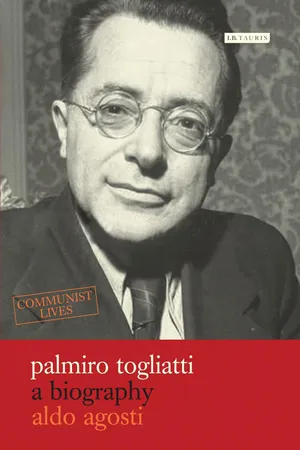 eBook - PDF
Palmiro Togliatti
A Biography
- Aldo Agosti(Author)
- 2008(Publication Date)
- I.B. Tauris(Publisher)
8 COLD WAR AND RETREAT CRITICISMS BY Cominform For the entire summer of 1947, the PCI’s political line was characterised by overall moderation. Togliatti was motivated not only by the hope of a prompt return to government, but also by the desire to obtain final approval of a draft for the constitution which would ratify the gains of the struggle for liberation, together with an institutional framework in which the PCI would be fully recognised. Nevertheless, in view of the social tensions caused by the government’s economic policy, Togliatti had to make certain concessions to the dissatisfaction voiced by the leaders of his own party, who considered his position ‘too soft’. However, a real change in the PCI line could only be detected after the beginning of October. A meeting of nine communist parties took place on 22–26 September at Szklarsa Poreba, in Polish Silesia; seven of the participants were those in power in the ‘People’s Democracies’, and they were joined by the French and Italian communist parties. At the end of the proceedings, the formation of the Communist Information Bureau – better known as Cominform – was announced; this was to be a permanent agency, based in Belgrade, for consultation and coordination among the member parties. The invitation to participate was sent to the PCI leadership in August, and the secretariat decided that Luigi Longo and Eugenio Reale would represent the party. We do not know whether it is true, as Reale claims, that Togliatti was invited to speak in person and declined on health grounds.
Index pages curate the most relevant extracts from our library of academic textbooks. They’ve been created using an in-house natural language model (NLM), each adding context and meaning to key research topics.

