History

Bandung Conference
The Bandung Conference was a meeting of Asian and African states in 1955, held in Bandung, Indonesia. It aimed to promote economic and cultural cooperation and to oppose colonialism and imperialism. The conference is significant for its role in shaping the Non-Aligned Movement and for fostering solidarity among newly independent nations.
Written by Perlego with AI-assistance
Related key terms
1 of 5


12 Key excerpts on "Bandung Conference"
 eBook - ePub
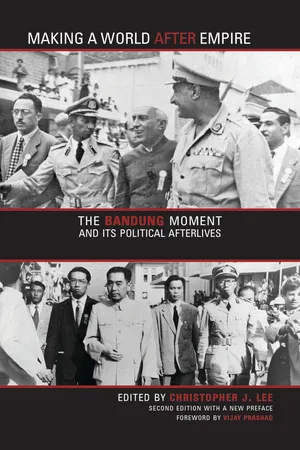
Making a World after Empire
The Bandung Moment and Its Political Afterlives
- Christopher J. Lee(Author)
- 2019(Publication Date)
- Ohio University Press(Publisher)
Introd.2 . Local popular reception of the arrival of international delegations in BandungBandung was such an occasion. In retrospect, it can be seen as a pivotal moment placed in mid-century between colonial and post-colonial periods, between the era of modern European imperialism and the era of the cold war. It summarized an alternative chronology of world events attended by intellectuals and activists of color who had been subjected to forms of colonialism, racism, and class oppression. This historical sequence includes such precursors as the series of Pan-African Congresses that took place beginning in 1900, the 1911 Universal Races Congress in London, the League Against Imperialism meeting held in Brussels in 1927, and the two Pan-Asian People’s Conferences held in Nagasaki (1926) and Shanghai (1927).14 At a deeper level, Bandung also served as a culmination of connections and relationships that had crossed the Indian Ocean world for centuries.15 The common ground shared and frequently cited at the conference was the history of Western imperialism in Asia, Africa, and the Middle East since the sixteenth century. These claims similarly extended to a broader set of thematic experiences including racism and cultural discrimination, which further attracted such noted observers as Richard Wright, the African American novelist.16 The meeting therefore captured and represented a complex global present, one that signaled political achievement but also future uncertainty. Of the twenty-nine countries that sent official delegations, many had attained independence, though there were others, particularly from Sub-Saharan Africa, which still remained under the last remnants of colonial rule. Not all were former colonies either. Constituting a diverse spectrum, participants included leading lights of the postcolonial world, such as India and Egypt, as well as countries that had recent imperial legacies of their own, namely Japan.17 From cultural, religious, and linguistic standpoints, the differences between attendees were equally pronounced. And yet, it is essential to recognize that the organizers themselves acknowledged such factors of division, resting their contingent solidarity and sense of purpose on a shared history of Western aggression.18 eBook - PDF
The Anticolonial Front
The African American Freedom Struggle and Global Decolonisation, 1945–1960
- John Munro(Author)
- 2017(Publication Date)
- Cambridge University Press(Publisher)
Indonesian president Sukarno decided to host the conference at just this spot, and for good measure renamed it the Freedom Building during a pre-conference inspection of the site. 6 Bandung’s Many Meanings The Bandung Conference was in many ways an announcement that colonialism was the fundamental dynamic of an age often thought of in cold-war terms. In April of 1955, representatives of twenty-nine African and Asian nations met in the Indonesian city in the hopes of fostering cooperation between postcolonial nations, to indicate that race and empire were issues of paramount concern in the Third World whether or not independence had been attained, and with the intent to explore the possibilities of economic cooperation. 7 It was a complex event subject to varied interpretations, many of which were inflected by cold-war politics. General Carlos Romulo of the Philippines, who attended the conference, was one representative of the pro-US position. Although he felt that “goodwill was supreme” among the varied delegates, he worried that “counter-racism” might lead into a “racist trap” in which people of color would “lump white men by their supposed racial grouping and govern our acts and reactions accordingly,” thereby betraying the “uni- versal” values held up by the United States and “most of the Western countries.” 8 Ajoy Ghosh, the General Secretary of India’s Communist Party, also noted that Bandung heralded Third World solidarity, but insisted that the delegates had come to realize that “they were faced with the triple task of defending their own national freedom, of resisting the imperialist war drive and of upholding the cause of Asian solidarity.” 9 Cold-war ideology mattered at the conference and in how those follow- ing it interpreted its meaning, but even for some “aligned” nations, such as Japan, Bandung provided space to promote regional allegiances not wholly beholden to superpower patrons.
- Ide Anak Agung Gde Agung(Author)
- 2018(Publication Date)
- De Gruyter Mouton(Publisher)
It was the first manifestation of the Asian and African nations of their intention to: 'make decisions on their own future without interference from the Western world,' (Barnett, 1955b: p. 97), as Premier Ali from Indonesia put it in describing the character of the conference at which such a wide range of world topics were discussed. It is true that in January 1949 the Asian and Arab states had met in conference in New Delhi on the invitation of Premier Nehru, but the subject of discussion then was restricted to the Indonesian problem, in order to give support to the Indone-sians in their struggle against the Dutch intention to bring back colonial rule over Indonesia, and to contribute to the United Nations in its search for a peaceful settlement in the Dutch-Indonesian dispute. Thus, the two confe-rences were different in character, purpose, and scope, so that the Ban-dung Conference could truly be said to be the first Asian-African confe-rence of that magnitude, stressing the solidarity of the Asian and African nations and their indomitable will to put the Asian-African states on the world map of diplomacy, not allowing other powers to decide over their political destiny and future. Observers at that time were correct in stating that: 'the conference in New Delhi in 1949 was the birth of Asian-African solidarity, while this Bandung Conference was the high noon of Asian-African solidarity.' (Jan-sen, 1966: p. 399·) It was characterized as a conference of 'the Rebirth, revival and Renaissance of the colored people' by Premier Ali of Indonesia and as a conference of brotherhood... that 'will give evidence that Asia and Africa have been reborn, nay, that a New Asia and a New Africa 220 Indonesia's foreign policy until the implementation of guided democracy have been born!' by President Soekarno in opening his speech at Bandung. (Kahin, 1956: p. 50.) The reactions of the big powers vis-ä-vis the conference were different one from the other. eBook - ePub
Meanings of Bandung
Postcolonial Orders and Decolonial Visions
- Quynh N. Pham, Robbie Shilliam, Quỳnh N. Phạm, Robbie Shilliam(Authors)
- 2016(Publication Date)
- Rowman & Littlefield(Publisher)
INTRODUCTION Chapter 1 Reviving Bandung Quýnh N. Phạm and Robbie Shilliam Introduction“[T]his hall is filled not only by the leaders of the nations of Asia and Africa; it also contains within its walls the undying, the indomitable, the invincible spirit of those who went before us,” declared Indonesian president Sukarno, as he hosted twenty-nine nations of Asia and Africa from April 18 to 24 in 1955 (Asia-Africa Speaks 1955). These newly independent nations met in Bandung, Indonesia, to discuss the present condition and future prospects of international relations. Upon reading the news of this historic gathering a few months before, African American writer Richard Wright, even from remote Paris, instantly realized its empire-shaking significance: “[T]his is the human race speaking” (Wright 1956: 11–13). Wright felt compelled to go and witness “the agenda and subject matter” that “had been written for centuries in the blood and bones of the participants.” Both Sukarno’s solemn tribute to “those who went before” and Wright’s thrilled “stream of realizations” that “[t]his smacked of something new, something beyond Left and Right” suggest that the meanings of the event, what is known nowadays as the “Bandung Conference” or simply “Bandung,” far exceed the standard narratives of geopolitics, diplomacy and ethics.It is not that certain conventions of international relations cannot be read into the conference. It has been argued that among the major concerns for its five original sponsors – Burma, Indonesia, India, Ceylon and Pakistan – were diffusing growing tensions between China and the United States, decreasing polarization between the two ideological poles of the Cold War, and addressing the destructive power of nuclear and thermo-nuclear explosions (e.g. Kahin 1956). However, it is telling that the few engagements with Bandung in the field of International Relations have tended to place it entirely within already-existing theoretical problematiques. Apart from the predominant focus on strategic self-interest and statesmanship, Bandung was, in the estimation of English Schooler Martin Wight (1987: 224–225), an example of “Kantian moral solidarity” in action, that is, an attempt to “sweep away evil” from international society (see also Jackson 2005: 66). More recently, Roland Burke (2010: 13–34) has placed Bandung as a landmark in the evolution of the United Nations and its mission to promote universal human rights. Alternatively,
- Roland Burke(Author)
- 2011(Publication Date)
- University of Pennsylvania Press(Publisher)
Chapter 1
Human Rights and the Birth of the Third World: The Bandung Conference
At Bandung something unexpected happened. The voices of freedom spoke clearly and decisively.—Carlos Peña Romulo, Philippine delegate, 1956I understand the chief objective of this Conference is to promote neighborly amity and mutual understanding among the peoples of the Asian-African region…. This objective tallies exactly with the aim of the Universal Declaration of Human Rights calculated to preserve peace, freedom and justice. It will, I trust, appeal to all men and women who have at their hearts the progress of mankind.—Tasunosuke Takosake, Japanese delegate, address to the opening session of the Asian-African Conference, April 1955The 1955 Asian-African Conference in Bandung, Indonesia was a landmark in the emergence of the non-aligned movement and the birth of the Third World.1 Celebrated as a turning point in international affairs, its participants included the six independent states of Africa, along with virtually all of Asia. The meeting at Bandung, which was so vital to the later development of ideas of non-alignment and Afro-Asian solidarity, also served as a key point of origin for the human rights agenda that would be pursued by the decolonized states in the General Assembly. Just as importantly, its proceedings revealed the prevailing attitude toward human rights amongst the leaders of the nascent Third World. Their speeches at Bandung marked out many of the basic contours that came to define key UN human rights battles, such as that on self-determination.While the implications of the Asian-African Conference for international relations have been widely acknowledged, little scholarship has been devoted to conference's significance for human rights. Given the considerable prominence of human rights at the conference, its virtual absence from most accounts is surprising. Mary Ann Glendon, in her pioneering history of the founding years of the UN human rights regime, has offered a brief, generally negative assessment. Glendon argued that the conference's significance lay predominantly in its latent anti-Western dimension. The conference “signaled trouble ahead,” despite the affirmation of universality contained in the Final Communiqué.2 Initial opposition to the recognition of the Universal Declaration by the Chinese presaged future struggles over the universality of human rights.3 Unity at Bandung was achieved, in Glendon's view, “through shared resentment of the dominance of a few rich and powerful countries.”4 This anti-Western “mood” at Bandung very quickly found expression “in characterizations of the Declaration as an instrument of neocolonialism and in attacks on its universality in the name of cultural integrity, self-determination of peoples, or national sovereignty.”5 eBook - ePub
Japanese Diplomacy in the 1950s
From Isolation to Integration
- Makoto Iokibe, Caroline Rose, Junko Tomaru, John Weste(Authors)
- 2008(Publication Date)
- Routledge(Publisher)
The study is based essentially on US archival documents which inform us about the thought processes and decisions of top officials of the State Department, the US Embassy in Tokyo and the Japanese Ministry of Foreign Affairs (MoFA). What is manifestly evident in the study are Japan’s initiatives in the mid-1950s (under the Hatoyama Ichirō administration) to reaffirm an independent foreign policy, away from encroachments from the State Department. The study is separated into five sections: US concerns about the Conference and a perceived shift toward neutralism in Japan; pre-conference consultations between the US and Japan; the composition of the Japanese delegation and America’s concerns about it; the semblance of a working compromise between the US and Japan; and America’s response to the Japanese performance at the conference.The Bandung (officially the Asian—African) Conference of 18–24 April 1955 emanated from the Bogor Conference of 28–29 December 1954. The latter, which was also attended by the prime ministers of India, Indonesia, Burma, Ceylon, and Pakistan, was a by-product of the Colombo meeting of May of the same year. Before the meeting in Colombo there had been the shadowy and halting existence of the Asian Relations Organisation which emanated from the Asian Relations Conference of March 1947—an event of great historical significance for a continent bursting out of its seams in its desire for international recognition and respect.At the meeting in Colombo, the leaders of the five participating countries adopted a loosely worded agreement that pledged their five countries to neutrality in the conflict between the Communist bloc and the West.2 Jawaharlal Nehru, the prime minister of India and the most influential of the leaders, had also intimated just before the Bogor Conference that the objective of the meeting in Bandung ‘should be to create an atmosphere of co-operation and to put Asia and Africa more in the picture.’3 This was necessary because, as he put it, ‘the old balances no longer hold good’. More importantly, it was also agreed that the Bandung Conference should aim to contribute to the reconstruction of the economies of the participating countries. Consequently, the Colombo powers agreed to set up a committee for economic assistance and were determined to lay the foundations for the technological advancement of Asia, a proposal that the Japanese found rather attractive.4 eBook - PDF
- Joo-Jock Lim(Author)
- 2018(Publication Date)
- ISEAS Publishing(Publisher)
In Pravda (23 April 1985), the paper's political correspondent, Vsevolod Ovchennikov, declared that "many of the problems" that had beset the delegates at the 1955 Asian-African Conference "have since been resolved". But "imperialism" remained, and the United States was intent on taking "social revenge" (a term not further explained) on those who opposed its attempt at world dominion. Still, "Bandung Il" offered "an excellent occasion" to consider modern problems "in the ways" of the first conference's "heritage", according to Ovchennikov. The organ of the Institute of the Far East of the Soviet Academy of Sciences, Far Eastern Affairs (no. 3, 1985), made an attempt to see "Bandung II" in historical depth. The first Asian-African Conference in 1955, V. Vasilyev wrote, had reflected the "urgent task" confronting the then newly independent Asian and African states, and the older Latin American nations as well, to join together in preserving international peace against the alleged schemes of the "imperialist powers". With a nice eye for the present nuances in ASEAN policy towards the Kampuchean conflict, particularly Indonesia's current con- ciliatory moves towards Vietnam, Vasilyev declared that "it is common knowledge" that the "first" attempt at such a joint peace venture had been launched in 1945 by Ho Chi Minh, when he proposed to Indonesia a joint action against colonialism as well as the formation of a Southeast Asian mutual "cooperation commission". According to Vasilyev, the first Asian-African Conference in 1955 had been subjected to the machinations of those who had wanted to use it "to weaken if not to eliminate the socialist world's influence in Asia". But Asian-African solidarity, and the support from the socialist community, had foiled these "reactionary" schemes. The first, like the second Asian-African Conference, represented "an objective historical tendency" against colonialism, according to this analysis. eBook - ePub
Non-Aligned Movement Summits
A History
- Jovan Cavoški(Author)
- 2022(Publication Date)
- Bloomsbury Academic(Publisher)
The 1961 Belgrade Conference, formally the very first summit of non-aligned countries, as well as the point of origin of the NAM but not its true birthplace, represents a major international event, a defining moment and a conceptual watershed in the history of the non-bloc, Third World and developing countries during the early Cold War years. Together with the earlier Asian-African Conference held in the Indonesian town of Bandung in April 1955, a gathering of a similar though not identical format, this summit in Belgrade stands tall as one of two major international events shaping the collective postcolonial and non-bloc identity, thus largely determining the guiding principles, political outlook and international presence of countries standing between the blocs during 1950s and early 1960s.However, when one discusses the link between the Bandung Conference and the history of global non-alignment, in the international literature a straight line often exists between this gathering and the one in Belgrade, often portraying the preceding Afro-Asian event as a precursor to the global history of the NAM.1 However, it is only in more recent literature that some of this earlier comprehension has been largely discarded, with this misplaced historical analogy between Bandung and Belgrade becoming less clear and far more complex.2 Essentially, the Belgrade Conference was largely motivated by ideas, principles and aspirations somewhat different, although not fundamentally, from the ones dominating the Bandung discourse. The NAM was not founded in either of these two places, both envisaged as one-time events; however, the movement’s entire subsequent history had much more to do with the summit in the Yugoslav capital than with the one in Indonesia, particularly with respect to the ideas, principles, motivations and format of such events.3In fact, it was the Belgrade Conference that eventually pushed the non-aligned agenda out of the exclusive orbit of anti-colonial and anti-imperialist sentiments and strict ‘regionalist’ adherence, and set it on a path largely transcending historical, political, social, economic, cultural and other boundaries on four different continents. In this way, this summit was laying down foundations of a more ‘universalist’ programme largely dedicated to international peace and security and economic and developmental issues which were paramount to the stability and prosperity of non-bloc nations, and thus proving these crucial issues were far more conducive to successfully pushing back against any potential neo-colonialist and imperialist resurgence than any calls for an armed struggle set by Bandung.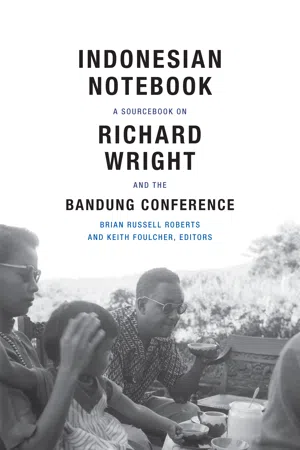 eBook - PDF
Indonesian Notebook
A Sourcebook on Richard Wright and the Bandung Conference
- Brian Russell Roberts, Keith Foulcher, Brian Russell Roberts, Keith Foulcher(Authors)
- 2016(Publication Date)
- Duke University Press Books(Publisher)
As Barthes observes, this image required putting “the biography of [this individual] Negro in parentheses” (116) in order to “naturalize” the logic and coherence of the French Empire (131). If on the one hand the “young Negro” appearing on the magazine cover functioned to naturalize European empire, then the Bandung Conference (on the other hand) has worked at cross-purposes with the French “Negro,” emerging in some scholarly and popular narratives as an equally mythic image but stand-ing resolutely against European and American empire, as a naturalization of postcolonial ideals and conditions during the late twentieth and early twenty- first centuries. The Bandung Conference’s mythic quality found commentary just eleven years after it convened in 1955. A decade after Wright published The Color Curtain , the India-based British journalist G. H. Jansen wrote in his book Nonalignment and the Afro-Asian States that “two conferences were held at Bandung in April 1955. One was the real conference, about which not very much is known. . . . The other was a quite different conference, a crystallisa-tion of what people wanted to believe had happened which, as a myth, took on reality in . . . the Bandung Spirit” (182). Nearly a half century after Jansen’s observations on the two conferences, scholars have increasingly observed— and sought correctives for the fact—that while we know very little about the Bandung Conference, the Bandung myth has continued to grow. Historian Lorenz L ü thi has framed the conference as a mythic stand-in for a much more complex—and as yet undocumented—history of the development of Asian- African solidarity and “cooperation among countries from the Global South” (1), and political scientist Robert Vitalis has critiqued a sometimes superficial narrative of Bandung as the “birthplace of not one but two global ‘solidari-ties’ ”—“non-alignment” and “global racial consciousness” (261).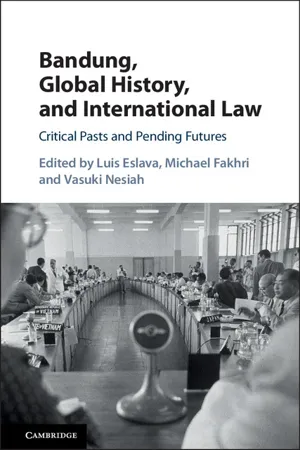 eBook - PDF
Bandung, Global History, and International Law
Critical Pasts and Pending Futures
- Luis Eslava, Michael Fakhri, Vasuki Nesiah(Authors)
- 2017(Publication Date)
- Cambridge University Press(Publisher)
It was a coming out party for the Peoples Republic of China and the Democratic Republic of Vietnam (North Vietnam) and marked the first time that emissaries of Asia’s two communist States had met with a general assemblage of Africans and other Asians. 14 The world needed alternatives to the decaying Manichean visions of the West and East. Bandung could have been the first step toward a radically new, more humane path. However, it ultimately helped promote new false dichotomies. The Conference was a valiant attempt, at best, to construct an escape for dispossessed peoples from inexplicable and unyielding forces of history and time that no evocation of false worlds or paradise could counter. The organ- izers may have thought, perhaps even believed – if only briefly – that it would be different when they were in charge. But even if we grant them hubris, they were like many others before them, undisciplined and dangerously romantic. They prepared against what they understood but they did not fully appreciate the irreducible immensity, dynamism, relentlessness, and comprehensiveness of the human capacity for the absurd. Their egotism or hubris cannot be a sufficient excuse and their legacies should not be covered up in retelling of myths. 14 See Tillman Durdin, “Richard Wright Examines the Meaning of Bandung,” NY Times, Mar. 18, 1956. Bandung 1955 131 A brief discussion of the rule of two iconic figures of the era, Sukarno of Indonesia and Kwame Nkrumah of Ghana, further illustrates the level of deceit perpetrated by those who saw Bandung in the reign of these servants turned saviors turned oppressors. sukarno: father of the nation Sukarno was a preeminent leader of Indonesia’s epic struggle for independ- ence against the Dutch and their European allies. His courage, tenacity, and commitment in that struggle cannot be faulted. eBook - ePub
Informal Alliance
The Bilderberg Group and Transatlantic Relations during the Cold War, 1952-1968
- Thomas Gijswijt, Thomas W. Gijswijt(Authors)
- 2018(Publication Date)
- Routledge(Publisher)
As this chapter shows, the Bilderberg discussions on decolonization did provide a much-needed forum to air grievances and to draw attention to the difficult political implications of the colonial question in most NATO countries. The Suez crisis was the most dramatic expression of transatlantic differences and led to much soul-searching at the 1957 Bilderberg conference in the United States. In terms of practical solutions to the challenge of decolonization, the Bilderberg discussions focused strongly on economic development and technical assistance. This was important because many Bilderberg participants and members, from World Bank President Eugene Black to Eisenhower speechwriter C. D. Jackson, were engaged in private and public initiatives focused on development of the ‘underdeveloped world.’The Bandung Conference and the emergence of the Third World
Starting in the second half of 1954, transatlantic differences over decolonization became more important because of two related developments. First, the Soviet Union and China increased their efforts to bring the non-aligned countries of the Third World into the Communist bloc. At the very least, they attempted to create a sense of community among these countries based on their colonial experiences, the question of race, and a sense of inferiority vis-à-vis the West. Moscow’s leaders started traveling to countries such as India, offering help and advice on industrialization and spreading the communist gospel. The Soviet strategy of peaceful coexistence, in other words, meant the emergence of the Third World as an important new battlefield.Secondly, Indonesia and several other Asian countries took the initiative to organize a large conference in Bandung, Java bringing together leaders from Asia, Africa, and the Middle East. The Bandung Conference took place in the second half of April 1955 – a few weeks after the Barbizon conference – and gave a prominent world stage to neutralist and communist politicians such as India’s Prime Minister Jawaharlal Nehru and China’s Zhou Enlai.3 Nonalignment was one of the keywords of the conference, as many of the world’s smaller nations considered ways of not being drawn into the Cold War.4There was no shortage of issues on the Bandung agenda with a decidedly anti-Western connotation. The history of colonialism and the remaining decolonization conflicts no doubt were the most emotional ones, but many politicians, especially in Asia, were also worried about having to choose sides in the Cold War. They resented the fact that the United States had created the Southeast Asia Treaty Organization (SEATO) after the armistice in Indochina, and they wished to see the dangerous conflict between communist China and the nationalist Chinese on Formosa – in which the United States played a key role – brought to an end. Last but not least, there was the question of race. As Antoine Pinay said at Barbizon: “For the first time we will see a Conference, organized at the initiative of communist countries, representing almost one billion people at which no one representing the white race will be present.”5 eBook - ePub
Hard Interests, Soft Illusions
Southeast Asia and American Power
- Natasha Hamilton-Hart(Author)
- 2012(Publication Date)
- Cornell University Press(Publisher)
Taufik Abduallah’s history gives the conference all of two pages and offers no elaboration of its goals or the wider international context. The lack of attention to Bandung across the region prompted one historian to ask, “How to account for the failure of either the Bandung Conference or the Bandung Spirit to appear as much more than a quaint footnote in thematic and narrative treatments of the region’s recent past?” The answer, he suggests, lies in the “engagement between China and Southeast Asia at Bandung, in most ways the highlight of the Conference,” combined with “the effective writing both of China and of linkages with China out of the historiography of the region.” 175 Sukarno-era foreign policy generally gets a hostile reading in New Order histories. Taufik Abdullah’s history of nation-building sarcastically dismisses Sukarno’s charge of neocolonialism and British interference as a reason for Indonesia’s Confrontation and gives no consideration to competing accounts that make his actions intelligible. Although generally ignoring the Cold War context, he clearly favors one side
Index pages curate the most relevant extracts from our library of academic textbooks. They’ve been created using an in-house natural language model (NLM), each adding context and meaning to key research topics.

