History

Potsdam Conference
The Potsdam Conference was a meeting held in Potsdam, Germany, in 1945, between the leaders of the United States, the Soviet Union, and the United Kingdom. The conference aimed to discuss the post-World War II reorganization of Europe and the establishment of peace. Key decisions made at the conference included the division of Germany and the implementation of war reparations.
Written by Perlego with AI-assistance
Related key terms
1 of 5

11 Key excerpts on "Potsdam Conference"
 eBook - ePub
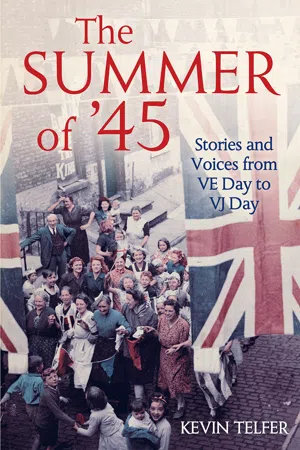
The Summer of '45
Stories and Voices from VE Day to VJ Day
- Kevin Telfer(Author)
- 2015(Publication Date)
- Aurum(Publisher)
Chapter 5 The Potsdam Conference and the New Shape of Europe ‘A desperately serious conference held to decide the future of a stricken continent’Manchester Guardian 1Two months after the end of the war in Europe, the leaders of the three main Allied nations – the United States, the Soviet Union and Great Britain – came together to decide the future of the continent. Truman, Stalin and Churchill – the so-called Big Three – assembled at Potsdam, a city just outside Berlin, the day before the conference started on 17 July 1945. Churchill arrived from the Southwest of France where he had been on holiday, touring through the rubble of Berlin on 16 July before heading to the villa he had been allocated in the grounds of the Cecilienhof Palace, where the conference was to take place.July 16 was a significant day in world history for quite another reason: it was the date of the first nuclear detonation in the Jornada del Muerto desert in New Mexico. Churchill recalled learning about it for the first time the following day when American Secretary of State for War Henry Stimson handed him a report on the detonation. The headline at the top of the page read: ‘Babies satisfactorily born.’ It meant that the test had been successful.‘The bomb, or its equivalent,’ Churchill remembered reading, ‘had been detonated at the top of a pylon one hundred feet high. Everyone had been cleared away for ten miles round, and the scientists and their staffs crouched behind massive concrete shields and shelters at that distance. The blast had been terrific. An enormous column of flame and smoke shot up to the fringe of the atmosphere of our poor earth. Devastation inside a one mile circle was absolute. Here then was a speedy end to the Second World War, and perhaps much else besides.’2Churchill was impressed. For him it changed everything. But for Alan Brooke, Churchill was naïve in the extreme. ‘He had absorbed all the minor American exaggerations, and as a result was completely carried away!’ he wrote in his diary on 23 July. Paraphrasing the prime minister he wrote, ‘It was now no longer necessary for the Russians to come in to the Japanese war, the new explosive alone was sufficient to settle the matter. Furthermore we now had something in our hands which would redress the balance with the Russians!’ Brooke wrote that he ‘tried to crush his over-optimism based on the results of our experiment, and was asked with contempt what reason I had for minimizing the results of these discoveries. I was trying to dispel his dreams and as usual he did not like it.’3 eBook - ePub
Allied Wartime Diplomacy
A Pattern In Poland
- Edward J Rozek(Author)
- 2021(Publication Date)
- Routledge(Publisher)
From the Potsdam Conference to the Elections July 17, 1945 to October 20, 1947 DOI: 10.4324/9780429044434-81. The Potsdam Conference
The new Government centered its attention on the preparation of its case for the western frontier to be drawn along the Oder and Neisse Rivers. At this point, the Poles and the Soviets were in agreement to push Polish frontiers west. Only their motives were different. While the Poles, independent of political affiliations, were anxious to regain western territories which had once belonged to the Polish Kingdom, the Soviets were supporting them in their desire in order to advance their own sphere of influence and control to the west. Furthermore, the Soviets were undoubtedly realistic enough to foresee that the Western Powers would not be so anxious to support the Polish claim against Germany, in the expectation that a democratic Germany would be a stronghold against communist pressure from the east.This meant that only the Soviet Union would support Polish demands and, by doing so, would "prove" to the Poles that the Western Powers were oriented towards Germany while the Soviet Union was the only friend on whom Poles would or could rely. In addition, and from a long-range point of view, the Soviets undoubtedly realized that Polish fears of German efforts to regain these territories would virtually assure Poland's orientation toward Moscow rather than to the West. For the Soviets this was an extremely convenient situation to be exploited for their own purposes.On July 17, the Big Three met at Potsdam. On the second day of the Conference, Stalin asked for an immediate transfer to the Provisional Government of Poland, "of all stocks, assets and all other property belonging to Poland" which was still at the disposal of the Polish Government in London. Furthermore, he asked that all Polish armed forces, including the Navy and the Merchant Marine be transferred to the new Government.1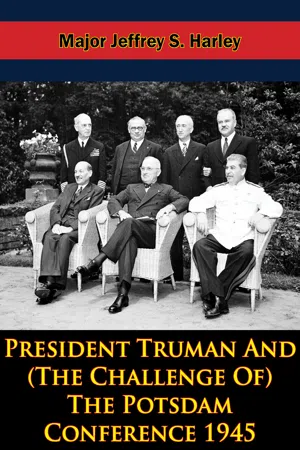
- Col. Uwe F. Jansohn(Author)
- 2015(Publication Date)
- Lucknow Books(Publisher)
THE Potsdam Conference
“Potsdam was a convenient spot, and that was doubtless Stalin’s reasoning for choosing it (to conduct the final conference of the Great Alliance). But the place had a meaning for him, too, that escaped the notice of ‘Churchill and Truman. Potsdam is famous not for the Cecilienhof Palace, where the conference meetings took place, but for the palace of San Souci, built by Frederick the Great of Prussia in 1745. It was...in the rooms of Sans Souci, that Frederick doubled the size of the Prussian Army .For Stalin, then, Potsdam was a memorial to the beginning of Prussian militarism, the end of German military might, and the continuous struggle in peace and war for power. Potsdam was an appropriate setting for the aims of all three leaders who met to confer, though only Stalin knew it.”{110}Truman and his party arrived in Potsdam on the evening of 15 July 1945. Churchill was already there and he had brought his potential successor Atlee with him. The results of the British parliamentary elections would be announced on 27 July 1945 and the British delegation wanted to ensure that pending the outcome a smooth handover would be guaranteed. Since Stalin, who had suffered a minor heart attack, which was a well-kept secret, had not yet arrived at Potsdam the opening session of the conference, scheduled for the afternoon of 16 July 1945, was delayed one day. Truman took the opportunity to receive Churchill for a “social visit” in the morning. Despite the informal nature of the meeting some general conclusions could be made. Truman stated in his memoirs that he and Churchill never had “a serious disagreement about anything, although they argued about many things.” On the fundamentals of the great principles they were in great agreement. Another indicator that the British Prime minister would follow Truman’s strategy was that he had not prepared his own agenda of talking points to present at the meeting.{111} In their discussion about the latest news from the Pacific theatre, there was a first slight change in Truman’s objectives in drawing in the Allies—especially the Soviets—at any prize. Because of recent positive reports Truman had received from East Asia in the last days, he appreciated Churchill’s generous offer to provide British troops, but he stated that the war in the Far East was going well enough without the British and the Soviet help.{112} Churchill enjoyed the meeting and was impressed with Truman’s “gay, precise, sparkling manner and obvious power of decision.”{113} eBook - ePub
The Major International Treaties of the Twentieth Century
A History and Guide with Texts
- John Grenville, Bernard Wasserstein(Authors)
- 2013(Publication Date)
- Routledge(Publisher)
309). The British government and the United States recognized a reorganized Soviet-sponsored Polish Provisional government of National Unity on 5 July 1945. The machinery of Allied control over Germany was established, and the zones of occupation brought under the respective military control of the USSR, France, Britain and the United States. The Polish western frontier had not been finally settled at Yalta; the Russians handed over German territory as far as the rivers Oder and the western Neisse to Polish administration. The Potsdam Conference was to settle future Allied policies, to lay the foundation for definitive peace settlements and to reach agreed policies on the treatment of Germany. The Potsdam Conference, 17 July–2 August 1945 (p. 271) – Attlee, Churchill (prime minister until 26 July when the general election brought Attlee and the Labour Party to power), Stalin, Truman, Bevin, Byrnes, Eden, Molotov – appeared to get off to a good start with an agreement on an American proposal that a Council of Foreign Ministers should be set up to prepare drafts of peace treaties with the ex-enemy states in Europe and Asia (this body replaced the European Advisory Commission); London was chosen as the permanent seat of the council. The French had not been invited to Potsdam but were to be represented on the Council of Foreign Ministers. Germany’s frontiers were not established with finality, though it was agreed that the frontiers of 1937 should be taken as the basis for discussion, which excluded Austria, the territory taken from Czechoslovakia at Munich, as well as German-occupied Poland. The Polish question led to acrimonious debate, particularly the extent of Polish expansion eastward at Germany’s expense, the Russians and Britain and the United States differing later as to what had been settled eBook - ePub
The Allies and the German Problem, 1941-1949
From Cooperation to Alternative Settlement
- Andrew Szanajda(Author)
- 2015(Publication Date)
- Palgrave Pivot(Publisher)
2 The Stage Is Set: The Conferences of Yalta and PotsdamAbstract:Concrete plans for the postwar Allied military occupation were established at Allied Conferences in Yalta and Potsdam following the preliminary work on the Allied treatment of postwar Germany that had been formulated by the European Advisory Commission. The Allied blueprint for the reconstruction of postwar Germany set down plans for Germany to be rebuilt as a unified democratic nation under the direction of separate Allied occupation governments, which was to undertake joint policies until German sovereignty was restored. France was introduced as a fourth occupation in addition to the United States, the United Kingdom, and the Soviet Union and intended to pursue its separate objectives for postwar Germany that were not included in the Potsdam Protocol. Disputes between the Allies also arose concerning Germany’s eastern boundaries with Poland.Szanajda, Andrew. The Allies and the German Problem, 1941–1949: From Cooperation to Alternative Settlement . Basingstoke: Palgrave Macmillan, 2015. DOI : 10.1057/ 9781137527721.0004.The preliminary work on the Allied treatment of postwar Germany was formulated by the European Advisory Commission (EAC). Although the governments that were represented in the EAC confirmed its agreements on the pattern of the postwar Allied occupation of Germany, detailed plans for the occupation were not made. The Allied course of action on postwar Germany would be set by the leaders of the Big Three Allies at the Yalta and Potsdam Conferences, at which the final planning for the joint Allied occupation and administration of Germany was formulated. The notion of dismembering Germany, which had been predominant throughout discussions at the top level, was effectively rejected by the end of the war. The Allied blueprint for the reconstruction of postwar Germany set down plans for Germany to be rebuilt as a unified democratic nation under the direction of the Allied occupation government, which was to undertake joint policies until German sovereignty was restored. eBook - ePub
- Michael Balfour(Author)
- 2004(Publication Date)
- Routledge(Publisher)
discussions, they did not even obtain written confirmation of what had been agreed. They imagined that they had only to consider the rights and interests of their own troops. Only when they met again ten days later to settle how the city should be ruled were they faced with a Russian demand that supplies of food and coal for the Western Sectors must be obtained and brought from the Western Zones; only later still did the question arise of how far and under what conditions German persons and goods possessed rights of movement between the city and the West.THE Potsdam Conference
The meeting which took place at Potsdam between 17 July and 2 August 1945 was not a peace conference and was in no position to dictate a Treaty to the leading enemy state, since there was no German government to sign such a document. Instead the conclusions were given to the world in a ‘Protocol of Proceedings’ drawn up somewhat hastily in the closing hours; it was not considered to need ratification by either Congress or Parliament. Thirteen of its twenty-one sections, amounting to about two-fifths of its total space, did not concern Germany.The Political Principles, based upon an American draft, were agreed to without much argument. Germany was to be completely disarmed and kept indefinitely in that condition. The Nationalist Socialist Party and everything connected with it was to be dissolved: all Nazi laws which provided the basis of the regime or established discrimination on grounds of race, creed or political opinion (though not necessarily other legislation passed since 1933) were to be cancelled. All members of the Party who had been ‘more than nominal participants in its activities’ were to be removed from office, while leaders and high officials were to be interned and war crimininals were to be brought to judgement. A significant clause laid down that ‘so far as practicable’ the German population throughout the country was to be treated uniformly. Preparations were to be made for the eventual reconstruction of German political life on a democratic basis, particularly by the encouragement of democratic political parties and the introduction of selfgovernment from local councils upwards. Freedom of speech, press and religion were (subject to considerations of security) to be permitted. Although no central government was to be established for the time being, five or more central administrative departments were to be set up, which were intended to issue to lower levels the orders needed to get the policy of the Control Council put into execution. One of the objects of the Occupation was declared to be the convincing of the German people that they had suffered a total military defeat and could not escape responsibility for the inevitable distress and chaos which they had brought on themselves. eBook - ePub
West Germany
A Contemporary History
- Michael Balfour(Author)
- 2023(Publication Date)
- Routledge(Publisher)
When they met on 29 June, Zhukov refused to grant his Western colleagues two out of the three railways, one out of the two highways and one out of the three airfields for which they asked. Moreover he made clear that what they did receive would come as a privilege rather than a right, while he passed over in silence their request that all traffic be free from customs control and military (but not police) search. Faced with the need for an immediate decision and reluctant to hold up the Allied arrival in Berlin, not to mention the Summit Conference, by haggling, the British and American generals contented themselves with what they could get, merely reserving the right to reopen the matter in the Control Council (unaware that in it the Russians would have a veto). Partly to save time, partly to leave elbow-room for future discussions, they did not even obtain written confirmation of what had been agreed. They imagined that they had only to consider the rights and interests of their own troops. Only when they met again ten days later to settle how the city should be ruled were they faced with a Russian demand that supplies of food and coal for the Western Sectors must be obtained and brought from the Western Zones; only later still did the question arise of how far and under what conditions German persons and goods possessed rights of movement between the city and the West.Much subsequent argument flowed from the failure to get the Western rights of access to Berlin clearly defined at the outset. The Civil Affairs Department certainly has a good deal to answer for. Against the generals the case is less clear. The cost of being intransigent might have been considerable and the existence of an agreed document would only have impeded and not prevented Russian inclinations to make trouble. In the last resort, the Western presence in Berlin rests not on written texts but on the power which is deployed in its support.The Potsdam Conference
In the meeting which took place at Potsdam between 17 July and 2 August 1945, the British and Americans were at a certain disadvantage. It was barely three months since the inexperienced Truman had succeeded Roosevelt. He naturally hesitated to break away from his predecessor’s determination to work with the Russians and refused Churchill’s suggestion of preliminary Anglo-American discussions for fear of thereby antagonising Stalin. Moreover the British General Election was so timed that the Conference had to be interrupted as it neared its climax while the British delegates went home for the poll to be declared and when they came back, the leaders were Attlee and Bevin rather than Churchill and Eden. Attlee had admittedly attended the Conference from the start while both he and Bevin had belonged to the War Cabinet but according to Churchill this did not prevent them from taking their places ‘without any serious preparation’ and ‘unacquainted with the ideas and plans’ which their predecessors had in view.16 eBook - PDF
The Oder-Neisse Line
The United States, Poland, and Germany in the Cold War
- Debra J. Allen(Author)
- 2003(Publication Date)
- Praeger(Publisher)
2 Interpreting the Potsdam Agreement The months following the Potsdam Conference brought forth varying interpretations of the accord concerning Poland's western border. Poland and the Soviet Union claimed that the conference had settled the border issue that would be confirmed at the peace conference. The United States continued to emphasize the provisional nature of Poland's administration of the western lands until a peace conference settled the issue. In spite of this public stand, U.S. representatives in internal correspondence recognized that the Poles already controlled much of the area, largely with the aid of the Soviet army, and that the possibility of Poland's relinquishing those lands was slim. Thus, a pattern is generally evident in the early years of the Truman administration in which State Department officials protested or objected to Polish and Soviet actions that suggested the Oder-Neisse as a permanent border, recognized privately the ineffectiveness of these protests, and disagreed among themselves about the best course of action in such a situation. POPULATION TRANSFERS This pattern is apparent in the transfer of the German population from the area east of the Oder-Neisse Line. Although the Potsdam Protocol requested the suspension of population transfers until the Allied Control Council developed a plan to carry out the transfers in an "orderly and humane" manner, the removal of Germans from the Polish-administered territories continued. 1 The reason for this was apparent to American Ambassador Arthur Lane when he arrived in Warsaw to take up his assignment. eBook - PDF
Defending the West
The Truman-Churchill Correspondence, 1945-1960
- Gregory W. Sand(Author)
- 2004(Publication Date)
- Praeger(Publisher)
I am sending a similar message to Premier Stalin. 135 136 Defending the West Potsdam—and After Churchill had been pleased to learn that Truman contemplated a meeting that would be unhurried, that would last two weeks, if not longer, and that the meeting would go on and not end so abruptly as happened at the Crimea Conference at Yalta, whatever happened in the British General Election. Churchill's view was that a Peace Conference would "be held later in the year" or in the spring of 1946, following the end of the Japanese war. 136 Truman, for his part, averred that his "immediate purpose" for going to Potsdam "was to bring the Russians into the war against Japan," although his main purpose was to achieve a "working relationship" to pre- vent another world conflict from happening again. 137 Truman and Churchill had never met before, though their liking for one another grew quickly from their first meeting on 16 July, reinforced by their outlook on life and the "great principles" they held in common, in contrast to Stalin's differing outlook which was "guided by the calculation of power." As Truman wrote of his first meeting with Churchill on the morning of July 16th: "I had an instant liking for this man who had done so much for his own country and for the Allied cause. There was something very open and genuine about the way he greeted me." 1 3 8 At Potsdam, accordingly, the following memoranda and corre- spondence between Truman and Churchill dealt with such key mat- ters as the Japanese war and Lend-Lease, and such others as the Munitions Boards, and even Palestine. TRUMAN TO CHURCHILL (Babelsberg) July 17, 1945 Memorandum for the Prime Minister, Secret I have gone into the question that you raise in your telegram of May 28 in regard to Lend-Lease during the Japanese war. eBook - ePub
- Frank A. Settle Jr.(Author)
- 2016(Publication Date)
- Praeger(Publisher)
CHAPTER EIGHT Potsdam and Trinity As General Marshall departed for the July meeting of Truman, Churchill, and Stalin, code named TERMINAL, in the Berlin suburb of Potsdam, he knew its primary focus was on managing the unconditional surrender of Germany and the recovery of postwar Europe. Given his aversion to political issues, Marshall was not enthusiastic about yet another trip to Europe. Nevertheless, he was concerned with many of the topics to be discussed at the conference, which included the major unresolved, interrelated issues from the war in the Pacific. They included the terms for Japan’s surrender, the Soviet Union’s entry into the war, use of the untested atomic bomb, and an invasion of the Japanese mainland. In addition to a series of agreements concerning the occupation and governance of postwar Germany, Poland, and Indochina, the meeting produced the Potsdam Declaration. Signed by the United States, Britain, and China and delivered to the Japanese leaders on July 26, it demanded an unconditional surrender but in terms less harsh than those imposed on Germany. Marshall hoped that an easing of surrender terms might hasten Japan’s capitulation and avoid an invasion. If surrender could not be obtained by diplomatic means, he was ready to employ a sequence of actions including conventional bombing and a naval blockade coupled with Russian intervention, use of the bomb, and an invasion to force Japan to surrender. On May 28 Stalin had assured presidential adviser Harry Hopkins that Soviet forces would attack the Japanese in Manchuria by August 8. 1 The Joint Chiefs of Staff agreed that Soviet entry into the war was not essential to defeating Japan but would be useful in reducing U.S. invasion casualties. Marshall remained unconvinced that the use of the bomb on Japan by itself would force surrender eBook - ePub
- Len Giovannitti, Fred Freed(Authors)
- 2021(Publication Date)
- Routledge(Publisher)
These were the main issues which Truman, Byrnes and Stimson would have to resolve during the Potsdam Conference. Only the question of the Soviet entry into the war would be settled by the three powers. All the others would be on the minds of the American delegation as to how they related to the issues on the agenda but they would not be discussed openly. The atomic bomb, once tested and ready, would give the United States the power of unilateral decision on these questions. As Stimson foresaw on May 15 when he urged postponement of the Potsdam meeting: “Over any such tangled weave of problems the S-1 secret would be dominant.” He thought then that it would be “a terrible thing to gamble with such big stakes in diplomacy without having your master plan in your hand. . . .”Now, on July 16, as the Big Three prepared to meet, those fears would be allayed. The United States would have its “master plan” in hand.The Potsdam Conference had been scheduled to open on July 16 but it was delayed a day because of Stalin’s late arrival. It has been reported that his tardiness was due to a mild heart attack. If this was so, his recovery was apparently complete by the time of the first plenary session.Truman and Churchill arrived in Berlin on the 15th. They met briefly for the first time when Churchill paid a social call on the President. Each took an instant liking to the other. They “talked about the latest news in the Pacific,” and Truman told the Prime Minister, “I had an agenda which I would like to present at the meeting and asked him if he had one. He said, ‘No, I don’t need one.’”On the 16th, both leaders took advantage of the day’s delay of the opening of the conference to make separate tours of Berlin and the surrounding area. They saw a city that “was nothing but a chaos of ruins.” The devastation of the war against Hitler, to which their nations had been jointly committed, was to be seen everywhere. The sight of the German people later provoked Churchill to remark, “My hate died with their surrender . . . and I was moved by their haggard looks and threadbare clothes.” After his tour, Truman wrote, “I saw evidence of a great world tragedy and I was thankful that the United States had been spared the unbelievable devastation of this war.”While his chief inspected the rubble and ruins of Berlin, Stimson put in a hard day’s work on the matter he considered most immediate—the prosecution of the war against Japan. In the morning he worked with McCloy and Harvey Bundy on a memorandum for the President entitled “The Conduct of the War with Japan,” which contained a section on “The Warning to Japan.” As he composed his memorandum, Stimson was thinking about recent Japanese peace maneuvers that had come to his attention. Five days earlier on July 11 and 12, an exchange of cables between Ambassador Sato and Foreign Minister Togo had started the efforts of the Japanese to try to use the Russians as peace mediators. Since the Japanese diplomatic code had been broken by American Naval Intelligence, “the content of certain of these papers were known to United States officials in Washington ... as early as July 13.” The official report of the State Department on the Potsdam Conference adds, “. . . information on Japanese peace maneuvers was received by Secretary of War Henry L. Stimson at Babelsberg on July 16.” Stimson confirms some knowledge of these peace feelers in his July 16 diary entry: “I also received important papers in re
Index pages curate the most relevant extracts from our library of academic textbooks. They’ve been created using an in-house natural language model (NLM), each adding context and meaning to key research topics.

