History

Yalta Conference
The Yalta Conference was a meeting held in February 1945 between the leaders of the United States, the Soviet Union, and the United Kingdom. The conference aimed to discuss the post-World War II reorganization of Europe and the establishment of the United Nations. Key decisions made at Yalta included the division of Germany and the commitment to hold free elections in Eastern European countries.
Written by Perlego with AI-assistance
Related key terms
1 of 5

12 Key excerpts on "Yalta Conference"
 eBook - ePub
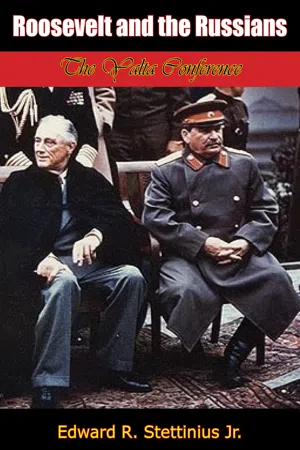
Roosevelt and the Russians
The Yalta Conference
- Edward R. Stettinius Jr.(Author)
- 2017(Publication Date)
- Eschenburg Press(Publisher)
PART ONE—TRYING TO BUILD A BETTER WORLD
CHAPTER 1—Background of the Yalta Conference
The Yalta Conference—February 4–11, 1945—was the most important wartime meeting of the leaders of Great Britain, the Soviet Union, and the United States. It was not only the longest meeting of President Roosevelt with Prime Minister Churchill and Marshal Stalin; it was also the first time that the three leaders reached fundamental agreements on post-war problems as distinct from mere statements of aims and purposes. Many problems of a non-military nature had been discussed at Teheran, but basic agreements were not reached or even attempted.This was the second time the three war leaders had met, but it was the first occasion on which they had met with all their foreign ministers. Although Anthony Eden and V. M. Molotov had participated in the Teheran Conference—November 28–December 1, 1943—Cordell Hull had not.The Yalta Conference, too, was the first real occasion on which the Chiefs of Staff of the three countries conducted an exhaustive examination of the respective military positions of the Allied forces and discussed in detail their future plans. The timing of the second front and related military questions had been discussed at Teheran, but it was not until Yalta that sufficient confidence existed among the three nations for a free and open examination of future operational plans.Thus the Yalta Conference marked the high tide of British, Russian, and American co-operation on the war and on the post-war settlement. In the days immediately after the Conference most American newspapers gave high praise to what had been accomplished in the Crimea. eBook - ePub
From War to Cold War
The Education of Harry S. Truman
- Robert James Maddox(Author)
- 2019(Publication Date)
- Routledge(Publisher)
YaltaThe Yalta Conference began on February 4, 1945, the day after the U.S. and British delegations arrived from Malta. Housed in impressive if antiquated buildings, members of both groups complained about the shortage of bathrooms and the surplus of bedbugs. Whatever the inadequacies of accommodation, few could have been unaware that this meeting would have momentous consequences. With the war in Europe grinding to its end, the time for exploratory talks such as had taken place at Teheran was over. Decisions would have to be made about the postwar treatment of Germany and the liberated areas. Although much preliminary work had been done about the proposed structure of the United Nations, several important issues remained unsettled. The struggle in the Pacific was far from over, and from the U.S. standpoint, it was crucial to formalize Soviet promises to enter the war after Germany's defeat. Important as these matters were, they were subsumed by an even larger question: whether the wartime coalition would continue after the fighting. If it did, chances of another largescale conflict would be small. If it began breaking down over one or more issues, prospects would be bleak.1Of the three leaders, Stalin remains the most enigmatic. His stated objectives are clear, as are his cabled messages before and after the conference. Beyond that little is known. What did he mean when he said he wanted "friendly" nations on the USSR's borders? Would it be sufficient that they not be anti-Soviet, or did he intend all along to dominate them as eventually happened? What were his thoughts about the United Nations? Without access to internal Soviet memoranda, records of conversations, and recollections by associates, the answers can only be guessed. In the sets of notes taken during the discussions at Yalta, Stalin comes across as well-prepared, economical with words, and adept at pointing out inconsistencies in the arguments of others. Above all, one is struck by his apparent moderation. Adamant on certain matters, on others he seemed ready to accept compromise for the sake of Allied unity. Stalin's conduct at Yalta strengthened the belief, held by some U.S. officials, that he represented the "soft" faction in Moscow while Molotov spoke for the more militant group.2 eBook - PDF
Ambiguous Partnership
Britain and America, 1944–1947
- Robert M. Hathaway(Author)
- 2019(Publication Date)
- Columbia University Press(Publisher)
7 The Final Journey Yalta: the name even today evokes images of a failing Roosevelt, weary from the battles of twelve tumultuous years, and a cunning, grasping Stalin, plotting to seize the spoils of victory and more, and to obtain in addition the dying President's acquiescence in this thievery. For Americans, the conference held at that forbid-ding spot under conditions of the utmost secrecy has transgressed the bounds of history and entered into the realm of mythology. Skewed by later events and distorted for partisan purposes, America's understanding of the proceedings which took place during those few momentous days has been, at best, partial and imbalanced. Less justifiably, American historians have contributed to this confusion, for until quite recently they have been overly preoccupied with just one aspect of the conference: its role in dividing East and West into bitter cold war antagonism. 1 One must be careful not to overreact to this bipolar reading of the past. It does, after all, seem indisputable that American officials at Yalta devoted the great bulk of their attention to relations with the Russian colossus, and that they defined the success or failure of the conference by the extent to which Stalin agreed to cooperate with the United States and Great Britain after the war. Matters of a predominantly British-American nature were clearly second- The Final Journey 113 ary. Yet, to talk about the hard rock of Anglo-American soli-darity, as some scholars have done, or to view the meeting solely as a tale of incipient East-West conflict, is to impose an order upon the negotiations which they lacked at the time. Both then and in later reminiscences, Churchill and the other British officials present at Yalta bemoaned Roosevelt's unwillingness to hammer out a common position vis-à-vis the Soviets or even to exchange views with his British allies. 2 From the start, Churchill approached this conference with a certain trepidation.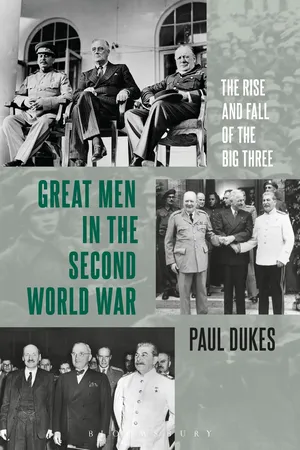 eBook - PDF
Great Men in the Second World War
The Rise and Fall of the Big Three
- Paul Dukes(Author)
- 2017(Publication Date)
- Bloomsbury Academic(Publisher)
10 On the other hand, S. M. Plokhy asserts that ‘Stalin was an imperial conqueror who never fully shed his revolutionary ideology. … His sphere of influence would be secured by brute force and maintained through the intimidation, incarceration and elimination of his opponents’. But he also suggests that, while beyond doubt ‘Yalta was a stepping stone to the insecure world of great-power tensions and the threat of nuclear annihilation … the main decisions leading to the Cold War were made after the Yalta Conference. … With the passage of time, Yalta became much more important than its participants intended it to be, both as political reality and as historical mythology’. 11 Bearing this welcome caveat in mind, we may nevertheless conclude that the conference in the Crimea marked the high point of the Big Three as individuals and perhaps as great powers too, sometimes synonymous for Churchill, Roosevelt and Stalin. The relationship prepared by correspondence and a number of bilateral meetings, then consolidated at Tehran, was taken to a new degree of intimacy at the conference in the Crimea. Simultaneously, however, fatal flaws in the association were revealed as never before, between the UK and United States as represented by Churchill and Roosevelt on the one hand and the Soviet Union led by Stalin on the other on questions concerning Eastern Europe, on Poland especially, which, to reiterate the point crudely, Churchill saw primarily as a matter of honour, Roosevelt of votes and Stalin of security. But there was disagreement between the Western Allies as well: indeed, regarding the end of empire, Roosevelt seemed on Yalta: World ‘Security and Well-being’ and the Death of Roosevelt 79 occasion to be closer to Stalin than to Churchill. On Asia in particular, there were already some hints of the Big Three being replaced by the Super Two, although ambiguities persisted concerning the powers and the personalities. eBook - PDF
Cold War and Revolution
Soviet-American Rivalry and the Origins of the Chinese Civil War, 1944–1946
- Odd Arne Westad(Author)
- 2019(Publication Date)
- Columbia University Press(Publisher)
ONE Yalta and the Search for Stability As Louis Fischer has observed, Yalta made less history than is gener-ally believed. 1 This claim is particularly true for those agreements on East Asia that came out of the summit conference. They were all products of complex political calculations shaped during the preceding months, and only to a small extent influenced by the negotiations themselves. The basis for the Yalta agreements on East Asia was an attempt by both the Soviet and the American leaders to regulate the international system in the region at the end of the Second World War in a way that would satisfy the governments of both powers. Besides his concern with ending the Pacific war as quickly as possible. Franklin D. Roose-velt saw U.S. global interests best served by a continuation of the cooperation with the Soviet Union. He wanted to avoid a conflict over the last phase in the war against Japan or over postwar arrangements in China. Joseph Stalin wanted to widen his alliance with Washington to encompass the complete defeat of Japan, as well as American guar-antees for any Soviet diplomatic or territorial gains in East Asia. Both Soviet and American East Asia policy up to the Crimean summit thus 8 Yalta and the Search for Stability show a distinct pre-Cold War pattern that historians have often ig-nored. 2 Events in China determined the form of the Great Power agreement. In the latter half of 1944 Jiang Jieshi's government was fighting for its survival against Japanese offensives, and the Chinese leader's best hope was that Japan's foreign enemies would rescue his regime. In particu-lar, Jiang hoped that Washington would intervene in his strained rela-tionship with Moscow, so that Stalin could be made to support the Chinese government rather than its domestic enemies. At Yalta Roose-velt and Stalin used the diplomatic legitimacy of Jiang's beleaguered regime in their attempt at stabilizing the relations between the Great Powers. eBook - ePub
Soviet Diplomacy And Negotiating Behavior
The Emerging New Context For U.s. Diplomacy
- Joseph G. Whelan(Author)
- 2019(Publication Date)
- Routledge(Publisher)
195Informality was also a marked characteristic as the Conference took on the style most favored by the President.196 And despite pressures and counterpressures of negotiations, a cooperative spirit seemed to prevail.197 Accounts of the Conference, such as Eden's, convey the general feeling of a traditional negotiating environment with expected tensions in the give-and-take of negotiations as the participants sought to achieve their own purposes. Tough and complex issues were resolved, often according to existing power realities; some were only discussed; others were deferred.That a generally favorable spirit prevailed at the proceedings was perhaps most evident by the hopeful expectations reflected in the attitudes of the participants upon leaving Yalta for home. Yet the cordiality of the Conference was counterbalanced by the seriousness of its business. As Bohlen recorded, "Underneath this gloss of goodwill, the three leaders were waging a fierce struggle on the shape of the postwar world."198(2 ) Aspects of Conference support and organization(a ) Procedure and agenda: Order and confusion.At Yalta, there was both order and confusion. A strong advocate of informality in international negotiations, President Roosevelt set the stage when he proposed at the opening first plenary session on February 4, which he chaired, that the talks be conducted, in the words of Bohlen's minutes, "in an informal manner in which each would speak his mind frankly and freely, since he had discovered through experience that the best way to conduct business expeditiously was through frank and free speaking."199Organizationally, Yalta was a multilevel conference with many sessions going on often simultaneously among the military chiefs, the Foreign Ministers and the Heads of State. In addition, business was carried on at luncheons and dinners and at private meetings between any of the leaders. Plenary sessions were held every day at 4 p.m. and meetings of the Foreign Ministers and military chiefs every morning.200 eBook - ePub
- Stephen R. Rock(Author)
- 2021(Publication Date)
- The University Press of Kentucky(Publisher)
29 The Soviets made some concessions. They accepted the voting formula proposed by the United States for the United Nations Security Council and abandoned their demand for U.N. membership for each of the Soviet Union’s sixteen republics. Instead Moscow would settle for three seats in the General Assembly: for Russia, the Ukraine, and Byelorussia. Stalin informed Roosevelt that he would have no objection to the United States being given the same special consideration.The Soviets also acquiesced to French membership on the Control Council for postwar Germany, accepted changes in the language of agreements pertaining to the composition of the Polish and Yugoslav governments, and gave ground on the issue of German reparations. Still, the Western Powers must be regarded as having made the greater concessions.30 In the Far East, they acceded to Russian demands for the port of Sakhalin and the islands adjacent thereto, for the Kurile Islands, and for the restoration of a naval base at Port Arthur. With respect to Poland’s borders, the informal agreement reached at Teheran was largely reaffirmed. A modified version of the Curzon line was established as the eastern boundary. The western boundary was left to a peace conference to determine, but it was agreed that Poland would realize “substantial accessions of territory in the north and west.”31The most important concession by the Western Powers at Yalta was their acceptance of a formula for establishing a postwar Polish government that made it likely Poland would be nondemocratic and dominated by the Soviet Union. The agreement left the existing pro-Soviet Provisional Government of the Lublin Poles in firm control of the country, requiring only that this government should “be reorganized on a broader democratic basis with the inclusion of democratic leaders from Poland itself and from Poles abroad.”32 For the British, who had gone to war to defend Poland and had steadfastly recognized the government-in-exile as the legitimate Polish leadership, this was a bitter pill to swallow, though irritation at the London Poles’ utter unwillingness to compromise made sacrificing them somewhat less painful. Roosevelt appreciated Britain’s position, but, as he had reminded Churchill on a previous occasion, “Our primary concern is . . . the essential unity [of the Allies] which was so successfully established at Moscow and Teheran.”33 To maintain this unity, the president acceded to an agreement that placed Polish independence and the prospects for democracy at the mercy of the Soviet Union. Told by his chief of staff, Admiral Leahy, that the language was “so elastic that the Russians can stretch it all the way from Yalta to Washington without ever technically breaking it,” Roosevelt replied, “I know, Bill—I know it. But it’s the best I can do for Poland at this time.”34 eBook - PDF
Chiang Kaishek's Last Ambassador to Moscow
The Wartime Diaries of Fu Bingchang
- Yee Wah Foo(Author)
- 2010(Publication Date)
- Palgrave Macmillan(Publisher)
The meetings were held at the Livadia Palace in the resort town of Yalta on the Crimean Peninsula, and the accords were signed by Roosevelt, Stalin and Churchill on 11 February. 11 Two days later, Soviet newspapers pub- lished the results of the conference, minus the Agreement concerning China, 12 and Fu met the new US Secretary of State, Edward R. Stettinius Jr., who had been present at Yalta. It was a short meeting, and Fu noted nothing of the Far Eastern Agreement; simply that Stettinius had invited the Chinese Ambassador to Great Britain, Gu Weijun (also known as Wellington Koo), to visit the United States, which seemed to imply to Fu that Stettinius wished to help China. 13 On 14 February, Fu met with Ambassador Harriman. A complete copy of the Yalta Accords lies amongst Fu’s papers, but no copy of the Agreement concerning China is attached. Fu’s copy of these papers is punctuated with notes closely resembling those written in his journal 166 Alliances of the same date, so it is probable that Harriman gave him this copy at their Valentine’s Day meeting as they discussed the accords para- graph by paragraph: First, regarding China, there was a US proposal for joint Four Power consensus on international peacekeeping. There was also an agreement to convene a Big Three conference. Noting this, Fu asked Harriman if anyone had suggested that a provisional orga- nization of the Four major powers meet (in other words, to include China) – something which had been proposed in the past by British and US officials. ‘No’, replied Harriman, because there would be prob- lems establishing such an organization (he did not elaborate why) and regular meetings between the three foreign secretaries would be both practical and more convenient. Harriman then told Fu that Stalin had refused in the formal sessions to discuss the Far East, suggesting ‘per- haps he is fearful of risking a surprise Japanese attack against Russia’. eBook - ePub
- Robert J Maddox(Author)
- 2018(Publication Date)
- Routledge(Publisher)
Stalin enjoyed yet another advantage. Roosevelt and Churchill constantly had to weigh decisions on the scales of public opinion. FDR was particularly vulnerable because he believed that active U.S. participation in the postwar world would be undermined if open disputes with the Soviet Union developed. What constraints Stalin worked under are unclear, but he did not have to worry about a critical press, an opposition party, and the need to obtain a two-thirds majority to get treaties through the Senate. In view of these circumstances, FDR and his advisers had reason to be gratified with what had been accomplished. “We really believed in our hearts,” one of them later recalled, “that this was the dawn of a new day we had all been praying for."After Yalta
The honeymoon did not last. On March 1, Roosevelt reported on the Yalta Conference before a joint session of Congress. He obviously was in poor health: He read his speech while sitting, his hands shook, and his speech at times was slurred. After discussing in general terms the agreements that were made, omitting the Far Eastern accord, he concluded by saying he was confident the American people and Congress “will accept the results of this Conference as the beginnings of a permanent structure of peace."Only a few days after he spoke, the Anglo-American-Soviet commission, meeting in Moscow to form the Polish provisional government, bogged down over which Poles would be invited to participate. Roosevelt and Churchill had hoped Stalin would permit representatives of major non-Communist parties to participate in the provisional government prior to the free elections. But the Soviet representative on the commission, Foreign Minister Molotov, soon made it clear that he would agree to name only those who were Communist or pro-Communist. Otherwise, he said, “we might find a fascist in our midst.” Roosevelt and Churchill, who feared the Grand Alliance might break apart if the Polish question were not resolved, grew more alarmed as the deadlock continued through March. Reports from inside Poland indicated that the Communists, aided by the Red Army and secret police, were closing rival newspapers, breaking up organizations, and arresting individuals in large numbers. FDR and Churchill became convinced that the stalemate in Moscow had less to do with interpretations of the Yalta accord than with sealing off Poland until the Communists had eliminated all potential opposition. eBook - ePub
Allied Wartime Diplomacy
A Pattern In Poland
- Edward J Rozek(Author)
- 2021(Publication Date)
- Routledge(Publisher)
32 Speaking about Yalta to Sherwood, Hopkins said:We really believed in our hearts that this was the dawn of a new day we had all been praying for and talking about for so many years. We were absolutely certain that we had won the first great victory of the peace—and, by "we," I mean all of us, the whole civilized human race. The Russians had proved that they could be reasonable and farseeing and there wasn't any doubt in the minds of the President or any of us that we could live with them and get along with them peacefully for as far into the future as any of us could imagine. But I have to make one amendment to that—I think we all had in our minds the reservation that we could not foretell what the results would be if anything should happen to Stalin. We felt sure that we could count on him to be reasonable and sensible and understanding—but we never could be sure who or what might be in back of him there in the Kremlin.33It can hardly be doubted that Hopkins was expressing the views of the American policy makers. Churchill and Roosevelt believed that the Yalta decision on Poland was just. Stalin's feelings about the outcome of Yalta were presumably reflected in the Soviet press, which overflowed with praise for the Yalta communiqué.Pravda published a special issue devoted to the Conference and said in its editorial that the Yalta Conference had proved that. . . the alliance of the Three Big Powers possessed not only a historic yesterday and a victorious today, but also a great tomorrow.Izvestia called the Conference the "greatest political event of current time."34But Stalin did not exhibit a permanent joy and gratitude for his success at Yalta. In a speech on February 23, 1945, on the occasion of the celebration of Red Army Day, he did not mention Yalta even once. He avoided displaying his appreciation, presumably in the fear that the Western Powers would exploit this by asking for similar favors in return. His plan was still only partially realized. An appearance of indifference to the results of the Yalta Conference paid him better dividends than exultation would have. Poland was only a steppingstone in the fulfillment of Soviet objectives, anyhow. Now that Poland was removed as a cause of diplomatic friction between the Big Allies, an era of "friendly understanding and collaboration" was supposed to follow. eBook - ePub
- Elizabeth Churchill Brown(Author)
- 2017(Publication Date)
- Eschenburg Press(Publisher)
Chapter III—YALTA AND THE ADVISERS
The Yalta Conference. Harry Hopkins and the advisers. Roosevelt’s view of Stalin and Churchill. U.S. Policy toward Russia set forth by Gen. Burns and Hopkins. The controversy over Russian entry into the Pacific war. The press continues its attack on Hirohito. Bohlen explains the Yalta agreements.THIRTEEN million young Americans were taken from peaceful pursuits and hauled into the tortuous cauldron of World War II. In three and one half fateful years they had fought one of the most brutal wars in history and laid before the feet of a grateful nation an amazing record of victories. Yet the United States was to go far in losing the fruits of victory at a quiet conference table six months before the war ended. This was Yalta where, among other tragic errors, Chinese territory was traded for Russia’s entry into the war against Japan.Gathered at this conference in February of 1945 were the most powerful leaders in the world; Roosevelt, Churchill and Stalin. The most powerful of them all was President Roosevelt, but it was to be his team which lost the battle of political wits. The question is, “why”? The only way to find out is to look as closely as possible at the experts and advisers accompanying him; to carefully scrutinize their political thinking.What went on in Roosevelt’s mind during the course of the wartime alliance with Russia has puzzled even the closest and best informed observers. As an outsider who has had the privilege of listening to many informed discussions, I have been unable to reach any conclusions myself. One reasonable and plausible explanation of the late President’s attitude comes from one who had access to many official documents including Roosevelt’s personal correspondence with Churchill and Stalin. His careful analysis strongly supports the conclusion that, until 1943, Roosevelt regarded Russia with a patronizing attitude, and that he assumed it would be the United States and Great Britain who would settle the post-war problems. But beginning with mid-1943, American policy seemed to change to “fear” of post-war Russia. And the correspondence indicated that FDR’s attitude changed to one of wishful thinking—that Roosevelt the aristocrat could charm Stalin the peasant. The President put great faith in his theory that if the United States proved its honest intentions with honest action, Stalin would react likewise. But such a policy was no more successful then than it was in 1955. eBook - PDF
The Oder-Neisse Line
The United States, Poland, and Germany in the Cold War
- Debra J. Allen(Author)
- 2003(Publication Date)
- Praeger(Publisher)
4: 3. 34 The Oder-Neisse Line 26. Christian Science Monitor, 6 December 1943, 20. 27. "To the Poles and Russians," New York Times, 30 December 1943, 16. 28. Congressional Record Appendix, 78th Cong., 1st sess., pt. 12, 89 (1945): A5538. 29. Ibid., A5424. 30. Feis, Churchill, Roosevelt, Stalin, 299. 31. Jan Ciechanowski, Defeat in Victory (Garden City, NY: Doubleday, 1947), 305-306; Lukas, Strange Allies, 58; Foreign Relations of the United States Diplomatic Papers, 1945, The Conferences at Malta and Yalta (Washington, DC: U.S. Government Printing Office, 1955), 220. Hereafter cited as FRUS, Yalta. 32. Ciechanowski, Defeat, 332. 33. Ibid., 341-342; FRUS, Yalta, 210. 34. FRUS., Yalta, 218-219. 35. Ibid., 230. 36. Ibid. 37. Ibid., 220-221. 38. Ibid., 230-234. 39. Briefing Book for Yalta Conference, undated, Department of State Record Group 43, Records of the International Conferences, Commissions and Expositions, Box 3, in National Archives, Washington, DC. Hereafter cited as DS/NA. 40. FRUS, Yalta, 508-509. 41. Ibid.; Edward R. Stettinius, Roosevelt and the Russians: The Yalta Conference, ed. Walter Johnson (New York: Doubleday, 1949), 64-65. 42. FRUS, Yalta, 509. 43. Wandycz, The United States, 294; Bohlen, Witness, 177-178 claims that it w evident at Yalta that Roosevelt did not use the briefing books "as much as he should have." Byrnes, who was with Roosevelt at Yalta, commented that, although the president did little paper work before the conference, he made a "good presentation." James F. Byrnes, All in One Lifetime (New York: Harper and Brothers, 1958), 256. 44. FRUS, Yalta, 667-669. 45. Vojtech Mastny, Russia's Road to the Cold War: Diplomacy, Warfare, and th Politics of Communism, 1941-1945 (New York: Columbia University Press, 1979), 180, 247.
Index pages curate the most relevant extracts from our library of academic textbooks. They’ve been created using an in-house natural language model (NLM), each adding context and meaning to key research topics.

