History

Cominform and Comecon
Cominform was an organization established in 1947 by the Soviet Union and its Eastern European satellite states to coordinate communist parties and policies. Comecon, established in 1949, was an economic organization aimed at integrating the economies of the Eastern Bloc countries under Soviet influence. Both organizations were part of the Soviet Union's efforts to maintain control over its satellite states during the Cold War.
Written by Perlego with AI-assistance
Related key terms
1 of 5
5 Key excerpts on "Cominform and Comecon"
 eBook - ePub
A History of Eastern Europe
Crisis and Change
- Robert Bideleux, Ian Jeffries(Authors)
- 2007(Publication Date)
- Routledge(Publisher)
They also initiated a series of ‘specialization agreements’ designed to curb costly industrial duplication and import-substitution, especially in those states that lacked the appropriate resource base to sustain autarkic neo-Stalinist patterns of industrialization. In 1956 ten permanent standing commissions were established to promote specialization and co-operation in particular sectors (Brabant 1989 : 46–7, 52–4). Comecon was revitalized, and its scope extended, partly in response to an extension of the range of tasks and challenges confronting the Soviet Union under its frenetic new party leader, Nikita Khrushchev (1953–64). The Soviet Union increasingly relied on the Balkans and especially East Central Europe to provide the types of machinery, equipment, manufactured consumer goods and foodstuffs that were in short supply domestically and to provide ‘captive’ markets for Soviet-produced plant, machinery, armaments and oil (Mellor 1971 : 14). (The Soviet Union initially faced difficulties in breaking into international oil markets controlled by Western multinational oil companies.) The December 1955 and May 1956 Council Sessions of Comecon called for the co-ordination and synchronization of national Five-Year Plans. In practice, however, most of the attempts at plan co-ordination at this time were limited to bilateral ex post harmonization of the trade implications of national economic plans and failed to achieve ex ante harmonization of either trade intentions or planned production (Brabant 1989 : 51) eBook - ePub
- Gen. Walter Bedell Smith(Author)
- 2018(Publication Date)
- Eschenburg Press(Publisher)
I am glad to report that neither of these steps came as a surprise to the Embassy or to the United States Government. Much as we were deliberately isolated from original sources of information in the Soviet Union, it is inevitable that when one lives there long enough to become thoroughly steeped in Russian history, Stalinist ideology and Communist double-talk, he develops a fairly accurate “sixth sense” for what the Kremlin is going to do and why.Moscow had, for some time, been showing an inclination to tighten the bonds between the Communist parties throughout the world and, for this purpose, had adopted the procedure of organizing what were really big international Communist meetings around important national Communist congresses. Thus I find notes in my diary early in 1947, which were reflected in my reports to the State Department, to the effect that the British Communist Party conferences held in London at that time seemed to be the occasion for a secret, rather large-scale Comintern meeting. Visiting delegates of considerable importance in the Communist world were to be present from practically all countries in Europe and the Near East. We felt that this revived international Communist activity was probably a prelude to the overt re-establishment of an international Communist agency.Furthermore, the recapture of the initiative by the West through the Truman and European reconstruction programs had put the Kremlin on the defensive and called for some dramatic new action. Consequently, while the actual time and place of the Cominform meeting in Poland was a carefully guarded secret to which we were not privy, it was no surprise when Pravda , on October 5, 1947, announced that the conference of Communist Party leaders from nine countries had taken place.Actually, the public establishment of the Cominform probably added very little to the thoroughness or the effectiveness of the Kremlin’s international organization which had been constantly and continuously in existence under cover. However, organization is not everything. The struggle for Europe is to a large degree a struggle for the minds and for the allegiance of men. eBook - ePub
- Andrew H. Dawson(Author)
- 2017(Publication Date)
- Routledge(Publisher)
imparium from the world as completely as possible. It was also seen, variously, as Soviet retaliation against Western actions following the blockade of Berlin, a means to make more effective the ostracism of Yugoslavia, and as a way of strengthening centripetal tendencies - drawing the satellites closer to the Soviet Union - after the centrifugalism of 1947 and 1948. It was further suggested that Stalin's belief that the 'all-embracing world market' of pre-war times had collapsed into 'capitalist' and 'socialist' markets underlay the idea that COMECON might be appropriately used to organise the latter.Organisation and Aims
Whatever the objective, COMECON is faced with significant geographical, economic and social differences between its members, though in every dimension of geography, economics, natural resources, population and political influence the Council is dominated by the Soviet Union. The other members fall into several groups - one containing the more advanced economies with a considerable industrial component - Czechoslovakia, the GDR, Poland, and perhaps Hungary - and a second including the countries with strong agrarian elements Bulgaria, Romania, Yugoslavia and, for a short period, Albania. A third, more recently admitted group includes the backward economies of the non-European members - Cuba, Mongolia and Vietnam.COMECON is a rigid, hierarchical bureaucracy, typical of the management patterns of the socialist bloc, and decisions and directives tend to filter slowly through its cumbersome administration. The key to the development of policy is the annual meeting of the Council, attended by the premiers of member countries, their chief planners and any necessary ministerial heads, which meets in a different capital city on each occasion, and is chaired by that country. As the highest organ within the structure it makes the key decisions (Figure 11.1 eBook - PDF
War in the Twentieth Century
Reflections at Century's End
- Michael A. Hennessy, B.J.C. Mckercher, Michael A. Hennessy, B.J.C. Mckercher(Authors)
- 2003(Publication Date)
- Praeger(Publisher)
Poland was forced to import Soviet ores, oil prod- ucts, and raw cotton and export coal, textiles, railway rolling stock steel, Economic Foundations 79 and cement. Moscow trade officials consistently underpriced imported goods and overpriced their own exports. On some occasions the Soviets even reexported East bloc goods to "hard currency" countries at higher prices than for what they were purchased. 57 The creation of COMECON in January 1949 was the culmination of socialist reforms designed to facilitate the economic integration of the Soviet satellites. Negotiation and compromise were not the hallmarks of the new multilateral socialist economic order. There is surprisingly little reference to COMECON in the standard literature on the Cold War suf- fice to say that it was explained as a reaction to the intrusiveness of the Marshall Plan. 58 But the perceived threat of the Marshall Plan is only a partial explanation of the motives behind this new Soviet initiative. In fact, COMECON was also designed as an instrument to coordinate the Communist bloc boycott of the dissident Tito regime in Yugoslavia. 59 Still another useful function was that COMECON stopped once and for all any efforts on the part of individual satellite countries to take further initiatives to improve economic relations with each other. 60 From 1949 to 1955 COMECON engaged in statistical research, tech- nical exchanges, and the promotion of bilateral trade treaties. Trade was planned by annual agreements that in 1951 were extended for longer periods.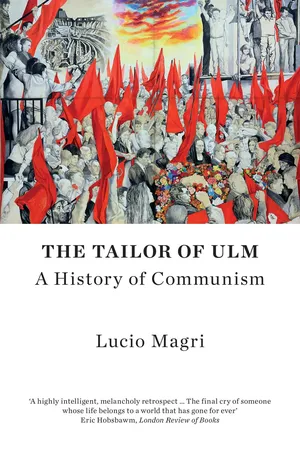 eBook - ePub
The Tailor of Ulm
A History of Communism
- Lucio Magri, Patrick Camiller(Authors)
- 2019(Publication Date)
- Verso(Publisher)
The turn became explicit at the meeting near Wroclaw that gave birth to the Communist Information Bureau (Cominform). This was not a replica of the Communist International: first, because only ultra-loyal Communist parties (plus a couple that would later be accused of betrayal, the French and the Italian) were invited to attend the meeting; and second, because in the course of its brief life it met only rarely to issue directives or judgements, after the decisions had been taken elsewhere. The meeting’s lead player was unquestionably Andrei Zhdanov, whom Stalin then considered his spokesman, even though he often spoke his lines so emphatically that his ‘Report’ seemed to offer, in the crudest way, a new analysis of the situation and a new political line. His thinking is easy to summarize. The division of the world into two camps, hitherto presented as an enemy objective to be opposed, was now a fait accompli that Communists had to adapt to and even turn to advantage; there was no longer room for equivocation on either side, and the search for alliances was a secondary, or slippery, business. The Soviet Union was not only the natural political leader but the finished model, whose imitation was to be proposed to everyone everywhere. The capitalist camp was already entering a new economic crisis and the cold war would develop into an inter-imperialist war; its ruling groups were turning towards a new kind of authoritarianism. There was no point in fooling around any longer with the concept of ‘progressive democracy’, which was inevitably sinking into mere parliamentarism and obscuring the class struggle. Political unity should be based on the organic, codified ideology of Marxism-Leninism-Stalinism, of which the ‘History of the CPSU, Short Course’ was the finished synthesis. All sectors of culture (including science, literature and music) had to adopt an explicitly political viewpoint and express themselves in simple forms close to popular culture, avoiding any comparison with Western culture, including unorthodox Marxism and ‘degenerate’ avant-garde arts. This platform, conveyed in extreme terms that even Stalin would have avoided (and at one point slightly corrected), met with no resistance or objections at the Wroclaw meeting, only a few expressions of concern from Gomulka, Tito and Dimitrov, who subsequently became its targets of attack. The Chinese were not present, and anyway they were used to going their own way. Criticism and accusations – necessary, as always, to establish the limits of orthodoxy – were directed, as we shall see, against the French and the Italians.At the level of foreign policy and inter-state relations with the West, the infant Cominform confined itself mainly to counterproductive propaganda. Especially in the early years, there was never any hint of expansionist intentions. Even the Berlin blockade, which caused a period of tension in 1948, was presented merely as a protest against the arbitrary and unilateral decision to unite West Germany into a permanent state entity. The blockade was soon lifted, because instead of re-launching the serious proposal for a united, neutral Germany it helped to fuel West German nationalism and to underline the powerlessness of the Soviet Union to do anything about it.
Index pages curate the most relevant extracts from our library of academic textbooks. They’ve been created using an in-house natural language model (NLM), each adding context and meaning to key research topics.

