History

Scottish Devolution
Scottish Devolution refers to the process through which Scotland gained its own parliament and government with devolved powers from the UK Parliament. The devolution of powers to Scotland began with the establishment of the Scottish Parliament in 1999, allowing for decisions on areas such as education, health, and justice to be made at the Scottish level, while certain powers remain reserved to the UK Parliament.
Written by Perlego with AI-assistance
Related key terms
1 of 5


12 Key excerpts on "Scottish Devolution"
 eBook - ePub
The Constitution of the United Kingdom
A Contextual Analysis
- Peter Leyland(Author)
- 2021(Publication Date)
- Hart Publishing(Publisher)
Further, the Scottish Parliament has taken over responsibility for the support for the unemployed. The Scottish Parliament assumes all powers in relation to the holding of elections at devolved level and for local government in Scotland. Also, certain powers in relation to energy efficiency and fuel poverty have been transferred to Scotland. In the domain of broadcasting the Scottish Government and Scottish Parliament has a formal consultative role reviewing the Charter under which the BBC operates and in appointments to and the setting of strategic priorities for the broadcasting regulator OFCOM. Other areas where additional powers have been devolved include consumer advice and advocacy, rail franchising, roads, and onshore oil and gas extraction. 69 In sum, the revised form of Scottish Devolution amounts to a formidable catalogue of powers and functions. The devolved institutions in Scotland have acquired a greater degree of autonomy, particularly in relation to finance, than is evident in many federal systems. Over the same period Wales has acquired a conferred powers model of devolution and it has been granted some tax-raising powers. 70 Additional competences have been given to the Welsh Assembly (now Parliament) in significant policy areas, 71 but, in contrast to Scotland, there is limited capacity for the legal divergence of Welsh institutions from those in England. 72 DEVOLUTION AND BREXIT The break up of the UK as a nation state was foreseen by some commentators as a likely, perhaps even inevitable, consequence of UK withdrawal from Europe, but any precipitous outcome has been overtaken by events. In the immediate aftermath of the EU referendum, which indicated a decisive majority in favour of ‘remain’ in Scotland, the Scottish First Minister, Nicola Sturgeon repeatedly called for a second vote on Scottish independence. In fact popular support for the SNP and for independence has fluctuated since 2016 eBook - PDF
- Roger Mortimore, Andrew Blick, Roger Mortimore, Andrew Blick(Authors)
- 2018(Publication Date)
- Palgrave Macmillan(Publisher)
Mackintosh, The Devolution of Power (1968); J. Banks, Federal Britain (1973); A. Birch, Political Integration in the British Isles (1977); K. Wright, The People say Yes: the Making of Scotland’s Parliament (1997); V. Bogdanor, Devolution in the United King- dom (1999); see also the White Papers listed in the chronology above SCOTLAND Under the Treaty of Union 1707 Scotland preserved her independent legal and judicial systems. Scotland developed arrangements for education and local gov- ernment which have never been assimilated to those of England and Wales. The established (Presbyterian) Church was also recognised by the Union set- tlement. After the abolition of the post of Secretary of State for Scotland in 1746, until the date of the establishment of the Secretaryship for Scotland in 1885 (this office became a full Secretaryship of State in 1926), Scotland had been controlled into the nineteenth century by a ‘Manager’, then the Lord Advocate acting through the Home Secretary, and, for a short period from 1881, by an Under-Secretary at the Home Office with responsibility for Scottish Affairs, as well as by the developing system of Boards. 18 DEVOLUTION 771 The continued existence of the Boards was criticised as anachronistic, maintaining a system of patronage and lacking direct responsibility to Par- liament in practice, if not in theory (see Reports of the Royal Commission on the Civil Service, Cmd. 7338/1914, and the Haldane Committee on the Machinery of Government, Cmnd. 9320/1918). Under the Reorganisation of Offices (Scotland) Act 1928, the Boards of Agriculture and Health for Scot- land became Departments statutorily defined as independent of, though in reality responsible to, the Scottish Secretary of State. This constitutional peculiarity disappeared along with the remaining Boards after a general review of the Scottish administration by the Gilmour Committee (Cmnd. 5563/1936–37) which led to the Reorganisation of Offices (Scotland) Act 1939. eBook - PDF
Practising Self-Government
A Comparative Study of Autonomous Regions
- Yash Ghai, Sophia Woodman(Authors)
- 2013(Publication Date)
- Cambridge University Press(Publisher)
And the autonomy of devolution since 1998 builds on and develops the earlier forms by providing a new directly elected Scottish Parliament with broad legislative competences exercisable in Scotland and with the capacity to exert new forms of supervision and control over Scottish gov- ernment. New competences and new accountabilities are provided by the new institutions. As to the desirability of this new constitutional development from 1998, there are widely differing views that derive from different visions of the future of Scotland and different perceptions of the probable contribution of devolution. The different visions, as explained earlier, are distributed across those who see Scotland’s future as an independent state, albeit within the European Union – broadly the view of the more fundamentalist wing of the SNP – and, on the other hand, those whose loyalty is to a continuing United Kingdom. That latter group includes, however, those of a federalist persuasion whose aim would be a stronger and constitutionally entrenched autonomy for Scotland and, on the other hand, those UK unionists who are apprehensive of any such division of the state. Fundamentalist separatists resisted devolution as a distraction. Strong unionists resisted it as a threat. In the middle ground are the more pragmatically inclined nationalists who see devolution as a staging-post to much stronger autonomy or even to independence, federalists who also see devolution as progress towards their ultimate objective and the more pragmatic unionists whose perception of devolution is as a concession to democratic pressures that is necessary to save the union itself rather than, in the memorable words of a high-profile Labour Party opponent of devolution, a ‘motorway without exit to a destination that may not have been intended but is indistinguishable from a separate state’.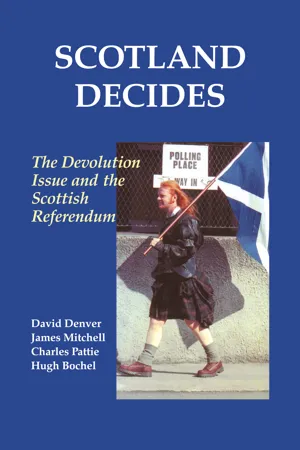 eBook - ePub
Scotland Decides
The Devolution Issue and the 1997 Referendum
- Hugh Bochel, David Denver, James Mitchell, Charles Pattie(Authors)
- 2013(Publication Date)
- Routledge(Publisher)
1Scottish Devolution: TheHistorical Context
INTRODUCTION
The referendum on Scottish Devolution held in September 1997, less than five months into the new Labour government's term in office, was the second to be held on this issue. Eighteen years before, in the dying days of the previous Labour administration, the Scottish electorate was asked to decide in a referendum whether, as proposed by the government, a Scottish Assembly should be established. A narrow majority of those who voted agreed that there should be an Assembly but this was not enough to overcome the qualification (that 40 per cent of the eligible electorate had to support the measure for it to be passed) which had been imposed by Parliament at Westminster. The change in the use of language between 1979 and 1997 is itself significant. By the time of the second referendum the debate was about creating a Scottish ‘Parliament’, not an ‘Assembly’. There were other changes which were more than symbolic, however. A substantial change of attitude had occurred among Scots although few home rulers could have anticipated this in 1979. Shortly after the first referendum, a cartoon appeared in a Nationalist newspaper. It showed a picture of a boy reading a book about ‘EVOLUTION’ with a picture of dinosaurs on its cover while his father was reading a newspaper with ‘DEVOLUTION LATEST’ on the front page. The caption below summed up the feeling of many supporters of Scottish Devolution at the time. ‘No son — they're not the same thing — devolution takes longer!’, the father explained.Although it was not until the 1970s that Scottish Devolution became a serious possibility, it could be argued that it was indeed a long time in coming. A Scottish Home Rule Association (SHRA) had been set up in 1886 and Scottish home rule was part of Keir Hardie's platform when he contested the Mid-Lanark by-election, as the first independent Labour candidate, in 1888. Hardie was supported by the SHRA although this later proved controversial within the organisation, as its secretary argued that the SHRA had been mistaken in backing Hardie (Mitchell, 1996: 71). This was only the first difficulty Labour was to have in a long history of relations with umbrella groups campaigning for a Scottish Parliament, up to and including the 1997 referendum. During the late nineteenth and early twentieth centuries, however, Scottish home rule was not an important issue in British politics. The Irish question was far more pressing and divisive and it had a considerable impact on Scottish politics. The issue split the Liberals to the great advantage of the Conservatives. The Scottish Unionist Party, initially a coalition of Conservatives and Liberal Unionists, was the official title of the Conservative Party in Scotland until 1965. Such was the relative importance of Scottish and Irish home rule, that the unionism expressed in the name of the party referred to the union between Ireland — later Northern Ireland — and Britain rather than to the constitutional position of Scotland. At the same time, while Labour in Scotland attracted strong support among Irish Catholic immigrants and there was much sympathy for Irish nationalism in Labour's ranks, this was not translated into support for Scottish nationalism. Indeed, Scottish Unionists and Conservatives often portrayed Scottish home rulers as in some way connected with Irish nationalism while Labour supporters, in the west of Scotland, often associated Scottish nationalism with the Orange Order and Irish unionism.1 eBook - PDF
- Robert Schütze, Stephen Tierney, Robert Schütze, Stephen Tierney(Authors)
- 2018(Publication Date)
- Hart Publishing(Publisher)
4 House of Lords Constitution Committee, ‘Inter-governmental relations in the United Kingdom’ (11th Report, Session 2014–15, HL Paper 146); House of Commons Political and Constitutional Reform Committee, ‘The future of devolution after the Scottish referendum’ ibid. remaining the norm in descriptions of the UK as a state. For the first two dec-ades of devolution it has also been rare to find any suggestions that the UK ought to become federal. However, in light of constitutional changes since the Scottish independence referendum of 2014 it now appears that the federal question can no longer be avoided. The Scotland Act 2016 brings with it extensive new pow-ers for the Scottish Parliament, the Cities and Local Government Devolution Act 2016 introduces potentially radical changes to the system of local, city and even regional government in England; the Wales Act 2017 promises the most funda-mental reform of Welsh devolution since 1998, while further tax powers have been devolved to the Northern Ireland Assembly. 1 The hollowing-out of the United Kingdom has occurred without any sense of coherent planning, and the extensive new powers for the Scottish Parliament in particular brings to light the danger of a form of decentralisation without direction. 2 It is now apparent to Parliament that devolution continues to be extended with no vision of the state as a union of peoples. 3 The direction is also entirely one way, with no concentration upon the central institutions of the state and their role in binding the union together, as a counterbalance to the way in which more and more autonomy for the devolved territories loosens the bonds of the state. The Scotland Act 2016 is focused only upon the grant of more powers to Scotland, including extensive tax powers. eBook - PDF
Constitutional Futures Revisited
Britain's Constitution to 2020
- R. Hazell(Author)
- 2008(Publication Date)
- Palgrave Macmillan(Publisher)
Part I The Decentralised State 2 Scotland and Wales: The Evolution of Devolution Alan Trench Introduction This chapter is about the future of devolution in Scotland and Wales, the two parts of Great Britain that have experienced devolution to elected sub- state institutions since 1999. Less than a decade on, it is easy to forget quite how significant a development that was, so quickly has devolution become an accepted part of the political and constitutional framework of the United Kingdom. Yet the achievement of that model of devolution followed many years of debate and struggle on the part of supporters of institutional auton- omy or ‘home rule’ for those nations and took many aspects of British government into uncharted territory. It is little wonder that a large part of the first Constitutional Futures (Hazell 1999) was devoted to considering the immediate and longer-term implications of that form of devolution, for the United Kingdom as a whole as much as for Scotland and Wales themselves. This chapter examines some likely paths of constitutional development for Scotland and Wales in the coming years. Devolution has already created a set of institutions and processes as a result of Scottish and Welsh distinc- tiveness, and the existence of these also means that there is an enduring constitutional debate about those parts of the United Kingdom and their relationship to the United Kingdom at the centre. While the institutional framework of devolution may leave a great deal of power in the hands of UK institutions (discussed in detail in Trench 2007), different attitudes toward what government should do and how it should do it had already become apparent during the first two terms of devolution in Scotland and Wales, when Labour had continued to dominate all three governments. In this sense there is a tension (even a contraction) between the centralised insti- tutional structure of devolution and its political logic. eBook - PDF
- Roger Masterman, Colin Murray(Authors)
- 2022(Publication Date)
- Cambridge University Press(Publisher)
15. 41 Ibid., p. 15. 42 Scotland Act 2012, s. 10. 43 Constitution Committee, Scotland Bill (2011) HL 184, para. 8. 44 HM Government, Scotland in the United Kingdom: An Enduring Settlement (2015) Cm. 8990, p. 5. 45 Scotland Act 2016, ss. 3–10. 46 Scottish Elections (Reduction of Voting Age) Act 2015. 47 Scotland Act 2016, s. 50. 48 Ibid., s. 40. 49 Ibid., s. 53. 450 14 The United Kingdom’s Devolution Arrangements Scottish Parliament gained competence over a wide range of benefit payments. 50 The net effect of these changes is to radically change the picture set out above in Table 14.2, increasing the range of transferred powers and reducing the number of reserved powers. Many of these new powers, however, require cooperation between Holyrood and Westminster to operate effectively. 51 Some benefits are devolved, others not, which poten- tially adds complexity for some claimants and for the administration of benefits. Although the legislative devolution of these powers took place in 2016, Scotland is not scheduled to have the systems in place to operate these benefits until 2024. (iii) Financing Devolution in Scotland The Scottish Parliament’s remit means that the Scottish Government is responsible for over half of the public expenditure which affects the people of Scotland. This means that, in order for the devolved competence to be meaningful, the Scottish Government must have control over the public finances necessary to exercise this competence. Instead, under the Scotland Act 1998, the Scottish Parliament enjoyed a very limited capacity to raise funds to support distinct Scottish policies. Following devolution, the Scottish Parliament gained a power to vary income tax rates in Scotland by up to three pence per pound earned by comparison to the national standard. eBook - PDF
- M. Rush, P. Giddings, M. Rush, P. Giddings(Authors)
- 2007(Publication Date)
- Palgrave Macmillan(Publisher)
Nevertheless, the year was notable for questions about Labour’s control of devolution in Scotland and Wales, while problems within devolved government, and renewed constitutional debates, created the potential for considerably greater instability in the politics of devolution. In Northern Ireland, the stakes were raised as the UK and Irish governments insisted on either the restoration of power-sharing devolution or its rapid abolition. At 162 Devolution 163 the end of the year the hopes were stronger for the unlikely achievement of the former, thus consolidating devolution, albeit on an asymmetrical basis, as the institutional focus of territorial politics across the UK. Even so, sceptics were conscious that it hung in the balance, plunging Northern Ireland too into a more uncertain future. Scotland In Scotland, devolution had developed on a basis that many had expected. The previously dominant Labour Party had accepted the reality of coalition government with the Liberal Democrats. Policies had then been forged on the basis of Scottish Labour manifestos and Liberal Democrat insistence on policies such as electoral reform in local government and an alternative to tuition fees for university students. The constitutional question had been so heavily debated by the Scottish Constitutional Convention that there was little initial momentum for further development. As time went on, these adaptations in Scottish politics faced pressures. The 2003 Scottish Parliament elections left the Labour–Liberal Democrat coalition with a much reduced majority of six. Jack McConnell, the Labour leader and First Minister, was criticised for lacking vision; and policy performance was frequently found wanting. In 2005, even the constitutional question was reopened, with all the opposition parties raising the issue of fiscal powers and the Scottish National Party (SNP), the Scottish Socialist Party (SSP) and the Greens pressing for independence. eBook - ePub
The New Labour Constitution
Twenty Years On
- Michael Gordon, Adam Tucker, Michael Gordon, Adam Tucker(Authors)
- 2022(Publication Date)
- Hart Publishing(Publisher)
There are, however, three caveats that might be added here. First, the political dynamics within each of the devolved legislatures have an actual or potentially distorting effect on the way in which policy debates about the reform of public services are framed and conducted. This is to say that the traditional assumptions that underpin parliamentary democracy – that it is grounded in a battle for ideas (left versus right, collectivism versus individualism, social democracy versus liberalism) and driven by a genuine contest for power that conditions, and is conditioned by, alternativee rule – have been displaced. So, in Scotland and in Wales, we see policy debates give way to constitutional questions about independence (in the case of the former) and about the evolution of the devolution settlement (in the case of the latter). The SNP in Scotland and Labour in Wales both dominate electorally, with little prospect of a meaningful contest for power any time soon. 94 It seems likely, then, that polarisation about devolution – a leftward pull towards independence; a rightward pull towards abolition or a more assertive unionism – will characterise the devolution debate in the next period rather than contestation within devolution about which parties should control the levers of power and to what policy ends. Second, the devolution of power to the devolved legislatures has yet to be (and shows little prospect of being) matched by a corresponding devolution from those institutions to local government. Local government in Scotland – which had been bitterly divided about devolution in the 1970s – was (largely) won over to the cause in the 1990s by the promise of a more cooperative and consensual relationship with the devolved institutions than had been enjoyed with successive Conservative governments in the 1980s and 1990s. 95 Two decades later, that promise – in Wales as much as in Scotland – remains unfulfilled eBook - PDF
The Labour Party and Constitutional Reform
A History of Constitutional Conservatism
- P. Dorey(Author)
- 2008(Publication Date)
- Palgrave Macmillan(Publisher)
There was also a marked divergence of views within the Labour Party over whether a positive response to Scottish demands for devolution would satisfy and thus halt the advance of nationalism in Scotland, and thereby undermine support for the SNP, or whether any concessions to the cause of Scottish nationalism would serve to legitimize nationalist aspirations, and consequently boost support for the SNP, to the extent that the demand for Scottish independence would ultimately lead to the break-up of Britain. Those in the Labour Party who have proved willing, since the late 1960s, to countenance devolution to Scotland in the guise of a Scottish Parliament – debates and disputes about its precise powers and policy remit notwithstanding – have, understandably, tended to take the former view, but in so doing, they have also belied the electoral calculations underpinning any willingness by the Labour Party to enact devolution for Scotland. Moreover, consequent proposals for a Scottish Parliament have not been accompanied by any serious or sustained consideration, by the Labour Party, of the constitutional implications or nature of political power in the context of Scottish Devolution. Instead, the dominant Scottish Devolution 205 perspective has remained that of the Westminster Model, so that it has been emphasized, both to supporters and opponents of devolution, that parliamentary sovereignty remains undiminished and inviolate; that what government in London giveth, it can taketh away and that Scottish Devolution is actually intended to strengthen the United Kingdom. All of these conditions have variously been reiterated in the context of New Labour’s willingness to permit – ‘tolerate’ is perhaps a more accurate characterization – the creation of a Scottish Parliament in 1999.
- José Magone(Author)
- 2003(Publication Date)
- Praeger(Publisher)
Scotland's responsibility for European matters is outlined in Schedule Five of the Scotland Act, which classifies Europe under foreign affairs and stresses that relations with the European Union are reserved to the United Kingdom. It allows the Scottish Executive to play a role alongside the United Kingdom, as well as to observe and implement EU obligations in devolved areas. But it preserves the UK government's right to legislate in the event of Scotland's failure to do so, and prohibits the Executive from legislating in reserved areas or in violation of EU law. The primary aim and main challenge of the devolution settlement was identified by then-Devolution Minister Henry McLeish in his testimony to the House of Commons' Scottish Affairs Committee: We foresee that the role of the new Scottish Parliament Executive will actually enhance the involvement of Scotland in European affairs without diluting, in any way, that single central [UK] voice. (1998, 105) Given the Scotland Act's limited discussion of Scottish involvement in European affairs, most interactions between the Scottish and UK Executives are governed by concordats, which are non-legally binding agreements between the governments that primarily direct working relations between their officials. An overarching Memorandum of Un- derstanding (Scottish Executive 1999)—a "statement of intent" that binds the administrations to good communication, cooperation, and open information exchange—is supplemented by more specific and departmental agreements. These informal arrangements suggest that the involvement of Scottish elites in EU policymaking will remain dependent on good relations between officials, further enhanced by partisan links between politicians, north and south of the border.
- Helen Fenwick, Gavin Phillipson, Alexander Williams(Authors)
- 2020(Publication Date)
- Routledge(Publisher)
vires (originally, the final court was the Privy Council). If the Supreme Court determines that the Bill is outside the powers of the Scottish Parliament, it cannot be presented for Royal Assent un-amended. The UK Government, under s 35, can also block a legislative proposal if in its opinion it affects any reserved matter or would be incompatible with the UK’s international obligations or defence or national security.2. There is also a complex system for a Bill to be challenged once enacted, under the referral procedure in Schedule 6 to the Scotland Act. If a devolution issue (ie an issue as to whether an Act of the Scottish Parliament is outside its powers and so void) arises in an ordinary case, a lower court has a discretion to refer the matter to a higher court for determination. Appeals from the higher courts lie to the Supreme Court, the rulings of which are made binding in all legal proceedings. Reed, now Lord Reed of the UK Supreme Court, commented shortly after the scheme was set up that some within Scotland ‘might regard it as ironical, to say the least, that the Scots having voted for self-government by a Scottish Parliament are now to be governed, in a sense, by judges’.29 However, whilst this remains true in a theoretical sense, the courts are minded to be highly deferential towards the Parliament when deciding questions of its vires, as our earlier discussion shows.Devolution, Federalism and ‘Quasi-Federalism’
Federalism is a complex concept and there is no universally agreed definition of it.30 However, a rough definition might include three key elements: first, that there be exclusive areas of competence allocated to the federal and state/province legislatures; in those areas, only one body is competent to legislate and its legislation in that area cannot be overridden by the other body. Secondly, there is a written constitution, which defines and limits the jurisdiction of both legislatures, such that neither body can unilaterally abolish the other. Thirdly, there is a court, or courts, with power to review the vires of the acts of both legislatures to ensure that they remain with their respective competencies. If this definition is applied to Scotland, it is immediately apparent that no federal system has been created. The Scottish Parliament has no exclusive areas of jurisdiction, since Westminster remains competent to legislate in all the devolved areas. While the Scotland Act could be seen as a written constitution that defines and limits the jurisdiction of the Scottish Parliament, there is no such instrument in relation to Westminster. Moreover, whilst the higher courts may review the vires
Index pages curate the most relevant extracts from our library of academic textbooks. They’ve been created using an in-house natural language model (NLM), each adding context and meaning to key research topics.

