History

Second Wave Feminism
Second Wave Feminism refers to the feminist movement that emerged in the 1960s and continued into the 1980s, focusing on issues such as reproductive rights, workplace equality, and sexual liberation. It sought to address the systemic inequalities and discrimination faced by women, advocating for social and political change. This wave of feminism also emphasized the importance of intersectionality and inclusivity in addressing women's rights.
Written by Perlego with AI-assistance
Related key terms
1 of 5


10 Key excerpts on "Second Wave Feminism"

- Eugene F. Provenzo, Jr., Eugene F. Provenzo(Authors)
- 2008(Publication Date)
- SAGE Publications, Inc(Publisher)
First wave feminism is associ-ated with Seneca Falls, New York, and the sustained agitation for concrete social change of suffragettes such as Lucreta Mott, Elizabeth Cady Stanton, Susan B. Anthony, and Sojourner Truth. The “second wave” of the feminist movement cor-responds to the 1960s to ’70s and to women’s efforts to obtain equal access to higher education in all fields of study and to be free from discriminated in the workplace due to their gender. While second wave feminists sought equal treatment in the classroom and on the job, they continued the fight for the right to manage their own bodies (e.g., sexual reproductive rights). Second Wave Feminism is associated with Ms. magazine and with Betty Friedan, Gloria Steinem, and Mary Daly, to name a few. It was during 340 ——— Feminist Theory in Education this time that women’s studies programs opened on college campuses across the country and feminist the-ory began to develop in earnest. Starting in the early 1990s, a “third wave” of the feminist movement began to develop. This third wave represents an explosion of multiple, diverse perspectives as Third World, lesbian, Chicana, indigenous, and Black feminists and others add their voices to the movement. They critique the essential-izing of “woman” as a category, one which has priv-ileged heterosexuality, First World, middle-class, and White norms. Third wave feminism is associated with Audrey Lorde, Adrienne Rich, María Lugones, Gloria Anzaldúa, Judith Butler, Luce Irigaray, Donna Haraway, Gayatri Spivak, and Trinh Minh-ha, to name a few. Beyond a general agreement that women have been oppressed and unjustly treated, and that dis-crimination on the basis of gender is wrong, there is much upon which various feminists do not agree. It is dangerous to assume there is a “female point of view” or that women have special resources avail-able to them due to their experiences as females. It is also problematic to think that only women can be feminists.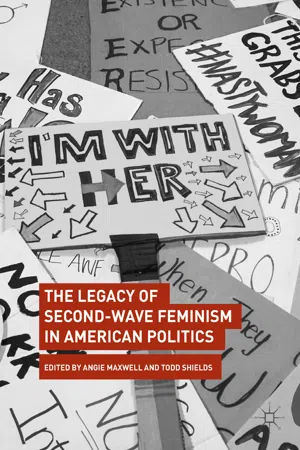
- Angie Maxwell, Todd Shields, Angie Maxwell, Todd Shields(Authors)
- 2017(Publication Date)
- Palgrave Macmillan(Publisher)
In this introductory chapter, Angie Maxwell and Todd Shields claim that the need to mark beginnings and endings of social movements, the over-reliance on popular, yet limited voices, the fact that feminism is not immune to white privilege, and the pain associated with lost battles for women’s rights have all contributed to obscuring the true legacy of the Second-Wave feminist movement. They contend that existing narratives have inordinately focused on the media-appointed “leaders” of the movement, who were almost exclusively white, heterosexual, well-educated women who overshadowed the multi-racial, grassroots cast of hundreds of thousands of women in America and around the globe. While Third-Wave feminists drew attention to these omissions and recovered the history of overshadowed communities, the time has come to reconcile both waves and re-examine the legacy of Second-Wave Feminism in American politics. This reassessment shows that the Second Wave was comprised of a heterogeneous army of women who, though often divided, still significantly influenced economics, theology, political activism, electoral success, attitudes toward homosexuality‚ and support for gay marriage. In fact, in many ways they were so successful that they were blind to the anti-feminist counterattack forming across the country. This introduction highlights the feminist historians, political scientists, gender studies scholars, and economists who are placing women’s activism at the center of our political landscape in their contributing chapters.The original version of the book was revised: Final corrections have been incorporated. The erratum to this chapter is available at https://doi.org/10.1007/978-3-319-62117-3_11End AbstractIn her edited collection, Feminist Coalitions: Historical Perspectives onSecond -Wave Feminismin the United States , Stephanie Gilmore speaks to the scholarly paralysis that has tempered our understanding of both the accomplishments and the failures, and of the structure and impact, of Second-Wave Feminism. Depicted most often as an offshoot of the Civil Rights Movement , Second-Wave feminists “are suspended in historical—or rather, ahistorical—amber, unable to move or be moved.”1Gilmore’s volume and its contributors did much to resurrect this debate. The paralysis, however, is not limited to the way in which the movement is conceived as branching from the larger fight for African-American rights, but also, as Sara M. Evans contends in Chap. 2 , to our proclivity to periodization. The need to mark a beginning and an end to what has been a sustained and constant effort for women’s equality—the need even to describe such periods as distinct “waves”—obscures much of the labor. And it obscures the laborers, many of whom remain absent from our narratives. Only popular leaders, or those leaders recognized by the media, present at key events highlighted by this periodization, remain in the public consciousness. Those leaders are almost exclusively privileged, white, and well-educated and function as the feature players overshadowing a multiracial, grassroots cast of hundreds of thousands of women in America and across the globe. And the movement itself, as the passage of a half-century has shown, lost control of the debate over women’s rights as the individual became more powerful than the collective. And so the united front needed to brace against the titanic backlash proved elusive. The consciousness-raising opened women’s eyes to their individual oppression, but not enough saw their own individual experience as part of a systemic and structural oppression for which political, collective, unified action remains the only antidote. Because the conservative backlash was so powerful, because the unity, despite the best efforts‚ was too fragile‚ because of our need to superficially mark beginnings and endings of social movements, because of our over-reliance on popular, yet limited voices, because feminism is not immune to white privilege eBook - PDF
Feminism in the News
Representations of the Women's Movement Since the 1960s
- K. Mendes(Author)
- 2011(Publication Date)
- Palgrave Macmillan(Publisher)
48 Introduction The Second Wave feminist movement takes place in the aftermath of the post-war era – a time of ‘home dreams’ (Parr 1995, p. 4) – where the (white) middle-class nuclear family was idealized as the norm after years of war. While many women had gained some semblance of inde- pendence and economic freedom when taking over men’s jobs during the war, traditional gender roles were quickly re-established in 1945, when women were kicked ‘out of the work force and into the ranch house’ (Fraser 1997, p. 165). Consequently, the public sphere once again became constructed as intrinsically ‘masculine’, and the private sphere as ‘feminine’ (Macdonald 1995), re-establishing a patriarchal, gendered hierarchy. Despite women’s expulsion from the public sphere, it also became clear that society was changing. Many women who had been in the paid work force during the war effort were unhappy with their postwar eviction (Bryson 2003). They started to recognize that their positioning within the home had more to do with ideology than biol- ogy and began to question the division of spheres (de Beauvoir 1989; Friedan 1963). As women’s consciousnesses were raised, they began to organize and agitate for change, recognizing that biology was no longer a plausible justification for job segregation, pay differences and limited opportunities. Women were not the first group to campaign collectively for social change during this period. The US Civil Rights movement began in the late 1950s, followed by the gay liberation and the New Left student move- ments. In Britain, activism was strongly focused on the anti-nuclear and peace movements. By the 1960s, women were just one of many groups who sought social change, and it is here that this study begins. 2 Reporting the Women’s Movement, 1968–82 Reporting the Women’s Movement, 1968–82 49 Feminism in the news For anyone interested in women’s history or welfare, the public con- struction of feminism is an important topic. eBook - ePub
Gender Communication Theories and Analyses
From Silence to Performance
- Charlotte Krolokke, Anne Scott Sorensen(Authors)
- 2005(Publication Date)
- SAGE Publications, Inc(Publisher)
1 Three Waves of Feminism From Suffragettes to GrrlsW e now ask our readers to join us in an exploration of the history of feminism or, rather, feminisms: How have they evolved in time and space? How have they framed feminist communication scholarship in terms of what we see as a significant interplay between theory and politics? And how have they raised questions of gender, power, and communication?We shall focus our journey on the modern feminist waves from the 19th to the 21st century and underscore continuities as well as disruptions. Our starting point is what most feminist scholars consider the “first wave.” First-wave feminism arose in the context of industrial society and liberal politics but is connected to both the liberal women’s rights movement and early socialist feminism in the late 19th and early 20th century in the United States and Europe. Concerned with access and equal opportunities for women, the first wave continued to influence feminism in both Western and Eastern societies throughout the 20th century. We then move on to the second wave of feminism, which emerged in the 1960s to 1970s in postwar Western welfare societies, when other “oppressed” groups such as Blacks and homosexuals were being defined and the New Left was on the rise. Second-wave feminism is closely linked to the radical voices of women’s empowerment and differential rights and, during the 1980s to 1990s, also to a crucial differentiation of second-wave feminism itself, initiated by women of color and third-world women. We end our discussion with the third feminist wave, from the mid-1990s onward, springing from the emergence of a new postcolonial and postsocialist world order, in the context of information society and neoliberal, global politics. Third-wave feminism manifests itself in “grrl” rhetoric, which seeks to overcome the theoretical question of equity or difference and the political question of evolution or revolution, while it challenges the notion of “universal womanhood” and embraces ambiguity, diversity, and multiplicity in transversal theory and politics.
- S. Budgeon(Author)
- 2011(Publication Date)
- Palgrave Macmillan(Publisher)
1 Introduction: Defining the Third Wave Since the early 1990s a set of literature which identifies a ‘third wave’ of feminism has been developing, often provoking lively debates about where feminism has been and where it is going. The con- cerns examined in this literature and the problems that are identified are linked to the second wave of Western feminism associated with the 1970s and 1980s. However, in this literature the case is often made that feminism has reached a key turning point in its devel- opment and that questions must be asked about its applicability to contemporary gender relations and transformed late modern social conditions. Third wave feminist assessments of the state of feminism therefore aim to offer a corrective to established tenets, so that fem- inism may have greater resonance with women’s lives today. The contemporary context is one in which the structure and meaning of gender relations are undergoing substantial questioning, due in part to advancements achieved by women; societal changes brought about by the restructuring of economies; increased cultural diversity; the proliferation of technoculture and the expansion of information technologies; the dynamics of globalization and the rise of global cap- italism; crises of environmental degradation; diversifying sexualities and intimate practices; changing demographics; and declining eco- nomic vitality (Dicker and Piepmeier, 2003: 4). It is now also accepted that feminism itself is characterized by diversity, fragmentation, and a series of internal contestations. One response to the uncertainty resulting from all of these developments is to declare that feminism and the study of gender has reached a state of crisis in which there is little agreement about why the study of gender is still relevant and 1 2 Third Wave Feminism and the Politics of Gender how best to proceed with the project of feminism. eBook - PDF
Women's Rights
People and Perspectives
- Crista DeLuzio(Author)
- 2009(Publication Date)
- ABC-CLIO(Publisher)
Third Wave Feminists: The Ongoing Movement for Women’s Rights Janice Okoomian The problem is that, while on a personal level feminism is everywhere, like fluoride, on a political level the movement is more like nitrogen: ubiquitous and inert. —Baumgardner and Richards 2000, 18 Introduction: The “ Wave ” Metaphor “Third Wave feminism” is a term “generally used to describe three intercon- nected concepts: generational age, ideological position, and historical moment” (Henry 2004, 34). Third Wavers are usually younger feminists, born in the early 1960s or later, who have a distinct set of political or ideological beliefs arising from the social and historical conditions of their era. This chapter traces the rise of the Third Wave as an historical movement. The metaphor of feminist waves helps us to identify commonalities and differences between large groups of feminists who differ by age, historical period, and ideology. Nevertheless, it is important as we proceed to keep in mind the drawbacks of the waves framework. For one thing, this framework may imply that femi- nist disagreements are trivial mother/daughter squabbles rather than genu- ine political debates. The waves model also tends to exaggerate ideological and historical differences, when in fact there is considerable continuity in Second and Third Wave feminisms. It is more accurate to think of Third Wave feminism as both a departure from and a continuation of Second Wave Feminism. This view yields a more complex and historically rich picture of U.S. feminism over the past 40 years. 12 WOMEN’S RIGHTS P E R S P E C T I V E S I N A M E R I C A N S O C I A L H I S T O R Y 208 Background: Postfeminism and Backlash By the late 1980s, feminism was dead — or so the media had repeatedly claimed. Writer Erica Jong discovered, for instance, that between 1969 and 1998, Time magazine announced the demise of feminism 119 times.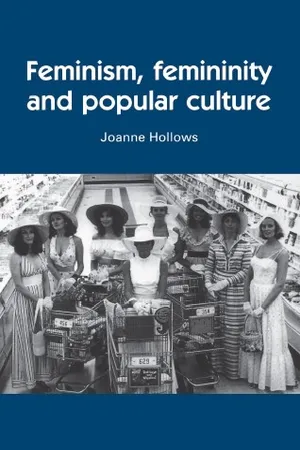 eBook - PDF
- Joanne Hollows(Author)
- 2024(Publication Date)
- Manchester University Press(Publisher)
1 Second-wave feminism and femininity This chapter examines how some of the key ideas introduced in this book have their roots in what has become known as 'second- wave feminism', the ideas and practices associated with the women's movements of the 1960s and 1970s. While it might seem unnecessary to turn back to this period of feminist struggle, there are a number of important reasons for doing so. First, for many students of feminism today, myself included, second-wave feminism is seen as a product of the past. Therefore, this chapter aims to give, albeit sketchily, a history of some of the ideas, activ- ities and struggles that informed second-wave feminism. Second, a major concern of this book is the ways in which popular culture and femininities need to be studied historically. For this reason it is also necessary to understand feminist identities as the product of specific historical contexts. Third, debates about popular culture within feminist cultural studies often engage with the concepts and ideas generated by second-wave feminism. Therefore, an introduction to the debates of the past offers a context for understanding the debates of the present. Finally, feminism today is sometimes seen as something that happened in the past and is redundant in the present. While this debate is explored in the final chapter, it is only possible to think of what role feminisms might play in the present if we reflect on their, sometimes troubled, past. This chapter also begins to develop some the major themes of the book as a whole. It examines the different ways in which femininity was constituted as a 'problem' in second-wave femi- nism. For many feminists, feminine values and behaviour were seen as a major cause of women's oppression. In this way, the chapter explores how second-wave feminism, and the identity 'feminist', was predicated on a rejection of femininity. The politics of second-wave feminism There is a wide range of forms of feminist activity and thinking eBook - PDF
- Laurel Forster, Sue Bruley, Laurel Forster, Sue Bruley(Authors)
- 2019(Publication Date)
- Taylor & Francis(Publisher)
Each found satisfying personal sol-utions but none found a comprehensive political prescription. The Second Wave was weakly institutionalised and created few formal organisations. It is not clear if many women participated in left-wing feminist political activism. 144 Few mass mobilisations in the 1960s and 1970s were speci fi cally feminist. But many women read and thought and talked about their experiences in a variety of new, more open, personal ways. There was a fl owering of feminist books, reading groups, bookshops, presses, journals and magazines. 145 Established mainstream publishers and booksellers established extensive women ’ s sections. The collection of the Feminist Library holds over 2,000 published texts from the Second Wave. 146 Independent women ’ s bookshops became key centres for exchan-ging information and establishing contacts between informal feminist interest groups. The principle form of the Second Wave was the written word. And it changed lives. Notes 1. Miriam David (2014) Feminism, Gender and Universities: politics, passion and pedagogies (Farnham UK: Ashgate), p. 57, in her extensive international study of the values and common roots of Second Wave academic feminism also uses a cohort category which also notes a distinct change in women born before and after 1950. 2. The periodisation of ‘ waves ’ of feminism was famously utilised in analyses of feminism by Olive Banks (1985) The Biographical Dictionary of British Feminism, Volume One 1800 – 1985 (New York: New York University Press) and (1986) Becoming a Feminist: the social origins of ‘ fi rst wave feminism ’ (Athens: The University of Georgia University Press). As used here the term Second Wave does not, however, indicate a lack of feminist activity between the wars, but rather that it did not have the character or public pro fi le of a mass movement, or demand a signi fi cant political response.
- Martin Pugh(Author)
- 2015(Publication Date)
- Red Globe Press(Publisher)
294 12 Fourth wave feminism 1997–2014 ‘Is there a future for feminism?’ Time magazine asked in December 1989. A typical media sally, it reflected the hope, among reactionaries, that women had achieved enough – or too much. By the late 1990s it had become fashionable to portray the women’s movement as uncertain about its direction and lacking popular support. These hostile views appeared to find an echo within the movement as the terms ‘New’ and ‘Old’ feminist began to reappear, though the differences between them were largely matters of emphasis and priorities rather than fundamentals. Certain issues, such as free contraception, abortion on demand, educational reform, legal and financial independence for women and ending discrimination against les-bians, stood lower down the agenda by this time, while the key concerns of the movement now centred around equal opportunities in employment, equal pay and improvements in the provision of childcare; women’s role as mothers seemed the greatest remaining obstacle to female equality in the labour force. The evolution of the movement: ideas, organisation and membership To a large extent changes in priorities within the movement by the end of the century reflected the aspirations of a new generation of feminists. In 1999 when Germaine Greer published The Whole Woman , a sequel to the Female Eunuch after 27 years , she betrayed some disappointment with the fruits of women’s liberation; the 1960s’ movement had been sidetracked and the ‘New Feminism’ seemed rather conservative as though trying to reassure the faint-hearted that ‘there is nothing to fear from feminism’. At the opposite end of the spectrum some feminist writing exuded a confident, even triumphalist, tone. eBook - PDF
Perverse Politics?
Feminism, Anti-Imperialism, Multiplicity
- Ann Shola Orloff, Raka Ray, Evren Savci, Ann Shola Orloff, Raka Ray, Evren Savci, Julian Go(Authors)
- 2016(Publication Date)
- Emerald Group Publishing Limited(Publisher)
The gender order of the mid-twentieth century was characterized by explicitly gendered formal institu-tions. Informal institutions, too, reflected and reinforced gender difference and inequality and masculine power. Many organizations advocating women’s equality À a “second wave” of feminism À emerged in the 1970s in the United States and across the West to contest these conditions. The fact of state-sanctioned discrimination and explicitly gender-differentiated social provision, buttressed by informal institutions keeping most women in a state of economic dependency and vulnerability to violence and sexual exploitation, gave credence to the claims of second-wave feminists that women shared interests in eradicating this state of affairs, despite many dif-ferences among them. Today, long-standing feminist support for women’s claims to person-hood, and most importantly to the recognition of women as individual social beings (see, e.g., Pateman, 1988 ), has undoubtedly found some suc-cess. 5 Yet, while great strides have been made in eliminating formal discri-mination, gendered inequalities remain notable. Since World War II in the global North, manufacturing has declined as service sector employment has 113 Feminism/s in Power: Rethinking Gender Equality risen, driven importantly by outsourcing of the work formerly done by housewives to paid service workers, many of whom migrate to take up this work, and contributing both to women’s increasing employment levels and to increasing income inequality. 6 The gendered division of labor of the “male breadwinner family,” with married women doing full-time care or part-time work plus care, and men providing most of the income and working full-time, has been modified, not ended, as À on average À women’s time in unpaid caregiving and domestic work has declined while men’s take-up of care work within and across households is far less than women’s take up of paid work.
Index pages curate the most relevant extracts from our library of academic textbooks. They’ve been created using an in-house natural language model (NLM), each adding context and meaning to key research topics.

