History

Serfdom in Russia
Serfdom in Russia was a system of forced labor in which peasants were bound to the land and under the control of landowners. It was a central feature of the Russian economy and society from the 16th to the 19th centuries, with serfs having limited rights and facing harsh conditions. The system was eventually abolished in 1861.
Written by Perlego with AI-assistance
Related key terms
1 of 5

12 Key excerpts on "Serfdom in Russia"
 eBook - PDF
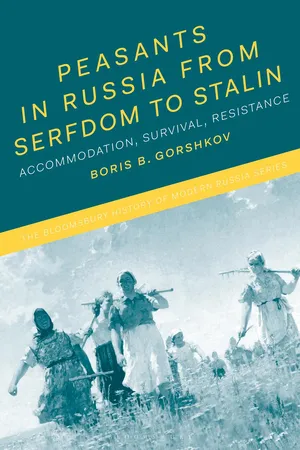
Peasants in Russia from Serfdom to Stalin
Accommodation, Survival, Resistance
- Boris B. Gorshkov(Author)
- 2018(Publication Date)
- Bloomsbury Academic(Publisher)
The relationship between a serf and the landowner was intertwined with many extremely complex factors. In general, serfdom entailed a system of relations between serfs and their owners which was regulated by laws. The relations involved a range of legal, social, economic, and cultural characteristics, which together made serfdom a multifaceted institution. Laws passed over a hundred-year period, during the sixteenth and seventeenth centuries, entrenched Russia into serfdom, which in turn influenced many aspects of Russian life. At the very time North Western Life under Russian Serfdom 17 Europe was moving away from feudalism (and serfdom), the Russian nobility and aristocracy were gradually stripping peasants of the small amount of rights and privileges they still possessed. Serfdom emerged in Russia in the sixteenth century. Beginning with a series of late sixteenth-century laws, the state step-by-step restricted the peasants’ mobility and subjugated them to the authority of the landlords. The famous 1649 Law Code ( Ulozhenie ) capped the earlier legislation by attaching peasants to the land and the landlord by banning them from leaving their place of residence without permission. It must be pointed out, however, that all social estates in Russia, including the nobility (until 1762, when the decrees of Peter III emancipated the nobility from obligatory state and military service), were prohibited from moving their place of residence without special permission. Russian peasants lived on the land in settlements known as communes or, in Russian, mir , a word which has other significant connotations, for instance, “peace” and “world.” Although sometimes the land belonged to the peasants themselves, by the 1600s, the majority of communes were located on lands that belonged either to an individual landlord, to the church, or to the state. A peasant village and the landlord’s lands on which it was settled constituted the landlord’s estate, known as the manor or pomest’e . eBook - ePub
The Russian Peasantry 1600-1930
The World the Peasants Made
- David Moon(Author)
- 2014(Publication Date)
- Routledge(Publisher)
Serfdom and the other means by which the state extracted a large part of the product of the labour from its mainly peasant population met this need. Together with all landowners, moreover, the state was concerned to maintain internal security against the threat of peasant revolts. Serfdom and restrictions on all peasant movement were ways to keep peasants under control. 8 By the early eighteenth century, the measures binding peasants to the land had led to the division of the Russian peasantry into categories according to the owners of the land they lived on. The main categories were: seigniorial (pomeshchich’i) peasants, or ‘serfs’, who lived on the estates of nobles; state (kazennye, gosudarstvennye) peasants, whose land was state property; church (tserkovnye, ekonomicheskie) peasants, who lived on lands belonging to the Russian Orthodox Church; and the smaller numbers whose landowners were members of the tsar’s family, known as court (dvortsovye) peasants until 1797, and thereafter as appanage (udel’nye) peasants. 9 The emergence of servile labour was not restricted to Russia. While serfdom had largely died out in north-west Europe by the sixteenth century, in addition to Russia it also developed in large areas of eastern and central Europe, including right-bank Ukraine, Belorussia, Lithuania and the Baltic provinces of Estonia, Livonia and Kurland, which were annexed by the Russian Empire in the eighteenth century. At roughly the same time, moreover, slavery was introduced to Europe’s American colonies. 10 PEASANTS’ OBLIGATIONS TO LANDOWNERS AND THE STATE (TO 1860 S) The enserfment of a large part of the Russian peasantry and similar restrictions on the rest of the peasantry greatly facilitated the exploitation of the mass of the rural population by the ruling and landowning elites eBook - PDF
Seventeenth-Century Europe
State, Conflict and Social Order in Europe 1598-1700
- Thomas Munck(Author)
- 2017(Publication Date)
- Bloomsbury Academic(Publisher)
Nevertheless, some compar-isons with peasant conditions both in east-central Europe and in some parts of the Mediterranean seems plausible. 5 Serfdom in Muscovy Serfdom, when fully developed in eastern Europe in the eighteenth century, amounted to very comprehensive seigneurial domination over the peasantry. By then, serfs on private estates could in practice be bought, sold or transferred, with or without their land, and their services were customarily reckoned as part of the capital assets of the estate. There were no real limitations on the exercise of seigneurial authority, except that of paternalistic self-interest. In contrast to peas-ants bound to the land in France or Denmark, serfs in the east were tied to the particular landowner by social practices and legal restric-tions that were clearly demeaning and utterly one-sided – and which also directly affected the status of women. Serf–seigneur relations were not contractual but part of an institutional and social framework unconditionally backed by the law and the state. The legal framework for serfdom was only gradually worked out, but there is good reason to assume that the realities of the system had become well ingrained in practice before formal legislation was complete. In Muscovy the peasantry, originally free, had by the later fifteenth century been subjected to substantial restrictions on their The structure of society: peasant and seigneur 259 entitlement to move from one estate to another, and in the period 1581–92 these were tightened with the help of new tax registers. It is not clear who was behind this, but landowners and servitors were concerned about severe manpower losses in central Muscovy caused by peasant migration, flight and war. eBook - PDF
- Harold Bolitho(Author)
- 1998(Publication Date)
- Yale University Press(Publisher)
And it may easily transpire that certain individuals will seek to address their un-acknowledged grievances by using force, and then a frightful struggle may ensue: one class will rise up against another and the new order will be baptized in a fountain of blood. Among social questions urgently requiring immediate resolution in Russia is the problem of serfdom. Twenty-two million persons of both sexes, more than a third of the entire population of Russia, now are the property of private individuals. An appalling phenomenon! In the nineteenth century, when the inner reserves of nations are mobilized to meet external threats, when industry and education move so swiftly forward, when political might itself depends not only on governments' military resources but on citizens' intellectual and eco- On Serfdom 71 nomic activity, in the nineteenth century, across enormous areas of Russia, there exists an institution which inhibits every positive development and which reduces Russia to a semibarbarian power. This fact alone should suffice to persuade us that, at present, we cannot expect to compete with Western states on equal terms. A man bound hand and foot cannot hope to best a rival who enjoys free use of his appendages. Serfdom is a ball and chain which we drag behind ourselves and which confines us to virtual immobility while other nations forge irresistibly ahead. Without the abolition of serfdom the resolu-tion of [our society's] other problems—political, administrative, and social— will be impossible. Wherever one looks, serfdom looms as an insurmountable obstacle, a stigma upon all civic and political relations. In fact, regardless of the angle from which we view the question, serfdom cannot be justified. eBook - PDF
Buying Freedom
The Ethics and Economics of Slave Redemption
- Kwame Anthony Appiah, Martin Bunzl, Kwame Anthony Appiah, Martin Bunzl, Kwame Appiah, Martin Bunzl(Authors)
- 2018(Publication Date)
- Princeton University Press(Publisher)
Part III HISTORICAL CONSIDERATIONS Chapter Eight The End of Serfdom in Russia—Lessons for Sudan? LISA D. COOK The literature on slavery in the Americas is often cited when the current problem of slavery in Sudan is considered. But in addition to looking to American slavery as a benchmark, it would be equally instructive to ex-amine the less-compared serf-emancipation schemes developed and exe-cuted by tsarist Russia. Emancipation and redemption schemes have been debated and, with some controversy and mixed success, implemented in Sudan. Elaboration of the factors influencing design of an abolition pro-gram may shed light on alternatives available to those considering eman-cipation in Sudan. The Mechanics of Serfdom in Russia Serfdom comprised a number of forms of limited (by law or by custom) ownership of human beings or legal claims to varying parts of their wealth, income, or services. 1 A serf and the serfowner’s land were typi-cally an asset bundle, and title to the land included title to the serf. Data on the evolution of serfdom, on serfs during the eighteenth and nineteenth centuries, and on serfs and serfowners on the eve of emancipa-tion reported in tables 8.1, 8.2, and 8.3 may be useful in understanding the timing, scale, and scope of Serfdom in Russia. Blum’s (1961) estimates of the number and proportion of male serfs in the Russian population are given in table 8.2. While most series suggest a decline in the proportion of serfs between 1800 and 1861, estimates vary. The estimates of Hoch and Augustine (2001), for example, are generally lower than Blum’s. They estimate that 50.1 percent of the male population was enserfed in 1811, and that this fell to 36.5 percent by 1857. 1 See Kahan (1973) for a fuller discussion of the definition of serfdom and Troinitskii (1861) for a summary of the rights and responsibilities of serfs and serfowners. eBook - ePub
Serfdom and Slavery
Studies in Legal Bondage
- M. L. Bush(Author)
- 2014(Publication Date)
- Routledge(Publisher)
The importance of serfdom is often assumed, but with what good reason? One view is to see it as a veil draped over the true face of rural society, obscuring its essential features. Thus, in eighteenth and nineteenth-century Russia, the mentality of the peasantry, it is argued, was conditioned not by serfdom but by other factors, notably the way authority was allocated within the commune and among its component families, the way relationships between lord and serf were determined by the collusion of family heads, and the way relationships between families within the commune were determined by the practice of repartitional tenure (Hoch). Within this scheme, serfdom played little part in determining the peasant outlook. On the other hand, without the coercion of serfdom, it is argued, the Russian peasantry would have been much less productive (Mironov). The importance of serfdom could also be questioned on the grounds that, within the peasant community, social divisions were created by the differences between rich and poor rather than by the distinction between those of free or unfree status.One means of stressing the importance of serfdom is to view it in class terms, especially by assuming that peasant societies which featured serfdom were dominated by it and therefore especially vulnerable to exploitation, so much so that, thanks to serfdom, the peasants’ advantage of possessing the means of production was denied and lords instead gained free access to their surplus and took full charge of their labour. However, in medieval serf societies the unfree formed only a minority (Dyer, Davies). In the modern period, serfs often formed the majority, but, outside Poland, Hungary and Bohemia, not usually an overwhelming one (Bush). Furthermore, the unfreedom of the serf was no bar to the possession of rights and the acquisition of wealth: the former, a protection against exploitation, the latter, proof of the effectiveness of these rights. Serfdom was presented by reformers in the eighteenth century as a cause of peasant impoverishment, but much depended upon the degree to which serfs were exposed to the demands of their lords and the crown. Studies of living standards and the weight of exaction, in both medieval and modern serf societies (Dyer, Hagen, Hoch), suggest that serfdom could serve the peasant as well as the lordly interest. Within the chain of exploitation, serfs were not at the bottom. As peasants, serfs were better off than landless labourers; and, protected by seigneurial custom or urbarial regulations, they were better off than those free peasants who were rack-rented, either because they leased demesne or because they held subleases of tenure land. Serfs were not downtrodden simply because of their servile condition; and lords were not necessarily free to do what they liked because their tenants were serfs. All this would suggest that explaining the condition of serfdom in class terms fails both to identify its true nature and to appreciate its pre-capitalist character (Hoch). eBook - ePub
Foundations of Modern Slavery
Profiles of Unfree and Coerced Labor through the Ages
- Caf Dowlah(Author)
- 2021(Publication Date)
- Routledge(Publisher)
Some studies also show that emancipation of serfs contributed to greater productivity gains and economic growth for Russia. Markevich and Zhuravskaya (2018), for example, found that Russian GDP increased by 18 percent in the second half of the nineteenth century, mainly because of the change in the incentive structure brought forth by serf-emancipation. The study found that gaining back the rights to own land and labor, peasants transformed themselves into free small-scale farmers, and exerted greater effort to adapt to local conditions and applied available agricultural knowledge and technologies better than before.E Concluding remarks
The Russian serfdom, that survived almost 400 years, thrived on a two-prong strategy: tying peasants to a parcel of land- and serf-owners, and empowering of the serf-owners to serve the monarchy. The nature of relationships between serfs and serf-masters, as well as between the nobles and monarchs, was consistently shaped by the same strategies. While a segment of serfs—especially state-serfs and those lived on imperial land—enjoyed greater latitude, for a vast majority of the serfs, the serfdom resembled chattel slavery—their mobility, productivity, education, and economic activities were severely restricted. Russian serfs could be bought and sold as any other property.The captive serf-labor force helped Russian economy to thrive agriculturally, and even helped Imperial Russia to emerge as a major power in Europe militarily, but the institutional regime of serfdom turned out to be fundamentally antithetical to economic development. The nation almost completely missed the boat of industrialization, urbanization, and modernization that flourished in Western Europe during the same the period. The Russia indeed ended up as an agrarian and backward economy when serfdom ran its course. While early disappearance of serfdom contributed to the rise of Western Europe and its transition to capitalism, long dependence on serfdom left Russia with a fertile background to make a transition to socialism.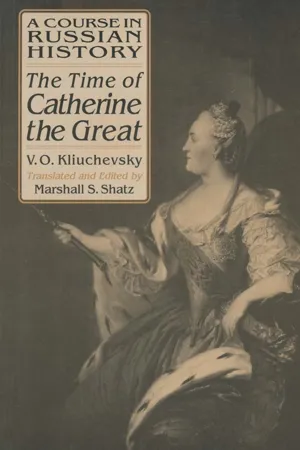
- Vasili O. Kliuchevsky, Marshall S. Shatz(Authors)
- 2015(Publication Date)
- Routledge(Publisher)
Catherine did not choose any of these methods. She simply consolidated the domination of the owners over their peasants in the form that it had assumed in the middle of the eighteenth century, and in some respects even broadened that power. As a result, serfdom under Catherine II entered a third phase of its development; it took a third form. The first form of serfdom, up to the decree of 1646, was personal dependence of the serfs on the landowners by agreement. This was the form in which serfdom existed until the middle of the seventeenth century. Under the Code of Laws of 1649 and Peter’s legislation, serfdom was transformed into the hereditary dependence of the serfs on the landowners by law, on condition of the landowners’ compulsory service. Under Catherine, serfdom assumed a third form: it turned into the complete dependence of the serfs, who became the private property of the landowners, but no longer on condition of the latter’s compulsory service, from which the nobility had been released. That is why Catherine can be called the perpetrator of serfdom—not in the sense that she created it, but in the sense that under her it was transformed from a variable fact, justified by the temporary needs of the state, into a right recognized by law but in no way justified.Now let us examine the consequences of serfdom in this, its third and last form. Those consequences were extremely varied. Serfdom was the hidden spring that moved and gave direction to the most diverse spheres of national life. It not only shaped the course of the country’s political and economic life but put a sharp stamp on its social, intellectual, and moral life. I will briefly enumerate some of the most notable consequences of serfdom and indicate first of all the effect it had on the landlords’ agriculture. For an entire century, from the manifesto of February 18 to the manifesto of February 19,2 our social, intellectual, and moral development proceeded under the weight of serfdom, and perhaps another whole century will elapse before our life and thought are freed from its traces.Under the shelter of serfdom, distinctive relationships and procedures took root in the landlord’s village in the second half of the eighteenth century. I will start with the methods by which landlords exploited serf labor.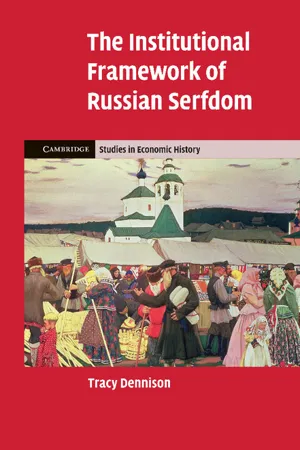
- Tracy Dennison(Author)
- 2011(Publication Date)
- Cambridge University Press(Publisher)
17. 4 Ibid., pp. 17–21. See also O. Crisp, Studies in the Russian economy before 1914 (London and Basingstoke, 1976), pp. 70–2. 5 The sections of the Muscovite Law Code (Ulozhenie) of 1649 which are now viewed as the legal foundations of Russian serfdom were concerned primarily with (the prohibition of) peasant mobility and procedures for dealing with fugitive serfs. See the discussion in R. Bartlett, ‘Serfdom and state power in imperial Russia’, European History Quarterly 33 (2003), pp. 29–64 esp. pp. 30–1. 214 The institutional framework of Russian serfdom Imperial law largely left it to landlords to run their estates as they saw fit. This loose legislative cloak gave rise to a vast heterogeneity of different local and landlord-specific forms by the early nineteenth century. In any particular local context, what serfdom amounted to was the policy of the landlord, both its explicit official framework and its actual day-to-day, year-to-year implementation. These gaps in the legal framework meant that it was possible for serf- dom, as it existed at Voshchazhnikovo, to have certain positive aspects for estate inhabitants. Most of these resulted from the reasonably well- developed and quasi-formal legal and administrative framework devel- oped by the Sheremetyevs to oversee their many scattered holdings. We have seen some specific aspects of this system in the preceding chapters. The framework itself had two main parts: first, a legislative component, a written set of rules and regulations (instriuktsii or ‘instructions’), accord- ing to which all estates were to be governed; and second, an enforcement mechanism, the central authority (domovaia konsulariia) to which all bailiffs and stewards and elected officials were accountable. The so-called instructions were usually quite detailed; one surviving set for the Voshchazhnikovo estate, from the year 1764, contained ninety-five sepa- rate points. eBook - ePub
A Course in Russian History
The Seventeenth Century
- V.O. Kliuchevskii(Author)
- 2016(Publication Date)
- Routledge(Publisher)
ChapterIXThe Coming of SerfdomAt the same time that servicemen and townspeople were set apart as two distinct classes, the position of the rural agricultural population was also finally settled. The change affected the greater part of that population, the peasants living on private landowners’ estates. It separated them not only from other classes, but also from other groups of the rural population—that is, from the “black” or state peasants and from those living on court lands. I am referring to the introduction of peasant-servitude to private owners. We have seen that at the beginning of the seventeenth century, state and court peasants were already attached to the soil or to village communities. The position of peasants living on private owners’ land was still undefined because it involved several conflicting interests. By the beginning of the seventeenth century all the economic conditions attaching peasants to private landowners were fully operative, and it only remained to find a legal formula that would convert their de facto servitude into bondage sanctioned by law.In the sixteenth century the position of manorial peasantry as a social class contained three distinct elements: the payment of land tax, the right to leave, and the need for a loan from the master—that is, elements of political, juridical, and economic significance. Each of them was opposed to the other two, and the changing course of the struggle between them accounted for the hesitancy of legislation in defining the peasants’ status. The struggle was due to the economic factor. From the middle of the sixteenth century onward, for various reasons that we have partly considered, the number of peasants needing loans for starting and carrying on their farming began to increase. The need for loans compelled the peasants to remain in bondage and forfeit their right of free movement until they repaid their debts. This right was not abolished by law, but became a legal fiction. The argument against peasant bondage was that as freemen they paid a land tax, from which bondsmen were exempt; and so at the beginning of the seventeenth century legislation tried to prevent peasants from becoming bondsmen, and a law was passed establishing “peasant perpetuity,” which made it impossible for a peasant to escape the status of taxpayer. These aspects of the peasants’ position, combined with the conditions of personal bondage as it existed in ancient Russia, provided the legal framework for the enslavement of the manorial peasantry. eBook - PDF
The Rise of Economic Societies in the Eighteenth Century
Patriotic Reform in Europe and North America
- K. Stapelbroek, J. Marjanen, K. Stapelbroek, J. Marjanen(Authors)
- 2012(Publication Date)
- Palgrave Macmillan(Publisher)
40 What is not in dispute is that it exposed serfdom to the devastating critique of natural law theory. Consider the winning essay, written by the Aachen jurist Beardé de l’Abbaye. As Beardé put it, unlike the Ottoman Empire, whose system was based on what Beardé called ‘the equal distribution of slavery’, Russia had a free noble elite on top of an enslaved peasantry. The first casualty was legality itself: ‘All order is shrouded in a thick fog; no one knows if the children born into slavery belong to their father, their lord, or their sovereign.’ The second victim was the peasantry, deprived of the most basic human dignity: ‘Poor creatures! They cut wood or till the land at their master’s command: the smallest desire, the tiniest enterprise is denied them; great actions are forbidden them; they grow old and die. And what have they accomplished?’ Although Beardé favoured landed property and personal freedom for serfs, he urged introducing reform slowly. Arguing that ‘it would be senseless to demand from a crude peas- ant the fulfilment of laws unknown to him’, he insisted that Russia’s noble class must educate peasants before freeing them: Thus the lord may tell several slave families: last year you worked only 100 desiatiny (270 acres) and I received only 300 measures of grain from your arable; double your efforts and labour for my benefit, cultivate the land which I entrust you with zeal; and as soon as you bring it to a level which can increase my income by 100 measures of grain, I will grant you your own land; I will grant you the freedom and power to enrich yourselves through your diligence and labour. 41 Aside from this call for voluntary manumission, Beardé included few specific recommendations. He advised lords to reward the most diligent serfs with conditional property rights, assuming that other peasants would emulate their example. Full emancipation would be postponed until an unspecified point in the future.
- Markus Cerman(Author)
- 2012(Publication Date)
- Red Globe Press(Publisher)
To acknowledge the results of the new approaches to East-Central and Eastern European rural history would mean doing without the concept of a general serfdom and employing more useful concepts, like the English-language equivalents of terms in Czech, German, Hungarian, Polish or Slovak historiography such as demesne lordship. The system is now understood not as compact, but as including all the different manifestations of seignorialism in the area, which ranged from milder forms of lordship to serfdom, the latter limited to a small number of territories only. The actual practice of demesne lordship in individual regions and estates depended on the development of four main characteristics: mobility restrictions, jurisdictional powers of lords, property rights and labour rents (see Section iv). Variation in these characteristics largely explains the regional differences observed, which is why it is inadequate to think of demesne lordship as a monolithic system. This conclusion is largely owed to the most recent approaches, in which determined efforts to give priority to a view from the The Myth of a Second Serfdom 39 village highlighted the scope and possibilities of villagers and their institutions to influence and shape rural society. Demesne lordship, subjection and serfdom could interfere directly in several aspects of villagers’ everyday lives. Yet many case studies illustrate that the power of demesne lords was far from absolute and that there were legal and other ways for successful action and resistance by the rural population. Villagers could and did determine their own affairs to a much larger degree than had previously been assumed. However, they often had to engage in bitter arguments and conflicts and incurred material losses to do so [210]. This suggests that there was continuous pressure from lords and – as everywhere else in Europe – from the growing power of the state.
Index pages curate the most relevant extracts from our library of academic textbooks. They’ve been created using an in-house natural language model (NLM), each adding context and meaning to key research topics.

