History

The Formation of NATO
The formation of NATO, the North Atlantic Treaty Organization, occurred in 1949 as a response to the growing threat of Soviet expansion in Europe after World War II. The alliance was established to provide collective defense against potential aggression and to promote stability and security in the region. NATO's formation marked a significant shift in international relations and had a lasting impact on the geopolitics of the Cold War era.
Written by Perlego with AI-assistance
Related key terms
1 of 5
10 Key excerpts on "The Formation of NATO"
 eBook - PDF
- David J. Galbreath, Jocelyn Mawdsley, Laura Chappell(Authors)
- 2019(Publication Date)
- Routledge(Publisher)
4 NATO and the transatlantic community, 1949–2019 James Sperling Introduction The North Atlantic Treaty (1949) forged an unbreakable security bond between Western Europe and North America. The Treaty marked a historic departure in US diplomacy. President Harry S. Truman, in committing the US to the defence of Europe, ignored President George Washington’s admonition that the United States should not enter into any ‘entan- gling alliances’. The transatlantic alliance, and its eventual institutionalisation as the North Atlantic Treaty Organization (NATO), was not only the essential component of the US grand strategy of containment, but also represented a unilateral American security guarantee that made possible the post-war political and economic recovery of Western Europe, legitimised the long-term stationing of American military forces on European soil, and provided a mate- rial foundation for US leadership of the West. The creation of NATO, its ability to sustain a transatlantic consensus on common geo- political interests and aspirational foreign policy goals, and the creation of a transatlantic community of like-minded states, was not foreordained. In fact, NATO was beset during the Cold War (1947–1990) by serial crises of confidence over the credibility of the American nuclear guarantee, episodic fears of abandonment or entrapment by Europeans and Americans alike, and an inability to strike a balance between American leadership and the European desire for greater equality within the alliance (see Thies, 2009). With the end of the Cold War and dissolution of the Soviet Union, tensions within the Atlantic Alliance became, if anything, more pronounced. The sudden absence of an existen- tial threat left the alliance bereft of purpose. NATO, a compulsory alliance during the Cold War without the option of exit for Europeans or North Americans, became, in 1990, a vol- untary alliance with one. eBook - ePub
NATO’s Post-Cold War Politics
The Changing Provision of Security
- S. Mayer(Author)
- 2014(Publication Date)
- Palgrave Macmillan(Publisher)
Against the background of dramatic circumstances in early 1948, the North Atlantic Treaty Organization (NATO) was constituted to institutionalize a defence arrangement. In view of East–West tensions eventually turning into a serious confrontation between the Western powers and the Soviet Union, France, Great Britain, and the US realized that their existing collective and bilateral arrangements (above all the Marshall Plan and US bilateral military aid) were insufficient and had to be sustained by a politico–strategic institution (Schmidt 2003: 87, 233–240). West Europeans therefore called upon the US, hitherto hostile to alliances, to negotiate what would eventually become the North Atlantic Treaty of 4 April 1949 (NAT), NATO’s founding document. That treaty constitutes a primarily political arrangement which largely relied on the deterrence effect of both a unity of purposes and principles among the allies (policy of strength) and on the overwhelming US military might, including nuclear weapons and strategic bombers.In this opening chapter to the historical part of the volume I outline NATO’s emerging political structure primarily with reference to two focal issues: firstly, the credibility of the US security guarantee under the impact of the changing structures of the evolving US–USSR arms race as well as the role of the US in making NAT(O) work;1 and secondly, the question whether the quest of western European states for politico–strategic and economic integration would suffice to make up for Europe’s deficiencies of defence arrangements (such as the Brussels Pact) before NATO was established.The link between these two grand themes was the concurrence of both US and west European convictions that NATO alone was unable to warrant the ‘Security of the West’ due to inevitable conflicts about the issue of nuclear deterrence. As we shall see below, the Alliance had therefore to be complemented by endeavours to promote and organize ‘European unity’ (Schmidt 1995a: 144). Some proponents of ‘uniting Europe’, like US President Eisenhower and his Secretary of State John F. Dulles (Neuss 2000), had in mind that the US eventually could and should reduce its presence as a ‘European’ (conventional) military power to the extent to which western Europe recovered (Cromwell 1992).The remainder of this chapter starts by elucidating the roots of NATO. First I discuss the most crucial institutional structures the Alliance was built upon, partially in benefiting from existing alliances (particularly the Western Union Defence Organisation, WUDO). In the second section, I outline the NAT and assess how the implementation of some of its articles affected the emergence of NATO’s politico– administrative structure. The third section discusses the significance of non-military cooperation in the founding of NATO. Next, the emerging Annual Review process is examined. In the fifth section, I proceed by discussing the emerging instrument of political consultation. The penultimate section reviews The Formation of NATO’s permanent politico– administrative unit, including its Secretary General, while the last raises the issue of a number of challenges to NATO as an independent international organization.
- Frank R. Douglas(Author)
- 2007(Publication Date)
- Praeger(Publisher)
7 The New U.S. Relationship with NATO The United States’ relationship with NATO’s European allies during the Cold War was one of American dominance. This dominance was over a military organization with a large command structure that controlled a potentially large military force, concerned with a static defensive posture against a single potent enemy, the Soviet Union. NATO was a military organization focused only on the defense of Western Europe. During the period 1989–91, the security environment in Europe had dramatically changed. No longer was there a threatening Soviet Union, or even a Soviet Union or a Warsaw Pact. The original reason for the formation of the North Atlantic Treaty Organization (NATO) was gone, and many thought the days of NATO were surely numbered too. NATO survived the decade of the 1990s and has since crossed into the twenty-first century. Why? NATO’s survival was due to creating for itself new functions, new flexibilities, new command structures, and new internal relationships for the new strategic realities facing NATO’s members in the post–Cold War world. This substantial transforma- tion of NATO was not complete by the end of the 1990s, but it was well on its way. Whether the new transformed NATO will really realize the goals and capabilities it has set for itself remains to be seen. Another point of NATO’s survival, besides its structural and strategic overhaul, was that it was in the interests of the United States and Europe to save NATO, and effort was devoted to this end. The 1990s were a period of a reduced military threat in Europe, reduced defense budgets, and reduced military forces for the United States and other NATO allies. Saving NATO was a paramount objective of the Bush administration. Keeping NATO was also in the interests of NATO’s European mem- bers at least for some time into the future, as it was more cost-effective to keep NATO than to build some new military alliance.
- Geir Lundestad(Author)
- 2019(Publication Date)
- Columbia University Press(Publisher)
His point of departure is that even in May 1948 Truman and his advisers had not resolved in their own minds the nature and range of The Origins of NATO 169 the obligations to be accepted in the contemplated mutual defense pact or the military arrangements for making it ef-fective. 2 Louis Halle, although less of a clear-cut traditionalist than Feis, basically follows the same line of analysis. The opening statement in his chapter on The Formation of NATO reads, The winter of 1947-1948 was a winter of crisis for the nations of western Europe. Their economies had broken down, the Communist parties under orders from Moscow had embarked upon an all-out effort to wreck their political structures, invasion by the Red Army seemed an imminent possibility. An economic recovery program was under way. What remained was for Western Europe to rehabilitate itself militarily. And, again, the Europeans had to call on the Americans to help in that task. 3 On the revisionist side less agreement exists on what led to the formation of the NATO alliance. As usual, the ex-treme version is found with the Kolkos. In their opinion not only was there little danger of a Soviet attack on Western Europe, but American policy makers were well aware of the improbability of such an attack. To the Kolkos the Soviet danger was something that successive administrations in Washington fostered to maintain a sustaining tension to enact extremely costly legislation generally desired for rea-sons having little, if anything, to do with Russia. The advance of U.S. capitalism was what counted, now as always. NATO was in part promoted as a means of crush-ing left-wing movements in Western Europe, in part, to sub-jugate Western Europe to the interests of the United States. eBook - PDF
- Elizabeth Pond(Author)
- 2000(Publication Date)
- Brookings Institution Press(Publisher)
51 CHAPTER FOUR Post–Cold War NATO T he North Atlantic Treaty Organization emerged from the cold war with glory and perplexity. Its deterrence had produced the longest peace on the European continent in history, and it had never fired a shot in anger. 1 Yet it appeared to many to have put itself out of business, now that Moscow’s troops had retreated a thousand miles to the east and the democratic Germans had regained unity and full sovereignty. Especially after the Warsaw Pact dissolved in 1990, the Soviet Union dissolved in 1991, and the Russian succes-sor to the Soviet army completed its withdrawal from Germany in 1994, NATO no longer seemed necessary to keep the Russians out or the Germans down. The U.S. Engagement Its strongest remaining rationale, then, was to keep the Americans in Europe—and various European and American voices argued that to prolong Pax Americana would be no more than bureaucratic self-perpetuation. 2 Other organizations that did not embody outdated U.S. hegemony, like the Conference on Security and Cooperation in Eu-rope, were proposed for the continent’s security architecture in the dawning era of peace. So strong was this sentiment that President George H. W. Bush testily warned the Europeans in 1991, “If your ultimate aim is to provide independently for your own defense, the time to tell us is today.” If so, he implied, the United States would happily go home and leave the Europeans to be hoist by their own petard. 3 52 / post–cold war nato As they took a second look at the uncertain world about them, however, NATO governments and the new central European democ-racies saw an urgent need for the United States to stay engaged in Europe—and saw NATO as the only possible instrument of this en-gagement. In its desire to reap a peace dividend so that it could focus on neglected domestic needs, the U.S. Congress was hardly in a mood to approve some new defense commitment to foreign allies. eBook - PDF
Europe and the Atlantic Relationship
Issues of Identity, Security and Power
- D. Eden(Author)
- 2016(Publication Date)
- Palgrave Macmillan(Publisher)
3 The Future of NATO and the Transatlantic Alliance in the Twenty-First Century Geoffrey Lee Williams Introduction This analysis is divided into a number of inter-related parts. One part concerns the nature of the international order as well as the nature of the future strategic environment. Indeed, we are dealing with a seamless robe whose constituent parts could pre-determine the nature of both NATO and the transatlantic relationship well into the twenty-first cen- tury. I therefore will start by discussing the impact of three powerful, simultaneous and intersecting revolutions on international politics. This should enable us to identify the driving forces, predetermined elements and critical uncertainties which, taken together, will shape the future of NATO and the transatlantic alliance which surely has been the most successful security community in twentieth-century history. The political revolution I start with the political revolution. This involves looking at the whole structure of world politics wrought by the Second World War, including the end of colonialism and the collapse of the Cold War. The Second World War saw the defeat of Germany, Japan and Italy and the rise of the two superpowers, America and the Soviet Union. It also saw the eclipse of Great Britain as a great power (a former superpower in the nineteenth century) as both world wars took their toll of British resources and capacity for world leadership. France too went into decline. The end of colonialism The end of European colonialism contributed to a quantum jump in the number of states, which led to the doubling in size of UN members in ten 30 Geoffrey Lee Williams 31 short years. Likewise, the end of the Cold War saw the rise- though on a more modest scale- of the number of nation-states operating within the international system, with UN membership rising to more than 184 states.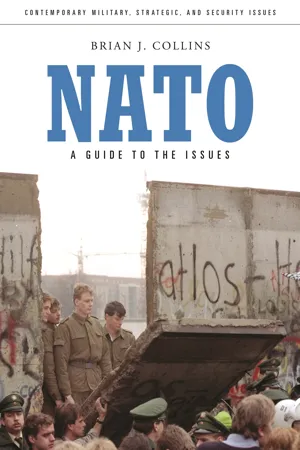 eBook - PDF
NATO
A Guide to the Issues
- Brian J. Collins(Author)
- 2011(Publication Date)
- Praeger(Publisher)
The language in Article 3 is particularly interest- ing because the phrase “continuous and effective self-help and mutual aid” came from the Vandenberg Resolution. The treaty negotiators were looking for ways to strengthen the case for U.S. Senate approval of the treaty. The NATO Treaty was signed in Washington on April 4, 1949, by Belgium, Canada, Denmark, France, Iceland, Italy, Luxembourg, the Netherlands, Nor- way, Portugal, the United Kingdom, and the United States. A few days later, the Brussels Treaty members, as well as Denmark, Italy, and Norway requested military and economic assistance from the United States. The Berlin Blockade ended on May 9, 1949. The NATO Treaty entered into force on August 24, 1949; ironically, the day after President Truman publicly announced the discov- ery that the Soviet Union had successfully exploded its first atomic bomb. The successful Soviet atomic test occurred approximately three to five years earlier than forecast by U.S. intelligence and was quite a surprise, indicating that the worst-case intelligence estimates were too optimistic. The first North Atlantic Council (NAC) session took place in Washington on September 17, 1949. The anticommunist cause suffered another setback on October 1, 1949, when Mao Zedong proclaimed communist victory in the Chinese civil war and founded the People’s Republic of China. In the West, it was easy to tie events together and believe oneself under siege from a monolithic communist movement. Congress passed the U.S. Mutual Defense Assistance Act of 1949 to au- thorize the president to provide military assistance to the NATO Treaty sig- natories and to set funding limits. President Truman signed the act into law on October 6, 1949: The President is hereby authorized to furnish military assistance in the form of equipment, materials, and services to such nations as are parties The Founding of NATO 19 to the [NATO] treaty and have heretofore requested such assistance.
- Nigel Thalakada(Author)
- 2012(Publication Date)
- Palgrave Macmillan(Publisher)
36 The Evolution of America’s Cold War Alliances stability beyond the Euro-Atlantic area in support of the US-backed international order; as Rebecca Moore cogently argues, NATO’s post- September 11 vocation is simply an extension of its post-Cold War realization that Euro-Atlantic security depends on addressing the many sources of instability skirting NATO’s borders. 55 As with other NATO operations and missions, all allies contribute in some form or another to the ISAF mission; whether through a contribution of troops, civilian specialists, financial support or a combination thereof, each ally is keen to ensure that it appears in regularly updated tables of allied contributions. This illustrates the role of alliances in eliciting contributions from a group of states toward collective goods than they might otherwise provide if they were completely unaffiliated, an indication of the power of demonstrating one’s commitment to the principle of reciprocal and collective self-defense as well as the social (or peer) pressures created by alliances. It is for this reason, for example, that the newer, former Eastern bloc members of NATO tend to make consistent albeit small contributions to allied operations, largely due to the private good connected with ensuring the viability of the alliance’s security guarantee in light of the prospect of a resurgent Russia. The Baltic republics or Visegrad group nations cannot do much to stand up to Russia on their own or even in concert, but could more conceivably deter Russian meddling or aggression with the United States standing behind them. Their contribution to alliance expeditionary operations, even though it depletes their own response capacity for contingencies closer to home, is geared to ensure that NATO’s mutual defense pledge remains alive and well. eBook - PDF
The Shaping of Peace
Canada and the Search for World Order, 1943-1957 (Volume 2)
- John Holmes(Author)
- 2019(Publication Date)
- University of Toronto Press(Publisher)
Collective Action: North Atlantic Let us not forget that the provisions of the Charter are a floor under, rather than a ceiling over, the responsibilities of Member States. If some prefer to go even below that floor, others need not be prevented from moving upwards. Two or more apart-ments in the structure of peace are undoubtedly less desirable than one family of nations dwelling together in amity, undivided by curtains or even more substantial pieces of political furniture. They are, however, to be preferred to the alternative of wholly separate structures. LOUIS ST LAURENT, United Nations General Assembly, ¡8Sept. 7947 1 ANTICIPATION By 1947 attitudes in Ottawa towards the Soviet Union were hardening, but they were far from reckless. A memorandum of 30 August 1947 recom-mended that 'The Western Powers maintain an overwhelming balance of force relative to that of the Soviet Union, that they use the threat of this force to hold back any further extension of Soviet power, but that they do not provoke the Soviet Union into any desperate gamble.' 2 It was this con-clusion about the necessity of counterforce that led to the active Canadian role in The Formation of NATO. The establishment of NATO was not based on simple presumptions about a Soviet march to the Channel. That was not the way the threat appeared in the Canadian memoranda of the time. To under-stand the fear in Ottawa, it is necessary to recognize that policy-makers had lived through the thirties when all good intentions were paralyzed by a lack of security. Democratic governments had collapsed from fear of rather than actual invasion and from an increasing suspicion that fascism was the wave of 5 99 Collective Action: North Atlantic the future. Countries behaved immorally because they lacked the power to do otherwise. eBook - PDF
Power and Purpose
U.S. Policy toward Russia After the Cold War
- James M. Goldgeier, Michael McFaul(Authors)
- 2003(Publication Date)
- Brookings Institution Press(Publisher)
8 NATO Is a Four-Letter Word T he North Atlantic Treaty Organization had been the West’s collective defense effort against the threat posed by the Soviet Union. With the cold war over and Russia on a path of democratic and market change at home and integration with the West abroad, Russians wondered why this organiza-tion was not only still standing but growing even larger. Almost nothing underscored Russia’s decline as a major power as much as NATO enlargement. As with the other security issues, Bill Clinton did try to make Boris Yeltsin feel better about the process, in this case through the creation of the NATO-Russia Founding Act and the formal invitation to Russia to join the G-7 and thereby make it the G-8. 1 But the process was always rocky. The key foreign policy offi-cials responsible for enlargement, National Security Adviser Anthony Lake and Assistant Secretary of State Richard C. Holbrooke, were determined to not let concern with Russia’s feelings get in the way of their effort to enlarge NATO as a means for reintegrating central Europe into the West and stabiliz-ing the Balkans. But the Russians’ bitterness over their failure to stop the alliance was strong, and Clinton and Strobe Talbott would spend an inordi-nate amount of time trying to assuage Russia’s concerns. Why the Russians Felt Betrayed Until December 1994, Boris Yeltsin and company felt that they had dodged a bullet on NATO enlargement since the United States appeared not to have the alliance on a concrete path for taking in new members. So when it became clear that NATO was setting the stage for taking in new members with an enlargement “study” in 1995, Yeltsin became enraged. What fueled the Russian reaction was a belief that the United States had promised several times over the previous years that no enlargement was in the offing.
Index pages curate the most relevant extracts from our library of academic textbooks. They’ve been created using an in-house natural language model (NLM), each adding context and meaning to key research topics.

