History

The Golden Horde
The Golden Horde was a Mongol khanate that ruled over parts of Eastern Europe, Central Asia, and the Caucasus in the 13th and 14th centuries. It was established by Batu Khan, a grandson of Genghis Khan, and became known for its significant impact on the region's political, economic, and cultural development. The Golden Horde played a key role in shaping the history of Eurasia during this period.
Written by Perlego with AI-assistance
Related key terms
1 of 5
11 Key excerpts on "The Golden Horde"
 eBook - ePub
- Sarolta Anna Takacs, Eric H. Cline(Authors)
- 2015(Publication Date)
- Routledge(Publisher)
G—KGenghis Khan
See China ; Mongols .Golden Horde
Western regions of the Mongol imperial confederacy that once connected the Middle East to China, established by the conquests of the Mongolian conqueror Genghis Khan (r. C.E. 1206-1227). The Golden Horde, which consisted of the Caspian steppes, the Crimea, the northern Caucasus, and the Ural basin in what became western Russia, was home to a collection of seminomadic tribesmen, farmers, and townspeople. This confederacy was financed by collecting taxes from farmers and townspeople along the Silk Road across central Asia, which since the first century B.C.E. had served as the overland trade connection between Europe and eastern Asia.In contrast to the Mongols, who eventually assimilated into the urban Chinese and Persian civilizations they conquered, the Turkish tribesmen who founded the Horde retained their seminomadic culture. Mongol chieftains (khans ) ruled the Horde indirectly, employing subservient native princes to carry out their orders. Mongol residents (baskaks ) and, later, nonresident representatives (posoly ) supervised the activities of the khans.The Golden Horde reached the height of its power under Allah Khan Ozbeg (r. 1313-1341). During his reign, the Mongol khans, baskaks, and posoly converted to the Islamic religion, in part to strengthen their ties with their powerful Islamic Mamluk Egypt-based neighbors to the southwest. However, they remained tolerant of their Roman and Orthodox Christian residents rather than forcing them to convert as well.Despite regular succession crises and the late fourteenth-century victories of Samarkand-based Tamerlane (d. 1405), a Turkik-Mongol who claimed authority as the rightful descendent of Genghis Khan, the Horde remained in power until the reign of Akhmar Khan (r. 1465-1481). In 1471-1472, Prince Ivan III of Muscovy defeated Akhmar's troops, and Akhmar himself failed to recapture Moscow in 1480. The last remnants of the Mongol realm collapsed in 1502, when Ivan allied with the Crimean khan Mengli Girei to crush the Horde's remaining centers of power. eBook - PDF
Russia and Islam
A Historical Survey
- G. Yemelianova(Author)
- 2002(Publication Date)
- Palgrave Macmillan(Publisher)
2 Russia and its Muslim Neighbours: 1480±1881 The Russian conquest of Genghizid Khanates Russia's emancipation from Genghizid tutelage enabled her to diversify her relations with the outside world, including her western neighbours ± the Poles, Lithuanians, Germans and Swedes. Russia still maintained her primary engagement with her eastern and southern neighbours all of whom shared a common Genghizid past. Among them were the Great Horde which represented the remnants of The Golden Horde, the khan- ates of Kazan, Astrakhan, Crimea, Siberia and Nogay. Compared to the Russian Orthodox tsars the rulers of the Great Horde and the khanates appealed to their Turkic and Islamic links with their former Genghizid suzerain. All of them claimed their rights to The Golden Horde's succes- sion although the real pretenders were sedentary Russia and the Kazan khanate. The rulers of the latter were convinced of their exclusive rights to succeed The Golden Horde and even attempted to force a yasak on Moscow and other former Genghizid provinces. However, the great power ambitions of the Kazan elite were not matched by the khanate's economic and military capability. In these terms the young and expan- sive Russian state had considerable advantages over the declining Kazan khanate, the rulers of which were steeped in corruption and internecine strife, effectively losing interest in state matters. 1 From the 1450s Moscow's rulers closely followed the internal scuffling in Kazan and sought to gain the sympathy of some disenchanted Kazan dignitaries. Eventually they succeeded in the formation of a pro-Moscow faction at the Kazan court. It opposed the pro-Nogay grouping which was oriented towards Central Asia and the pro-Crimean faction, supported by Ottoman Turkey. For two decades Moscow was confined to the policy of indirect political pressure on Kazan. But in 1471, Moscow finally 28 eBook - PDF
- Stéphane A. Dudoignon(Author)
- 2021(Publication Date)
- Klaus Schwarz Verlag(Publisher)
They also document the es-tablishment of the Tatar ethnos during the era of The Golden Horde until its dis-integration at the beginning of the fifteenth century. The authors consider that the Tatar ethnos came into being as a result of ethnic and political consolidation of 172 Central Eurasian Reader 1 (2008) THE CRIMEA, THE VOGA-URAL REGION, SIBERIA various communities within The Golden Horde, which they considered to be above all dominated by Turkic Muslim nomads referred to in Islamic sources of the pe-riod as Tatars. They also argue that The Golden Horde could be considered in po-litical terms a Tatar state because these Tatars dominated the military and feu-dal elite of the state. The authors also examine the cultural influence of indigenous sedentary Muslim and Turkic communities, centred in the Volga-Ural region, spe-cifically the Volga Bulgharians who found themselves integrated into The Golden Horde. Allen J. Frank (T akoma Park, MD) 200. PEACOCK A. C. S., The Saljuq Campaign against the Crimea and the Ex-pansionist Policy of the Reign of 'Ala' al-Din Kayqubad, Journal of the Royal Asi-atic Society 16/2 (2006): 133-49 This article aims at reassessing the beginning of the reign of 'Ala' al-Din Kay-Qubad, by far the most famous ruler of the Saljuq Sultanate of Rum (c. 1081-1308), by analysing the ins and outs of the naval expedition that he launched against the Crimean port of Sudak (Arabic: Sughdaq ¿ I J C . / Sudaq J l -^ ) . After noting that this event, though often referred to in sources, has not been investigated so far (ex-cept by Iakubovskii in 1927), the author sums up Ibn Bibi's account and makes an inventory of all the other available sources. The campaign is dated ca. 1220-2, be-fore the Mongols took control of the port (Iakubovskii had proposed a similar date, without explanation). eBook - PDF
- Erik Ringmar(Author)
- 2019(Publication Date)
- Open Book Publishers(Publisher)
Although very few Kalmyks live as nomads on the steppe, many still practise their religion. In 1991 the Dalai Lama visited the republic. Read more online: https://hdl.handle.net/20.500.12434/6e7f45c3 5. The Mongol Khanates 111 Yet the Mongols stayed on in Russia. Here they maintained a presence in the new capital they built for themselves on the Volga, named Sarai. This was where various Russian princes showed up to pledge allegiance to the Mongols and to receive a jarlig , a tablet which identified them as legitimate rulers recognized by the Great Khan himself. In the latter part of the thirteenth century, this Russian part of the Mongol Empire, known as “The Golden Horde,” increasingly came to assert its independence. As a result, it came into conflict not only with external enemies but also with other parts of the Mongol lands. It wasn’t until 1480, however, that the Russian princes finally assembled a united army strong enough to defeat the enemy. Even then, instead of simply disappearing, The Golden Horde broke up into smaller units which took their places among the other Russian city-states. In 1556, Sarai was conquered and burned, but the successor states lived on. One particularly successful successor state was the khanate on the Crimea peninsula which was annexed by Russia only in 1783. The last descendant of Genghis Khan to rule a country was Alim Khan, the Emir of Bukhara, who was overthrown by the Red Army of the Soviet Union in 1920. Muhammed Alim Khan, the last Emir of Bukhara Muhammed Alim Khan, 1911–1920, was the last Emir of Bukhara, in today’s Uzbekistan. His family considered themselves the direct descendants of Genghis Khan via Nogai, Genghis’s great-great-grandson. Once the Mongols had been ousted from Russia, the Nogai Horde, as it was known, retreated to two main areas, one north of the Black Sea, the other north of the Caspian Sea.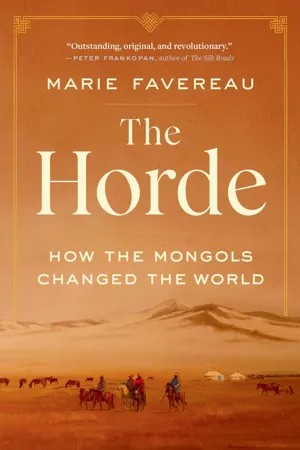 eBook - PDF
The Horde
How the Mongols Changed the World
- Marie Favereau(Author)
- 2021(Publication Date)
- Belknap Press(Publisher)
100 THE HORDE the hordes, requiring constant effort, organization, coercion, and toler- ance. Old loyalties needed to be broken and new ones forged to ensure the stability of the varied and expanding Horde. The Birth of the Jochids The great khans’ nominations, such as those of Ögödei, Güyük, and later Möngke, reveal that the Mongols had established patterns of suc- cession. The candidates were all Chinggis’s descendants though the male line, and they were also grown men whose fathers had died and who needed the support of other members of the elite. As these were the only requirements, a large number of individuals could compete for the throne. Juvaynī explained the rule for ranking: “According to the custom of the Mongols the rank of the children of one father is in proportion to that of their mothers, so that the child of an elder wife is accorded Major divisions of the Horde. The White Horde (Batu) controlled the modern territories of Russia and Ukraine in the west; the Blue Horde (Orda) held the modern territories of Kazakhstan, Uzbekistan, and Turkmenistan in the east. NEW HORDES 101 greater preference and precedence.” In this system, the khatun, the khans’ wives, had a crucial role. But what the Mongols meant by “elder wife” was again not a simple matter of seniority. 8 The status of a khatun was based on multiple factors. One was her date of marriage: the earlier in her husband’s life, the higher her rank. A second marriage often gave the first khatun greater responsibilities. The khatun’s age was also important: younger wives obeyed older ones. Character and reputation counted, too. And, finally, the wife’s personal pedigree and extended social network were of utmost importance. Chinggis Khan considered Qonggirad, Kereit, and Oyirad women the Decorated bowl showing a Mongol couple (Kashan, Iran, early thirteenth century). The Mongols were the ruling group in Iran at the time this piece was created.
- Peter Jackson(Author)
- 2023(Publication Date)
- Routledge(Publisher)
ghdād and murdered the Caliph (1258), and rolled onwards through ‘Irāq into Syria. For a time it appeared that the entire Islamic world would succumb to this threat; then events further east supervened.1 On the attempt by Ögedei’s family to recover power, and on their fate, see Sir H. H. Howorth, History of the Mongols, London 1876-1927 (3 vols in 4 & suppt), I, pp. 170-3; R. Grousset, L’Empire Mongol (Ire phase), Paris 1941 (Cavaignac, Histoire du Monde, VIII/3), pp. 306-11; idem, L’Empire des Steppes, 4th ed. Paris 1965 [henceforward Steppes ], pp. 338-41; V. V. Bartol’d, Turkestan down to the Mongol Invasion, trans. H. A. R. Gibb, 3rd. ed. C. E. Bosworth, London 1968 (Gibb Memorial Series, n. s., V), pp. 478-80.2 For Rubruck’s testimony, see especially Turkestan 1968, p. 480, & Bartol’d, Four Studies on the History of Central Asia, trans. V. Minorsky, Leyden 1956-62 (4 vols in 3), I, p. 121.Within a space of three years, the Mongol empire was torn apart by two major wars between members of the imperial family. Möngke’s death while besieging a fortress in China in 1259 unleashed a struggle for the succession on the part of Qubilai and Tolui’s fourth son, Arigh–böke, of whom the former was victorious only after a five years’ war which spread from Mongolia into Central Asia.3 At the same time the new Mongol power in Iran clashed with its neighbours beyond the Caucasus, The Golden Horde, now ruled by Batu’s brother, the Muslim convert Berke (1261). The rivalry of these two westernmost divisions of the empire was to last, with intervals, for almost a century. Its effect on the Mongol advance in the Near East, which had already been checked by the Mamlūk rulers of Egypt in two engagements, at ‘Ain Jālūt and at Ḥimṣ, in 1260, was profound. Hülegü had withdrawn eastwards with the bulk of his army in order, presumably, to keep watch on the succession dispute in Mongolia, and these reverses were inflicted on the greatly depleted Mongol forces left in Syria and Palestine. In view of the threat from The Golden Horde, neither he nor the later monarchs of the dynasty he founded in Iran (the ‘Ilkh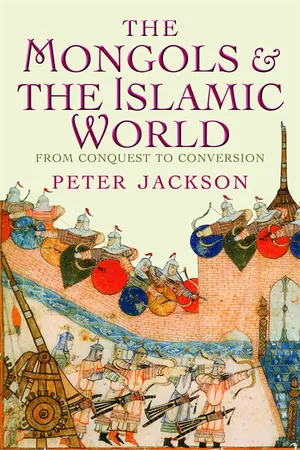 eBook - PDF
The Mongols and the Islamic World
From Conquest to Conversion
- Peter Jackson(Author)
- 2018(Publication Date)
- Yale University Press(Publisher)
Charles Halperin argued vigorously that conquests beyond the Caucasus were the primary concern of the khans of The Golden Horde, far outstrip-ping, that is, the attractions of the economically less desirable Rus´ princi-palities. 84 If anything, Jochid diplomacy and military activity would grow more menacing in the fourteenth century. Toqto’a reiterated the habitual Jochid demands in 702/1302–3, and they were revived on Özbeg’s accession in 712/1312. 85 The latter would personally head two major incursions into Azerbaijan, in 719/1319, during Abū Sa ‛ īd’s minority, and in 736/1336, following that monarch’s death; in 722/1322 we find him allied with the E u p h r a t e s T i g r i s D a n u b e D n i e s t e r D n i e p e r D o n V o l g a K a m a U r a l K u r A r a s O x u s S Ħ r -d a r y ă B l a c k S e a C a s p i a n S e a Lake Urmiya Lake Van Cyprus Mediterranean Sea C h u I r t y s h S a r i S u Aral Sea I l i T a r i m I n d u s Lake Balkhash R U S´ R U M -T R A N S O X I A N A I L K H A N A T E U L U S O F C H A G H A D A I KHWARAZM -BYZANTINE EMPIRE LESSER ARMENIA ARRAN -GEORGIA U L U S O F B A T U U L U S O F O R D A (‘BLUE HORDE’) 6ăTFKĦ Kiev Kaffa &KHUVRQ .HUFK 7DQD 5LD]DQ 0RVFRZ %XOJKăU 6DUDLFKXT hUJHQFK .KLYD .ăW %XNKăUă 6DPDUTDQG *KD]QD 0HUY %DJKGDG $OHSSR 0RVXO 'DPDVFXV &DLUR Rayy &RQVWDQWLQRSOH -DQG %DUFKLQOLJKNHQW>@ 6LJKQăT 6DZUăQ 8̝UăU 7DODV Emil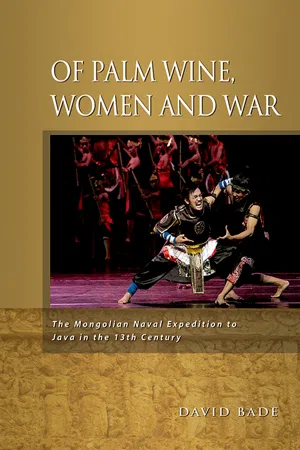 eBook - PDF
Of Palm Wine, Women and War
The Mongolian Naval Expedition to Java in the 13th Century
- David Bade(Author)
- 2013(Publication Date)
- ISEAS Publishing(Publisher)
139 P A R T I I I Meaning and Truth in Histories N o history of the Mongol Empire, no matter how erudite, which dwells only on Mongol destruction can be satisfactory. (Halperin, Russia and The Golden Horde, p. 25) The most well-known accounts of the Mongols in central and western Asia, Russia and Europe are laments and descriptions of terror on one side, slaughter on the other; the Javanese accounts differ from this pattern, but they are not the only ones to do so. Wassaf tells of a Shi‘i group in a southern Iraqi town (Hillah) who greeted the Mongols as those who would destroy injustice, sending an embassy to Hülegü with a letter telling of an old prophecy which they believed referred to the Mongols: When comes the group of horsemen which has no share, by God, you will surely be laid in ruins, oh mother of tyrants and abode of oppressors, oh source of tribulations — woe unto you, oh Baghdad, and unto your splendid palaces with their wings resembling the wings of peacocks, disintegrating like salt dissolves in water! There will come the Banu Qantura, preceded by a loud, neighing noise; they have faces like shields covered with leather, and trunks like the trunks of elephants, and there is no country they reach which they will not conquer, and no creature which they will not unsettle! (Wassaf, quoted in Pfeiffer, 2003) Hülegü thought that this is how people ought to respond, and like the Tibetans and others who submitted, the community of Hillah suffered no harm under Mongol rule. 140 • Of Palm Wine, Women and War The Mongol invasions of Japan in 1274 and 1281 and the perceived threat of such an invasion both before and after the actual invasions gave rise to a unique response in Japan: a long-term concerted effort to withstand a future attack. As in Java, the Mongols did not succeed in making Japan a vassal; nor was there a great slaughter of Japanese soldiers and citizens.
- Harilaos Kitsikopoulos(Author)
- 2012(Publication Date)
- Routledge(Publisher)
9 Russia Janet Martin In Russia the period 1200–1500 was transformative. At the beginning of the thirteenth century, the loose federation of principalities, known as Kievan Rus’, was experiencing severe political strains. As princes of the ruling Riurikid dynasty vied for dominance and control over the central capital of Kiev, the bonds among their individual principalities were weak- ening. Those bonds were severed in the aftermath of the Mongol invasion (1237–40), which resulted in the subjugation of the Rus’ principalities to the Mongols’ Kipchak Khanate, commonly known as The Golden Horde. For the next century the Rus’ principalities functioned as separate poli- ties, each ruled by its own Riurikid prince, who was confirmed in office by his suzerain, the Mongol khan. During the fourteenth century those principalities that had formed the southwestern and western portions of Kievan Rus’ and comprise modern Ukraine and Belarus’ were absorbed into Poland and Lithuania. The northern Russian principalities, from Novgorod in the west to Vladimir-Suzdal’ and Riazan’ in the east, gradu- ally from the fourteenth century through the early sixteenth century fell under the domination of the princes of Moscow. As The Golden Horde itself declined under combined political, military, and economic pressures stemming from the disintegration of the Mongol Empire and ultimately fragmented during the fifteenth century into several Tatar khanates, another new realm, Muscovy, also formed. The northern Russian prin- cipalities that comprised that realm will be the regions considered in the following discussion. The development of the Russian agrarian economy was also influenced by the Mongol invasions, which caused massive, if uneven, destruction, and stimulated population fl ight and resettlement. The capital city of Kiev and Vladimir, the major princely seat of northeastern Rus’, were among the towns badly damaged by the Mongol armies. eBook - ePub
- F. W. Mote(Author)
- 2003(Publication Date)
- Harvard University Press(Publisher)
Batu was originally granted four chiliarchies of Mongol cavalry and their dependents, perhaps 25,000 persons in all, and he settled down to rule over his khanate from the first of two Golden Horde capitals, Old and New Sarai, built successively on the lower Volga. The critical mass of Mongols in his realm was inadequate to long preserve a Mongol identity; his khanate came to be known as the Kipchak Horde as its Turkic population gradually absorbed its Mongols, turning it into a Turkic-speaking realm. When Batu died in 1256, his brother Berke succeeded him as khan and led his people in a conversion to Islam in the 1270s, thereby erasing a major distinction between Mongols and the Turkic nomads of the region. That was the first bloc of Mongols to adopt the religion that eventually would claim all the Mongols outside of Mongolia. Batu’s successors maintained their indirect rule over the Russians (the “Tatar Yoke,” as The Golden Horde’s power to coerce and collect taxes was called) until late in the fifteenth century. Berke, heading The Golden Horde when Möngke died in 1259, did not accept Khubilai’s irregular succession and seemed on the point of throwing his support to Arigh Böke, the youngest brother of Möngke, who also claimed to have been validated by a sparsely attended khuriltai held in western Mongolia in 1260, and who then declared war on Khubilai. Arigh Böke was much more the model Mongol warrior chieftain than was Khubilai, and for that reason probably had considerable support throughout the Chinggisid lineages and among the tribal nobility. A civil war lasting four years ensued before Khubilai prevailed. The threats to the stability of Mongolia gave the alliance between the other two brothers, Khubilai and Hülegu, great strategic importance. Hülegu died in Persia in 1265; his son and heir Abakha ruled ably until his death in 1282
- Alexander V. Maiorov, Roman Hautala, Alexander V. Maiorov, Roman Hautala(Authors)
- 2021(Publication Date)
- Routledge(Publisher)
2 intends to examine four cases from the late thirteenth to the first half of fifteenth centuries. His task is to analyze Rus’ medieval chronicles’ information as a valuable source on The Golden Horde court procedure and reconstruction of its main stages, while tracing the evolution of status of The Golden Horde’s khan as the judge of his Rus’ vassals during the ages. Also, the results of analysis could support our current knowledge on specific features of legal relations of The Golden Horde and Rus’ principalities in general.The four chosen cases are:- – the conflict of Galicia-Volhynian princes over the testament of prince Vladimir of Volhynia in 1287;
- – the confrontation of Vasilii of Kashin and Vsevolod of Kholm for the throne of the Tver’ principality in 1348;
- – the rivalry of princes Iurii and Fedor for the throne of Murom principality in 1355;
- – the contest of the Moscow prince Vasilii with his uncle Iurii of Zvenigorod for the throne of Vladimir Grand principality in 1432.
The basic sources are Rus’ medieval chronicles, but the author also intends to use additional historical sources to compare the analyzed cases with the trials of other Chinggisid rulers of the same epoch and, in case of need, to clarify some details of procedure.Khan's ‘circuit court' (1287)
In 1287, The Golden Horde’s Tölä Buqa Khan (r. 1287–91) with his cousin and co-ruler Alghui marched to the Poland. While staying on the way in the Galicia-Volhynian principality, he ordered local princes, Lev of Galicia (d. 1301), his son Iurii (d. 1308), brother Mstislav of Lutsk (d. 1290s), and cousin Vladimir of Volhynia (d. 1289) to join him in the raid. They obeyed to suzerain and came to khans with their troops including Vladimir who had to return half-way because of his fatal illness. Apprehending his death, Vladimir decided to testate and to leave his domain to his cousin Mstislav of Lutsk. He informed on his will the potential heir, as well as his elder brother, Lev, and nephew Iurii. Prince Mstislav in his turn sent to Lev the following message:
Index pages curate the most relevant extracts from our library of academic textbooks. They’ve been created using an in-house natural language model (NLM), each adding context and meaning to key research topics.

