History

The Quakers
The Quakers, also known as the Religious Society of Friends, are a Christian religious movement founded by George Fox in England in the 17th century. They are known for their emphasis on equality, simplicity, and pacifism, as well as their belief in the inner light of Christ within each person. The Quakers have played a significant role in social reform movements and have a strong tradition of humanitarian work.
Written by Perlego with AI-assistance
Related key terms
1 of 5
12 Key excerpts on "The Quakers"
 eBook - PDF
Friends and Strangers
The Making of a Creole Culture in Colonial Pennsylvania
- John Smolenski(Author)
- 2011(Publication Date)
- University of Pennsylvania Press(Publisher)
The Society of Friends was only one of many dissenting groups formed in the 1640 s and 1650 s; early Quaker leaders knew well that the movement’s success depended on its ability to develop a coherent religious identity among Friends, a project that required the creation of strict boundaries between those within and without the sect. Efforts to enforce spiritual conformity tempered spiritual individualism within the Society from its inception. The process through which early Quakers instilled a sense of common purpose and identity within the movement would profoundly shape Friends’ colonial efforts in Pennsylvania. Quakerism was founded in a tumultuous religious environment that bore more than a family resemblance to the New World Friends would face in America; Quakers in each instance faced the problem of creating a novel religious and cultural identity in a rapidly trans-forming social landscape. Fox and other leading Friends struggled to main-tain a delicate balance as they guided a spiritual movement that incorporated elements from other groups while asserting its revolutionary character. The result was a hybrid faith that trumpeted its own uniqueness. The strategies Quakerism’s English Roots 17 Fox and other leaders developed to manage the inherent tension between hybridity and uniqueness within their spiritual movement would later prove useful to American Friends struggling to create a creole religious identity across the Atlantic. In other words, English Friends had to become Quakers, and the manner in which they did so had a profound impact on the manner in which Quaker immigrants became Pennsylvania Friends. Understanding the influence of Quakerism’s English origins on Friends’ colonial project, however, requires analyzing the context in which the movement was born. eBook - PDF
Alternative Education for the 21st Century
Philosophies, Approaches, Visions
- P. Woods(Author)
- 2009(Publication Date)
- Palgrave Macmillan(Publisher)
66 / helen johnson Questions, Equality and Tolerance rather than Dogma Quakers have never easily accepted conventional wisdom and, at their ori- gin, can be seen to be part of the social upheaval in England of the seven- teenth century. Their founder, George Fox (1624–1691) was a man who asked questions of the prevailing social and political mores and in so doing was seen to be undermining—or at least, challenging—the authority of the established Church of England and its concomitant power structures. For he placed great emphasis on the uniqueness of the individual, and was supported by a group of those who were like-minded. Fox’s views about the possibility for an individual to have a direct relationship with God (or a higher power) without a priest as an intermediary can be seen to place him and his followers in the vanguard of Protestantism and so, in that context, be social and religious revolutionaries. MacCulloch (2003, 526) in his mammoth history of the Reformation, summarizes The Quakers’ historical evolution in these terms: . . . some gathered around the powerful figure of George Fox, who was determined to harness . . . energies to a godly purpose and end the excesses. Those who (more or less) accepted this centralizing direction came to call themselves “Friends of the Truth”. . . . At the time the Friends horrified and infuriated everyone else by their deliberate flouting of social convention to show that they acknowledged no power but God’s: they refused to doff their hats respectfully to social superiors. . . . MacCulloch (2003, 526) goes on to point out that almost alone among the rebellious groups of this time, The Quakers: . . . survived and transformed their character into a peaceable, self- restrained people. . . Their present-day association with peace, disarmament and ecological movements is a quiet return to their original commitment to questioning all established authority.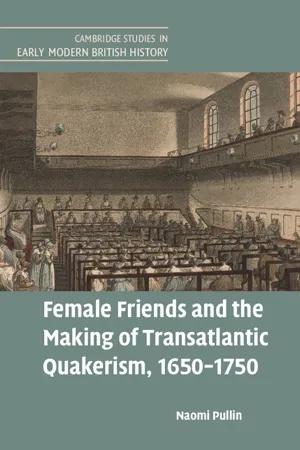
- Naomi Pullin(Author)
- 2018(Publication Date)
- Cambridge University Press(Publisher)
Critics were enraged by almost every aspect of The Quakers’ behaviour from their preaching style to their language, customs, and dress. Their emphasis on ‘plainness’ and ‘simplicity’, for example, led to a collective renunciation of vain and frivo- lous excess in outward appearance, language, and social interaction. This included flouting the rituals of social politeness, with male Quakers refus- ing to remove their hats before social superiors and abandoning honorific titles. They also refused to pay tithes or swear oaths. One of the biggest turning points in the first decade of the movement came with the ill-fated case of the early Quaker leader James Nayler, who took the theology of the indwelling spirit of Christ as literal fact and in 1656 infamously re-enacted Christ’s famous Palm Sunday entry into Jerusalem. Nayler was immediately 8 Kate Peters, Print Culture and the Early Quakers (Cambridge, 2005), p. 97. 9 LRSF, MS Vol S 81 Caton MSS vol. 3, pp. 435–436, Anne Audland to Margaret Fell, Banbury Gaol, 23 November 1655. 10 William C. Braithwaite was able to uncover one dubious reference to ‘Society of Friends’, dating from 1665, but he argues that this was used in a ‘descriptive’ rather than a ‘cus- tomary’ sense. William C. Braithwaite, The Beginnings of Quakerism (2nd edn, rev. H. J. Cadbury, Cambridge, 1961), pp. 307–308. The Temporary Subject Catalogue at the LRSF notes that the first official use of the term ‘Religious Society of Friends’ is thought to be in the 1793 address to George III. It was in common usage by 1800 when Joseph Bevan Gurney published A Refutation of Some of the More Modern Misrepresentations of the Society of Friends, Commonly Called Quakers. Introduction 6 6 arrested, and condemned by Parliament to be flogged, bored through the tongue, and branded with the letter B (for blasphemy). 11 But, above all, Nayler’s actions confirmed to critics that The Quakers posed a dangerous threat to religious and social order. eBook - ePub
- Thomas D. Hamm(Author)
- 2003(Publication Date)
- Columbia University Press(Publisher)
CHAPTER 2The Origins of American Quakerism, 1640–1800The story of American Quakerism begins, as do the stories of many American faiths, on the other side of the Atlantic. The first Friends were English men and women, visionaries caught up in the tumult of the political, religious, and social upheavals of the 1640s and 1650s in the British Isles.It was a “world turned upside down,” in the words of one contemporary. These were men and women suffering from inner torment, trying to work out for themselves, and seeking others who could help them answer, what seemed to be the most important question that anyone could ever confront: How do I know the will of God for my life? They were plain folk—shepherds, cobblers, farmers, what their neighbors called “goodmen” and “goodwives.” Their search took them into marketplaces and shops, barns and houses, and, most of all, onto the desolate moors and dales of the north of England. The answers that they ultimately found are the foundations of Quakerism.George Fox and the Children of LightThe eruption of Quakers from the moors and market towns of Yorkshire and Lancashire and Cumbria into the rest of the land was one of the strongest indications of that era’s dislocation. From their experiences in the lonely country in the north of England they drew the inspiration for one of the most distinctive and radical of all Protestant faiths.Religious movements begin by appealing to individuals, who, drawn together, form ties and find a common identity. Thus it is always dangerous to generalize too much from the experiences of one person. Yet, allowing for all of the disparate individuals and influences, understanding the rise of Quakerism means coming to terms with George Fox.Fox was born in Leicestershire, in the Midlands of England, in July 1624. Almost all of what we know about his early life and the first years of the Quaker movement comes from the autobiography that he composed in the 1670s. He entitled it a Journal. As is the case with any autobiography, historians find evidence of selective memory, choosing the incidents that reflected well on his abilities and those of his followers, omitting those that were embarrassing or might even become dangerous with the passage of time. Yet with all of these limitations, Fox’s Journal is an extraordinarily vivid portrayal of a gifted and driven personality.1 eBook - PDF
Pioneers of a Peaceable Kingdom
The Quaker Peace Testimony from the Colonial Era to the First World War
- Peter Brock(Author)
- 2015(Publication Date)
- Princeton University Press(Publisher)
No outstanding leader—or even any person of middling stature—arose to challenge the surrounding apathy of an age of materialism. The sources for many aspects of the story are meager—or submerged in a vast sea of reports and periodical literature dealing primarily with other topics. The most important elements, we begin to feel, are per- haps to be sought elsewhere: in the social transformation which was bringing Mennonites and Dunkers and their like out of their rural iso- lation, in the theological revolution within the American Society of Friends that was subtly undermining Quaker pacifism in large sections of the Society, in new ideologies that had as yet little or no contact T H E Q U A K E B T E S T I M O N Y with religious pacifism, like international socialism with its ideal of the brotherhood of man or anarchism with its goal of maximum freedom for all human beings. These forces—and others—were at work be- neath the surface, but their effect was not to show itself properly until after the events of August 1914 engulfed the nations in war. During the preceding half-century the Society of Friends remained the most active and concerned element within the pacifist movement. The Society was divided theologically and organizationally, but, de- spite the inroads that the Civil War had made in the ranks of its younger members in particular, the overwhelming weight of opin- ion within it still stood solidly behind the traditional Quaker peace testimony. No detailed study has been made of this period in the his- tory of Quaker pacifism, and generalizations based on examination of only part of the evidence can only be provisional. The Quaker press at this time was for a small denomination fairly large. The Hicksites had their Friends' Intelligencer, and from 1873 to 1882 they published, also in Philadelphia, a second periodical en- titled the Journal. The Orthodox branch was represented as earlier by the Philadelphia Friend and the more evangelical Friends' Review. eBook - PDF
- Edward J. Brantmeier, Jing Lin, John P. Miller, Edward J. Brantmeier, Jing Lin, John P. Miller(Authors)
- 2010(Publication Date)
- Information Age Publishing(Publisher)
Spirituality, Religion, and Peace Education, pp. 81–98 Copyright © 2010 by Information Age Publishing All rights of reproduction in any form reserved. 81 PEACE EDUCATION AND THE RELIGIOUS SOCIETY OF FRIENDS (QUAKERS) Mary Lee Morrison and Ian Harris INTRODUCTION Peace education, including its philosophical principles, values, skills (pro-cesses) and a life view turned toward service in the world, has been an integral part of the Religious Society of Friends since the early Quakers, under their fiery young leader, George Fox, who established the move-ment in the 1600s in England. Soon the faith spread to the American shores. Today there are Quakers around the world. Many Quaker meet-ings in Western Europe, the United States, Canada, and in other parts of the world worship in silence in what is known as the “unprogrammed” tradition. Members gather in prayer, “waiting upon the Lord” and, if felt called, a participant may rise and give a brief message to the gathered group. There are no ministers with a sermon to give, no prearranged tex-tual readings, nor order of worship, as in most other Christian worship formats. In fact, Quakers are often known for what they lack, those things CHAPTER 5 82 M. L. MORRISON that often distinguish other faith traditions, including creeds, systematic theological articulation of faith and hierarchical, administrative structure. In the nineteenth century, as a result of shifting geographical, histori-cal, and cultural factors, including United States westward expansion, a pastoral tradition developed among many Friends and Quaker missionaries began to evangelize throughout other areas of the world. Today this trend is evident in many Yearly Meetings, both in the United States, in Latin America, and in Africa, holding to a more Bible based, and, arguably, theologically more conservative approach to scripture and belief. eBook - PDF
Taking Sides in Revolutionary New Jersey
Caught in the Crossfire
- Maxine N. Lurie(Author)
- 2022(Publication Date)
- Rutgers University Press(Publisher)
109 5 The Society of Friends (Quakers) Pacifists and Participants While New Jersey members of the Society of Friends, called Quakers, shared with other religious groups the experience of being physically caught in the middle of the Revolution, they were unique because they were additionally entan- gled by their own religious doctrines, which magnified their problems during the war. Quakers had distinctive beliefs, particularly pacifism, and adhering to them led to riffs within their own community and charges of disloyalty from those who were outside it. Where they were a significant part of the population, as they were in Pennsylvania and parts of New Jersey, refusal to participate in the war produced resentment, even in places with a long history of religious toleration. From the perspective of whoever was in control at the time, when Quakers refused to fight, or pay taxes, others had to take up the burden. As a result, Quakers were doubly caught in the crossfire, first between contending armies, and second because of the tenets of their faith. Those unable, unwilling, stubborn, refusing any compromise, wanting to be martyrs, found living through the war particularly difficult. Afterward the Society of Friends was diminished in percentage of the population, prestige, and political power. At the time of the American Revolution Quakers were scattered throughout all the thirteen colonies but present in larger numbers in Rhode Island, Massa- chusetts, and North Carolina, as well as in the mid-Atlantic colonies. There were an estimated 61,000 altogether, with 24,000 in Pennsylvania and 6,000 in New 110 • Taking Sides in Revolutionary New Jersey Jersey (the largest numbers).1 Pennsylvania, with the Friends Yearly Meeting in Philadelphia, the governing body of the faith on this side of the Atlantic, was central. eBook - PDF
- Robynne Rogers Healey(Author)
- 2021(Publication Date)
- Penn State University Press(Publisher)
Several of the early schools have survived into the twenty-first century. Dozens of seventeenth- and eighteenth-century worship houses, peppering the globe, remain hallowed “places” where modern-day Friends worship and organize their forays into the “corrupt” world to “mend it.” The printed words of early Quaker visionaries are still reprinted, reread, and revered. Most of the communal living systems in which Quakers have sought self-government apart from the main society have been flawed and/ or transitory, but that has not deterred Friends from repeating such exper- iments at many times and in many places around the world. In these and other ways, modern Quakers continue the tradition set by early Friends of aiming to be the world’s “conscience.” notes 1. Mary Drinker Cope to Francis Cope, August 9, 1805, Cope-Evans Family Papers, HCLQSC. 2. A number of scholars have ruminated on various aspects of this phenomenon. See, for example, Barry J. Levy, “ ‘Tender Plants’: Quaker Farmers and Children in the Delaware Valley, 1681–1735,” Journal of Family History 3, no. 2 (1978): 116–35; J. William Frost, The Quaker Family in Colonial America: A Portrait of the Society of Friends (New York: St. Martin’s Press, 1973). 3. Estimates of mid-seventeenth-century England’s population put Quaker numbers at about sixty thousand, or roughly 1 percent of the population. This minority status is indicative of Friends’ desire—and need—to reinforce that cohesiveness. Stephen Broadberry, Bruce M. S. Campbell, Alexander Klein, Mark Overton, and Bas van Leeuwen, British Economic Growth, 1270–1870 (Cambridge: Cambridge University Press, 2015), chap. 1 and table 5.06. 4. Some aspects of that attenuation are summarized in Emma Lapsansky-Werner, “Quaker Life and Communities at the Turn of the Century,” in The Quakers, 1656–1723: The Evolution of an Alternative Community, ed. Richard C. Allen and Rosemary Moore (University Park: Penn State University Press, 2018), 216–37. eBook - ePub
- Rufus Matthew Jones(Author)
- 2021(Publication Date)
- Left of Brain Books(Publisher)
The term “Society of Friends” does not occur before 1665 and did not come into general use until the second period of Fox’s ministry—the organizing period. The word “Quaker” was first used by Justice Gervase Bennett, of Derby, in 1650 as a term of reproach. The word had been used earlier for trembling sectaries, and there is plenty of evidence that Friends did literally tremble or quake with emotion in their meetings, so that Justice Bennett’s term had some fitness, as Fox himself more than once allowed. It has now come to be a name in quite general usage both outside and inside the Society of Friends and no longer carries any stigma. This sketch presents in the briefest possible way how there ever came to be a Quaker branch of the Christian faith. I shall next proceed to set forth the main features of this type of Christianity. eBook - PDF
The Light in Their Consciences
Early Quakers in Britain, 1646–1666
- Rosemary Moore(Author)
- 2020(Publication Date)
- Penn State University Press(Publisher)
Practically everything The Quakers were thinking or doing was affected, and they were already showing the first signs of moving toward the eighteenth-century Society of Friends, a self-contained organization with a distinctive view of its place in the scheme of things. In 1659 this process came to an abrupt halt. The next few years were a period of upheaval. There were major political changes that had a drastic effect on Quakers, when it rapidly became clear that the old Quaker enthu- siasm was still alive beneath the surface. 1 Oliver Cromwell died in August 1658. His successor was his eldest son, Richard, who could not command the loyalty of the army, and a power vac- uum developed. In April 1659 the Protectorate fell. Many Quakers reacted to the events of the following months as they had in 1653, their hopes for the Kingdom of God becoming so closely involved with their political views as to be indistinguishable. They looked for the Kingdom of God on earth, in which God would rule through human beings by his Spirit within them. 170 turmoil and transition, 1659–1666 Quakers in 1659 were more closely involved with national events than they had been in 1653. In 1653 Quakers had still been a relatively small group, mostly in the North, but in 1659 their headquarters were in London, near to the action. In 1653, the leading London Quaker was probably Amor Stoddart, but by 1659 he had been reinforced by such men as Burrough and Hubberthorne, not to mention the underpinning provided by Gerrard Roberts, Ellis Hookes, and other London Friends. In 1653, the most capable pamphleteer was James Nayler, a man with long experience of politics and politicians and the gap between expectation and realization, and although for a few months in 1653 he had high hopes of the Nominated Parliament, politics did not rule his life.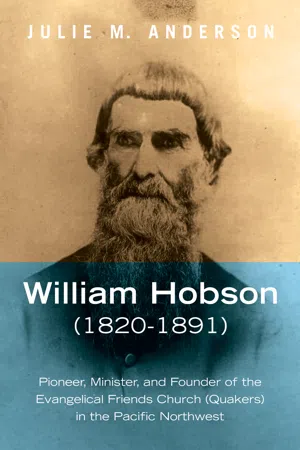 eBook - ePub
William Hobson (1820–1891)
Pioneer, Minister, and Founder of the Evangelical Friends Church (Quakers) in the Pacific Northwest
- Julie M. Anderson(Author)
- 2021(Publication Date)
- Wipf and Stock(Publisher)
1Quaker History, Testimonies, Culture, and Traditions in a Nutshell
Ye are my friends, if ye do whatsoever I command you. Henceforth I call you not servants; for the servant knoweth not what his lord doeth: but I have called you friends; for all things that I have heard of my Father I have made known unto you.John 15 :14 –15Importance of Quaker HistoryIn order to accurately consider William Hobson in his time and place, a brief look at Quaker history and practices is in order. Doing so will help to shed light on the environment Hobson both grew up in and chose to live in as an adult. It will also help us to see just how much the Quaker way changed in the span of Hobson’s lifetime. Elbert Russell offers a useful framework for the study of Friends history in his book History of Quakerism. He divides the story of Quakerism into three main sections as follows: “Rise of the Society (1647 –1691 ) from George Fox’s great experience to his death, [the] Age of Quietism (1691 –1827 ), from George Fox’s death until the separation of 18 27 in America, and The Revival and Reorganization of Quakerism (1827 –1941 ), from the separation of 1827 until the present time.”1 For Russell, the present time was 1941 . The history pertinent to a study of William Hobson falls within the scope of Russell’s first and second historical categories and part of the third. Therefore, the following quick look at Quaker history and practices will begin with the birth of George Fox and end with the decade in which Hobson’s life on earth ended, the 1890 s, sticking with broad trends as much as possible. Also, since Hobson was an American Friend, the main emphasis will be on American Quakers.It is important to note that starting with the founder of the Society of Friends, George Fox, many prominent Quakers kept journals and diaries. These Friends records are recognized by scholars as a distinct body of literature. Friends were also prolific letter, book, and tract writers, giving us a look into their public lives, as well as their personal lives. Contemporary accounts of Friends in journals, diaries, letters, and other writings are often the best glimpse of time, place, and thought we could have, so a few short biographical illustrations of unique individuals from a variety of time periods will be included as appropriate. William Hobson followed in this Friendly literary tradition with the diaries he kept and the many letters he wrote, the bulk of which, unfortunately, have been lost in antiquity.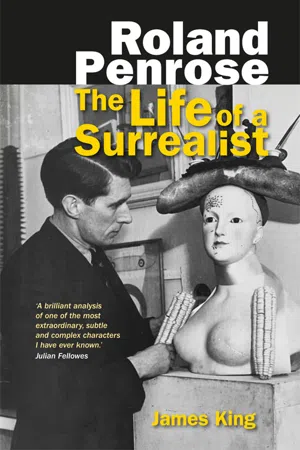 eBook - PDF
Roland Penrose
The Life of a Surrealist
- James King(Author)
- 2016(Publication Date)
- EUP(Publisher)
2 Roland Penrose: The Life of a Surrealist The term Quaker was obviously meant to ridicule Fox, but it soon became widely accepted by the scorned. Since all men were equal before the Lord, The Quakers (the group’s formal name is the Society of Friends) put egalitarianism into prac-tice: they did not doff their hats to persons supposedly their betters; they addressed everyone as ‘thee’ or ‘thou’, a form of address pre-viously reserved for children and servants; there were no holidays or special days of the week set aside for religious observance; there were no sacred spaces such as churches. Quaker belief systems also embraced pacifism – since the lives of all men were sacred, no one should bear arms against one another. For their adherence to this conduct of non-conforming behaviour, The Quakers were widely dis-liked and persecuted. In the eighteenth and throughout most of the following century, Quakers entered a quietist phase whereby they attempted to fit into and thus conform to mainstream British society. Many of the exter-nal marks of being a Quaker – and thus being genuine dissenters – had ceased to be practised. For example, in 1740, Friends were exhorted to avoid ‘instrumental means’ of changing society and to ‘wait in silence with reverence and singleness of heart.’ 2 The move-ment was in danger of eradication. Despite this development, to be a Quaker at the beginning of the twentieth century was to be someone who rebelled against the Church of England and all the orthodoxies with which it was associ-ated. Quakers remained outsiders, and their religious system empha-sised individualism. James Doyle Penrose was born on 9 May 1862 at his family’s home, ‘Michelstown’, Castleknock, County Dublin. His father, James Doyle Penrose Senior, was a landowning farmer who moved his family to Norfolk in 1874; his mother was Ann Bowles (Fig. 1). James was a pupil at the long-established private Quaker school, Stramongate, in Kendal.
Index pages curate the most relevant extracts from our library of academic textbooks. They’ve been created using an in-house natural language model (NLM), each adding context and meaning to key research topics.

