History

Treaties
Treaties are formal agreements between sovereign states or international organizations. They are used to establish peace, trade relations, alliances, and other forms of cooperation. Throughout history, treaties have played a crucial role in shaping the geopolitical landscape and have been instrumental in resolving conflicts and promoting diplomatic relations between nations.
Written by Perlego with AI-assistance
Related key terms
1 of 5


7 Key excerpts on "Treaties"
 eBook - PDF
- Jed Odermatt(Author)
- 2021(Publication Date)
- Cambridge University Press(Publisher)
3 The Law of Treaties 3.1 introduction There has been discussion in recent years about ‘the end of Treaties’ and how international cooperation is now often achieved through methods other than the formal treaty-making process. 1 Over the past decade, states have sought to deal with global challenges ranging from financial stability to climate change and nuclear non-proliferation, not through binding international instruments, but through non-binding commitments, diplomacy and unilat- eral domestic measures. This has brought into doubt the continued relevance of Treaties, which can be viewed as rigid and slow moving compared with other forms of international co-operation. Yet Treaties still play a large role in diplomatic life, and remain very much the cornerstone of modern international law. 2 For the EU, Treaties are a key method by which it acts on the international scene. Although the EU is able to take autonomous measures, and is developing its own diplomatic representa- tion, the main method by which the EU has acted internationally is through the negotiation and conclusion of international agreements. International Treaties remain a central part of the EU’s foreign policy. Much of the EU’s foreign policy towards its Eastern and Southern neighbours is pursued through the negotiation of agreements with those states. The 2014 unrest in Ukraine, for example, was sparked in part by the refusal of Ukraine’s President Viktor Yanukovych to sign an Association Agreement with the European 1 J. P. Rubin, ‘Farewell to the Age of the Treaty’, The New York Times, 21 November 2010. See the discussion on this issue at American Journal of International Law, AJIL Unbound, The End of Treaties? An Online Agora, www.asil.org/blogs/end-Treaties-online-agora. 2 O. Do ¨rr & K. Schmalenbach (eds), Vienna Convention on the Law of Treaties: A Commentary (Heidelberg: Springer, 2012) v. ‘[t]he law of Treaties forms the backbone of the international legal order’. 59 eBook - PDF
- Malcolm N. Shaw(Author)
- 2021(Publication Date)
- Cambridge University Press(Publisher)
They each refer to the same basic activity and the use of one term rather than another often signifies little more than a desire for variety of expression. A treaty is defined, for the purposes of the Convention, in article 2 as: an international agreement concluded between states in written form and governed by international law, whether embodied in a single instrument or in two or more related instruments and whatever its particular designation. 10 In addition to excluding agreements involving international organisations, the Convention does not cover agreements between states which are to be governed by municipal law, such as a large number of commercial accords. This does not mean that such arrangements cannot be characterised as international agreements, or that they are invalid, merely that they are not within the purview of the 1969 Convention. Indeed, article 3 stresses that international agreements between states and other subjects of international law or between two or more subjects of international law, or oral agreements, do not lose their validity by being excluded from the framework of the Convention. There are no specific requirements of form in international law for the existence of a treaty, 11 although it is essential that the parties intend to create legal relations as between themselves by means of their agreement. 12 This is logical since many agreements between states are merely statements of commonly held principles or objectives and are not intended to establish binding obligations. For instance, a declaration by a number of states in support of a particular political aim may in many cases be without legal (though not political) significance, as the states may regard it as a policy matter and not as setting up juridical relations between themselves. To see whether a particular agreement is intended to create legal relations, all the facts of the situation have to be examined carefully. eBook - PDF
- Marc Weller, Mark Retter, Andrea Varga(Authors)
- 2021(Publication Date)
- Cambridge University Press(Publisher)
But it is very clear, even from other contemporaneous European records, that the texts were themselves often inciden- tal to what participants considered the truly salient political gestures (everything from the razing of villages, or the death or surrender of a chieftain, to, in more equal transactions, a series of negotiations and ceremonies marking the inauguration of peaceful relations). Written terms were often understood by contemporaries as embedded within a whole set of surrounding understandings (this is of course also true of Treaties between European powers, but the greater cultural homogeneity in such transactions likely meant that such understand- ings were less in need of clear articulation). This embeddedness has implications for interpretation of Treaties. Indeed, in some settler-colonial states, jurisprudence has accepted the need to interpret such Treaties in light of the fact that historic Treaties were often not translated into indigenous languages, and may have recorded imperfectly a wider set of exchanges. 105 Today, interlocutors may have greater equality in their ability to have their specific understandings reflected in final texts. Moreover, collections like the UN Peacemaker resource are not merely the new Dumont or Martens collections for peace agreements. They are more comprehensive; somewhat more egalitarian in access, insofar as they often include several translations; and more interactive, inviting peace-makers to engage pro- actively in the identification and selection of appropriate precedents for particular clauses. But one might still wonder if a close focus on texts alone can capture the terms on which particular conflicts were settled.
- Anwara Begum(Author)
- 2019(Publication Date)
- Routledge(Publisher)
The RSFSR signed different kinds of agreements with the constituent republics of the Soviet Union. Some of them were cultural, some economic, some on coordinating foreign relations of the republics with those of Russia, and some were on basic principles of inter-state relations. The cultural agreements were about facilitating cultural relations, the economic ones typically dealt with maintenance of supplies. The most important agreements were the ones which dealt with the bases of inter-state relations. They were so because they chalked out the nature of relations between the signing parties. They also formed the source of later agreements. These Treaties are the focus of this chapter.There are important reasons for narrowing the focus of the study to an analysis of these core Treaties. These Treaties were the basic and fundamental ones. The others either emanated from them or were peripheral because they dealt with much less important issues as stop gap measures. Being the core of the set of written agreements they would better capture the attitudes of the Russian policy makers. Other agreements will be drawn upon in the process of analysis as supplementary evidence. The other reason relates to the issue of feasibility. Treaties are special legal documents interpretation of which is governed by particular rules developed by international legal scholars and the Vienna Convention on the Laws of Treaties, 1969. Their analysis thus prove to be detailed, complex and laborious, making it often impossible to manage the analysis of one or a few Treaties at a time.Some facts about the Treaties
Russia signed at least forty agreements and Treaties with the republics. In classifying these agreements Russia followed the Soviet legal tradition. Agreements were those documents which dealt with less important issues and were typically signed by the members of the Council of Ministers depending upon the nature of the agreements. The education agreement with Armenia, for instance, was signed by the deputy education minister and the economic agreements were signed by Prime Minister Silaev. The agreements on the principles of inter-state relations were signed by the chair of the Supreme Soviet and after the June 1991 RSFSR presidential election, the president. The same was true of the former Soviet Union where less important agreements were called agreements and signed by ministers and peace Treaties or Treaties of friendship were signed by the chair of the Presidium of the Supreme Soviet (Triska and Slusser, 1962, chapter 3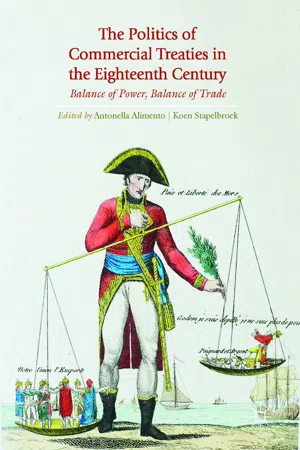 eBook - PDF
The Politics of Commercial Treaties in the Eighteenth Century
Balance of Power, Balance of Trade
- Antonella Alimento, Koen Stapelbroek, Antonella Alimento, Koen Stapelbroek(Authors)
- 2017(Publication Date)
- Palgrave Macmillan(Publisher)
As will be discussed at several points in this introduction, this idea suggests that commercial Treaties tended to be more than con- tractual arrangements on trade and taxation between merchants of differ- ent nationality, but often expressed or enacted a political will or vision on the part of contracting states to commit to the shaping of a certain international order. The aim of this book is to clarify how the basic understanding of commercial Treaties as having a structural impact on international relations developed during the eighteenth century. Merging the realms of eight- eenth-century political theory and diplomatic practice, the book takes commercial Treaties as a point of departure in order to help develop a new paradigm for thinking about the political economy of the interna- tional order in the eighteenth century. Yet, this by itself immediately poses a problem. From the perspective of a French diplomat, his time may have been a ‘siècle de traités’. 4 Yet, the existing historiography on commercial Treaties paints a very different picture, in which commercial Treaties were practically absent from the eighteenth century. This introductory chapter is therefore designed, firstly, to engage with the state of the art of the literature on commercial Treaties in different academic disciplines, including the usage and role of commercial Treaties in international diplomacy; secondly, to sketch and explain, with reference to the main turning points in the long eighteenth century, the conceptual development according to which Treaties were adopted and rejected as instruments for regulating international trade and politics; and thirdly, to provide a compiled overview in the form of a historical table of commercial Treaties signed in the period covered by the chapters in this book (see Table 1 at the end of this chapter). eBook - PDF
The Major International Treaties of the Twentieth Century
A History and Guide with Texts
- John Grenville, Bernard Wasserstein, John Grenville, Bernard Wasserstein(Authors)
- 2013(Publication Date)
- Routledge(Publisher)
By way of example, a common form of treaty is here considered. Such a treaty commences with a descriptive title , as for instance the ‘Treaty of Mutual Cooperation and Security between the United States of America and Japan’. Then follows the preamble , beginning with the names or description of the High Contracting Parties as ‘The United States of America and Japan’; next the general purpose is set out, ‘Desiring to strengthen the bonds of peace and friend-ship traditionally existing between them etc . . . Having resolved to conclude a treaty of mutual cooperation and security, therefore agree as follows . . . . ’ The preamble often includes also, though not in the particular treaty here cited, the names and designation of the plenipotentiaries who have produced their full powers, which have been found in good order, and have agreed as follows . . . . Next follow the substantive articles each with a numeral, I, II, III, etc. which constitute the objectives, the obligations and the rights of the signatories; these articles are frequently arranged beginning with the more general and leading to the more speci fi c. Where appropriate, an article follows which sets out the provisions for : other states which may wish to accede to the treaty. Next follows an article (or articles) concerning rati fi cation where this is provided for, the duration of the treaty and provisions for its renewal . Finally a clause is added stating ‘in witness whereof’ the undersigned plenipotentiaries have signed this treaty; the place where the treaty is signed is given, together with a statement as to the authentic languages of the treaty texts; and last the date is written in, followed by the seals and the signatures of the plenipotentiaries. Conventions, Protocols and other types of Treaties each have their own customary form. The vocabulary of Treaties Some terms used in treaty-making – a few of them in French and Latin – have special meanings. eBook - ePub
The decay of international law
A reappraisal of the limits of legal imagination in international affairs, With a new introduction
- Anthony Carty(Author)
- 2019(Publication Date)
- Manchester University Press(Publisher)
That is to say, the two disciplines of international law and diplomacy are equally concerned with looking beyond the ‘positions’ and ‘protests’ a State may have and make, to exploring how much resistance to or influence upon the course of events a State intends to exercise. 12 So it is not merely the diplomatic historian who may consider that Britain’s position on treaty obligations was merely a defence of the balance of power as it found expression in the 1815 Vienna Congress, its Treaties and Treaties concluded under later Congresses. 13 The real objection to any sharp academic disciplinary division between law and diplomacy is that both Britain and its opponents saw individual Treaties in nineteenth-century Europe as part of a framework of Treaties which were to reflect as well as to maintain a material distribution of power. This balance undoubtedly changed and in many cases Britain’s regular protests were not significant. Sometimes the balance of power was not seriously threatened, for instance when Italy was united under Sardinia. 14 At other times Britain could not influence events, as when Austria and Prussia conquered Schleswig-Holstein. 15 The crucial question – in what sense did Britain regard international Treaties as binding? – cannot receive the answer that it was acknowledging the existence of, contributing to the formulation of, a legal regime of Treaties. As another British international lawyer, Westlake, put it, the question whether a major ‘political’ treaty could be rescinded did not admit of a legal solution ‘because the appreciation of the circumstances on which its true value depended could not be reduced to a rule, but was a question for statesmen’. 16 Once again, the argument of this book will be that a very different view of the place of Treaties in international history and relations arose as a result of the influence of legal doctrine especially in the years before and after the first world war
Index pages curate the most relevant extracts from our library of academic textbooks. They’ve been created using an in-house natural language model (NLM), each adding context and meaning to key research topics.
