History

Types of Empire
Empires can be categorized into different types based on their governance and territorial control. Some common types include territorial empires, maritime empires, and commercial empires. Territorial empires expand through conquest and direct rule, while maritime empires rely on naval power and control of sea trade routes. Commercial empires focus on economic dominance through trade and investment rather than territorial expansion.
Written by Perlego with AI-assistance
Related key terms
1 of 5
10 Key excerpts on "Types of Empire"
 eBook - PDF
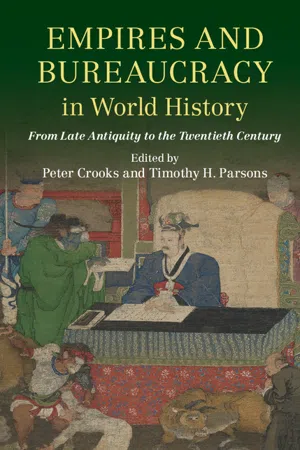
Empires and Bureaucracy in World History
From Late Antiquity to the Twentieth Century
- Peter Crooks, Timothy H. Parsons(Authors)
- 2016(Publication Date)
- Cambridge University Press(Publisher)
1 John Darwin describes empire as the ‘default setting’ for large-scale political formations until the past two centuries (After Tamerlane: the global history of empire since 1405 (London: Allen Lane, 2007), p. 23), a phrase echoed in Ashley Jackson, The British empire: a very short introduction (Oxford: Oxford University Press, 2013), p. 11; and Mrinalini Sinha, ‘Projecting power: empires, colonies, and world history’, in Douglas Northrop (ed.), A companion to world history (Oxford: Wiley-Blackwell, 2012), p. 263. See also Lieven, Empire, p. xvi (‘[empires] are one of the commonest forms of state in history’); Howe, Empire, p. 1 (‘a great deal of the world’ s history is the history of empires’); Goldstone & Haldon, ‘Ancient states’, p. 19 (‘[the] typical formation by which large territorial states were ruled for most of human history’); Burbank & Cooper, Empires, p. 8 (‘[empires] played a long and critical role in human history’). 2 Dane Kennedy, ‘Imperial history and post-colonial theory’, JICH 24:3 (1996), 357. 3 Such chronological and geographical scope, not to mention the range of disciplinary backgrounds and theoretical dispositions represented among our authors, is unusual in a book of this sort. It is quite deliberate. We explicitly reject the notion that an unbridgeable chasm separates historicist and generalist positions, ‘splitters’ and ‘lumpers’. 3 Our methodological point of departure is that a diachronic approach to the history of empires is mutually enriching for all the sub-disciplines involved, and that it is possible to engage in long-range comparison while attending closely to geographical specificity, human agency and change over time. eBook - PDF
Russian Imperialism
Development and Crisis
- Ariel Cohen(Author)
- 1996(Publication Date)
- Praeger(Publisher)
1 Definitions, Theories, and Methodology DEFINITIONS The word "empire" stems from the Latin imperium which means "command." This was the meaning of the word before it came to define the realm commanded. 1 Empire can be understood to be an age-old form of government between the subjects and the objects of pohtical power, involving two or more national entities and territorial units in an unequal pohtical relationship. John Starchey defined empire as "any successful attempt to conquer and subjugate a people with the intention of ruling them for an indefinite period" with the accompanying purpose of exploitation. 2 Michael W. Doyle maintains that empires are "relationships of pohtical control imposed by some pohtical societies over the effective sovereignty of other pohtical societies." 3 According to Maxime Rodinson, empires are "state units within which one ethnic group dominates others." 4 B.J. Cohen writes that the word "imperialism," a highly emotionally charged term, first appeared in nineteenth century France to denote the ideas of partisans of the one-time Napoleonic empire, and later became a pejorative for the grandiose pretensions of Napoleon III. In the 1870s the word "imperialistic" was used in Britain by supporters and opponents of Prime Minister Benjamin Disraeli to denote the policy of British imperial expansion. 5 It is ironic that in most cases neither the Soviet effort to sustain the Romanov realm nor the American expansion westward during the nineteenth century were labeled "imperialistic" but were rather seen as "nation-building." 6 Imperialism at the end of the nineteenth century denoted mostly the colonialism of maritime powers, from the Spanish and the Portuguese, to the British, the French and other Europeans, to the Japanese and Americans. eBook - PDF
- Peter Fibiger Bang, C. A. Bayly(Authors)
- 2016(Publication Date)
- Palgrave Macmillan(Publisher)
This is the case with the definition given by S. M. Eisenstadt, according to whom: an empire is a political system which is strongly centralised and covers a large territory. The centre of that system forms a separate, controlling whole with respect to the remaining areas, and the power is in the hands of the emperor and central offices. 1 Empire may also be defined in general terms as a political organisation which wields power over states (as a “state of states”), where the centre controls the subordinated areas through military, political and ideological means. A characteristic feature of an empire is the existence of internal diversity, coupled with the aspirations of the ruling group to order the world known to that group according to the religious, ideological or political principles developed in the centre. Those aspirations are one of the reasons for the expansiveness of empires. 2 Such general definitions do not diminish the importance of the second option, which consists in considering a typology of empires and introduc- ing more detailed criteria to distinguish between different forms of empires and variation over time. So, for example, in the historical and political sci- ence literature we may find described and defined as distinct: the ancient Imperium Romanum, the medieval Imperium Christianum, early modern seaborne empires, nineteenth century colonial empires, twentieth century totalitarian empires etc. 3 Two opposite theories link empires with the exist- ence of separate world-economies. According to F. Braudel and E. Wallerstein, an empire may be the political expression of a world-economy. 4 R. Kamen and J. Kieniewicz, however, give examples of empires which transgressed the Early Imperial Formations 109 borders of one and mobilised the resources of two or more separate world economies. 5 For example, the Mongolian empire or the Portuguese seaborne empire.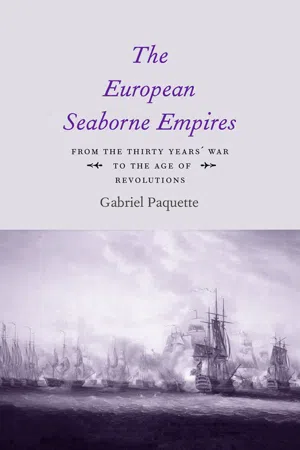 eBook - PDF
The European Seaborne Empires
From the Thirty Years' War to the Age of Revolutions
- Gabriel Paquette(Author)
- 2019(Publication Date)
- Yale University Press(Publisher)
17 1 . Definitions of “Empire” and Approaches to the Study of Its History To what extent is it accurate to denominate the Western European states and the overseas territory over which they claimed sovereignty as “empires”? Is “empire” a useful category of analysis? I contend that empire remains the apposite term and appropriate framework, even if it implies that European states exercised a degree of unchallenged authority that current scholarship has debunked. There is no shortage of definitions of empire. As historians John Gallagher and Ronald Robinson observed in the 1950 s, “The Imperial Histo-rian . . . is very much at the mercy of his own particular concept of empire. By that, he decides what facts are of ‘imperial’ significance.” 1 In this book, I conceptualize empire as a political phenomenon. This approach goes against the grain of recent historical writing, which has shifted away from political and military history and toward cultural and intellectual history. I have sought to incorporate insights from the more recent historiography, particularly with regard to political culture and the intellectual underpinnings of forms of rule. My approach shies away, though not without misgivings, from what historian Philip Pomper has termed “‘soft’ Marxian-PostModernism . . . [which] finds in the myriad global transactions of modern capitalism and the cultural products sold by it something called ‘empire.’” 2 This book thus can be only a fragment of a much larger history of empire studied from multiple perspectives. Yet even when we confine our attention to the political aspects of empire, a single, succinct definition remains elusive. The challenge is largely attribut-able to the variety, range, and complexity of entities that have been designated 18 d e f i n i t i on s o f “ e m pi r e ” “empires” by historians. There have been numerous efforts to arrive at a single definition. Here I mention in passing several of the more successful attempts. eBook - PDF
Empires and Boundaries
Race, Class, and Gender in Colonial Settings
- Harald Fischer-Tiné, Susanne Gehrmann, Harald Fischer-Tiné, Susanne Gehrmann(Authors)
- 2008(Publication Date)
- Routledge(Publisher)
1 Introduction Empires, Boundaries, and the Production of Difference Harald Fischer-Tiné and Susanne Gehrmann THE RETURN OF EMPIRE By the early 1970s, the global process of decolonization having been more or less completed, the academic preoccupation with European imperialism was clearly on the decline. Many historians, for instance, perceived ‘Impe- rial History’ as a marginal and slightly outdated field that had not kept abreast with contemporary theoretical and methodological developments in the discipline. Few anthropologists or scholars of cultural and literary stud- ies addressed issues of imperialism and colonialism at all. In today’s politi- cal climate, however, histories and cultures of empire are receiving renewed scholarly attention from various directions and for a number of reasons. Most significant, now that the optimism of the decolonization phase has evaporated, it has become clear that the legacies of imperialism and colo- nialism 1 remain ubiquitous into the twenty-first century. As such, an influ- ential body of recent historical studies has sought to emphasize the imperial origins of globalization from the impact of imperial transportation, com- munication and economic systems to international flows of ideas and world- views. 2 Considering such issues within an imperial framework, these studies have enhanced our understanding of what has been variously termed “the age of global empire” 3 or the period of a “great acceleration” 4 that coincided with the age of high imperialism. There is a growing awareness of other equally significant global legacies of colonialism—the substantial movement of people from former colonies to European countries and other destina- tions, creating huge diaspora communities, is another example. eBook - ePub
An Unproclaimed Empire: The Grand Duchy of Lithuania
From the Viewpoint of Comparative Historical Sociology of Empires
- Zenonas Norkus(Author)
- 2017(Publication Date)
- Routledge(Publisher)
However, even if such polities did not exist, the empire concept would not be an empty set if there were still polities that: (1) carried out broad territorial expansion, were hegemonic powers or aspired to become them in the international system, were ethnically or cultural heterogeneous and had a politically dominant ethnic group, but whose territory was not divided into a metropole and periphery; or (2) did not carry out broad territorial expansion but were hegemonic powers or aspired to become them in the international system, were ethnically and culturally heterogeneous and had a politically dominant ethno-cultural group, and whose territory was divided into a metropole and periphery; or (3) did carry out broad territorial expansion but were not hegemonic powers or aspired to become them in the international system, and were ethnically or culturally heterogeneous and divided their territories into a metropole and periphery; or (4) carried out broad territorial expansion, were hegemonic powers or aspired to become ones in the international system, were not ethnically and culturally heterogeneous and did not have a politically dominant ethnic group, but whose territory was divided into a metropole and periphery. The combinations of features demonstrated here define what are known in specialist literature as diminished sub-types (Collier and Mahon 1993; Collier and Levitsky 1997; Collier and Adcock 1999). They are “empires with adjectives”, where the adjective denotes which ideal-type or classical empire attribute is lacking among the referents of this sub-type. So the definitions above specify the following diminished sub-Types of Empires: (1) territorially homogeneous empires; (2) peaceful empires; (3) non-hegemonic empires; and (4) ethnically and culturally homogeneous empires. Such diminished sub-types should be distinguished from classical sub-types, which are produced from the root concept not by subtracting, but by adding attributes to its intension eBook - PDF
The Limits of Universal Rule
Eurasian Empires Compared
- Yuri Pines, Michal Biran, Jörg Rüpke(Authors)
- 2021(Publication Date)
- Cambridge University Press(Publisher)
Cambridge: Cambridge University Press. Eisenstadt, Shmuel N. 1963. The Political System of Empires. London: Free Press of Glencoe. Eisenstadt, Shmuel N. and Arie Shachar. 1987. Society, Culture, and Urbanization. Newbury Park, CA: SAGE Publications. Ellenblum, Ronnie. 2012. Collapse of the Eastern Mediterranean: Climate Change and the Decline of the East, 950–1072. Cambridge: Cambridge University Press. Elliott, Mark C. 2005. “Whose Empire Shall It Be? Manchu Figurations of Historical Process in the Early Seventeenth Century.” In: Time, Temporality, and Imperial Transition: East Asia from Ming to Qing, ed. Lynn A. Struve, 31–72. Honolulu, HI: University of Hawaii Press. Fall, Juliet J. 2010. “Artificial States? On the Enduring Geographical Myth of Natural Borders.” Political Geography 29: 140–7. Ferguson, Niall. 2004. Colossus: The Rise and Fall of the American Empire. London: Penguin. Finch, John. 1844. The Natural Boundaries of Empires: And a New View of Colonization. London: Longman. Fowden, Garth. 1993. Empire to Commonwealth: Consequences of Monotheism in Late Antiquity . Princeton, NJ: Princeton University Press. Fowden, Garth. 2012. “Pseudo-Aristotelian Politics and Theology in Universal Islam.” In: Universal Empire: A Comparative Approach to Imperial Culture and Representation 42 Yuri Pines with Michal Biran and Jörg Rüpke in Eurasian History , ed. Peter Fibiger Bang and Dariusz Kolodziejczyk, 130–48. Cambridge: Cambridge University Press. Fujinami Nobuyoshi. 2019. “Between Sovereignty and Suzerainty: History of the Ottoman Privileged Provinces.” In: A World History of Suzerainty: A Modern History of East and West Asia and Translated Concepts, ed. Okamoto Tadashi, 41–60. Tokyo: Toyo Bunko. Garnsey, Peter D. A. and C. R. Whittaker. 1978. Imperialism in the Ancient World. Cambridge: Cambridge University Press. Geanakoplos, Deno J. 1965. “Church and State in the Byzantine Empire: A Reconsideration of the Problem of Caesaropapism.” Church History 34(4): 381–403. eBook - PDF
Sociology and Empire
The Imperial Entanglements of a Discipline
- George Steinmetz(Author)
- 2013(Publication Date)
- Duke University Press Books(Publisher)
They have coexisted with and mutually influenced each other, even to the point where the same state might act or appear at one time as an empire, at another as a nation-state. China and the United States—both ambiguous cases of empire in the literature—are two obvious examples of this (see, e.g., Osterhammel 1986), but one could say the same thing about Britain or France. Nations and em-pires are different ways of conceiving the world as well as the collective self, but that has not prevented each of them from being regarded at various times as alternative possibilities, depending on their perceived fitness for the occasion. As ideological formations, nations and nationalism may well have occu-pied center stage in the modern world order, at least in the last two centu-ries. But empires have also been part of that order. Their disappearance has been relatively recent, and the signs of their existence are still all around us, not least in the large populations from the former empires that are now part of the life of most major Western cities. If empires belong to history, it is to that aspect of history that has an inescapable afterlife. “The empires of our time were short-lived, but they have altered the world for ever,” says a char-acter in V. S. Naipaul’s novel The Mimic Men ([1967] 1985: 32); “their passing away is their least significant feature.” 20 296 · Current Sociological Theories of Empire NOTES A different version of this chapter previously appeared as “Nation-States as Em-pires, Empires as Nation-States,” Theory and Society 39 (2010): 119–143. 1. Max Weber made a similar point in his contrast between the “striving for pres-tige” characteristic of “Great Powers” and mere “national pride”: “such pride can be highly developed, as is the case among the Swiss and the Norwegians, yet it may actu-ally be strictly isolationist and free from pretensions to political prestige” (1978: 911). eBook - PDF
Exceptional State
Contemporary U.S. Culture and the New Imperialism
- Ashley Dawson, Malini Johar Schueller, Ashley Dawson, Malini Johar Schueller(Authors)
- 2007(Publication Date)
- Duke University Press Books(Publisher)
The first step, as previously mentioned, is to replace talk of empires with that of hegemonic states. These terms need not be synonymous and have at times denoted importantly distinct entities. Michael Doyle, for instance, contrasts the ancient Greek states of Athens and Sparta, with Athens regarded as explicitly imperialistic and Sparta as hegemonic only. ∑ The difference lies in the degree of interference that the imperial or hegemonic power exercises on subordinate countries. The imperial power will be involved in ordering the internal social institutions of subject peoples (tax policy, property law, religious practices), while the hegemonic power will simply dictate external policy (dip-lomatic alliances, trade pacts, military deployments). Today, liberal schemes of global governance in theory are at most hegemonic, attempting to influence states (or more strongly, force them) to abide by certain international stan-dards of rights, development, governance, and so on. In practice, however, such attempts often become more intrusive, breaking down any distinction between internal and external policies. Furthermore, a burgeoning historical literature has shown how the United States, in replacing the colonial empires of England and France, developed an innovative set of institutions designed to establish an ‘‘informal empire,’’ that is, one without colonies. ∏ The uniqueness of this informal empire—what his- HEGEMONY AND RIGHTS 109 torians have more traditionally referred to as hegemony—should not, how-ever, be exaggerated. As Ferguson has mentioned, the hundreds of US military bases around the world today—what Chalmers Johnson has called an ‘‘empire of bases’’—are remarkably similar, in both geographical location and political purpose, to the system of British Royal Navy stations a century ago. eBook - PDF
- Simon Potter(Author)
- 2017(Publication Date)
- Red Globe Press(Publisher)
These scholars have much in common with those working in the field of transnational history and focusing on the past ‘interaction and circulation of ideas, peoples, institutions or technologies’ over long distances. 23 Transnational history tends to be concerned with the ‘connectors’ that provided concrete links between different places and peoples. 24 Yet it can be difficult to fit imperial history into the context of transnational history , for the simple reason that studying empires often involves examining territorial units that cannot be described as nations without risking serious anachronism. Moreover, in empires, core and periphery are bound together in distinctive and highly unequal ways: these links cannot easily be subsumed into more general (and possibly more benign) accounts of transnational interconnection. Much recent work in imperial history has built on ideas about global webs and networks. This has to some extent been inspired by the writings of social scientists, who have emphasized the importance of transnational networks Going Global 115 covering large spaces, networks that reinforced and reshaped existing social, cultural, political, and economic relationships. 25 Tony Ballantyne is nota-ble among those imperial historians who have used the idea of webs to help explain the various connections that linked Britain with its colonies, that bound colonies up with other colonies, and that connected them with places beyond the boundaries of the British empire. For Ballantyne, thinking about these webs moves us away from the traditional, binary model of empire that focuses on the relationship between core and periphery , and instead encour-ages us to consider complex flows of human, intellectual, and material traf-fic that moved in all sorts of directions.
Index pages curate the most relevant extracts from our library of academic textbooks. They’ve been created using an in-house natural language model (NLM), each adding context and meaning to key research topics.

