History

US and Israel
The relationship between the US and Israel has been characterized by strong political, military, and economic ties since Israel's establishment in 1948. The US has been a key ally and supporter of Israel, providing significant military aid and diplomatic support. This partnership has been influenced by shared democratic values, strategic interests, and historical connections.
Written by Perlego with AI-assistance
Related key terms
1 of 5
3 Key excerpts on "US and Israel"
 eBook - ePub
Israeli Historical Revisionism
From Left to Right
- Derek J. Penslar, Anita Shapira, Derek J. Penslar, Anita Shapira(Authors)
- 2013(Publication Date)
- Routledge(Publisher)
Historiosophical Foundations of the Historical Strife in Israel *Uri RamSince the 1990s Israeli collective identity and historical consciousness are much more heterogeneous and conflictual than ever before. Zionism, modern Jewish nationalism, emerged in Eastern Europe in the last third of the nineteenth century. It arose in the midst of a major shift in Jewish identity and an enormous wave of Jewish mobility and migration. In its first decades Zionism was a minority trend. It remained on the margins of this shift. Only a trickle of the Jews emigrating from Eastern Europe made their way to Palestine, and those who stayed there established the nucleus of the new Israeli society. The Holocaust of European Jewry, the emergence of a prosperous and influential Jewish community in the United States and the establishment of the State of Israel in 1948, all marked a new and different phase in modern Jewish and Israeli history. Today, at the beginning of the twenty-first century, the old nineteenth-century nationalist paradigm has already passed its peak. Two new major paradigms struggle, sometimes very ferociously, over the hearts and minds of Israeli Jews: a Jewish ethno-nationalist paradigm, and an Israeli civic-liberal paradigm. It is as if the hyphenated Israeli-Jewish identity is breaking apart, and the “civic Israelis” and “ethnic Jews” are drifting in opposite directions. On the one hand, Israeli political culture is fast becoming ever more universalistic and globalist; on the other hand, Jewish political culture in Israel is becoming ever more particularistic and localist. These two trends will be referred to below as post-Zionism and neo-Zionism respectively. This struggle between three different paradigms of collective identity — the historic, the ethnic and the civic — underlies the historical strife that erupted in Israel in the 1990s. In question are the spatial and temporal dimensions of the collectivity, the boundaries of its membership, and hence, its historical meta-narrative.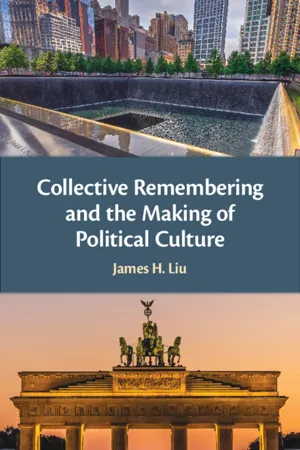
- James H. Liu(Author)
- 2022(Publication Date)
- Cambridge University Press(Publisher)
These two factions of opinion and belief, representing “hawks” and “doves” have been part of the diversity of Jews in the Middle East from the beginning of the twentieth century. Eretz Israel was the last gasp of European colonization. The experience of the Palestinians was of a kind to that experienced by Māori, Aztecs, Sioux (Lakota), or Inca. The crucial difference is one of timing: the Aztecs and Incas were doomed because they were colonized at the outset of this half millennium of Western supremacy. Māori are in better shape because they were colonized years later. Palestinians cannot be extinguished because they were colonized another hundred years later. Their numbers are in ascendence rather than decline, even if their position is one of subjugation and statelessness. Israel was made during a critical juncture where the possibilities for structural change were magnified, but in this coming century it faces tidal forces of time moving in the opposite direction. Israel came into being at the tail end of the era of colonization but now stands as a spearhead of a civilization in relative decline, in an era Colonization and Decolonization where decolonization is the norm. The fact that Israel is a nuclear-armed outpost ruled by Jews in the midst of Arab Muslim societies that are deeply resentful of the process of its creation makes this a preeminent location for ongoing and future conflict. “Uneventful Time”: Early Days of History and Identity in Israel In many ways, Jews are the harbingers of global consciousness. Their contributions to global science, industry, and philosophy are orders of magnitude beyond their population share of humanity. This is no accident. It is the blessing and curse of being both major contributors to Western civilization while simultaneously playing the role of its Religious Other. Jewish religion was the source of key features of Western civilization, including monotheism and a focus on contract law. eBook - ePub
The End of the Middle East Peace Process
The Failure of US Diplomacy
- Samer Bakkour(Author)
- 2022(Publication Date)
- Routledge(Publisher)
The first is the integration of Jews into American society and the second is the commitment that Americans have to Israel. The features of this special relationship were already in place before the American Jewish community mobilised, but this further strengthened and reinforced it. On closer reflection, the political role of America’s Jewish community appears to have been strengthened by the special relationship, rather than vice versa. 89 The belief that Israel is an underdog, forced to struggle for survival in an unforgiving neighbourhood, is particularly perverse but is nonetheless a motif of U.S. perceptions of the conflict. Eytan Gilboa’s account of the 1967 and 1973 wars describes how the casting of Israel and the Arab states as (respectively) David and Goliath helped to generate U.S. support for Israel. 90 One Republican Senator observed: A few years ago, I travelled to Israel and it was a transforming experience for me as I became aware of how small Israel is. I realized how rapidly an enemy could cross the small narrow band and attack any part of Israel. I understood then the significance of the Golan Heights and the issue of turning them over to enemies where they could be used to do whatever they chose. 91 This concern with Israel’s security is often rationalised as further evidence of the instinctive American sympathy for the poor and defenceless when they are aggressively attacked by an outside invader. 92 But this requires a quite staggering inversion of the reality: The aggressor is Palestinian children throwing stones and the victim is a nuclear-armed state with one of the world’s most powerful armies that has inflicted extensive harm on an occupied people for more than half-a-century. Historical Overview 1948 –1966 The U.S. political commitment to Israel was established in 1922 when the U.S. Congress approved the Balfour Declaration on the basis of a bipartisan consensus. 93 In his 1944 presidential campaign, the U.S
Index pages curate the most relevant extracts from our library of academic textbooks. They’ve been created using an in-house natural language model (NLM), each adding context and meaning to key research topics.

