History

US Cuban Relations
US Cuban relations have been marked by a complex history of conflict and attempts at reconciliation. Tensions escalated during the Cold War, leading to the Cuban Missile Crisis in 1962. In recent years, there have been efforts to normalize relations, including the reestablishment of diplomatic ties in 2015, although the relationship remains politically sensitive and subject to ongoing debate and negotiation.
Written by Perlego with AI-assistance
Related key terms
1 of 5
10 Key excerpts on "US Cuban Relations"
 eBook - ePub
- Aviva Chomsky(Author)
- 2015(Publication Date)
- Wiley-Blackwell(Publisher)
People from around the world went to Cuba after the Revolution – some to support the revolutionary process, and some to try to undermine or overthrow it. Cubans also went around the world – some to escape the Revolution, some to work against it, and some to act in solidarity with revolutionary movements elsewhere, especially in Africa and Latin America. Cuba after the Revolution achieved a high diplomatic profile as well, becoming a leader in the Non-Aligned Movement. And the foreign policies of other countries – in particular, the United States and the USSR – were influenced by, and in turn influenced, the Cuban Revolution.This chapter and the next look at how Cuba’s relations with the world shaped the Cuban Revolution, and how the Cuban Revolution shaped the country’s relations with the world. We will also look at the global importance and impact of the Revolution. Because the relationship with the United States was so fundamental to the shape and direction of the Revolution, we’ll begin there.The United States and Cuba
Accounts of United States–Cuba relations since 1959 tend to fall into two categories. Some privilege the Cold War context, emphasizing the Communist nature of the Revolution, Cuba’s ties with the USSR, and the Cold War ideologies that motivated U.S. policies during the second half of the twentieth century. Other, revisionist histories in the United States – as well as the majority of Cuban historians – consider the U.S. imperial stance towards the Caribbean and Latin America, which predated both the Cold War and the Revolution, as the most important analytical framework.Cuban singer-songwriter Silvio Rodríguez exemplified the latter stance in a song about the 1979 Nicaraguan Revolution and the U.S. response. “Now the eagle is suffering from its greatest pain,” he wrote. “It is hurt by Nicaragua because it is hurt by love. It is hurt by children being healthy and going to school, because it can’t sharpen its spurs that way.”2 eBook - ePub
Contemporary U.S.-Latin American Relations
Cooperation or Conflict in the 21st Century?
- Jorge I. Domínguez, Rafael Fernández de Castro, Jorge I. Domínguez, Rafael Fernández de Castro(Authors)
- 2016(Publication Date)
- Routledge(Publisher)
3 The United States and Cuba Intimate Neighbors? Marifeli Pérez-Stable DOI: 10.4324/9781315731711-3On December 17, 2014, President Barack Obama said what no other U.S. president had ever said. “Today, America chooses to cut loose the shackles of the past so as to reach for a better future – for the Cuban people, for the American people, for our entire hemisphere and for the world.”1The goal of American policy, Obama said, is to “end an outdated approach that, for decades, has failed to advance our interests” and normalize relations for the sake of the Cuban people. He addressed Cubans on the island, the ordinary citizens who struggle to make breakfast, lunch, and dinner for their families, the ones who say “No es fácil” – it isn’t easy.Nearly 53 years earlier, Dwight D. Eisenhower had broken diplomatic relations with Havana. Since the 1970s, other presidents had tried to ease tensions but their efforts had come to naught. Although the Cold War shaped U.S. policy, the U.S.–Cuba relationship had accumulated strains well before the revolution. Such is the history between a great power and a weaker neighbor, especially one with a strong sense of itself. At heart, this chapter argues that the United States and Cuba have never had normal relations even when embassies operated in Washington and Havana until 1961.2Over the course of the twentieth century, the United States and countries in the Caribbean Basin normalized relations, at least to the extent possible in the face of such power differentials. The revolutionary leadership’s decision to align their government with the Soviet Union preempted Cuba’s opportunity to normalize relations with the United States. In short, Cuban leaders also bear responsibility for the rupture and the long-enduring tensions.Had there been a peaceful transition from Fulgencio Batista’s dictatorship in the 1950s, Cuba would surely have had an opportunity to normalize relations with the United States under more auspicious circumstances. Instead, the United States and Cuba were challenged to find a modicum of normality during the Cold War. At first, Washington focused on destabilizing the revolutionary government via the Bay of Pigs invasion and the CIA-sponsored Operation Mongoose. For its part, the Cuban leadership pursued domestic and foreign policies that fueled the American alarm at having a Soviet ally 90 miles from Key West. During the Ford and Carter administrations, the United States and Cuba approached a crossroads of normalization. For the most part, Washington and Havana never quite manifested the will or the patience needed to end their enduring enmity. Even after the Cold War, with democracy taking hold in the former Eastern Europe and democratic transitions in Latin America, the United States embraced the idea of regime change in Havana. Not until President Obama made his historic announcement did the United States and Cuba finally begin the slow process of easing the long-entrenched tensions. eBook - PDF
- Catherine Krull, Soraya Castro Marino(Authors)
- 2011(Publication Date)
- University of Pittsburgh Press(Publisher)
Not-withstanding this development, in the twenty-first century, the relationship remains significant for both countries, something that Dmitry Medvedev’s visit to Havana and Raúl Castro’s visit to Moscow in late 2008 and early 2009 demonstrate. A wide variety of reasons and pressures explain the relationship’s fifty-year history . The timing of the victory of the Cuban Revolution at the height of the Cold War was important, but quickly other pressures appeared that would also impinge on the relationship for the following thirty years. Reform processes instigated in both countries began to question many of these issues in the late 1980s, with a number of issues simply vanishing with the end of the Cuban-Soviet Russian relationship. However, others did not; and as the 1990s progressed, not only did new issues evolve but also, remarkably, others that had disappeared remerged, though at reduced levels, to again have an impact on the relationship. Now that the Cuban Revolution has celebrated its fiftieth anniver-sary and relations between Havana and Moscow are half a century old, the relationship does have an enduring quality. The Cold War Setting Cuban-U.S. relations from the time of Cuban independence to the victory of the Cuban Revolution were vital for the relationship that would develop between Havana and Moscow after 1959. Washington had dominated the island both politically and economically, and although it was unclear what type of revolu-tion had taken place in Cuba, there was certainty that the new Cuban regime wished its relationship with the United States to be dramatically altered. The importance of nationalism to the revolution and the fact that Ernesto ‘‘Che’’ Guevara had witnessed the overthrow of the progressive government of Jacobo Árbenz in Guatemala in 1954 by American-backed exiles diminished the likeli-hood of cordial Cuban-U.S. relations still further. Fidel Castro would later comment: ‘‘We would not in any event have ended up as close friends.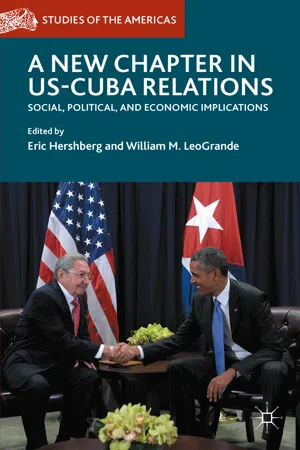 eBook - PDF
A New Chapter in US-Cuba Relations
Social, Political, and Economic Implications
- Eric Hershberg, William M. LeoGrande, Eric Hershberg, William M. LeoGrande(Authors)
- 2016(Publication Date)
- Palgrave Macmillan(Publisher)
Cuba’s persistence as a sovereign state over the decades of inter- action since 1959 has necessitated the search for nonzero-sum solu- tions to the US-Cuban conflict, solutions fitting the recognition model. The cumulative effect of successive rounds of negotiation and relaxations of tension—starting with the initiatives by Secretary of State Henry Kissinger and including important milestones during the Carter, Clinton, and Obama administrations—is noteworthy indeed. In the diplomatic arena, the opening of Interests Sections in Washington and Havana in 1977 was a watershed event (McCoy 2015) that allowed for a more fluid relationship between both ARTURO LOPEZ-LEVY 32 governments and societies than had the nonpeaceful coexistence that prevailed before. A list of the principal variables that transformed Cuban-US bilat- eral relations might include several mentioned by Alexander Wendt in his social theory of international relations between countries that have moved from a hostile stalemate to a negotiable one: a) A spike of interdependence 7 as a result of travel and trade licenses granted through exceptions to the embargo, which have greatly impacted Cuban-American and Midwestern farming communities; b) Identification of common interests and areas of cooperation (e.g., managing tensions regarding Guantánamo Naval Base, peace in Southern Africa, international cooperation on health issues in the campaign against Ebola in West Africa [Lopez-Levy 2014]) and recognition of common adversaries (international crime, terror- ism, drug traffic, pandemics, natural disasters, etc.); and c) Homogenization 8 of policies (e.g., Cuba’s economic reforms and political liberalization since 2008 have reduced the social differ- ences between the island and its neighbors; Cuban acceptance in 1995 of deference to Great Powers according to the 1968 Nuclear Non-Proliferation Treaty made its security policy compat- ible with a US-led liberal world order on this sensitive issue). eBook - ePub
The United States and Cuba
Intimate Enemies
- Marifeli Pérez-Stable(Author)
- 2011(Publication Date)
- Routledge(Publisher)
THE UNITED STATES AND CUBA HAVE NEVER HAD NORMAL RELATIONSThe Cold War, it is often said, has not ended for the United States and Cuba. Yet a key source of tension between the United States and Cuba—the dynamics between a great power and its weaker neighbor—antedates the U.S.–U.S.S.R. conflict. Pursuing what it saw as its Manifest Destiny during the nineteenth and early twentieth centuries, the United States never considered the rightful interests of neighbors like Cuba.1 Indeed, “what was good for the United States was good for Cuba” could have been the motto stamped on the U.S. calling card. For its part, Cuba viewed the United States with ambivalence: admiration for U.S. democracy and progress, mistrust of U.S. presumptuousness. The island, moreover, had an uncommon expectation of equality that Washington rarely considered. As a result, the United States and Cuba have never had normal ties.In the years before Fidel Castro came to power in 1959, the two countries had failed to establish a stable, mutually beneficial relationship as Mexico and the United States had done after 1940. When the revolution aligned Cuba with the former Soviet Union, U.S.–Cuba relations grievously deteriorated. More than two decades after the fall of Communism in Europe, Washington and Havana are still far from resolving their long-standing predicament: How can the great power learn to take into account Cuban sensibilities as its weaker neighbor turns geographic proximity to the United States into an asset? Because the Cold War so estranged the two countries, normalizing relations years after it ended has not been easy for either party. Nor will it be. Without doubt, Cold War legacies burden the prospect of ending a fifty-year enmity that has served neither country well. But they do precisely because, as the superpowers faced off against each other, Cuba upended Washington’s expectations of loyalty. A brief period of détente in the 1970s opened a door to a U.S.–Cuba rapprochement that ultimately closed. Had it not, a book about Cuba and the United States after the Cold War would not have been subtitled Intimate Enemies eBook - PDF
Revolutionary States, Leaders, and Foreign Relations
A Comparative Study of China, Cuba, and Iran
- Houman A. Sadri(Author)
- 1997(Publication Date)
- Praeger(Publisher)
Photograph courtesy of UN/DPI Photo. 74 Revolutionary States, Leaders, and Foreign Relations the national interest of the United States or Cuba. The prudent method of studying Cuban foreign relations is to analyze with impartiality how certain events and issues contributed to the formation of Cuban foreign policy. The first period of Cuban non-alignment strategy began with the triumph of the revolution when the rebel army troops under Ernesto Che Guevara entered Havana on 1 January 1959. Fidel Castro, the commander of the rebel army, soon became prime minister of the revolutionary government. In April of 1959, Castro made a highly publicized trip to the United States at the invitation of the Association of Newspaper Editors. During this visit he also met with Vice-President Richard Nixon, who was not impressed with Castro despite the media's mostly positive image of this young upper-class-lawyer-cwra-rebeL The first controversy in American-Cuban relations came when the issue of compensation for the expropriation of U.S.-owned assets was raised after Revolutionary Cuba passed the 1959 Agrarian Reform Law, which nationalized about one-third of the arable land on the island. Earlier in 1959 the Eisenhower administration did not have a policy in place if Revolutionary Cuba began to nationalize American property, mainly because there were voices in the 37 administration suggesting restraint. By mid-1959, however, the advocates of accommodation were gone and the administration had a clearly antagonistic posture toward Cuba. An indicator of the administration's sentiment toward Cuba 38 was Eisenhower's leaving for a golfing trip to Georgia during Castro's visit/ In February of 1960, Washington became alarmed when Soviet Foreign Minister Anastas Mikoyan visited Cuba and signed trade and aid agreements. eBook - PDF
Looking Forward
Comparative Perspectives on Cuba's Transition
- Marifeli Perez-Stable(Author)
- 2007(Publication Date)
- University of Notre Dame Press(Publisher)
T W E L V E 280 T W E L V E Cuba’s Future Relations with the United States W I L L I A M M . L E O G R A N D E Since the collapse of the Soviet Union, Cuba’s relations with the rest of the world have changed dramatically. The disappearance of the socialist bloc meant that Cuba lost not only its military allies but also its principal trade partners and source of foreign assistance. Since then, Cuba’s top foreign policy priority has been to reorient its international economic relations to new trade partners, princi-pally in Europe and Latin America. Cuban troops have come home from Africa, and Havana has abandoned its policy of promoting revolutionary insurgents in Latin America. Fidel Castro still culti-vates good relations with other third-world governments, espe-cially those that are skeptical about the benefits of neoliberalism and globalization, such as Hugo Chávez in Venezuela, Luiz Inácio Lula da Silva in Brazil, and Néstor Kirchner in Argentina. But Cuba no longer plays on the world stage the way it did in the 1970 s and 1980 s, when it sent tens of thousands of troops to Africa. The one international relationship that changed least as a result of Cuba’s diminished place in the new world order was its relationship with the United States. Although pressures have been growing in Washington for a relaxation of U.S. economic sanctions, especially regarding sales of food and medicine and the right of Americans to travel to Cuba, a full normalization of relations between Havana and Washington seemingly remains distant. The collapse of European communism set in motion significant economic and social changes in Cuba, but little political change. The les-son Fidel Castro took from the experience of the European communist regimes is that attempting political reform in the midst of economic dis-location can prove disastrous. Even after Castro departs from the scene, a Cuban transition to multiparty democracy is uncertain. eBook - PDF
The Cuban Revolution
Past, Present and Future
- G. Lievesley(Author)
- 2003(Publication Date)
- Palgrave Macmillan(Publisher)
The motivating factor behind Cuba's actions on the world stage has been and remains its strong commitment to internationalism. This interna- tional perspective has been tempered by the restraints imposed by Cuba's most defining relationship - that with its near neighbour, the United States. The historical roots of this relationship are examined in the following chapter, but here I wish to consider Washington's reac- tions to the political situation in Cuba prior to the Revolution's triumph on 1 January 1959. Revolutionary struggle in Cuba: the 1950s, Batista, Castro and the Americans Fulgencio Batista dominated Cuban politics between 1934 and 1959. However US confidence in his ability to maintain order and prevent political unrest began to dissipate following his coup of 1952. The sym- bolic beginning of growing opposition to his rule was Castro's abortive 26 July 1953 attack on the Moncada Army Barracks in Santiago de Cuba whilst armed rebellion began in earnest with the Granma expedi- Encounters with 'the Monster' and Others 11 tion which landed in Cuba from Mexico on 2 December 1956. 6 The United States was extremely concerned because there 'was uniform hostility ... to the idea of a successful antidictatorial movement domi- nated by radical nationalists'. Morley argues that 'American hostility to Castro before 1959 is central to an understanding of the US response to the Cuban Revolution after 1959'.1 Thus, there was policy continuity rather than a new initiative on Washington's part after 1959. There were strong US military and intelligence links with Batista's regime and a heavy flow of military materiel ranging from guns to rocket launchers was orchestrated by the Military Assistance Advisory Group. Such aid was supposedly regulated by a mutual security agreement and was intended to be used for 'hemispheric defense' but the US turned a blind eye to the fact that it was being used to repress domestic critics rather than external enemies. eBook - PDF
The Cuban Embargo
The Domestic Politics of an American Foreign Policy
- Patrick Haney, Walter Vanderbush(Authors)
- 2005(Publication Date)
- University of Pittsburgh Press(Publisher)
2 The Making of an Embargo U.S.-Cuban Relations, 1959 – 1980 T he U nited S tates and Cuba share a complicated and intercon-nected history. A full examination of this history, particularly of the preembargo (and pre–Cuban revolution) period, is beyond the scope of this book, which focuses on the politics of Cuba policy from the Reagan administration to the present. 1 We try here, however, to orient readers, es-pecially those less familiar with the background of U.S.-Cuban relations, to the dynamics of U.S.-Cuba policy from the time of the Cuban revolu-tion to the election of Ronald Reagan. Following the rise of Fidel Castro, U.S. presidents from Eisenhower through Carter struggled to find ways to isolate Castro and Cuba and to force Castro’s demise. When Cuba moved inside the Soviet sphere as the U.S. embargo took hold, the em-bargo became embedded in the politics of the cold war. The U.S. had long been Cuba’s major trading partner; now the Soviet Union would become her main supporter. This early cold war period was also the era of the rise of the Imperial President, a time when presidents, working with select members of the executive branch and a few congressional leaders, made 11 Cuba policy with little intrusion from other domestic actors. From the imposition of the embargo by Executive Order, to the failed invasion at the Bay of Pigs, through failed attempts at restoring more normal relations during the détente of the 1970 s, the president largely called the shots on Cuba policy during this period. The Eisenhower administration decided to end U.S. support for Cuban dictator Fulgencia Batista, but as Castro’s communist positions took shape Ike eventually not only put in place the U.S. embargo policy but also set in motion plans for covert operations aimed against Castro and his government. As the embargo began under Eisenhower, we will discuss this period in a little more detail than the oth-ers in this chapter. eBook - ePub
- Aviva Chomsky(Author)
- 2010(Publication Date)
- Wiley-Blackwell(Publisher)
Most of the figures that have come to symbolize Cuba’s national identity had strong ties to other places as well. Hatuey, the indigenous rebel who stood up to the Spaniards in the early 1500s, came from Hispaniola. Antonio Maceo’s father was Venezuelan. Carlos Manuel de Céspedes went to university and law school in Spain, while José Martí was the son of Spanish immigrants and spent much of his adult life working, writing, and organizing in the United States. Che Guevara hailed from Argentina, and Fidel Castro’s father was an immigrant from Galicia, in northern Spain. The July 26th Movement was plotted in exile in Mexico. To be quintessentially Cuban, it seems, means to be a citizen of the world.People from around the world went to Cuba after the Revolution – some to support the revolutionary process, and some to try to undermine or overthrow it. Cubans also went around the world – some to escape the Revolution, some to work against it, and some to act in solidarity with revolutionary movements elsewhere, especially in Africa and Latin America. Cuba after the Revolution achieved a high diplomatic profile as well, becoming a leader in the Non-Aligned Movement. And the foreign policies of other countries – in particular, the United States and the USSR – were influenced by, and in turn influenced, the Cuban Revolution.This chapter and the next look at how Cuba’s relations with the world shaped the Cuban Revolution, and how the Cuban Revolution shaped the country’s relations with the world. We will also look at the global importance and impact of the Revolution. Because the relationship with the United States was so fundamental to the shape and direction of the Revolution, we’ll begin there.The United States and CubaAccounts of United States–Cuba relations since 1959 tend to fall into two categories. Some privilege the Cold War context, emphasizing the Communist nature of the Revolution, Cuba’s ties with the USSR, and the Cold War ideologies that motivated U.S. policies during the second half of the twentieth century. Other, revisionist histories in the United States – as well as the majority of Cuban historians – consider the U.S. imperial stance towards the Caribbean and Latin America, which predated both the Cold War and the Revolution, as the most important context.Cuban singer-songwriter Silvio Rodríguez exemplified the latter stance in a song about the 1979 Nicaraguan Revolution and the U.S. response. “Now the eagle is suffering from its greatest pain,” he wrote. “It is hurt by Nicaragua because it is hurt by love. It is hurt by children being healthy and going to school, because it can’t sharpen its spurs that way.”1
Index pages curate the most relevant extracts from our library of academic textbooks. They’ve been created using an in-house natural language model (NLM), each adding context and meaning to key research topics.

