Economics

Cuban Economy
The Cuban economy is characterized by state ownership of the means of production and central planning. It has historically been heavily reliant on sugar exports, but the government has made efforts to diversify into other sectors such as tourism, biotechnology, and pharmaceuticals. The economy has faced challenges due to trade embargoes and internal inefficiencies, but recent reforms have aimed to liberalize certain aspects of the economy.
Written by Perlego with AI-assistance
Related key terms
1 of 5

10 Key excerpts on "Cuban Economy"
 eBook - PDF
- Archibald R.M. Ritter(Author)
- 2004(Publication Date)
- University of Pittsburgh Press(Publisher)
The purchase of needed products for popular consumption at the best price takes precedence over servicing past debts. Purchases from the United States also strengthen the anti-embargo forces in that country. The Cuban Economy in the Twenty-first Century /23 Cuba's Economic Prospects Cuba has been gradually emerging from its crisis of the 1990s. Policy modifications and institutional refonns made in the 1993 to 1996 period yielded important positive results, although their effects are incomplete. At the 4.2 percent average rate of per capita economic growth for 1996 to 2000, Cuba should recover its 1990 level ofin- come by about 2005. However, some of the current sources of economic growth, namely family remittances and tourism, are vulnerable. Sugar exports will likely con- tinue to shrink. But, on the other hand, improvements in oil extraction and nickel mining appear to be sustainable and may be strengthened further. Although in the short tenn the Cuban Economy cannot avoid being affected by the international slowdown and the effects of 11 September, in the long term Cuba's eco- nomic perfonnance will also depend on a variety of other faetors. Among the positive factors are basic levels of human development, well-developed institutions in parts of society, a backlog of innovations in the outside world awaiting implementation in Cuba, tourism potential, and a large U.S. market. Improved economic performance will require that Cuba address a number of daunting challenges, such as expanding and diversifying exports, increasing invest- ment levels, tenninating monetary and institutional dualism, creating an appropriate environment for self-employment and small- and medium-scale enterprise, and ad- dressing other institutional and policy problems and infonnation control. Cuba's re- lationship with the United States, which appears to be frozen at least until the end of the presidency of George W. Bush, will also have an important bearing on Cuba's economy. eBook - PDF
Case Studies of U.S. Economic Sanctions
The Chinese, Cuban, and Iranian Experience
- Hossein G. Askari, John Forrer, Hildy Teegen, Jiawen Yang(Authors)
- 2003(Publication Date)
- Praeger(Publisher)
It is important to note that despite their acknowl- edgment of widespread economic problems on the island, all of these scholars argue for the continuation of a socialist framework for the Cuban Economy. While their motivation for adhering to a socialist model may be normative in nature, it may simply reflect the need for consistency with the calls of a regime rigidly beholden to such economic organization. Their main arguments, as summa- rized by Mesa-Lago (2001), are as follows: 1. Macroeconomic adjustment is difficult and produces tensions between economic and political objectives. 2. Increased domestic efficiency and enterprise competitiveness are required to make up for lost investment formerly provided by the Soviet Union. 3. Multiplier effects from tourism, current foreign investment, and remittances are limited. U.S. Economic Sanctions Against Cuba 123 4. The depressed sugar industry is retarding growth in the rest of the economy. 5. The economy is dominated by production that adds little value to goods. 6. Growing dependence on food and energy imports reduces capital and hinders purchases of intermediate goods needed for growth. 7. Hard-currency earners such as tourism are too dependent on imports. 8. An overvalued peso limits export opportunities. 9. Access to, and the high cost of, credit limit growth and trading prospects. 10. The dual exchange rate must be corrected (i.e., there must be a unifi- cation of official and unofficial exchange rates between pesos and dol- lars). 11. Agricultural market prices are fueling inflation. 12. Wages are disconnected from prices. 13. Centralized physical planning is not viable, yet no consensus exists on an alternative. 14. There is a trend toward enterprise concentration. 15. There is an increasing stratification of society along economic lines (correlated with dollar access).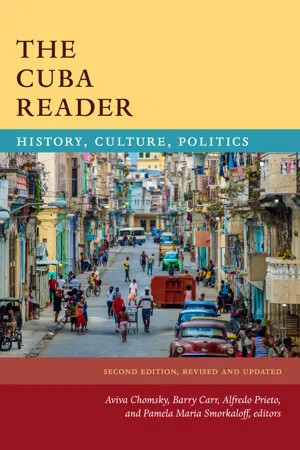 eBook - PDF
The Cuba Reader
History, Culture, Politics
- Aviva Chomsky, Barry Carr, Alfredo Prieto, Pamela Maria Smorkaloff, Aviva Chomsky, Barry Carr, Alfredo Prieto, Pamela Maria Smorkaloff(Authors)
- 2019(Publication Date)
- Duke University Press Books(Publisher)
The labor force faces short- and medium-term challenges due to low birthrates and a high percentage of the population being over sixty years of age, while emigration exceeds forty thousand people a year. These closely interrelated problems are present in an economy where the Fruit and vegetable stand in Havana, 2017. Courtesy of Tayeb Zaidi, photographer. Raúl’s Reforms 583 domestic market is small. Demand is still feeble among an important part of the population, especially the so-called budgeted sector of the Cuban state. Furthermore, Cuba still faces the U.S. economic blockade, in spite of the re-establishment of diplomatic relations between the two countries. Sixty years of the Cuban socialist project and an analysis of the experi-ences of Asian socialist countries like China and Vietnam reveal the utter necessity for the Cuban state to update its economic model. The market must have a steadily growing role in the Cuban Economy. While the documents of the Sixth and Seventh Party Congresses mandate a commanding role for planning, they also acknowledge that the market must play a role. A brief analysis of selected socioeconomic indicators shows that the results are not encouraging. Cuban authorities have at times resisted change, but changes in mentality are necessary. While executing change is complex, it is vital that we unlearn the ways in which the economy has been managed and conceived. Economic Policy In the period from 2008 to 2016, the Cuban government undertook economic transformations based on the Lineamientos (Guidelines) approved at the Sixth and Seventh Party Congresses in April 2011 and April 2016. The time-table for these very gradual changes was not publicly explained. eBook - ePub
- Ted A. Henken, Miriam Celaya, Dimas Castellanos, Ted A. Henken, Miriam Celaya, Dimas Castellanos(Authors)
- 2013(Publication Date)
- ABC-CLIO(Publisher)
The draft guidelines only dedicated two brief sections to Cuba’s internal problems, citing “low efficiency, the decapitalization of the productive base and infrastructure, an aging population, and stagnant population growth.” However, all of these problems—along with many others not mentioned—are the consequence of a model that it is impossible to update or reform. With this mask, the document once again attempted to sweep under the rug transcendent domestic realities that have been repeatedly shown to be at the root of the country’s current social, economic, and political woes. Cuba’s most serious problems are not rooted abroad. Nor can they be solved by outsiders. They arise from internal causes and can only be addressed by replacing Cuba’s economic and political system.The draft guidelines clearly stipulate that the central plan will continue to predominate over the market. In the second section, the document states: “the socialist state enterprise . . . is the principal motor of the national economy,” adding in section three that, “the concentration of property . . . will not be allowed in the new non-state sectors of the economy.” Thus, the document that is to guide Cuba’s economic modernization does not mention the concept of “private property,” doubling down on a policy that willfully blocks the growth of individual entrepreneurial initiative. Announced as a plan for the future, the “Lineamientos ” only ratify the continued bureaucratization of society under rigid centralization, which prevents the flexibility required for productive and efficient economic activity.THE SIXTH CONGRESS OF THE CUBAN COMMUNIST PARTY, APRIL 2011
As expected, the Sixth Congress of the Communist Party, held in April 2011, approved the “Guidelines of Economic and Social Policy,” which will govern the destiny of Cuba over the next five years, serving as a blueprint for removing the country from the economic crisis in which it finds itself. The original draft guidelines were expanded from 291 to 313 sections in the final approved document. Nevertheless, the original outdated concept of socialist planning remained at the heart of the guidelines, with only a slight nod to the market “as a factor influencing the plan.” Furthermore, state enterprise remains the principal motor of the economy, while the document recognizes the supplementary role of foreign investment and other forms of ownership, such as cooperatives, small private and usufruct farms, and self-employment, among other “non-state” entities. Still, concentrations of wealth and property remain prohibited for private individuals and entities. eBook - PDF
Latin America after the Financial Crisis
Economic Ramifications from Heterodox Perspectives
- Juan E. Santarcángelo, Orlando Justo, Paul Cooney, Juan E. Santarcángelo, Orlando Justo, Paul Cooney(Authors)
- 2016(Publication Date)
- Palgrave Macmillan(Publisher)
Notwithstanding that over the last two decades a broad debate has opened in Cuba over exactly what their desired socialism should look like, 2 this commitment generates restrictions on what sorts of policies Cuba is willing to consider for confronting the crisis. Three recent examples illustrate how this central commitment affects the economic policies adopted. When, at the beginning of the 1990s, Cuba entered its deepest economic crisis by far since the beginning of the Revolution in 1959, its output shrank by more than 35% in three years. The standard capitalist response to such a downturn, of course, would be massive layoffs (as in the similar-sized contraction in the Great Depression in the United States), thus effecting the standard capitalist procedure of transferring as much of any economic difficul- ties as possible onto the workers. Cuba, on the contrary, for years maintained the employment of a large majority of the workers that the crisis had made under- or entirely unproductive, and who could not find alternative employment, at full or near-full pay. Though sel- dom noted, there exists a meaningful rough estimate of the quantita- tive extent of this anti-capitalist policy. The Economic Commission for Latin America and the Caribbean estimated that of the roughly 3.5 million workers in the state sector in 1998, about 700,000—or 20%—were surplus 3 (CEPAL, 2000: 253). A second example is that in the face of that same crisis, with its draconian drop in govern- ment revenue, Cuba rejected the standard capitalist austerity policies of cutting government spending on fundamental social services To the contrary, the state maintained its defense of social equity on the basis of universality and free basic social services, in the first place in health care and education, and actually marginally increased spending on them. eBook - ePub
Counter-Globalization and Socialism in the 21st Century
The Bolivarian Alliance for the Peoples of Our America
- Thomas Muhr(Author)
- 2013(Publication Date)
- Routledge(Publisher)
It is not just important that the Cuban Revolution survived the Special Period, but how it survived. Cuban GDP growth averaged 6.3 per cent between 2001 and 2006 (Molina, 2009); however, as material conditions improved, rather than entrenching capitalist mechanisms, the revolutionary government began to roll them back (Yaffe, 2009b). For example, in 2005 the financial autonomy granted in the early 1990s to Cuban state enterprises, and the Cuban-dividend of joint ventures with foreign capital, was withdrawn. Financial reserves were transferred to the central bank resulting in a degree of financial centralization not seen since Guevara's Budgetary Finance System. Also, the number of mixed enterprises with foreign capital decreased by 41 per cent, from 403 in 2002 to 236 in 2006, when joint ventures accounted for just 1 per cent of employment.However, the impact of the global financial crisis and economic recession from 2007–08 onwards has underscored the need for more efficiency and rationalization measures. Reforms introduced under Raúl Castro since mid-2008, including changes to the employment structure (Yaffe, 2010b), and since the Cuban Communist Party's 6th Congress in April 2011, have increased small openings for market exchanges and the emphasis on material incentives to boost production and productivity. It is a mistake, however, to view contemporary developments from a purely ideological perspective, as if they express the political decision to embrace capitalism. Rather, they have to be understood as pragmatic measures to deal with Cuba's liquidity and balance of payments crises, low productivity and dependence on international trade under deteriorating conditions. These measures are not disguised as theore-tical advances or political improvements but reflect the Revolution's flexibility in devising policies to deal with urgent problems without straying from the paradigm of Cuba Socialista eBook - PDF
- Cole Blasier, Carmelo Mesa-Lago, Cole Blasier, Carmelo Mesa-Lago(Authors)
- 1979(Publication Date)
- University of Pittsburgh Press(Publisher)
Perhaps the most basic means of exporting the Cuban model is to ensure that the model itself is functioning effectively. As long as the Cuban Economy was experiencing the severe contortions of the 1960s, and despite achievements in income redistribution and the elimination of open unemployment, the Cuban economic model was widely perceived abroad as being fundamentally flawed. Moreover, growing perceptions abroad of internal militarization, bureaucratiza- tion, one-man rule, and lack of meaningful political participation apparently came to be considered by the revolutionary elite as an additional stain on Cuba's international image. It is likely that the current dedication to participation and poder popular, and on making the Cuban Economy function efficiently from the standpoint of production and growth, is to some extent part of an attempt to make the Cuban model more attractive internationally. Second, the Cubans have attempted to influence the nature of the informa- tion disseminated through international media, so as to present the Cuban experi- ence in a more favorable light. A variety of techniques has been used at various times for this purpose, including extreme official secrecy and release of selected information or statistics; limitations on research by foreign academics; use of such publications as Cuba Internacional and Granma; formation of the inter- national news agency Prensa Latina to compete with such agencies as Reuters and the Associated Press; dissemination of revolutionary art, movies, and litera- ture; and provision of revolutionary experiences for foreign students. Third, the Cubans have undertaken certain projects which have had as an important subsidiary objective the portrayal of Cuba as a superior, efficient, humanistic, and solidaristic society. eBook - PDF
Cuba
A Global Studies Handbook
- Ted A. Henken(Author)
- 2007(Publication Date)
- ABC-CLIO(Publisher)
This external opening was combined with a set of state-enforced austerity measures that sought to utilize tradi- tional popular mobilization strategies to confront the eco- nomic crisis. During this first three years, the Cuban leadership made an attempt to bring in foreign investment in mineral extraction and the tourism industry, while exhorting the Cuban popula- tion to make greater sacrifices so that the revolution (and the regime) could survive the economic crisis without changing 164——CUBA: A Global Studies Handbook The infamous Cuban camello, a massive camel-shaped bus. (Ted Henken) its internal socialist economic policies or its authoritarian political structure. Only after initial external adjustments proved insufficient did the regime undertake a more funda- mental economic restructuring of the island’s internal econ- omy. However, those economic changes were never intended to begin a transition toward capitalism. Instead, reforms were explicitly aimed at making possible the survival of socialism and “saving the revolution.” A principal area of economic growth arising from the needs of the special period has been tourism. Tourism has rapidly become the island’s number one “export,” recently pulling ahead of both sugar and hard-currency remittances. Tourist visits to the island have grown from a mere 275,000 in 1989 to almost 1.8 million in 2000, and the number of hotel rooms jumped from 5,000 in 1987 to more than 30,000 in 1999. Likewise, gross revenue from tourism jumped from just $243 million in 1989 to over $2 billion in 2000 (Peters 2002a). While Cuba’s tourism economy did experience stag- nation after 2000 because of the terrorist attacks of 2001, the ——Economics and Development——165 As transportation became increasingly scarce during the 1990s, many trucks were converted into makeshift buses. This mode of transport is still common in Cuba's provinces. (Ted Henken) industry rebounded between 2002 and 2005 (Mesa-Lago and Pérez-López 2005: 42). eBook - PDF
A New Chapter in US-Cuba Relations
Social, Political, and Economic Implications
- Eric Hershberg, William M. LeoGrande, Eric Hershberg, William M. LeoGrande(Authors)
- 2016(Publication Date)
- Palgrave Macmillan(Publisher)
Worn out equipment was replaced when it was feasible, but Cuba also began to develop the capacity to produce its own spare parts. However, inasmuch as Cuba’s technical obsolescence continued to worsen, its industrial plants per- manently operated below capacity (Rodríguez 1990), due to both general wear and tear and recurring interruptions and breakdowns. Finally, the excessive concentration of trade within COMECON significantly contributed to the slow rate at which Cuban enterprises engaged in foreign trade and adopted new business practices and mar- keting techniques. Intergovernmental policies and agreements had previously guaranteed sales to socialist countries, but once this prefer- ential framework disappeared, Cuban trade suffered accordingly. From the perspective of important sectors of the Cuban state, ongoing aggression from a powerful neighbor has been thought to reinforce the need for centralized and vertical governance. Such a response is common in extreme situations, including cases of armed conflict. Here, it was fostered by the US sanctions, which helped to legitimize the belief in the utility, and indeed the necessity, of a central- ized Cuban model that extends beyond the purely economic sphere. In general, US policies served to isolate Cuba and push it toward its COMECON allies. The government was left with virtually no other alternatives, and the sanctions handed an argument to those seeking to justify the orthodox policies enacted in the mid to late 1990s. Much the same has happened since the end of that decade. Faced with an unfavorable international environment, Cuba has con- centrated its trade again with countries that offer the island certain special arrangements or advantages, among them Venezuela, China, Russia, and Brazil. eBook - ePub
Socialist Cuba
Past Interpretations And Future Challenges
- Sergio G Roca, Rhoda Rabkin, Sergio Diaz-Briquets, Carmelo Mesa-Lago(Authors)
- 2019(Publication Date)
- Routledge(Publisher)
Part Two Economic Issues Passage contains an image
4 The Cuban Economy in the 1980s: The Return of Ideology
Carmelo Mesa-LagoThe Cuban Revolution has been building socialism now for more than twenty-five years. It has achieved success in several areas of the social domain such as education, health care, social security, full employment and income distribution. And yet several fundamental economic problems of the nation remain largely unsolved: insufficient output diversification, excessive export concentration on sugar, overwhelming dependency on one trade partner, low labor and capital productivity, and scarcity of consumer goods.1 The issue of economic growth is currently the subject of a heated academic debate, particularly about the performance in the first half of the 1980s.2 In any case, whatever growth Cuba has been able to generate has been largely based on the enormous economic aid provided by the USSR which I have estimated at $40 billion in 1960-1984.3 Furthermore, after healthy growth rates in the first half of the 1980s, the Cuban Economy suffered a significant decline in 1986 (1.4 percent or 0.3 percent per capita) and the planned growth rate for 1987 has been set from 1.5 to 2 percent, for a per capita growth rate of 0.5 to 1 percent for both years, the lowest since 1970.In my opinion, one of the principal obstacles to the solution of these problems has been the perennial conflict between "ideology" and "pragmatism" on several key economic areas and the frequent changes in economic organization and policy induced by such conflicts. This chapter analyzes these conflicts throughout the revolutionary period emphasizing the new shift towards "ideology" that has taken place since the mid-1980s and explores alternative socialist economic models that Cuba could follow in the future.
Index pages curate the most relevant extracts from our library of academic textbooks. They’ve been created using an in-house natural language model (NLM), each adding context and meaning to key research topics.

