History

Voltaire
Voltaire, the pen name of François-Marie Arouet, was a prominent French Enlightenment writer, philosopher, and advocate for freedom of speech and religious tolerance. He is known for his wit, satire, and criticism of the Catholic Church and monarchy. His works, including "Candide" and "Letters Concerning the English Nation," had a significant impact on shaping modern Western thought.
Written by Perlego with AI-assistance
Related key terms
1 of 5

10 Key excerpts on "Voltaire"
 eBook - ePub
- Intelligent Education(Author)
- 2020(Publication Date)
- Influence Publishers(Publisher)
Voltaire was a believer in and practitioner of the historical method. This can best be seen in one of his major works, The Age of Louis XIV (1756). In it, Voltaire is not only interested in the parade of leading figures, as many of his predecessors had been, but in the lives of the people, the “temper of the times,” and in casual relationships. Some modern historians credit Voltaire with having been the first to use the term “philosophy of history.” In his works, we find none of the supernatural events which mark previous histories. Voltaire once wrote that it is impossible to verify events before the fifteenth century, which indicates his interest in sources and the use of historical criticism. On the other hand, some of the material found in his works cannot be verified independently.Voltaire was anti-clerical as a natural outgrowth of his belief in freedom and the historical method. He saw no basis in fact for the claims of the various churches and charged religious leaders with suppressing free thought and criticism. Referring to the clergy, he wrote, “Crush the infamous thing!” As for himself, Voltaire was a Deist, and is often considered the father of the movement.Voltaire believed in rule by reason. He was no democrat, having little trust in the common man. Voltaire called for rule by an enlightened despot, who would allow freedom of speech and other basic freedoms, and do what had to be done, not that which was popular with the masses. It was for this reason, among others, that Frederick the Great admired Voltaire. It may be said that Voltaire desired freedom for the enlightened, and cared little for the rest of humanity.As important as these contributions were, Voltaire’s major impact was due to other factors, namely his catalytic qualities and his skepticism.Voltaire was the major intellectual influence during much of the French Enlightenment. This influence came not only from his own writings, but also through his work with others. The Encyclopedists considered him their leader; the physiocrats thought of Voltaire as their guide. Turgot turned to Voltaire, then an old man, when he gained power in French politics. His writing influenced an entire generation of French Revolutionaries. During his later life, Voltaire had a long correspondence with Rousseau. Although the two men differed on many points, the impact of Voltaire on Rousseau is evident from reading the letters.
- E. Ousselin(Author)
- 2009(Publication Date)
- Palgrave Macmillan(Publisher)
CHAPTER 1 Voltaire’s Europe The Enlightenment is Europe’s most prestigious achievement, and it could not have come about without the presence of a European domain, at once unified and diverse. Tzvetan Todorov, L’Esprit des Lumières F ew writers have so dominated their period as Voltaire (1694–1778); even fewer have accomplished this beyond the borders of their country. While he was often skeptical about the possibility of sustained, peaceful coop- eration among European states, Voltaire, the multilingual philosophe who cor- responded with widespread segments of the European elites, occupied a central position in the literary and political crosscurrents of his day. Much of his work thus reflects or participates in the already active debates on the issues of Euro- pean identity and integration. Perhaps the most famous (or infamous) man in Europe during his life, Voltaire announces, in positive or negative terms, the variations the European topos will undergo: a utopian community of nations that would establish perpetual peace; an imperialist continent colonizing the rest of the world; a racist Europe periodically ridding itself of undesirable minori- ties; a rough balance of power among a group of interconnected nation-states; and an expanding union based on social and cultural commonalities. A prolific writer in almost all genres, Voltaire was originally a playwright, poet, and historian before becoming, during and after his lifetime, the embodi- ment of the Enlightenment. What Daniel Brewer referred to as the “Voltaire effect” (chapter 8) still reverberates to this day. Although his historical standing as the best-known and most influential eighteenth-century philosophe remains unchanged, most of Voltaire’s texts are largely forgotten. While he wrote more plays than Shakespeare, for instance, they are today almost never performed. eBook - PDF
Icons of Unbelief
Atheists, Agnostics, and Secularists
- S. T. Joshi(Author)
- 2008(Publication Date)
- Greenwood(Publisher)
Voltaire Jean-Claude Pecker Voltaire is certainly the most famous French writer of the eighteenth century, one of the few in the Western world who paved the way for modern society. He symbolizes the fight of the intelligentsia against blind powers, stupid prej- udices, and intolerant religions. Perhaps he was less a pure philosopher than John Locke, Benedict de Spinoza, or Denis Diderot, perhaps less a scientist than Sir Isaac Newton, Gottfried Wilhelm Leibniz, or Antoine-Laurent Lavoisier, perhaps less a politician than Thomas Jefferson, Thomas Paine, or the Marquis de Condorcet; but he was all of those, and moreover, he was a magnificent writer, and his ironical style was as powerful as an entire army. The name of Voltaire is frequently associated with his famous motto “Écra- sons [or Écrasez] l’infâme!” (“[Let us] crush the infamy!”), from a letter to Jean Le Rond d’Alembert of November 28, 1762. Actually, Voltaire’s position with respect to religion, and to the concept of God, is more complex. It stems from a remarkable life story, from several painful experiences, and from his sensitivity to the denial of justice in his own country. LIFE OF Voltaire François-Marie Arouet (not yet Voltaire) was born in Châtenay, a country suburb of Paris, on February 20, 1694. He was a very weak baby, and during his whole life he complained regularly of poor health. Still, his career became one of the longest in the history of literature. His father was a wealthy and prominent man. For this reason he felt obliged to adopt a pseudonym, “Vol- taire,” an anagram of Arouet l.j., or Arouet le jeune (Arouet junior), where u and j became v and i. Later, he was called Monsieur de Voltaire. 428 Icons of Unbelief Being wealthy, Voltaire was free; he was never obliged to sacrifice his inde- pendence. Being free, he was often persecuted. Being persecuted, he used his wits in the strongest possible manner. eBook - ePub
The Art of History
A Study of Four Great Historians of the Eighteenth Century
- J. B. Black(Author)
- 2016(Publication Date)
- Routledge(Publisher)
1 Voltaire DOI: 10.4324/9781315647937-1 CRITICAL estimates of Voltaire’s work have been written from many angles, and the most diverse judgments have been passed upon it. This is perhaps unavoidable in the case of one who touched contemporary life at so many points, wrote voluminously on topics of public interest, and was himself a kind of epitome of an entire century. In the following pages we are concerned only with a fragment of the man—that part which reveals itself in his histories. But it is well to remember, at the outset, the amazingly rich and varied genius with whom we have to do. “In whatever branch of literature one practises,” remarks Condorcet, 1 “that person will always have an immense advantage, who has an extensive or profound vision in another.” So, at any rate, it was with Voltaire. He was an acknowledged master of literary expression, one of the greatest of grands écrivains : a thinker who amassed probably more accurate information about the world in all its aspects than any man since Aristotle; and, above all, one who possessed a remarkable capacity for collecting, condensing, simplifying, and re-directing the scattered lights shed by all manner of studies on the problems arising out of human existence. “As a simplifier and populariser,” says M. Taine, 2 “he had no rival in the world.” If, in addition, it be also borne in mind that this same mercurial genius moved about among men, grappled with affairs, was consulted and almost worshipped by most of the crowned heads of Europe, it will be apparent how eminently fitted he was for the task of writing humanely and attractively on history. It was virtually impossible for one so gifted by nature, and so conversant with the political and intellectual currents of the age, to take up the pen of the historian and fail to be interesting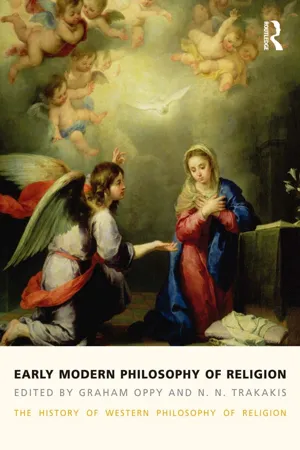 eBook - ePub
Early Modern Philosophy of Religion
The History of Western Philosophy of Religion, volume 3
- Graham Oppy, N. N. Trakakis(Authors)
- 2014(Publication Date)
- Routledge(Publisher)
15 Voltaire David Williams Françis-Marie Arouet de Voltaire (1694–1778) was the author of a wide range of moral, philosophical and political essays and treatises. After experiencing early success as a dramatist, he was exiled from Paris following a quarrel with an aristocrat, and in 1726 he went to England, where the impact made on him by English empirical science and philosophy in the two years he spent in London would be deep and long-lasting. In the early 1730s his reputation as a freethinker grew rapidly, and in 1734, in the wake of various controversies and accusations of religious non-conformity, he took refuge in Cirey in Alsace-Lorraine where he worked with Madame Du Châtelet, one of the leading female scientists of her day, on a translation of Isaac Newton’s Principia. In 1750 he accepted Frederick II’s invitation to join the royal court at Potsdam. Moving from Prussia to Geneva in 1755, he soon offended the Genevan authorities, and by 1759 he had settled in Ferney, where he remained until his triumphant return to Paris in the last weeks of his life. In the 1760s Voltaire rose to new heights of fame as a result of his militant engagement with the forces of religious dogmatism and intolerance; his personal involvement in a series of sensational causes-célèbres, in which the authority of the state, the Church and the courts was openly challenged, attracted international attention. A remarkably prolific writer working in many different genres, he lead the ‘party of humanity’ at a time of great danger for French dissident philosophers, sustaining and inspiring their mission of reform and progress. After his death, Voltaire’s intellectual legacy was ensured with the publication between 1784 and 1789 of the great seventy-volume Kehl edition of his complete works, directed by Pierre Beaumarchais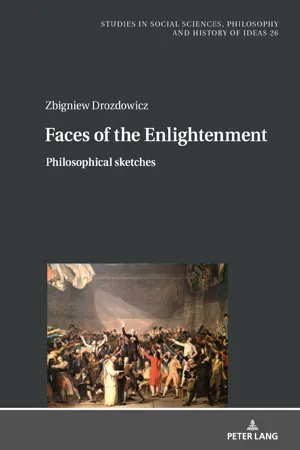 eBook - PDF
Faces of the Enlightenment
Philosophical sketches
- Zbigniew Drozdowicz(Author)
- 2020(Publication Date)
- Peter Lang Group(Publisher)
He authored numerous treatises and briefer forms of comment (his complete works number over fifty volumes), and at least a few sayings and postulates that were to become a permanent element of public discourse—if only to give as an example here his demand: “Ecrasons l’infâme” (Let us crush the vile thing!). That “vile thing” for him meant not only the Christian clergy, but also Christian fanat- icism, Christian intolerance, Christian ignorance and a few other “cardinal sins” of this religion. However, one must bear in mind that this call was worded by a philosopher who had received a Catholic education (having graduated from the Collège Louis-le-Grand in Paris) in a country where the vast majority of society felt a connection with the Catholic Church. In today’s France, many fewer French declare such a connection with this Church, and even fewer want to participate in its rituals or take guidance from its figures of authority. Of course one cannot say that this came about exclusively due to such philosophers as Voltaire. But excluding him from the circle of those who had a share in leading to this specific divorce would be challenging obvious facts. Voltairean Radicalism 108 Biographical Sketch For Voltaire’s Enlightenment supporters, even if his life could not be a role model for all to follow, at least they could find nothing in it that could evoke indigna- tion or offence. On the other hand they discerned achievements there that made him a monumental figure—and not only in the metaphorical sense of the word, but also literally, as testified by the monuments raised in his name. Panegyrics and hagiographies written in his honour also served to display his greatness and to perpetuate it in the memories of generations to come.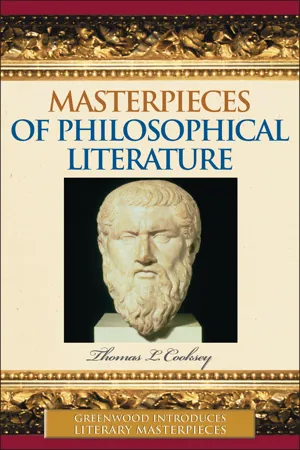 eBook - PDF
- Thomas L. Cooksey III(Author)
- 2006(Publication Date)
- Greenwood(Publisher)
As a Turkish dervish asks Candide, “[w]hen his 94 Masterpieces of Philosophical Literature highness sends a ship to Egypt, does he worry whether the mice on board are comfortable or not?” (Candide 73). In place of various false tales and ideolo- gies that too often are the source of our misery, Voltaire offers a tolerant and skeptical realism. Voltaire stands among Denis Diderot and Jean-Jacques Rousseau as one of the towering French philosophes of the eighteenth century. R. G. Saisselin aptly describes the philosophes as the “fighting wing of the Enlightenment elite” (qtd. in Yolton 395). They were public intellectuals, their fields of battle the salons of Paris and the general reading public. While centered in France, and including among their number such notables as Montesquieu, Condillac, Helvétius, d’Holbach, La Mettrie, D’Alembert, and Mme. d’Épinay, their spirit was international, embracing the Scotsman David Hume, the Neapolitan Abbé Galiani, the Milanese Cesare Beccaria, the Americans Benjamin Franklin and Thomas Jefferson, and the Germans Friderich Melchior Grimm, Gotthold Ephraim Lessing, and Moses Mendelssohn (the prototype for Lessing’s Nathan the Wise). Among their political supporters (at least in spirit, if not always in practice or pocketbook), Frederick the Great of Prussia, Catherine the Great of Russia, and Mme. de Pompadour, long-time mistress of Louis XV of France. Voltaire AND THE ENLIGHTENMENT Writing in 1784, within 5 years of the French Revolution and in many regards at the end of the Enlightenment, the German philosopher Immanuel Kant offers a definition in his “Was is Aufklärung? [What is Enlightenment?]”: “Enlightenment is man’s leaving his self-caused immaturity,” he declares. Explaining, he adds, “Immaturity is the incapacity to use one’s intelligence without the guidance of another.
- Bernard N. Schilling(Author)
- 2019(Publication Date)
- Columbia University Press(Publisher)
While it is true that ideas of civil liberty are scattered here and there through most of his works, 20 as a rule he gives praise to liberty only so far as it might contribute to weaken the authority of the Church, and lower Sacred opinions. 21 Even his so-called in-tellectual and scientific interests were aimed at discrediting re-ligious belief. On finding that some of his reading in natural history seemed to contradict the Mosaic accounts, Voltaire exulted in his letters over his discovery and urged on his colleagues to bring forward every fact that was hostile to the Mosaic history. 22 He was actually incapable of constructing or reforming in any real sense; his professed aim was destruction. 23 This negative in-tention was the more dangerous, because Voltaire was a man of original and versatile genius and as such entitled to the high admiration of mankind. 24 He was indeed the giant of French literature, 25 a fact which makes the perversion of his talents the more lamentable and the more dangerous. T h e enemy of souls is of course, far too cunning to make use of weak and inadequate instruments for the extension of his designs. 28 Hence his use of Voltaire who could write in so pleasant a manner and concentrated a form as to make infidelity easy to the meanest capacity. 27 Let the young and unwary then be cautioned against the subtle en-ticements of Voltaire's opinions made attractive by the distinc-tion of his name and the charm of his expression. 28 If he had been satisfied to try for the ruin of Christianity single-handed, Voltaire would have been culpable enough. In fact, he was alone in this impious warfare for a long time while others held off, remained lukewarm, disagreed with him, or deserted his cause. But in the chaos of these divisions, Voltaire, away and in safety, kept up alone the fire of his artillery. He reanimated their zeal,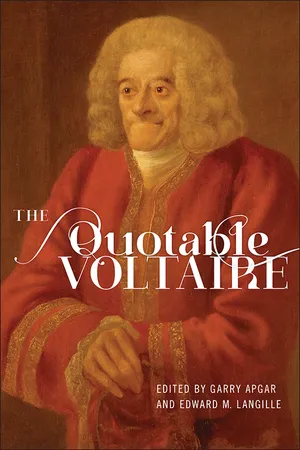 eBook - ePub
- François-Marie Arouet (Voltaire) (1694-1778), Garry Apgar, Edward M. Langille(Authors)
- 2021(Publication Date)
- Bucknell University Press(Publisher)
Candide.Gay, The Party of Humanity (1964), 7.He was not a dogmatist but an opportunist; he was never a consistent supporter of any particular form of government. He was a moderate constitutionalist in England, Holland, and Geneva, a vigorous royalist in France, and an advocate of absolutism in Prussia.Gay, The Party of Humanity (1964), 91.It is true that Voltaire contradicted himself.… But his political aims show a complete consistency. The rule of law, freedom of speech, a humane legal code, and a tolerant religious policy—these were desirable everywhere.Gay, The Party of Humanity (1964), 91–92.Among the men of the Enlightenment Franç ois Marie Arouet, self-styled Voltaire, stands first.Gay, “The Enlightenment,” Horizon, Spring 1970, 42.Larry Getlen (circa 1965–)STAND-UP COMIC, COMEDY WRITER, AND JOURNALISTBelieve it or not, Voltaire was the Jennifer Aniston of the eighteenth century.Getlen, “Ben Franklin Was the Country’s First Fame Whore” (2017).André Glucksmann (1937–2015)FRENCH PUBLIC INTELLECTUAL AND “NOUVEAU PHILOSOPHE”Glucksmann, “L’Europe sera voltairienne ou ne sera pas” (2015).Qui criminalise la liberté d’expression criminalise Voltaire vivant ou mort.He who criminalizes freedom of expression criminalizes Voltaire, living or dead.Glucksmann, “L’Europe sera voltairienne ou ne sera pas” (2015).Voltaire est un contestataire. Plus que de gauche ou de droite, plus que croyant ou athée, il est fondamentalement libre.Voltaire was a dissenter. Beyond liberalism or conservativism, beyond faith in God or atheism, he was fundamentally free.Howard Goldberger (1921–2014)Some books are good, some books are great. The Bonfire of the Vanities eBook - PDF
Voltaire, Goethe, Schlegel, Coleridge
Great Shakespeareans: Volume III
- Roger Paulin(Author)
- 2014(Publication Date)
- The Arden Shakespeare(Publisher)
Chapter 1 Voltaire Michèle Willems Although in the history of European culture Voltaire appears as one of the leading figures of the Enlightenment, when it comes to the reception of Shakespeare he is mostly remembered as leading the army of French anti-Shakespeareans. Indeed, his name has so often been associated, par-ticularly in English-speaking countries, with iconoclastic resistance to the Bard, that defining him as a ‘Great Shakespearean’ may appear as a para-dox, if not as a provocation. It has been common critical practice to explore the reception of Shakespeare in France (‘Finicky France’, as could recently be heard at a Paris conference on the subject) as a site of genetic incomprehension, reflect-ing the incompatibility between the great English dramatist and ‘l’esprit français’, 1 as epitomized by Voltaire. Instead of deciding that the alleged incapacity of the French to appreciate Shakespeare’s drama is, like so many other national defects, ‘la faute à Voltaire’, 2 it is perhaps more profitable to approach his criticism of the dramatist from a different angle, in relation to the century which his life roughly spans (he was born in 1694 and died in 1778). Straddling the excesses of a declining monarchy and the chaos of a social revolution, the ‘Siècle des Lumières’ is in effect, culturally and ideo-logically, the seat of tensions between stability and movement, which some would perceive as order and disorder. Voltaire often mirrors these contra-rieties, nostalgia for the age of Louis XIV coupled with admiration for the progressiveness of England being but one example of his own inner strains. In the light of the paradoxes and contradictions which are the trademark of his age and of his life, it may thus be instructive to revisit Voltaire’s con-tribution to the reception of Shakespeare in France, and in Europe. Both as a discoverer and a deprecator of Shakespeare, Voltaire is, from the start, in two minds about the plays which he imports into France.
Index pages curate the most relevant extracts from our library of academic textbooks. They’ve been created using an in-house natural language model (NLM), each adding context and meaning to key research topics.

