History

Zheng He
Zheng He was a Chinese mariner, explorer, and diplomat who led seven major expeditions to the Indian Ocean and beyond during the early 15th century. He commanded a massive fleet of ships and is known for promoting trade, cultural exchange, and establishing diplomatic relations with various countries. Zheng He's voyages were significant in expanding China's influence and maritime power during the Ming Dynasty.
Written by Perlego with AI-assistance
Related key terms
1 of 5
5 Key excerpts on "Zheng He"
 eBook - ePub
Transnational Sites of China’s Cultural Diplomacy
Central Asia, Southeast Asia, Middle East and Europe Compared
- Jarmila Ptáčková, Ondřej Klimeš, Gary Rawnsley, Gary Rawnsley, Jarmila Ptáčková, Ondřej Klimeš(Authors)
- 2020(Publication Date)
- Palgrave Macmillan(Publisher)
7 the official PRC narrative views and portrays the voyages in a very different light.First and foremost, Zheng He is celebrated as a navigator and explorer who ventured into the unknown, considerably expanding the horizons of mankind long before the European ‘age of discovery’ even began.8 But unlike the Western explorers, who, according to the PRC narrative, brought nothing but violence and exploitation, oppressing the peoples they encountered and colonizing their lands, Zheng He allegedly embarked on a peaceful mission of friendly and mutually beneficial cultural and commercial exchange which initiated the economic growth of the region.9 Zheng He is invoked as an envoy of peace—a harbinger of civilization introducing advanced technologies and spreading Chinese culture to the outside world (Li 2005 ). As such he has become a symbol of peaceful and harmonious cooperation within a larger community of shared interests and his maritime enterprise is presented as proof that China is a good neighbor whose peaceful rise to power should not be feared but embraced as an opportunity for further development.10The voyage of the Zheng He training ship and its stop in Malacca is but one example of the various diplomatic activities revolving around the figure of the Ming eunuch. Already in 2005 , when China celebrated the sexcentenary anniversary of Zheng He’s first voyage, the ministries of culture of the PRC and Malaysia co-organized a traveling exhibition, Envoy of Peace from China . Opened by the then Malaysian Prime Minister Badawi as part of official celebrations, the exhibition ‘highlighted the spirit of peace and friendship embodied in Zheng He and expressed China’s wish to carry out dialogue and exchanges with all other countries in the world’ (Malaysian PM 2005 eBook - PDF
Mapping the Chinese and Islamic Worlds
Cross-Cultural Exchange in Pre-Modern Asia
- Hyunhee Park(Author)
- 2012(Publication Date)
- Cambridge University Press(Publisher)
Chinese Learning about the Islamic World that Resulted from the Seven Voyages of Zheng He from 1405 to 1433 The Chinese naval expeditions initiated by Emperor Yongle, which lasted from 1405 to 1433, marked a significant page in Chinese – and world – history. Several hundreds of large vessels sailed from China to the Indian Ocean, completing a total of seven journeys; archaeological, documen- tary, and inscription sources reveal that four of Zheng He’s voyages traveled as far as the Arabian Peninsula and East Africa. 18 It may seem surprising that the emperor dispatched fleets of such grand scale at a time when the first emperor’s ban on ocean travel was still in effect. 19 The court would have perceived no inconsistency here: The ban pertained to private travel and trade, and Zheng He’s fleets sailed under the auspices of a governmental enterprise. It appears that the emperor wished to relax restrictions to some degree; during his reign, Yongle took initial steps to resurrect government offices that once supervised and assisted maritime trade such as the Office of the Superintendent of Merchant Shipping (shi- bosi). However, commercial trade constituted only one facet of Zheng He’s mission. Primarily, the Ming court sought to rebuild China’s com- mercial networks as an integral part of the state’s tribute-based diplo- matic order, as well as show off the power of their new empire. 20 Mapping the Chinese and Islamic Worlds 170 In order to carry out such grand maritime projects, the Ming gov- ernment needed experienced sailors, advanced navigation techniques, shipbuilding technology, and information about sea routes and foreign countries including those in the Islamic world. To this end, the govern- ment made practical use of resources and knowledge it inherited from the previous dynasty. Descendents of Muslim merchants who had been the most actively engaged in the Indian Ocean sea trade during the previous century also participated in the projects. eBook - PDF
- Sin Kiong Wong(Author)
- 2012(Publication Date)
- World Scientific(Publisher)
Zheng He’s voyages brought all countries in Southeast Asia, the Middle East, and as far as East Africa to establish closer and harmonious relations with Ming China. These relations continued to prevail until the end of the 15th century. Chinese historians of today are of the opinion that it was court politics which had stopped Zheng He’s mission after the reign Xuanzong ( ). However, Chinese merchants continued to visit and trade with the above-mentioned countries and also played a dominant part, politically, economi-cally, socially, culturally, and ecclesiastically. It is believed that the daughter of Shi Jinqing ( ), known as Shi Erjie ( ) or Njai Gede Pinatih, has been honored as a religious leader and served as a Shahbandar in Java and was very powerful and influential. 45 This indeed is another important episode about Ming China’s maritime trade with overseas in the late 15th and early 16th centuries. The arrival of the Portuguese and Spanish fleets on the China waters enlarged China’s perspectives; it offered Ming China a chance to realize the importance of foreign relations and international trade. I feel I must not indulge myself to go further, for an important topic of this kind needs another occasion for further deliberation. Zheng He : Navigator, Discoverer, and Diplomat 123 Notes 1. Ban Gu (1912). Han Shu 28B ( Treatise on Geography ) (transl. and annot P Pelliot) in T ’ oung Pao , Vol. XIII, pp. 453–455; Ferrand, G (1919). “Le K’ouen-louen et les anciennes navigations interoceaniques dans les mers du Suds”. Journal Asiatique , tome XIII, 233–239, 431–492 and tome XIV, 6–68, 201–241; Cf. Ling-yeong, C (1965). “Chinese maritime expansion, 1368–1644”. Journal of the Oriental Society of Australia , 3(1), 27–47. Paul Wheatley (1980). The Golden Khersonese , Chapter 1. Kuala Lumpur: University Malaya Press. 2. Chen Shou ( ), Sanguo zhi ( ), 60, Wuzhi ( ) ( Biography of Lu Dai ), 15. eBook - PDF
The Ocean Reader
History, Culture, Politics
- Eric Paul Roorda(Author)
- 2020(Publication Date)
- Duke University Press Books(Publisher)
76 Zheng He comparison between that level of violence and the European model, which inflicted carnage. Zheng He died during his seventh voyage, in 1433, and was buried at sea. In the years that followed, China turned away from the sea, prohibiting most seafaring activity and expunging Zheng He’s accomplishments from the record. China soon declined from being the preeminent naval power in the world to a condition of such weakness that the enormous country was beset by resurgent piracy and Western incursions into its coastal waters, which would eventually lead to disaster in the nineteenth-century Opium Wars. Despite the imperial court’s attempt to efface the national memory of Zheng He, evidence survived in the form of inscriptions written in stone on temple steles. Not discovered until 1935, the Chinese steles date to 1431, the year the last Treasure Fleet departed. Their inscriptions summarize Zheng He’s first six yoyages. Inscription on stone in the palace of the Celestial Spouse at the Liu-chia-chian in eastern Lu in memory of the intercourse with the barbarians. 1 In the sixth year of the Hsüan-te of the Ming Dynasty (1431) the cyclical year hsin-hai , the first day of (the second) spring (month) (March 14th) the principal envoys, the Grand Eunuch Cheng Ho and Wang Ching-hung, the assistant-envoys, the Grand Eunuchs Chu Liang, Chou Fu, Hung Pao and Yang Chen, and the Senior Lesser Eunuch Chang Ta have erected an inscription as follows: The Majestic miraculous power of the goddess of the Celestial Spouse to whom by imperial command the title has been conferred of “Protector of the country defender of the people whose miraculous power manifestly answers [prayers] and whose vast benevolence saves universally,” is widely spread over the great sea and her virtuous achievements have been recorded in a most honorable manner in the Bureau of Sacrificial Worship.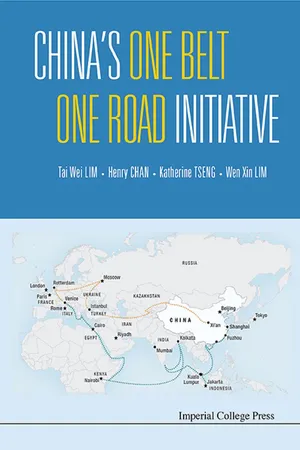 eBook - ePub
- Tai Wei Lim, Henry Hing Lee Chan;Katherine Hui-Yi Tseng;Wen Xin Lim(Authors)
- 2016(Publication Date)
- ICP(Publisher)
Section BThe History of Zheng He (Cheng Ho) and the Maritime Silk Road
 Passage contains an image
Chapter 2
Introduction of the Overland Silk Road and Maritime Silk Road
TAN Ta SenIn September and October of 2013, the President of China, Xi Jinping, spelt out his vision of rebuilding economic belts along two ancient Silk Roads, the Northern Silk Road and the Southern Maritime Silk Road. In the context of the Maritime Silk Road, President Xi also mentioned the legendary voyages made by Cheng Ho (Zheng He in Hanyu Pinyin pronunciation) from China to East Africa in the 15th century. This prologue to the edited volume first brings you through an interesting historical journey of the two Silk Roads setting a stage for the appearance of the Ming dynasty Admiral Cheng Ho. His historic seven voyages fill the pages of the last part of this prologue giving the readers insights into the man himself, his voyages and its historical and contemporary significance in relation to today’s business opportunities and international relations.Zhang Qian’s expeditions to Central Asia
Zhang Qian, who was credited for opening up the Silk Road, was an official during the reign of Emperor Wu of the China’s Han Dynasty (206 BC–AD 220).During the Han dynasty, the Inner Asian steppe in Central Asia to the west of China known as the Western Regions by the Chinese, was dominated by nomadic Xiongnu tribes. In the late 3rd century, Xiongnu formed the first great confederation of nomadic tribes along China’s north and northwest borders. The Great Wall was built by Emperor Qin (Qinshi Huang) as a defense measure against them. However, Xiongnu continued to be a major threat to early Han emperors and prevented Han China from establishing economic relations with the Western Regions.In 138 BC, Emperor Wudi sent a mission led by Zhang Qian to the Yuezhi in modern-day Tajikistan with an aim to form an alliance against the Xiongnu. While traveling south of the Kunlun Mountains and crossing Qinghai, the group was captured by the Xiongnu and was put to hard labor. The courageous and devoted diplomat Zhang Qian married a native wife who bore him a son just to gain the trust of the Xiongnu king. Taking advantage of the internal power struggle within the Xiongnu tribe when the old king died in 126 BC, Zhang Qian and his men escaped but only three (Zhang Qian, his Xiongnu wife and the Xiongnu member of the mission) made it to the capital Changan (now Xian, Shaanxi province). During these 13 years abroad, he held on to his imperial insignia.
Index pages curate the most relevant extracts from our library of academic textbooks. They’ve been created using an in-house natural language model (NLM), each adding context and meaning to key research topics.

