Languages & Linguistics

Interactionist Theory
Interactionist Theory in linguistics emphasizes the role of social interaction in language development and use. It posits that language is shaped by the interactions between individuals and their environment, and that communication is a dynamic process influenced by social and cultural factors. This theory highlights the importance of context and social relationships in understanding language acquisition and usage.
Written by Perlego with AI-assistance
Related key terms
1 of 5
12 Key excerpts on "Interactionist Theory"
 eBook - ePub
- Anthony J. Liddicoat, Angela Scarino(Authors)
- 2013(Publication Date)
- Wiley-Blackwell(Publisher)
The theories described so far give salience to the internal processing of information in the mind of the individual learner. Further theoretical work on language learning considers the role of interaction. Building on Krashen’s (1982) notion of comprehensible input, Long (1985, 1996) proposes an interactive view of input whereby learners work at understanding each others’ meanings in interaction. Essentially, within this view comprehensible input becomes available in situations of social interaction. This is because the context of interaction provides opportunities for the negotiation of meaning. Through the process of negotiation, input becomes comprehensible as native speakers adjust or modify their language until learners show signs of understanding. This is not only a process of simplification, but also a process of clarification, elaboration, emphasis, or providing further contextual clues. The adjustment involves negotiation in order to clarify and confirm meaning in the particular instance in response to difficulties experienced by the learner. Long (1996, pp. 451–452) sees the negotiation for meaning that takes place in interaction as connecting input, internal learner capacities, particularly selective attention, and output in productive ways. The interactivity here remains focused on language understood as grammar, and is aimed at resolving communication problems: improving the comprehensibility of input, attention, and the need to produce output, within a computational metaphor. Interaction is needed to facilitate cognition and learning; it is a means to a learning end but not constitutive of learning itself in the sense of learning how to interpret, create, and exchange personal meanings. Furthermore, the link between increased opportunity for negotiation of meaning and improved learning is yet to be demonstrated empirically (Littlewood, 2004).Another important development in relation to interaction-based approaches to language learning is the recognition that output plays an important role in acquisition (Swain, 1995). Speaking and writing forces learners to attend to aspects of form that they do not need for comprehension purposes alone, and in the process of speaking and writing learners identify gaps, make hypotheses about how language works, and obtain feedback towards extending their understanding of the language. Within these interaction-based views, interaction plays a mediating role in learning in that it stimulates students to seek scaffolds or supports from peers or the teacher in order to fill gaps or extend their learning (Littlewood, 2004).In the theories discussed above, the emphasis is on cognitive processes that underlie second language learning. They are psychologically oriented theories that consider learning as developing in the mind of the individual. Interaction becomes the vehicle for stimulating various kinds of mental processes within the individual. It is one of the conditions for learning. Context is considered to be important but it is understood only as the immediate setting in which interaction takes place; it is not seen as shaping the interaction towards the exchange of meaning. Furthermore, language itself remains the substance of learning rather than also including significant “content” that is derived from other domains of knowledge and culture(s) of the target language being learned or the personal knowledge of the students themselves.Sociocultural theories, as the second family of theories, have developed in reaction to cognitive theories. They consider the relationship between thinking and the wider social, cultural, historical, and institutional context in which it occurs. The context itself is seen to be constitutive of learning. Within these theories social interaction is seen as the major means through which learning occurs. As Lantolf explains, “sociocultural theory holds that specifically human forms of mental activity arise in the interactions we enter into with other members of our culture and with the specific experiences we have with the artifacts produced by our ancestors and by our contemporaries” (2000, p. 79). Within the sociocultural family of theories the mental and the social are not seen as a dichotomy but rather as being in a dialectic relationship where each is shaped by and shapes the other.
- Julia Herschensohn, Martha Young-Scholten(Authors)
- 2013(Publication Date)
- Cambridge University Press(Publisher)
Some sociolinguists view the language learner in a similar way to cog- nitivists, as an individual mind whose task is to acquire the rules of the L2, albeit its sociopragmatic rules in this case, rather than its grammar or vocabulary (see Chapter 23, this volume). In order to study the acquisi- tion of these rules, they make use of (socio)linguistic or psycholinguistic methodologies. Ethnographers, on the other hand, focus on the learner as a social being situated within a specific context, affording different oppor- tunities for learning linked to specific communities of practice, involving unequal power relationships which shape the interactional practices taking place. Learners in this view are very much seen as active social partners within complex social settings and the focus of this approach is on how they negotiate their learning in situated contexts, as well as on how their identity is shaped by these encounters (for more details, see Chapter 12, this volume). Interactionists, as outlined above, pay attention to the interactional pat- terns learners engage in, and how they affect language learning. Their view of the learner is primarily as an individual engaging with conversational partners in order to develop an interlanguage system, and making use of internal cognitive and linguistic mechanisms for so doing (see Chapter 10, this volume). Within this broad theoretical family, the view of the language learner varies substantially according to the approach adopted, from an individual making use of psycholinguistic tools to assist learning, to the learner as a primarily social being negotiating new identities and power relationships. eBook - ePub
International English in Its Sociolinguistic Contexts
Towards a Socially Sensitive EIL Pedagogy
- Sandra Lee McKay, Wendy D. Bokhorst-Heng(Authors)
- 2017(Publication Date)
- Routledge(Publisher)
Chapter 6 Interactional sociolinguisticsIn this chapter we examine how interactional sociolinguistics can provide insight into the use of English in an era of globalization. The chapter begins with an overview of the central figures and tenets of interactional sociolinguistics. Using this background, we examine existing research regarding EIL interactions. Specifically, we explore the ways in which interactional sociolinguistics has been beneficial in providing insight on:f• English as a lingua franca (ELF) interactions;• the code-switching behavior of bilingual users of English; and• bilingual users’ attitudes toward code-switching.In each section we will consider the manner in which the topic has relevancy for EIL pedagogy.Defining interactional sociolinguistics
Historical development
Interactional sociolinguistics developed out of linguistics, sociology, and anthropology. Current interest in interactional sociolinguistics began largely as a reaction to Chomsky’s (1957) view of language as a fixed universal property of the human mind that exists devoid of context. A major challenge to Chomsky’s view of language was the work of Hymes (l974), a linguistic anthropologist, who argued that a description of language must take into account the social knowledge that individuals bring to linguistic interactions. Hymes argued that researchers interested in describing how language is used need to consider the context in which particular interactions take place and how this context affects the inter-action. Specifically, Hymes (1972) maintained that the following four questions must be raised in analyzing language use. eBook - ePub
(Re)defining Success in Language Learning
Positioning, Participation and Young Emergent Bilinguals at School
- Katie A. Bernstein(Author)
- 2020(Publication Date)
- Multilingual Matters(Publisher)
While interaction plays a role in nearly all theories of second language acquisition, the view that interaction is both a place for language learning as well as for the construction of social relationships and structures is a broadly sociocultural one. Vygotskian sociocultural theory, which was brought to the field of Second Language Acquisition through the work of Rick Donato, Jim Lantolf, Merrill Swain and Steve Thorne, among others, theorizes that learning is a process of internalization and appropriation. Any new skill appears first on the social plane, through participation in interaction with others, and then, later, on the individual plane (Vygotsky, 1978). Through interaction, children learn to use artifacts, or cultural tools – more concrete ones, like spoons or markers, to more abstract ones, such as language and gesture – to mediate their goal-driven activity. For second language researchers who draw on Vygotskian sociocultural theory, interaction is at the core of language learning, which takes place through participation in ‘cultural, linguistic, and historically formed settings such as family life and peer group interaction’ (Lantolf & Thorne, 2007: 197). Far from simply providing input, interaction is the location of learning itself.Specifically, Lantolf (2000, 2013; Lantolf & Thorne, 2006, 2007) described interaction as mediating L2 learning in two important ways. First, it provides opportunities to understand and appropriate others’ intentional ways of using language to participate in activity. Second, it enables learners to use language in ways that are just beyond their individual capabilities, in their zones of proximal development, or the range of activities that a person cannot yet complete independently, but can in cooperation with another person. Donato (1994, 2000) and Swain (1997; Swain et al., 2002) described similar learning processes, which they called ‘collective scaffolding’ and ‘collaborative dialogue,’ respectively. Through these interactions with others, learners appropriate language that they can then rehearse in private speech or use productively in other interactions. Importantly, from a sociocultural perspective, development and learning are not individual processes. Instead, they involve appropriation and internalization of intro-individual social activity. Sociocultural theory thus dispenses with the dichotomy between the individual and the social, as well as between the cognitive and the cultural. All development, and the learning that precedes it, is both social and cultural. There is no ‘that which surrounds.’ This is also true in the second theoretical perspective Cole mentioned: practice theory.Language – and Human Activity – as Social PracticePractice theory was developed by sociologist Pierre Bourdieu (1977, 1990), as a way to overcome what he saw as three related and false dichotomies in sociological and anthropological research: objectivity and subjectivity, positivism and phenomenology, and structure and agency. The first in each set come together in the researcher striving to view human activity as an outsider, looking down from above in order to create a stable account of patterns and routines, by, for example, mapping the daily schedule in a prekindergarten classroom. The latter in each pair convene in attempts to understand the ‘native perspective,’ or personal experience of, say, being the new kid in school or the parent of a child with a disability. For Bourdieu, the former approach reduces human activity to acting out predetermined roles on stage or to executing prewritten plans, while the latter ignores everything outside individual experience, including the conditions, such as relations of power, that made that experience possible. With practice theory, Bourdieu sought to bridge the two and to understand how structure sets the conditions for human activity without determining it and how activity (re)produces those structures. He accomplished this through the notions of habitus and field.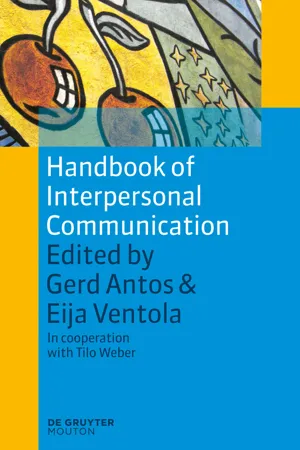 eBook - PDF
- Gerd Antos, Eija Ventola, Gerd Antos, Eija Ventola(Authors)
- 2008(Publication Date)
- De Gruyter Mouton(Publisher)
It touches upon issues such as routine and expectations and is relevant in any context which argues for (or against) the emergence Interactional Linguistics 89 and sedimentation of forms (cf. Bybee 2006; Barth-Weingarten 2003; also Section 4., below). In addition, Interactional Linguistics employs concepts, methods and tools from specific linguistic theories and models with which it is readily compatible such as, for instance, Rhetorical Structure Theory, Empirical Construction Grammar and Genre Theory (for examples, cf. Mann and Thompson 1992; Deppermann 2006; Günthner and Imo 2006; Günthner and Knoblauch 1995). Moreover, due to its focus on actual language use in natural environments Interactional Lin-guistics has a great potential for a wide range of applied-linguistic objectives (cf. Section 5., below). Interactional Sociolinguistics and Anthropological Linguistics offer a com-parison of diverging cultural practices and, in addition, with the theory of con-textualization a tool for the in-depth analysis of interactional processes (cf. Günthner this volume). Finally, a method should be mentioned which appears to be unique to Inter-actional Linguistics: the reflexive investigation of linguistic patterns and their interactional co(n)text, i.e., the constant “back and forth between looking at the detailed linguistic properties of items […] and inspecting the evolvement of the interaction” (Hakulinen and Selting 2005: 10). This method is based on the close connection between the actions and activities carried out by the partici-pants and the linguistic resources they use in order to do so. 4. Research questions and future challenges Ultimately, interactional linguists aim at a general theory as to how language is organized and used, structurally and functionally, in social interaction. eBook - ePub
- Rod Ellis(Author)
- 2012(Publication Date)
- Wiley-Blackwell(Publisher)
In situated social practices, use and learning are inseparable parts of the interaction. They appear to be afforded by topics and tasks and they seem to be related to specific people, with particularized identities, with whom new ways of behaving occur as the unfolding talk demands (Firth and Wagner, 2007: 812).A cognitive theory of second language acquisition seeks to explicate the psychological mechanisms that underlie comprehension and production and are the means by which competence develops in the mind of the learner (Harrington, 2002: 124).These two theoretical perspectives have been evident throughout the previous chapters. But they become central in this chapter, where we seek to investigate the relationship between the interactions that take place in a classroom and L2 learning. Each perspective operationalizes and investigates learning in a different way.Learning necessarily involves change (Ellis, 2010b). From a sociocultural perspective change can take a number of different forms that reflect different levels of development. These are shown in Table 8.1 .Table 8.1 Types of ‘development’ in sociocultural theory1. The learner is unable to produce a specific target form even with assistance. 2. The learner demonstrates that with substantial assistance he/she can use a specific linguistic feature (x), which previously he/she could not use. 3. The learner demonstrates that subsequently he/she can use x in the same or similar context but now requires less assistance than on the previous occasion. 4. The learner subsequently demonstrates that he/she can now use x in the same or very similar context in which he/she had used it previously without any assistance. 5. The learner is now able to employ x on different occasions in new contexts and with different interlocutors without any assistance (i.e. ‘transfer of learning’ has taken place). Sociocultural studies have, by and large, been content to investigate the role played by classroom interaction in learning in terms of (1) and, to a lesser extent, (2). (1) requires only a cross-sectional study; the researcher analyzes a sample of interactions to pinpoint occasions where the use of a new linguistic form is mediated. A weakness of much of this research, however, is that it has often failed to demonstrate that the learners were unable to use the feature previously (i.e. there was no pre-test). Thus, it is difficult to know whether the use of the linguistic feature represents development or simply the use of a feature that has already been (partially) internalized. (2) and (3) are unique to sociocultural studies. They require a longitudinal study in order to investigate changes in the degree of assistance that the learner requires in order to use a specific feature. (4), however, requires that a new context for the use of the feature is created and this typically involves some kind of test of the learner's ability to use the feature. Only a few sociocultural studies have investigated learning in terms of (4). eBook - PDF
- Edna Andrews(Author)
- 2014(Publication Date)
- Cambridge University Press(Publisher)
Several important ideas are articulated in the above definition. First, language is a dynamic phenomenon that is acquired, maintained, and lost continuously 32 throughout the lifespan of a speaker. While there may be periods of more intensive acquisition and loss, these three modes of language usage are not consecutive, but simultaneous. Within each of them are different dynamic coefficients. For example, lexical acquisition is robust continuously through- out a large portion of the lifespan, while grammatical acquisition is more intensely acquired in early education for a first language, but may also be acquired later in life – not only in one’s first language but also in second, third, fourth (and more) languages. Second, my definition of language places language within the sociocultural context: language is not the product of a single brain but rather a product of multiple brains in sync with each other and embedded in the cultural context. This means that there can be no definition of language in the brain that excludes the communal aspects of language itself as manifested. Once we admit that language is never “in the one,” but rather is an integral part of what it means to be human and a social being, then we are compelled to take the next step and characterize language as a shared phe- nomenon. In this regard, cognitive linguistics, a fundamentally “usage-based, not rule-based” theory (Sinha 2007: 1270), has played a central role in under- standing the interactive process-oriented nature of generating and negotiating meanings. eBook - PDF
- Peter Jordens, Josine A. Lalleman(Authors)
- 2016(Publication Date)
- De Gruyter Mouton(Publisher)
Parents thus do reinforce, but generally not in the way in which is was claimed by behaviorists, by correcting ungrammaticalities. Behaviorist theory was severely criticized by Chomsky (1959), and in recent years its 17 value is more often acknowledged in the area of treatment of language disorders (e.g. Guess, Sailor & Bear 1974, Lovaas 1977) than for its power to explain normal language acquisition. Maratsos formulates this tendency as follows: Classical conditioning laws of association and contiguity do not apply to all stimuli and responses ( .... ) the child is not an unbiased observer and processor of stimuli (Maratsos 1983:768) However, the study of environmental factors influencing language development is a positive side effect of the theory (e.g. Snow 1986, Hickmann 1986, Schaerlaekens & Gillis 1987). 3.2. Cognitivist theory Cognitivist theorists try to establish the relationship between language and other intellectual abilities. Over the past thirty years, ideas concerning the question as to how linguistic and cognitive development are interrelated have gradually been almost reversed. At first, researchers (e.g. Whorf 1957) hypothesized that the organization of language determined the way in which children develop their sense of reality, and that language acquisition was thus a prerequisite for the formation of concepts. Cromer (1974) is one of the many researchers who have denied this claim. One of the arguments against the idea that children are passively waiting to have their concepts formed by language is that they tend to overextend and underextend the meaning ot linguistic forms. A child may use the word car for all kinds of vehicles (bicycles, trains, buses), or use it only with respect to his father's car driving away. eBook - PDF
- Elizabeth A. Winston, Christine Monikowski, Elizabeth A. Winston, Christine Monikowski(Authors)
- 2013(Publication Date)
- Gallaudet University Press(Publisher)
90 Terry Janzen Device (LAD) illustrates, there may be facets of a formalist theory that do impact interpreters’ approach to and understanding of language compe-tence and their potential to achieve it as bilinguals). Cognitive and Contextualist Theories Since the 1970s new branches of theoretical linguistics have surfaced that, as Linell (1997) suggests, do impact the interpreter’s tasks, which are function-alist, social-interactionalist, and contextualist in nature. These theories are anchored in spoken and, more recently, signed discourse that take interac-tion as primary and written text as peripheral and thus are more explanatory when applied to interpretation theory. To these I would add that in recent years functionalist linguistic theory has become increasingly usage based (e.g., Bybee and Hopper 2001; Hopper 1998) and, coupled with the un-derstanding that interpretation as communication is not different from any discourse as communication (e.g., Wilcox and Shaffer 2005), this suggests that theories of linguistics and interpretation can converge in extremely productive ways. Interpretation researchers such as Tabakowska (2000) and Wilcox and Shaffer (2005) have also espoused a cognitive–linguistic view of interpretation as communication activity, which may also prove to be productive, given that the cognitivist agenda begins with conceptualization, and from there attempts to understand meaning relationships, along with how speakers and signers assemble linguistic units to reflect their intentions. This approach is a cogent way of describing what interpreters do, as what all communicators do, and serves to resolve the “black box” conundrum at the core of many early interpretation theories of meaning transfer. In some cases, the assumptions (or hypotheses, if you will) that a lin-guistic theory makes about language have clear and direct implications for what the researcher expects. eBook - PDF
Language and Man
Anthropological Issues
- William C. McCormack, Stephen A. Wurm, William C. McCormack, Stephen A. Wurm(Authors)
- 2020(Publication Date)
- De Gruyter Mouton(Publisher)
Edited by Eric Lenneberg and Elizabeth Lenneberg. UNESCO and International Brain Research Organization. 124 MICHAEL A. K. HALLIDAY INGRAM, DAVID 1971 Transitivity in child language. Language 47. LAMB, SYDNEY M. 1970 Linguistic and cognitive networks, in Cognition: a multiple view. Edited by Paul Garvin. New York: Spartan Books. LEWIS, M.M. 1951 Infant speech: a study of the beginnings of language (second edition) International Library of Psychology, Philosophy and Scientific Method. London: Routledge and Kegan Paul. (Originally published 1934.) 1957 How children learn to speak. London: Harrap. SECTION THREE Language Acquisition The Role of Social Context in Language Acquisition TATIANA SLAMA-CAZACU There is a problem which seemed to have been solved for the most part, but which has suddenly become the object of doubt, controversial discussion, and even sharp polemics. Succinctly stated, extremely sim-plified and even somewhat misrepresented, the problem is that of the relationship between the biological and social factors in language ac-quisition. Of course this problem is worth discussing for its intrinsic interest; looking at it here, however, might prove particularly useful because this offers an opportunity to expound facts and ideas which transcend the problem and seem to indicate goals for scientific research in the future. It is well known that during the last few years some people have again strongly supported the hypothesis (peremptorily set forth and considered to be almost a thesis) that in language acquisition the in-dividual is guided by determinations originating within himself rather than determinations coming from the environment. The Chomskyan formulation of this concept has become well known: a language acquisition device (LAD) receives a corpus of utterances (represent-ing various concrete aspects, the components of the system of each language) and comes to construct a grammar, that is, comes to build an individual concrete grammatical system. eBook - PDF
Teacher's Handbook
Contextualized Language Instruction
- Judith Shrum, Glisan, Judith ShrumGlisan(Authors)
- 2015(Publication Date)
- Cengage Learning EMEA(Publisher)
Sociocultural research, however, has rejected the notion that language learners are defi-cient communicators striving to reach the level of an idealized native speaker, but rather sees them as learners who succeed at communication by using every competency and strategy they have at their disposal (Firth & Wagner, 1997, 2007). 8 A new attitude toward learners and what they do, rather than what they do not do, derives from the perspective of the learner as creatively managing language resources rather than struggling to find a strategy to compensate for a gap in knowledge. You have seen how sociocultural theory provides the impetus for language teach-ers to develop a classroom setting in which learners collaborate with each other, receive scaffolded help from the teacher, work within their ZPDs, use mediational tools to make sense of the target language and progress in their language development, and creatively manage language resources they have at their disposal. Through a sociocultural approach to classroom instruction, teachers will become more familiar with the language levels of their students and consequently will be able to provide more effective support for their language development. Interactional Competence As seen in the previous section, sociocultural theory focuses on the social nature of language learning and development and the role of learners’ interaction in the class-room setting. Within this framework, as early as 1979, Mehan stressed the importance of “interactional competence” (see earlier definition), which includes the ability to manage discussions in relevant ways. Hall (1995) expanded on Krashen’s i + 1 concept by illus-trating that input is a necessary but insufficient condition for acquisition to occur; that is, input must also occur within meaningful contexts and be situated within real com-munication. No longer available |Learn more
Second Language Acquisition
An Introductory Course
- Susan M. Gass, Jennifer Behney, Luke Plonsky(Authors)
- 2020(Publication Date)
- Routledge(Publisher)
Language is not an isolated phenomenon that can be understood out of its social THE SOCIAL ENVIRONMENT OF LEARNING 366 context. Consequently, learning is not situated in an individual’s cognition; that is, it is not an intrapsychological process. Rather, it is linked to social and local ecology; it is adaptive to an emergent set of resources that are embodied in social interaction, and learning is anchored in the social practices that a learner engages in. In this view, lin-guistic utterances are sensitive to, and reliant upon, their interactional context. Unlike other approaches discussed in previous chapters, with a social-interactive perspective on language, the linguistic code cannot be understood as an isolated phenomenon, outside of its social context. Nor can one understand how learning takes place without the support of the social context. Isolated grammaticality judgments or experiments of psycholinguistic processing make little sense within this paradigm. Conversation analysis (CA) is one manifestation of a social-interactionist per-spective. Evidence for learning is embedded in the changes in accomplishment of social activities, not necessarily in the linguistic code used to express those activ-ities. In other words, because language learning is a social activity, it is important that the focus be on a speaker’s orientation toward language. One can view language in this framework as linked to social and local ecology, and the linguistic encoding of utterances is sensitive to their interactional contexts. A term coined by Markee and Kasper (2004) (see also Kasper & Wagner, 2011; Markee & Kunitz, 2015) is CA-for-SLA. This concept uses conversation analysis methods to study learning. What evidence is there that learning has taken place within this framework? One piece of evidence is the kinds of activities in which learners engage (e.g., social interactions) and are successful.
Index pages curate the most relevant extracts from our library of academic textbooks. They’ve been created using an in-house natural language model (NLM), each adding context and meaning to key research topics.

