Languages & Linguistics

Nativist
"Nativist" refers to the belief that humans are born with an innate capacity for language acquisition. In the field of linguistics, nativists argue that the ability to learn language is a natural, inherent trait rather than a learned behavior. This perspective is often associated with Noam Chomsky's theory of Universal Grammar, which posits that all languages share a common underlying structure.
Written by Perlego with AI-assistance
Related key terms
1 of 5

10 Key excerpts on "Nativist"
- Alexander Clark, Shalom Lappin(Authors)
- 2010(Publication Date)
- Wiley-Blackwell(Publisher)
1 Introduction: Nativism in Linguistic TheoryClearly human beings have an innate, genetically specified cognitive endowment that allows them to acquire natural language. The precise nature of this endowment is, however, a matter of scientific controversy. A variety of views on this issue have been proposed. We take two positions as representative of the spectrum. The first takes language acquisition and use as mediated primarily by genetically determined language-specific representations and mechanisms. The second regards these processes as largely or entirely the result of domain-general learning procedures.The debate between these opposing perspectives does not concern the existence of innately specified cognitive capacities. While humans learn languages with a combinatorial syntax, productive morphology, and (in all cases but sign language) phonology, other species do not. Hence, people have a unique, species-specific ability to learn language and process it. What remains in dispute is the nature of this innate ability, and, above all, the extent to which it is a domain-specific linguistic device. This is an empirical question, but there is a dearth of direct evidence about the actual brain and neural processes that support language acquisition. Moreover, invasive experimental work is often impossible for ethical or practical reasons. The problem has frequently been addressed abstractly, through the study of the mathematical and computational processes required to produce the outcome of learning from the data available to the learner. As a result, choosing among competing hypotheses on the basis of tangible experimental or observational evidence is generally not an option.The concept of innateness is, itself, acutely problematic. It lacks an agreed biological or psychological characterization, and we will avoid it wherever possible. It is instructive to distinguish between innateness as a biological concept from the idea of innateness that has figured in the history of philosophy, and we will address this difference in section 1.2. More generally, innateness as a genetic property is notoriously difficult to define, and its use is generally discouraged by biologists. Mameli and Bateson (2006) point out that it conflates a variety of different, often not fully compatible, ideas. These include canalization, genetic determinism, presence from birth, and others. eBook - ePub
- M. J. Cain(Author)
- 2021(Publication Date)
- Routledge(Publisher)
7 Language acquisition and linguistic nativism Introduction Language is a fundamental aspect of human life. It is the primary means by which we communicate complex information, it supports much of our thinking, and it plays a central role in facilitating culture and transmitting cultural practices from one generation to the next. The widespread view amongst theorists who study language is that language is unique to humans; many non-human animals have communication systems but they generally fall short of constituting genuine languages (Fitch, 2010; Hurford, 2014). A natural view is that our linguistic capacities – in particular, our ability to produce sentences to express specific meanings and our ability to understand the sentences produced by our fellows – is based upon a rich body of knowledge of the relevant language. This raises the question as to how we acquire such linguistic knowledge: is any of it innate or is it all learned and are the mechanisms involved in language acquisition domain general or, if not, specific to language? The purpose of this chapter and the next is to examine these questions about language acquisition, questions that have been debated ferociously over the past five decades. Since the late 1950s much of the debate surrounding language acquisition has focussed on the work of Noam Chomsky who, more than anyone, is associated with a Nativist perspective. Chomsky revolutionised linguistics and was central to the cognitive revolution that overthrew behaviourism and gave rise to cognitive science. 1 However, in recent years his work has been subject to much criticism and though still prominent it no longer counts as orthodoxy in linguistics or cognitive science in general. Nevertheless, no serious discussion of language acquisition can ignore Chomsky’s work eBook - PDF
Language and Poverty
Perspectives on a Theme
- Frederick Williams(Author)
- 2013(Publication Date)
- Academic Press(Publisher)
Without such capa-cities, the Nativists assert, the child could not acquire a language. They argue that without the postulation of such capacities there cannot be developed any adequate explanation for what we observe as the child's productive use of language. 256 Biological and Social Factors The evidence for the Nativist position is, with the exception of the informa-tion provided by cross-cultural comparisons of early speech, largely of an indirect nature. There is one kind of support in Lenneberg's arguments that language is a species-specific phenomenon and is genetically determined. Another type of supportive evidence derives from the study of language univer-sal. The Nativist view of language universals is that all human languages share these features because all humans share specific learning capacities. None of the arguments put forward by the Nativists proves their case for elaborate language-information-processing abilities. The Nativists however, provide the basic question that any substantial theory of child language acqui-sition will have to answer: How does a child go beyond the examples of sentences he hears in the speech around him? THE ENVIRONMENTALIST POSITION Psychologists who work within the framework of behaviorism (e.g., Skinner 1957; Mowrer 1960) have taked about language development in terms of the traditional categories of explanation derived from learning theory—namely, reinforcement and generalization—rather than invoking the learning of rules and innate supportive mechanisms. The beginning of language behavior, as described by Mowrer (1960), can be summarized as follows: The infant begins to learn language by associating the sounds of the human voice, particularly his mother's, with need-satisfying circumstances (e.g., milk drinking). The result of this is that when he hears his own random babbling, he is more likely to repeat those sounds that are similar to the pleasurable sounds made by his mother. eBook - PDF
- Florian Coulmas(Author)
- 2017(Publication Date)
- De Gruyter Mouton(Publisher)
Introduction: The Concept of Native Speaker 19 In itself, the former statement does not imply that language is innate, but this is what it is taken to mean by mentalists. It is interesting to note, in passing, that this mentalistic stipulation eventually leads to a materialistic question, i.e., to the quest for the material, i.e., neurophysiological con-ditions of language. On the basis of our knowledge to date, we cannot but notice a tremendous inferential gap between theoretical statements about language and neurophysiological correlates. However, neurolinguistics is a rapidly developing and increasingly interesting subdiscipline of the study of language (cf. Whitaker & Whitaker 1976-79). Whether or not it will substanti-ate the innateness doctrine in any specific way remains nevertheless an open question. Our understanding of the physiological prerequisites of speech are quite advanced; but they supposedly have no bearing whatsoever on the innate nature of language. The Nativists claim that certain aspects of knowledge are inborn. Con-ceptions as to the content of innate ideas range from so-called analytic truths to moral principles. The idea that the abstract foundations of language are among these universal dispositions of the mind is relatively new, having come to prominence chiefly through Chomsky's reinterpretation of rationalist philosophy. Obviously, the doctrine of innate (unconscious) knowledge favors certain scientific methods; most importantly, it favors deductive over inductive reasoning. This is clearly one of the implications of nativism that give reason to controversy. The general assumption is that every normal human being is equipped with the innate ideas of language as such. If there is an invariant faculty of language, it must be deducible from individual performance. More empirically inclined scholars disagree since they tend to pay more attention to the varieties of language. eBook - PDF
- Geoffrey Sampson(Author)
- 2005(Publication Date)
- Continuum(Publisher)
2 The Original Arguments for a Language Instinct Drawing up the battle lines In this chapter I deal with the various significant strands of argument for linguistic nativism put forward during the two decades, between about 1960 and 1980, when this idea first flourished and won converts. Overwhelmingly, those arguments were produced by Noam Chomsky, and most other linguistic Nativists at the time were essentially interpreting and restating ideas of Chomsky's; so I begin by examining his writings. Later in the chapter, I shall take up a separate group of Nativist arguments which were rather different in content and style from Chomsky's, but which in practice functioned to reinforce his case. I begin by recapitulating the case Chomsky has advanced, in order to identify as precisely as possible the opinions which I aim to refute. Since Chomsky still holds and defends the views discussed, I shall use the present tense in expounding his doctrines, despite the fact that some illustrative quotations are now more than forty years old. In outline, Chomsky's position is as follows. No child speaks a language at birth. After some years of life in a speech community, all children (apart from a tiny minority who have physical disabilities which interfere with speech and/or hearing) become competent users of the language of their society. Chomsky claims that this process of first-language acquisition must be determined in most respects by a genetic programme, so that the development of language in an individual's mind is akin to the growth of a bodily organ, rather than being a matter of responding to environmental stimulation by 'learning' a system to which the individual is not in detail predisposed. Human language, and the cognitive achievements (such as scientific theorizing) for which language is a prerequisite, are for Chomsky largely a product of biology, rather than being (as others have supposed) almost wholly a cultural product: eBook - PDF
- I. M. Roca(Author)
- 2019(Publication Date)
- De Gruyter Mouton(Publisher)
Nativist and Functional Explanations in Language Acquisition James R. Hurford University of Edinburgh 1. PRELIMINARIES 1.1. Setting and Purpose Current theories of language acquisition and of linguistic universals tend to be polarised, adopting strong positions along dimensions such as the following: formal (or Nativist) versus functional; internal versus external explanation; acquisition of language versus acquisition of communication skills; specific faculté de langage versus general cognitive capacity. As with many enduring intellectual debates, there is much that is convincing and plausible to be said on each side. Some works are very polemical, apparently conceding little merit in the opposing point of view. Some so-called 'functional' explanations of language universals, which appeal to properties of performance mechanisms, e.g. the human parser, miss the important point that these mechanisms are themselves innate and as much in need of explanation as the properties of the linguistic system. Another class of proposed functional explanations for language universals, which appeal to the grammaticalisation of discourse patterns, fail to locate this mechanism in the life-cycle of individual language-knowers. On the other hand, some Nativist explanations imply that they are complete, having finally wrapped up the business of explaining language acquisition, missing the point that the demand for explanations never ceases, and that the 'solution' to any given puzzle immediately becomes the next puzzle. The appearance of a direct confrontation between Nativist and functional styles of, or emphases in, explanations of language acquisition and linguistic universals was greater in the 1970s than it has been recently, as Mallinson (1987) emphasises. Golinkoff and Gordon (1983) give a witty, but fairly accurate, historical account of the pendulum-swings and emphasis-shifts in the debate since the inception of generative grammar. eBook - PDF
- Erika Hoff(Author)
- 2020(Publication Date)
- Cengage Learning EMEA(Publisher)
Critics of nativism have proposed alternative accounts. It is possible to accept the pro-posal that creolization, language creation, and language acquisition all reflect the same process without accepting the idea that this process is language specific. Bates (1984) argued that both language creation and language acquisition result from nonlinguistic cognitive mechanisms seeking a solution to communicating. Meier (1984) also argued that general cognitive mechanisms could underlie creolization and language acquisition. One such mechanism would be the ability to find patterns or even impose patterns on noisy data. Adults who speak a pidgin show inconsistent use of many grammatical fea-tures. Children exposed to this inconsistent input end up acquiring a more regular sys-tem, which is the creole. This imposition of a system on variable data may be a feature more true of children ’ s learning than of adults ’ learning. In artificial language-learning experiments, children who were exposed to unpredictable variation did not reproduce exactly what they heard; they made the language more consistent. Adults did not (Hudson Kam & Newport, 2005). In sum, the evidence shows clearly that language is an intrinsic part of human nature. Humans are not just able to learn language; they create language. There is disagreement, however, over the extent to which this capacity is unique to children and specific to lan-guage. We will leave these questions for the moment and turn to a description of the anatomical structures that serve this capacity — the vocal tract and, more important, the brain. The Human Vocal Tract and Language The capacity to produce speech depends on the structure and the functioning of the human vocal tract, which is illustrated in Figure 2.1. Speech is produced when air from the lungs exits the larynx and is filtered by the vocal tract above the larynx. We can change the pitch of the sound we produce by tightening or loosening the vocal folds in the larynx.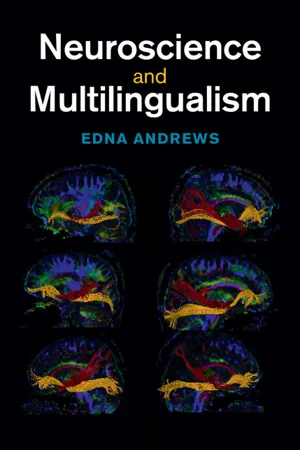 eBook - PDF
- Edna Andrews(Author)
- 2014(Publication Date)
- Cambridge University Press(Publisher)
Many members of the linguistic community were resistant to such a generalization about potential biological constraints on language acquisition (cf. Danesi for an excellent summary of the problem [2003: 43–44]; also see Scovel 1988 and Birdsong 2006). We will return to Birdsong’s contribution in Chapter 4. 42 Building the basis It is also an empirical fact that language acquisition is not something that occurs only in the first few years of life, but is a process that accompanies language maintenance and loss throughout the life cycle. There is no question that robust vocabulary building is a result of education and reading over a significant period of years and is not restricted to pre-puberty; nor does it end with formal study in an institution of higher learning. One of the most salient properties of human language is its dynamic nature, and speakers are con- stantly learning new forms at a variety of hierarchical levels, including phonological, morphological/grammatical, lexical, discourse, and pragmatic levels, as well as renegotiating those forms that are “maintained” as relevant and statistically significant representations of the speech acts that are articu- lated thousands of time per day. A note on deconstructing hypotheses of innateness in language As I have already introduced in Chapter 1 and touched on briefly above, the question of what is potentially innate about human language is an issue that continues to be debated in the cognitive neurosciences. I believe it is worth a moment to reconsider one particular philosopher’s discussion of this issue, namely that of Hilary Putnam. eBook - PDF
Process linguistics
Exploring the processual aspects of language and language use, and the methods of their description
- Thomas T. Ballmer, Wolfgang Wildgen, Thomas T. Ballmer, Wolfgang Wildgen(Authors)
- 2017(Publication Date)
- De Gruyter Mouton(Publisher)
186 LANGUAGE ACQUISITION IN AN INTERACTIVE; SEMANTIC-COGNITIVE, AND NEUROLINGUISTIC PERSPECTIVE* Ton van der Geest Ruhr-Universität Bochum Abstract Two conflicting theories with respect to the processes underlying the acquisition of language (viz. the language acquisition theory (L.A.) relying on the 'innateness hypothesis' and a language learning theory (LL) relying on general learning and mother-child interaction principles) will be discussed on the basis of recent literature and linguistic, psycholinguistic, and neurolinguistic evidence. It will be argued that there is a great deal of evidence supporting the latter (LL) theory at least insofar as the earlier stages of language acquisition are concerned. Finally after having concentrated upon the fact that language develops in the child almost unnoticed we will discuss some implications for both language acquisition research and language education. I. Two conflicting theories of language acquisition Literature focusses during the last two decades mainly upon two conflicting theories with respect to the underlying processes of language development. The first theory - which I will call language acquisition (LA) - is based upon Chomsky's innateness hypothesis. It emphasizes that the child creates his own linguistic rules rather than deducing them directly from the primary linguistic data the child is confronted with. In this theory the argument that in children's speech peculiarities occur that cannot be traced back to the adult system plays a crucial role. See e.g. * A revised and enlarged version of my Language acquisition as a hidden curriculum; in: Communication and Cognition, 1974 (7), 169-190. 187 Menyuk (1969), McNeill (1970), Gruber (1967), Wode (1978), and Felix (1978). The other theory - language learning (LL) - is based on the view that the primary data are sufficiently richly structured that the child is able to deduce the linguistic system from these data.
- Julia Herschensohn, Martha Young-Scholten(Authors)
- 2013(Publication Date)
- Cambridge University Press(Publisher)
In 1570 a text by the human- ist Benedetto Varchi (1503–65) took a different stance. Like Dante, Varchi 30 MARGARET THOMAS distinguished native from non-native languages and attributed “natural- ness” to the former. But Varchi viewed them as essentially commensurate outside the context of acquisition: non-native languages are “those which one does not speak naturally, but which one learns with time, effort, or from those who teach the languages, or who speak them, or from books” (Varchi 1804 [1570]: 211). In other words, for Varchi (unlike for Dante) non-natively acquired languages are not different in kind from natively acquired ones, only different with respect to a given learner’s experience. What is a native language to one speaker could be a non-native language to another speaker and vice versa. This was a significant intellectual achievement in the history of conceptualization of L2 acquisition. 2.2.2 Role of L1 in twentieth-century structuralism The gap between Quintilian’s assumptions about Greek/Latin bilingualism and the essentially equal footing on which Varchi placed native versus non- native languages stretches across fifteen centuries of changing social, intel- lectual and linguistic circumstances. Scholars continued to explore differing epistemological bases for natively versus non-natively acquired languages. Moving forward abruptly to the middle of the twentieth century, study of lan- guage in the United States had by then claimed membership in the company of the sciences, in large part due to the initiative of American structuralist Leonard Bloomfield (1887–1949). Bloomfield worked in an era when Saus- surean synchronic study of language was taking a seat next to diachronic study of language, that is, next to the historical-comparative linguistics that dominated nineteenth-century European language scholarship.
Index pages curate the most relevant extracts from our library of academic textbooks. They’ve been created using an in-house natural language model (NLM), each adding context and meaning to key research topics.

