Languages & Linguistics

Chomsky
Chomsky is a prominent linguist known for his influential theories on language acquisition and generative grammar. He proposed the idea of a universal grammar that underlies all human languages, suggesting that humans are born with an innate ability to understand and produce language. Chomsky's work has had a significant impact on the field of linguistics and cognitive science.
Written by Perlego with AI-assistance
Related key terms
1 of 5

12 Key excerpts on "Chomsky"
 eBook - PDF
English Linguistics
A Coursebook for Students of English
- Thomas Herbst(Author)
- 2010(Publication Date)
- De Gruyter Mouton(Publisher)
13 Theories of grammar and language acquisition 13.1 Chomsky’s approach 13.1.1 Basic assumptions A radically different approach towards the description of syntactic struc-tures is taken by Noam Chomsky, whose ideas can no doubt be said to have dominated much of the linguistic and particularly syntactic research in the second half of the twentieth century all over the world. It is probably fair to say that for many researchers in the field his theories presented not only a new and in many ways interesting way of looking at language, but the only conceivable framework for linguistic analysis. From a slightly more cau-tious perspective, this phenomenon is difficult to explain. The enormous appeal of Chomsky’s theories may have a number of reasons, such as -the high degree of formalization characteristic of his theories, -the precise formulation of the aims of linguistic theory connected with a clearly defined view of language, -his interest in language universals, i.e. properties that are common to all languages, -certain psychological implications of his theories. For instance, the crucial distinctions introduced by Chomsky between com-petence and performance (> 3.1.2) and his own concentration on compe-tence as the object of research have resulted in a view of language and sen-tence analysis that to a very large extent abstracts from (and thus ignores) sociolinguistic and situational factors. This becomes particularly apparent in Chomsky’s (1965: 3) notion of the ideal speaker/hearer, which forms the basis of his theory: Linguistic theory is concerned primarily with an ideal speaker-listener, in a completely homogeneous speech community, who knows its language per-fectly and is unaffected by such grammatically irrelevant conditions as memory limitations, distractions, shifts of attention and interest, and errors 13 Theories of grammar and language acquisition 201 (random or characteristic) in applying his knowledge of the language in ac-tual performance. eBook - PDF
Thinking About Language
Theories of English
- Siobhan Chapman(Author)
- 2017(Publication Date)
- Red Globe Press(Publisher)
But many other linguists have been equally convinced that his ideas about language are mistaken and that the conclusions he has drawn from them are erroneous. In fact a substantial proportion of Chomsky’s influence within linguistics has come about from linguists reacting against his understanding of what language is. We will con-sider to some of these reactions in the next section. In particular we will discuss the ideas of thinkers who have taken issue with Chomsky’s dismissal of performance as relatively unimportant, and have argued that communica-tion is an essential, in fact the defining, property of language. One area of linguistics where Chomsky’s influence has been particularly significant, in terms of both positive support for and reaction against, is the field of language acquisition. While Chomsky has not engaged in the study of children’s language, or of the processes of language learning, his ideas about the nature of language in general, and specifically his innateness LANGUAGE IS . . . 53 hypotheses, have some very significant implications for the processes that children go through when they learn a first language. We will therefore be returning to Chomsky’s work again in Chapter 9 when we consider the ques-tion of how children learn language. ❙ 2.3 Language is communication The idea that language should be explained in relation to communication has been around for a long time. This is hardly surprising; there is a strong common-sense appeal to this approach. We are probably most aware of lan-guage when we are sharing our thoughts with other people, or interpreting what they are saying to us. Our experience of language is so strongly linked to the ways in which we communicate with each other using language that it may not seem to make much sense to talk about one without the other.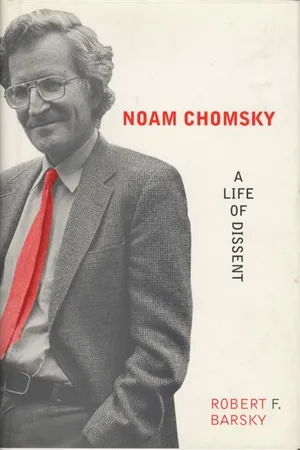 eBook - PDF
Noam Chomsky
A Life of Dissent
- (Author)
- 1996(Publication Date)
- Ecw Press Digital(Publisher)
Linguistic research has since been deemed a scientific area of study, and has been enriched by new insights into the nature of speech and language. But this innovation 3 96 Chapters owes a great deal to Chomsky, who had the courage to reconceive the implications of what he had learned in the academy. The details of Chomsky's early contribution to the field are complex, and have caused much confusion among historians (especially linguistic historians), particularly when it comes to the relationship between his early work and other work undertaken in the field. This confusion may be somewhat alleviated if we consider that except for Systems of Syntactic Analysis, his 1953 article on procedural-constructional approaches that appeared in the Journal of Symbolic Logic, virtually all of Chomsky's work is a rejection of the Bloomfield-Harris school, particularly in terms of his emphasis on the generativity of human language and the tenet that any theory of grammar must account for the speaker's ability to under-stand sentences that he or she hears for the first time. This is not to suggest that there is in Chomsky's work an emphasis on the often-mentioned distinction between grammatical and ungrammatical sentences; in fact, as Chomsky points out, in Logical Structure and Syntactic Structures there is no such bifurcation: there are just varying degrees of gramma-ticalness. Every expression falls among them somewhere and there is no special two-way split (27 June 1995). In the area of discovery pro-cedures, another frequently discussed issue is that a linguistic theory should not be identified with a manual of useful procedures, nor should it be expected to provide mechanical procedures for the discovery of gram-mars (Syntactic Structures 55n6). eBook - PDF
Language Learning and Cognition
The Basics of Cognitive Language Pedagogy. With Contributions by Kees de Bot, Marina Foschi, Marianne Hepp, Sabine De Knop and Parvaneh Sohrabi
- Jorg Roche, Ferran Suñer(Authors)
- 2023(Publication Date)
- LIT Verlag(Publisher)
With compe- tence and the existence of universal grammar, the individual is also able to use the language system, for which Chomsky used the term performance. This is more or less equivalent to de Saussure’s concept of parole, although it only plays a secondary role in transformational grammar (Smir- nova/Mortelmans 2010: 11). However, in Chomsky’s theory, the social di- mension and the communicative function of language and language acqui- sition were being completely ignored (cf. Geeraerts/Cuyckens 2007: 11). For example, Chomsky interprets grammar as a rather abstract set of rules that can be established by transformations (replacement and conversion rules) (also cf. Klenk 2003: 71). The respective underlying transformations should enable the transition from a deep structure into a syntactic surface structure or concrete utterances (cf. Klenk 2003: 74). Accordingly, gram- mar is formally operational and forms a coherent set of rules. Individuals can only modify it to a very small extent, and it can function relatively independently from meaning and general cognition. From this perspective, language is determined by a universal grammar and is quite rigid: it cannot be easily manipulated by non-linguistic cognition. It was not until the end of the 1980s that cognitive linguistics led to a par- adigm shift from a mainly syntax-oriented language description to a mean- ing-oriented one. Langacker (2008a: 8), one of the most important repre- sentatives of cognitive linguistics, claims “[i]f generative linguistics views 24 syntax as being central to language, Cognitive Linguistics accords this honor to meaning”. Cognitive linguistics consequently emphasizes the symbolic function of language, whose parts or symbols are described as pairs consisting of (phonological) form and meaning. eBook - PDF
The Extended Mind
The Emergence of Language, the Human Mind, and Culture
- Robert K. Logan(Author)
- 2017(Publication Date)
- University of Toronto Press(Publisher)
We also explore the duality implicit in the notion that the brain and the human mind are distinct phenomena. But before embarking on these comparisons and syntheses, we will pause and consider the work of Noam Chomsky, who dominated the field of linguistics in the latter half of the twentieth century. 5 How Universal Is Universal Grammar? Chomsky’s Generative Grammar Even though Chomsky is a sceptic when it comes to trying to under-stand the origin of language in evolutionary terms, his work must be evaluated because of his dominance of the field of linguistics for the past half century. One cannot ignore his contribution when comparing different explanations of the origin of language, especially as the field divides rather neatly into Chomsky supporters and Chomsky detractors. Many members of the anti-Chomsky camp do not attempt to discredit the main thrust of Chomsky’s work in describing the Universal Grammar (UG), but rather they are critical of some of his more extreme positions vis-à-vis the ontogeny and phylogeny of language. Perhaps the most con-tentious of all of these is his notion that the brain is hard-wired with a Language Acquisition Device (LAD), which is Chomsky’s explanation of why children are able to learn languages with such ease. The hard-wiring of the LAD in the human brain also explains why all the lan-guages of the world share the Universal Grammar (UG). While there is general agreement that the languages of the world share many similari-ties, not all linguists accept Chomsky’s explanation of this regularity, and there is some debate as to just how universal UG is given his claim that it is hard-wired into the brain. It is instructive to examine the roots of Chomsky’s UG hypothesis and compare it with Newton’s ‘UG’ hypothesis of universal gravity. eBook - PDF
On Being a Language Teacher
A Personal and Practical Guide to Success
- Norma López-Burton, Denise Minor(Authors)
- 2014(Publication Date)
- Yale University Press(Publisher)
(Please refer to the bibliography for more reading you can do about other researchers and other areas.) Instead, I will concentrate only upon what I be-lieve to be the essential theories that hook together like the links of a chain: Universal Grammar, the mind’s Language Acquisition Device (LAD); Acquisi-tion vs. Learning; Input + 1; Whole Language; Output; interaction and com-munication; investment in the second language (L2); and motivation. I will also touch on research focused on the role of grammar instruction in the second language classroom. H I S T O R Y O F S E C O N D L A N G U A G E A C Q U I S I T I O N 9 9 NOAM Chomsky, UNIVERSAL GRAMMAR, AND LAD Noam Chomsky is a true Renaissance man. He is a linguist, a philosopher, a cognitive scientist, a historian, and an activist; moreover, he is highly re-spected in all these fields. Chomsky was born in Philadelphia in 1928 to a Hebrew linguistics professor father and a radical activist mother from Belo-russia. Although Chomsky’s majors at the University of Pennsylvania were linguistics and philosophy, he was very influenced by brilliant mathemati-cians there who were using mathematical theories to understand linguistic structure (Fox 2007). Chomsky completed his PhD in linguistics in 1955 and then moved to Harvard for post-doctoral work. It was there in 1957 that he published a slim volume, Syntactic Structures , that would come to be considered a turning point for modern linguistics. What the young Chomsky began to see that the white-haired scholars around him failed to recognize was the incredible similarity among all human languages. Until that point, these similarities had mainly been attributed to the fact that all languages were members of “families” and had evolved from a common ancestor of those families. It makes perfect sense that, for instance, in both French and Italian indirect and direct object pronouns are usually placed before verbs because that is the way it was done in Latin. eBook - PDF
Process linguistics
Exploring the processual aspects of language and language use, and the methods of their description
- Thomas T. Ballmer, Wolfgang Wildgen, Thomas T. Ballmer, Wolfgang Wildgen(Authors)
- 2017(Publication Date)
- De Gruyter Mouton(Publisher)
IV. Language acquisition and cognition The actual problem we are concerned with when we confront Chomsky's language acquisition theory with cognitive psychology is that in a way the child mastering his language can be compared according to his theory with a linguist writing a grammar of that language (see also McNeill 1966). Although Chomsky formulates it carefully by saying that his discussion of the topic does not refer to conscious formulation and expression of these (rules, hypotheses, etc.) but rather to the process of arriving at an internal re-presentation of a generative system which can be appropriately described in these terms (Chomsky, 1965, p. 46), the present comparison has been taken too literally many times in actual research. Chomsky's above quoted remark, however, is vague in the sense that it either emphasizes that the linguist's and the child's activity differs in terms of resp. conscious and uncon-scious or it states that the processes of arriving at an internal representation of a generative system can be described both for the child and the adult in the same terms. It is clear that a linguistic theory is only explanatorily valid if the processes as meant by Chomsky are appropriately described, that is to say are also cognitively validly described. The very 206 question now is whether one can maintain that the processes - whether conscious or unconscious - of the child's language learning are identical to those of an adult and professional linguist describing a language or in other words that the child's discovery procedures are identical to those underlying the lingu-ist's professional and systematic linguistic intuitions. If not, then Chomsky's linguistic theory is only psychologically valid inasfar as it describes correctly the ultimate products of different kinds of psychological operations. eBook - PDF
Children's Language: Revised Edition
Consensus and Controversy
- Ray Cattell(Author)
- 2007(Publication Date)
- Continuum(Publisher)
A close look at Chomsky's theories 83 environment leads to the baby soon beginning to act as if (s)he knew something of the grammar of the language. The child goes through a number of mental states as (s)he acquires more and more of the language. Eventually, after a few years, (s)he arrives at a 'steady state', when (s)he has adult-like competence in the language. After that, there'll be no more major developments, though each individual will go on learning some vocabulary and perhaps occasional new sentence structures throughout life. Notice how this view of language learning contrasts with Skinner's view, described in Chapter 3. Skinner thought that the important things all happened externally to the child. It was what the mother and other people did that caused the child to learn language, and there was virtually no contribution from the child itself. Nothing was assumed to go on in the child's head - or at least nothing that could be described scientifically. By contrast, Chomsky believes the most important part of language acquisition is what goes on in the mind, and he's committed to trying to deduce what it's like. He's devised some ingenious methods of doing so. A key question for Chomsky is what kind of 'knowledge' about language doesn't have to be learnt by the child, because it's already there at birth. You might think that this would be an impossible question to answer, but Chomsky has found ways of making progress with it. His main tool for probing the mind is grammar. Before we can get down to describing how he uses it, we need to make clear what sort of grammar we're talking about. The next few sections will be devoted to that matter. 6.2 SOCIALLY BASED VIEWS ON GRAMMAR Since the term 'grammar' here means something rather different from what most people might understand by it, I'll take a little space to make clear what the difference is. In the past, grammar, especially in schools, was often concerned with questions of correct usage. eBook - PDF
Kanzi's Primal Language
The Cultural Initiation of Primates into Language
- P. Segerdahl, W. Fields, S. Savage-Rumbaugh(Authors)
- 2005(Publication Date)
- Palgrave Macmillan(Publisher)
Early in his career (Chomsky 1959) he argued against B. F. Skinner that the first level was not the proper level at which to define and study language, and ascended towards the second level, that of the more perfect order of the grammar of specific languages, with English as a standard example. But he soon began to emphasize the third level of universal grammar, what all languages have in common, and today virtually all his work is done at this most idealized level of linguistic generality and unity. Experience may play subordinate roles in Chomsky's development of theories, but there is no lack of purely intellectual forces governing his thinking, for he has strong demands on the architectonic of a satisfactory theory, and these demands constitute the dynamics of his thinking. Chomsky's ascending movement towards more uniform and potent levels of generality, within a basically grammatical outlook, makes it easy to translate his critique of behaviourism into the language of Plato's simile of the cave. In this translation, people like B. F. Skinner, and perhaps W. V. 0. Quine, are fettered in the dusky underground cave, with their backs to the cave's sloping entrance. Their tragic mistake is that they take the disorderly shadow pictures on the wall before them for reality. They lack a sense of an order of ascendancy of all things real, where what is more general and ideal (from an intellectual point of view) is also more real and potent. But there is no fire, sun or other What Does It Mean to Study Language? 169 source of light in Chomsky's modern version of Platonism. Instead of the sun, Chomsky speaks scientifically of the initial state S0 of the human language faculty, which is the hidden causal source of all frag- mentary order discernible at the shadowy level of linguistic perfor- mance. Only linguistic theory that connects the grammar of a natural language to this ultimate source of linguistic order is explanatory ade- quate (Chomsky 1965: 18-27; 2000: 7-8). eBook - PDF
Language and Creativity
An Interdisciplinary Essay in Chomskyan Humanism
- Bernard D. den Ouden(Author)
- 2019(Publication Date)
- De Gruyter Mouton(Publisher)
19 John Searle, Chomsky's Revolution in Linguistics, The New York Review of Books, A Special Supplement XXVIII, No. 12 (June 29, 1971). 20 Ibid., 16. CREATIVE LANGUAGE USE 53 the study of man should attempt to discover and discern the hidden and underlying laws or structures that are the source of human being and human creativity. To only delineate observable causes is to limit the study of man to factors of external determination and to preclude the possibility of discovering that man is other than a determined being. Chomsky argues that the 'creative aspect of language use' implies that man is a being whose nature is not exhausted in and through external determinations. Thus, methodically the study of man should focus on the elucidating and understanding of the underlying laws and structures of human being and selfhood. The underlying laws, since they are universal, are an indi-cation of the nature of man. Superficially, various men and languages appear to be different; but behind and below the surface structure and visible phenomena, there is a universal capacity that is essentially related to human nature. In this position, Chomsky is opposing the emphasis upon cultural relativity and the corresponding linguistic relativity that is so important to much of the discussions in linguistics and anthropology of this century. The Port Royal grammarians, who Chomsky cites as his predecessors, argued that there was a universal rational essence to man. In many linguistic studies of this century, relativity was strongly emphasized. Bloomfield, for example, sought to direct linguistics into a rigorous scientific discipline. This could be accomplished, he contended, by the careful description of particular languages. 21 The important factor in linguistic inquiry was the discovery of the unique grammar and system of each individual language. In a parallel manner, Benjamin Lee Whorf argued that different language groups implied different concepts and theories of man. eBook - PDF
- Peter Jordens, Josine Lalleman, Peter Jordens, Josine Lalleman(Authors)
- 2010(Publication Date)
- De Gruyter Mouton(Publisher)
Are there principles of universal grammar that do not apply to second language acquisition? Paul van Buren 1. Introduction I thought it might be interesting for budding language researchers to be taken through a detailed theoretical argument in second language research. This might show something of the way we struggle in this field. But before I get that far I shall have to do some groundwork on metatheory. I apologize if some of this should turn out to be redundant, but I think it is better for my present purpose to err on the side of overexplicitness. Ever since Chomsky introduced his linguistic metatheory to the world the main problem in the study of language acquisition has been: How can human beings acquire a language on the basis of data that are incomplete, defective and utterly opaque in relation to the abstract principles that characterize them? This epistemological problem has become known in the trade as 'the logical problem of language acquisition'. The problem is also called Plato's problem, since Plato was the first to ask the relevant question, namely, how is it that human beings can know so much on the basis of so little overt evidence? Part of the solution to Plato's problem was proposed by Chomsky as a body of innate constraining principles called Universal Grammar. It is important here to stress three things about Universal Grammar. 188 Paul van Buren First, Universal Grammar is not actually a grammar at all or even a set of possible grammars. Rather, it is a set of conditions that possible grammars must obey, a sort of abstract blueprint for the construction of grammars in other words. Secondly, Universal Grammar allows for variation between languages. Comparing it with biology we might say that UG is the genotype blueprint from which a wide variety of actual phenotypes or core grammars may be constructed. This variety is of course not the same as a free for all. Rather, the degree of variation is controlled by a set of possible parameters. eBook - PDF
Cognitive Linguistics in the Redwoods
The Expansion of a New Paradigm in Linguistics
- Eugene H. Casad(Author)
- 2011(Publication Date)
- De Gruyter Mouton(Publisher)
In fact, each individual employs a number of linguistic systems in speaking. How can one describe such an amalgam? (Chomsky 1979: 54). 118 DoritRavid I adopt a different position here, one that runs counter to both the synchronic/diachronic dichotomy and the homogeneous speech com-munity hypothesis. A basic assumption of this work is that a linguistic change has its source in the synchronic variation in the speech com-munity (Weinreich, Labov & Herzog 1968). Language, while certainly an inherently human faculty endowed equally upon all human beings, is essentially diverse in nature: Each language community displays dialects, sociolects, registers, child language, the language of adolescents and that of adults, educated and uneducated speech, spo-ken and written codes, formal and colloquial as well as ethnic variants. This variation reflects ongoing processes of change constantly being initiated, promulgated and completed in the various groups that make up the speech community (Bailey 1973; Blount & Sanches 1977; Labov 1972; 1980, 1981; Ravid 1988). In Vygotskiyan terms, language is inherently fluid in four basic dimensions. In evolutionary terms, language developed in Homo Sapiens Sapiens. On a smaller scale, each language undergoes change during its historical development. From a third point of view, lan-guage undergoes change in every child as she develops and acquires her mother tongue. Finally, language undergoes change as we speak, during on-line conversation. Thus the study of historical language change is intrinsically related to a number of fundamental queries. Its first business is with the na-ture of the relationship between language and cognition: the brain uses the same machinery to represent language that it uses to represent any other entity, yet language arose as a secondary representational sys-tem, representing a primary representational level of symbols and concepts (Bickerton 1990).
Index pages curate the most relevant extracts from our library of academic textbooks. They’ve been created using an in-house natural language model (NLM), each adding context and meaning to key research topics.

