Languages & Linguistics

Michael Halliday
Michael Halliday was a prominent linguist known for his work in systemic functional linguistics. He developed a theory of language known as systemic functional grammar, which emphasizes the functional aspects of language and how it is used to express meaning in different social contexts. Halliday's work has had a significant impact on the fields of linguistics, education, and language studies.
Written by Perlego with AI-assistance
Related key terms
1 of 5

8 Key excerpts on "Michael Halliday"
- Michael Byram, Adelheid Hu(Authors)
- 2013(Publication Date)
- Routledge(Publisher)
H
DOI: 10.4324/9780203101513-13Halliday, Michael Alexander Kirkwood
b. 1925, Leeds, UKThe founder of systemic-functional linguistics, Michael Halliday pioneered the analysis of language in its social context. He convincingly re-estabilished the centrality of meaning in understanding how language functions after the domination of linguistic research by Chomsky's generative grammar model.After studying Chinese language and literature at London University, he studied linguistics in China and completed his doctorate at Cambridge University. He taught at Universities in the UK and the USA before being appointed foundation Professor of Linguistics at Sydney University, Australia, (1973–87). His huge publication output of over 170 books and articles and his many keynote addresses at conferences of linguists and language teachers brought him acclaim as a leading international scholar in the linguistic sciences.Halliday's broad range of research interests is foreshadowed in the topics of his first three articles: ‘Grammatical categories in Modern Chinese’ (1956); ‘The linguistic basis of a mechanical thesaurus’ (1956); ‘Some aspects of systematic description and comparison in grammatical analysis’ (1957). The Chinese language was to inspire numerous articles including ‘Analysis of scientific texts in English and Chinese’ (1993). The ‘mechanical thesaurus’ topic evolved into machine translation and the principles of translation in ‘Towards a theory of good translation’ (1998). The analysis of language from a socio-cultural perspective produced his systemic-functional model. Other significant publication topics revealing the breadth of his expertise were to be intonation in English, child language development, the linguistic study of literary texts, scientific English, and the construction of knowledge founded on language as a system for making meaning.Systemic-functional linguistics is derived from the work of Malinowski, Firth (Halliday's teacher), Hjelmslev and Whorf. For Halliday, language is not only part eBook - PDF
Transitivity-Based Foregrounding in the Acts of the Apostles
A Functional-Grammatical Approach to the Lukan Perspective
- Gustavo Martín Asensio(Author)
- 2000(Publication Date)
- Sheffield Academic Press(Publisher)
185; see also pp. 36-40 in the same volume. 1. Hallidayan Functional Grammar 35 merely 'programmatic'. 53 Standing firmly in the tradition of his two predecessors of the London school, Halliday set out to investigate and expound 'the functional basis of language'. The indebtedness of Michael Halliday to John Firth, his teacher at University College, London, is readily admitted by Halliday, and becomes particularly evi-dent in statements such as the following: Text is meaning and meaning is choice, an ongoing current of selections each in its paradigmatic environment of what might have been meant (but was not)'. 54 For Halli-day, language is the primary attribute of social man ('homo grammati-cus'), and the behavioral potential of a society (i.e. what it 'can do'), is primarily realized by its linguistic potential ('can mean', socio-seman-tics), which is itself realized in the lexico-grammar ('can say'). 55 Lan-guage, then, is fundamentally functional, indeed, it is man's most effective means of 'doing'. This functional nature of language has in large measure—argues Halliday—determined its current form, and is reflected in its three major functional components or 'macro-functions': the ideational, the interpersonal and the textual. 56 Halliday's chief hypo-thesis in regard to these 'macro-functions' is that each tends to be deter-mined and constrained by one element of the context of situation. 57 Thus, the 'field' (i.e. 'what is going on', for example a game of poker) tends to constrain the choices arising from the ideational macro-func-tion. The element of 'tenor' (i.e. the participants), similarly, tends to constrain the interpersonal choices, while the 'mode' (the function of language in the situation, e.g., to warn) constrains the textual choices. 58 53. Butler, Systemic Linguistics, p. 3. 54. Halliday, Social Semiotic, p. 137. 55. See Halliday, 'Language in a Social Perspective', in idem, Explorations, pp. eBook - ePub
Linguistic Theory
The Discourse of Fundamental Works
- Robert-Alain De Beaugrande, Robert De Beaugrande(Authors)
- 2014(Publication Date)
- Routledge(Publisher)
Chapter 9 M.A.K. Halliday 1 9.1 Michael Alexander Kirkwood Halliday was a pupil of Firth's, and, with greater elaboration, has pursued similar precepts, above all that ‘linguistics’ should ‘deal with meaning’ ‘at all levels of analysis’ and should study ‘texts’ ‘in contexts of situation’ (cf. 8.46f vs. 9.8, 22f, 38, 49, 107). Halliday finds ‘the question “what is language?”’ unduly ‘diffuse’ and ‘disingenuous’, because ‘no one account of language will be appropriate for all purposes’ (IF xxix; EF 9) (cf. 12.22). ‘A theory being a means of action’, we must consider what ‘action’ we ‘want to take’ ‘involving’ ‘language’, so we know what is ‘relevant’ and ‘interesting’ for ‘the investigation or the task at hand’ – ‘the nature and functions of language’, its ‘formal properties’, its ‘role’ ‘in the community and the individual’, its ‘relation’ to ‘culture’, and so on (EF 9; IF xixf) (cf. 9.111 ; 10.6 ; 12.58). We may inquire ‘what all languages have in common’ or how they ‘differ’, and how they ‘vary according to user’ and ‘function’ or ‘evolve through time’; or ‘how a child develops language, and how language may have evolved in human species’. Or, we may explore ‘the quality of texts’ such as ‘written and spoken’ or ‘literary and poetic’ (IF xxx). Or, we may seek ways to ‘help’ people ‘learning their mother tongue’ or a ‘foreign language’, or ‘training translators and interpreters’, or composing ‘reference works (dictionaries, grammars)’ or ‘computer software’ to ‘produce and understand’ ‘text’ and ‘speech’ eBook - PDF
Discussing Language
Dialogues with Wallace L. Chafe, Noam Chomsky, Algirdas J. Greimas, M. A. K. Halliday, Peter Hartmann, George Lakoff, Sydney M. Lamb, André Martinet, James McCawley, Sebastian K. Saumjan, Jacques Bouveresse
- Herman Parret(Author)
- 2017(Publication Date)
- De Gruyter Mouton(Publisher)
M. A. K. HALLIDAY Michael Halliday, you are one of the most representative linguists of what one might call the trend of sociolinguistics. You use terms like sociogrammar and sociosemantics; does that imply a very particular view on the scope of linguistics ? - I would really prefer to leave out the 'socio', if I had the choice. But we probably have to talk about 'sociolinguistics' these days, because of the shift in the meaning of 'linguistics'. When I was a student, with J. R. Firth, linguistics was the study of language in society; it was assumed that one took into account social factors, so linguists never found it necessary to talk about sociolinguistics. But during the last ten or fifteen years the pendulum has swung in the opposite direction, away from the social context towards the study of language from what I would call an 'intra-organism' point of view, or language as knowledge if you like; so that anyone who is concerned with the other, 'inter-organism' aspect of language, with how people talk to each other, has to prefix 'socio' to what he is doing. Hence you have sociolinguis-tics; and hence, also, 'sociosemantics' or 'sociogrammar'. Let me put it this way: these two perspectives - on the one hand the intra-organism perspective, language as what goes on inside the head (language as knowledge), and on the other hand the inter-organism perspective, language as what goes on between people (language as interaction, or simply as behavior) - are complementary and not contradictory. There tend to be fashions in linguistics, as in many other things. I started in a tradition where the perspective was mainly of the inter-organism kind. Then the pendulum swung the other way, largely through the influence of Chomsky who emphasized the philosophical and psychological links of the subject.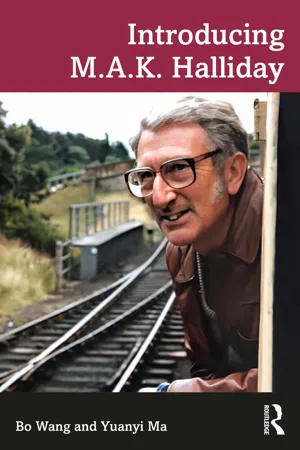 eBook - ePub
- Bo Wang, Yuanyi Ma(Authors)
- 2022(Publication Date)
- Routledge(Publisher)
Phun with Fonology and Games with Grammar (Halliday & Matthiessen in prep. c) that illustrates how people play with language.For Matthiessen, Halliday was “a linguist who had an extraordinarily deep insight into language, and whose work was in the first instance about language, not about linguistics” (Matthiessen et al. 2022: Chapter 1 ). What Halliday did was to try to achieve a rich and comprehensive understanding of language, rather than to solve jigsaw puzzles designed according to linguistic theories, like various other linguists did, as Matthiessen (Matthiessen et al. 2022: Chapter 3 ) comments on his impression of the lectures given by Halliday:I was struck that this was the first time I met somebody who was interested in language in the first instance rather than in linguistics. He was somebody who seemed to have a hotline to language, who really had a sense of what language was all about. His theories were not about games in linguistics, but a holistic theory of language in context designed to support the development of comprehensive descriptions of particular languages. That was quite mesmerizing.Influenced by Halliday’s (e.g. 1978) notion of social accountability, Matthiessen explored various areas and ideas and accepted various invitations to contribute to book chapters. He described himself as a linguistic plumber who would move in wherever there was a leak. Some of such topics he worked on include translation (The project of “the environments of translation” was started after being invited by Erich Steiner and Colin Yallop [2001] to present at a symposium in 1998, e.g. Matthiessen [e.g. 2001, 2014a, 2021a].), multimodality (e.g. Matthiessen [2007a], which was invited by Terry Royce and Wendy Bowcher to contribute a book chapter), morphology (e.g. Matthiessen [2015a], which was written for a book published in Latin America) and phonology (e.g. Matthiessen [2021b], written especially for the first volume of his Collected Works eBook - ePub
Language Learning
A Lifelong Process
- Joseph Foley, Linda Thompson(Authors)
- 2017(Publication Date)
- Routledge(Publisher)
Chapter 3 . These features provide the background for SFL descriptions of language use and development. Halliday built on these ideas in specific and important ways.4.2 The Hallidayan description of language as socio-semioticThe Malinowskian-Firthian tradition establishes the study of language as social interaction and communication within heterogeneous speech communities. Continuing in this tradition Halliday (1973,1975), proposed discourse as semantic choice in social contexts. His view of language extends beyond an individual’s language production, to a description of language as social fact (Halliday, 1977). In 1978 Halliday proposed the formulation of language as socio-semiotic. Rooted in the linguistics of Malinowski and Firth, language as socio-semiotic presents language as functioning as an expression of and metaphor for, the social processes which it creates and the social contexts in which it occurs. Inherent in the socio-semiotic approach to language description is the notion of language as a dynamic process. Hence, a whole range of modes of meaning are possible (from the concrete to the creative) because language not only facilitates everyday social encounters and supports social action, but it actually creates those contexts.A socio-semiotic description accounts for the fact that people talk to each other and that language is not sentences but is connected utterances between interlocutors known as discourse. That is naturally occurring and interactive. It allows for an exchange of meaning in interpersonal contexts and between contacts. The contexts where meanings are exchanged cannot therefore be devoid of social or personal values. Contexts cannot be value free. Language cannot be context free. Therefore, language cannot be value free. The context of speech becomes a semiotic structure, taking its form from the culture (or sub-culture) in which it occurs, embracing its mores, traditions and values. This form enables the participants to predict prevailing features of the register. Each society and its sub groups, has its own underlying rules, which govern acts of communication within its speech community. These rules, for appropriate linguistic behaviour, are learnt. Learning a new language is learning how to behave linguistically in a new culture. Learning a first (or subsequent) language requires understanding how everyday social encounters are organized linguistically within that speech community. Thus, individuals who have successfully learnt the rules are able to present themselves as bona fide eBook - ePub
- Jonathan J. Webster(Author)
- 2015(Publication Date)
- Bloomsbury Academic(Publisher)
A large number of the members of this group primarily concentrated on prosodic phonology. Those who discussed other aspects of his ‘philosophy of language’ include, among others, Mitchell and Halliday. Palmer (1968: 9), however, takes the position that Halliday (and other neo-Firthians) ‘have little in common with Firth’s approach’. In Palmer’s view, Halliday’s ‘essentially monosysternic categorization’ seems to have little in common with Firth’s ‘essentially polysysternic’ approach; and secondly, ‘Halliday’s theory retains the phoneme’ which ‘typifies the kind of segmentation and classification that Firth rejected’ (1968: 9). In fact, Palmer goes a step further and warns us against equating Halliday’s theory with that of Firth on the basis of the shared terminology: ‘Of course the terminology [of Halliday] is largely Firth’s, but Firth was particularly aware of the danger of equating terms in what were essentially different theories.’ Halliday does not agree with this evaluation of Palmer (see Halliday, 1971: 664–7).Is there then a neo-Firthian school, and in what sense is Halliday a chief representative of such a school? Kress (1976: xv) claims that ‘Halliday’s theory depends more strongly on Malinowski and Whorf, the label neo-Firthian which has been applied to him obscures the main thrust of Halliday’s thinking about language’.What then is Firth’s importance for and influence on Halliday? Kress (1976: xiv) believes that Firth’s importance lies ‘in the attempt which Firth made to provide the linguistic component to go with the sociolinguistic insights of Malinowski’. He specifically mentions two categories (Kress, 1976: xiv):(1) Context of situation , that is, a view of language as closely dependent on stateable general types of situation which influence language. From here Firth developed his theory of the multiplicity of ‘languages’ within the total language. This is an important insight which Halliday took over and developed in his work on register .(2) System , which in redefined form has become the major formal category in Halliday’s theory.These are not the only influences: for instance, Halliday uses Firth’s category of collocation in his work on lexis . . . but they are the significant ones. eBook - PDF
On Language and Linguistics
Volume 3
- M.A.K. Halliday, Jonathan J. Webster(Authors)
- 2003(Publication Date)
- Continuum(Publisher)
LINGUISTICS AND LANGUAGE PART Two This page intentionally left blank EDITOR'S INTRODUCTION At the outset of A brief sketch of systemic grammar, which first appeared in La Grammatica; La Lessicologia (1969), Professor Halliday makes clear that the fundamental concept in the grammar is 'system' -the system that formalizes the notion of choice in language. In Systemic background, published in the proceedings of the Ninth Systemic Workshop (1985), Halliday writes, the description of language is a description of choice. System networks — the grammar — specify the possible combinations of choices, which are subsequently 'realized' as structures. There are different types of structure, expressing different kinds of meaning: the experiential metafunction represented by constituency; interpersonal meaning by field-like structures; and texture by the periodic, wave-like pattern of discourse. In Systemic background, Professor Halliday acknowledges those who have influenced his own way of thinking, among them, his teacher, J. R. Firth, from whom the concept of'system' was derived; and others of his seniors, immediate precursors, and contemporaries. Also discussed are three of the salient motifs of the fifteen years between A brief sketch and Systemic background which provided part of the context of systemic work: language and social reality, language and human development, and language in the machine. The value of a theory, writes Professor Halliday in Systemic background, lies in the use that can be made of it. Systemic theory is described as a way of thinking about language and of working on language — and through language, on other things. Addressing the theme of the Ninth Systemic Workshop, 'The Applications of Systemic Theory', Halliday emphasizes the social accountability of linguistics and linguists, noting that Systemic theory is designed not so much to prove things as to do things.
Index pages curate the most relevant extracts from our library of academic textbooks. They’ve been created using an in-house natural language model (NLM), each adding context and meaning to key research topics.

