Social Sciences

Stuart Hall
Stuart Hall was a prominent cultural theorist and sociologist known for his influential work in the field of cultural studies. He is recognized for his contributions to understanding the complexities of identity, representation, and power within contemporary societies. Hall's work emphasized the role of media, language, and discourse in shaping social realities and cultural meanings.
Written by Perlego with AI-assistance
Related key terms
1 of 5


10 Key excerpts on "Stuart Hall"
 eBook - ePub
Modern Criticism and Theory
A Reader
- Nigel Wood, David Lodge(Authors)
- 2014(Publication Date)
- Routledge(Publisher)
36 Stuart Hall
DOI: 10.4324/9781315835488-36Introductory note
Stuart Hall (1932– ) is one of the most respected cultural theorists working on the interaction of race and culture. Born in Jamaica, he moved to Britain in 1951 and was educated at Oxford University before taking up a post at the University of Birmingham. His work as one of the editors of the Universities and Left Review brought him to the notice of E.P. Thompson and Raymond Williams when they formed the New Left Review in 1956. He was one of the founding editors. In 1964, he joined the Centre for Contemporary Cultural Studies at Birmingham, and became Director in 1968. The Centre’s international reputation was based on close studies of current British and European ideologies of identity, government power and media development, particularly in the area of popular culture. Although still aware of, and using, accepted analytic methodologies, the Centre’s Working Papers absorbed new theoretical approaches into their findings, including semiotic, psychoanalytic and structuralist work. The results were genuinely interdisciplinary, and Hall’s paper on audience research, ‘Encoding and decoding in the media discourse’ (CCCS, 1973) opened up new possibilities for discourse analysis.Although already engaged in the consideration of contemporary attitudes to race in the UK, it was with his move to the Open University in 1979 (up to retirement in 1997) that Hall turned explicitly to such issues in his work. In full-length studies such as Resistance Through Rituals (1989), Questions of Cultural Identity (1996) and Cultural Representations and Signifying Practices (1997), he emphasized the active role of an audience, including those posited as an ‘audience’ by race, gender or class stereotyping, in its inevitable negotiations with the mass media as well as literary texts. Readers or auditors always reserve a ‘margin of understanding’ that creates a significant space between the sender and the receiver of any message. Whilst any dominant cultural power generates ‘preferred meanings’, usually appealing to what appear to be ‘common sense’ definitions, their claim to universal consensus is always performed, never proven. This is where Hall makes most use of the ideas of Antonio Gramsci (1891–1937). In his Prison Notebooks, written between 1929 and 1933, (see Selections from the Prison Notebooks, ed. and trans. Quintin Hoare and Geoffrey Nowell-Smith, 1971), and in his other cultural writings (see Selections from Cultural Writings eBook - ePub
Whose Heritage?
Challenging Race and Identity in Stuart Hall’s Post-nation Britain
- Susan L.T. Ashley, Degna Stone, Susan L.T. Ashley, Degna Stone(Authors)
- 2023(Publication Date)
- Routledge(Publisher)
On Stuart Hall and the imagining of heritage Susan L.T. Ashley and Degna StoneDOI: 10.4324/9781003092735-1This book takes its inspiration from the foundational work of cultural studies scholar and public intellectual Stuart Hall (1932–2014). Hall was a British sociologist and cultural theorist, founder of the New Left Review in the 1950s and the influential director of Birmingham University’s School of Cultural Studies during the 1970s. He was instrumental in raising theoretical and social questions about race, culture, identity and representation in the UK. Hall’s intellectual leadership arose from his activist roots combined with groundbreaking ideas in the new field of cultural studies. As a ‘public’ intellectual rooted in action, he presented and debated his ideas and politics on television, radio and print media, beyond the typical confines of academia. Throughout this interdisciplinary and intersectional work, questions of how diasporas, particularly from his native Caribbean, challenged fixed concepts of ‘Britishness’ were foundational. Hall’s ‘first political lesson in black diasporic politics’ came in the late 1950s, when he supported Caribbean migrants with exploitative landlords in London’s Notting Hill (Hall and Schwarz, 2017 ).Hall’s ‘Whose Heritage?’ speech in 1999 was a product of these long years as a vocal public intellectual in the United Kingdom. He was then an emeritus scholar from the Open University and delivered the address at the Whose Heritage? conference organised in Manchester by the Arts Council of England (ACE). This event brought together culture, heritage and arts practitioners and policymakers for the first time in order to debate and challenge the concept of heritage in response to an increasingly multicultural Britain (ACE, 1999 ). Hall’s speech called on a re-examination of British heritage as a living activity – not only the conservation of the past – that included diasporic traditions as well as their arts and creativity. His presentation deconstructed the concept of The Heritage and the way in which it was locked into Eurocentric and imperialistic perspectives. He maintained in his speech that ‘continuing to misrepresent Britain as a closed, embattled self-sufficient, defensive, “tight little island” would be fatally to disable them’ (Hall, 1999 , p. 10). Instead, Hall pointed out how the ‘multi’ in multicultural ‘represents one of the most important cultural developments of our time: the stakes which “the margins” have in modernity, the local-in the global, the pioneering of a new cosmopolitan, vernacular, post-national, global sensibility’ (Hall, 1999 , p. 13). But to reach this point, ‘It will take the massive leverage of a state and government committed to producing, in reality rather than in name, a more cultural diverse, socially just, equal and inclusive society and culture, and holding its cultural institutions to account’ (Hall, 1999 eBook - PDF
- Anthony Elliott, Bryan S Turner, Anthony Elliott, Bryan S Turner(Authors)
- 2001(Publication Date)
- SAGE Publications Ltd(Publisher)
32 Stuart Hall CHRIS ROJEK BIOGRAPHICAL DETAILS AND THEORETICAL CONTEXT W hat are the chief theoretical achievements of Stuart Hall? He manoeuvred `culture' to the head of the agenda in the academic study of society; he brokered a synthesis between the Gramscian and Althusserian traditions which has been immensely in¯uential in cultural studies and cultural sociology; he cultivated and re®ned Gramsci's concept of the `organic intel-lectual' and provided an important role-model for public intellectuals; and he persuaded the left to reassess its rela-tionship with the history and politics of class by declaring `new times' and the rise of `the politics of difference'. The verbs `to manoeuvre', `to cultivate', `to broker' and `to persuade', suggest a political creature. No assessment of Hall will suf®ce unless it mentions his quality as a charismatic leader. Between 1964, when Richard Hoggart brought him to the newly formed Centre for Contemporary Cultural Studies in Birmingham, and 1997, when he retired as Professor of Sociology at the Open University, Hall was not simply a spokes-man for left-wing cultural criticism in England, he was one of its principal touchstones and talismans. A black scholar, born in Jamaica in 1932, who left the Caribbean as a Rhodes student in the early 1950s, Hall symbolized the poverty of white culture. His interest in social exclusion and the character of class rule are the tangible result of his expatriate experience. Similarly, the fascination, in his recent work, with diasporic culture and hybrid formations, reveal an abiding interest in the politics of difference and the shifting balance of power between established and outsiders. Hall's outsider status has been carefully preserved, despite enjoying a successful career in the British academic system and occupy-ing a prominent position in public life. SOCIAL THEORY AND CONTRIBUTIONS Revisionist Marxism Hall's work is best understood as an exercise in revisionist Marxism.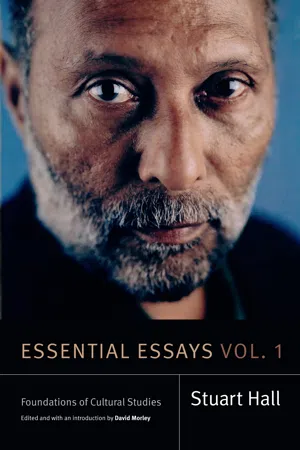 eBook - PDF
Essential Essays, Volume 1
Foundations of Cultural Studies
- Stuart Hall, David Morley(Authors)
- 2018(Publication Date)
- Duke University Press Books(Publisher)
Book-length studies are offered by Helen Davies, Understanding Stuart Hall (London: Sage, 2004); and James Procter, Stuart Hall (London: Routledge, 2004). There is also Chris Rojek, Stuart Hall (Cambridge: Polity, 2003), although Stuart himself regarded this last as rather ill-considered; see also the review by Bill Schwarz, Cultural Studies 19, no. 2 (2006). 3 Mike Phillips and Trevor Phillips, Windrush: The Irresistible Rise of Multi-Racial Britain (London: HarperCollins, 1998). 4 In an ironic role reversal, in recent years, some members of that generation of Commonwealth migrants have themselves been resentful of the claims on UK resources now made by Eastern European migrants. 5 Stuart Hall quoted by Ben Carrington, in his contribution to the discussion of “Thinking It Forward” at the Policing the Crises conference held at Barnard College/ Stonybrook University/Columbia University, New York, September 24–26, 2015. 6 Stuart Hall, “The Local and the Global,” in Culture Globalisation and the World System , ed. Anthony King (London: Macmillan, 1991). 7 See below and Essential Essays, Volume 2 on Stuart’s participation in a variety of policy-review processes, including his role in the “Runnymede Commission on the Future of Multi-Ethnic Britain” in 1997. The commission was set up by the Runnymede Trust under the chairmanship of Professor Bhikhu Parekh in 1997 and its Official Report was published by Profile Books in 2000. 22 | general introduction 8 See his comments on these issues in the talk given at the Illinois conference on Cultural Studies: ch. 3, below. 9 This predilection is also reflected in the work of some of Stuart’s foremost stu-dents: thus Dick Hebdige begins his Hiding in the Light with a quote from the quintessentially English poet William Blake, to the effect that “To Generalise is to be an Idiot. eBook - PDF
- Alexandra Ganser, Alexandra Ganser, Elisabeth Lechner, Barbara Maly-Bowie, Eva Maria Schörgenhuber, Alexandra Ganser, Alexandra Ganser, Elisabeth Lechner, Barbara Maly-Bowie, Eva Maria Schörgenhuber(Authors)
- 2022(Publication Date)
- V&R Unipress(Publisher)
In this respect, Hall helped his original audience well before the advent of Youtube and other streaming services. Through the recorded lecture, Hall’s physical presence can be experienced both visually and audibly to this day. With his lecture, Hall extends an invitation to his audience to discuss his argument, 25 years after the recording took place. Hall’s impact on Media Studies is also visible in a commemorative section of the 2016 Cultural Studies Review, which was published after his death in 2014. Most contributors are colleagues, former students and friends of Hall’s who work in Australian universities, many of them in Media Studies. All of them emphasise his many qualities and stress his impact on both Cultural Studies and Media Studies. This is no surprise given the departmental organisation of many An- glophone universities, where Cultural Studies are almost synonymous with Media Studies departments and sometimes seen as a branch of sociology. In the German (and Austrian) higher education environment, however, Cultural Studies have found their disciplinary place primarily in English departments. With the introduction of Cultural Studies professorships and curricula within English Departments from the 1990s onwards, the reception of the specific British tradition went along with the institutional establishment to a far greater extent than in other disciplines. Thomas Kühn 110 © 2022 V&R unipress | Brill Deutschland GmbH ISBN Print: 9783847114949 – ISBN E-Book: 9783847014942 Concluding Remark Stuart Hall’s impact as a theoretician of culture is closely linked to his role as a teacher. As the above considerations have shown, what makes Hall so remarkable is his ability to meet his students where they are and take them on an intellectual journey into the complex terrain of culture as a signifying practice. eBook - ePub
Feminist Engagements
Reading, Resisting, and Revisioning Male Theorists in Education and Cultural Studies
- Kathleen Weiler(Author)
- 2002(Publication Date)
- Routledge(Publisher)
8
Stuart Hall, Cultural Studies: Theory Letting You off the Hook?
ANNETTE HENRYStuart Hall, ONE OF THE FOUNDING MEMBERS OF THE BRITISH CULTURAL STUDIES movement, is a sociologist who has written extensively on a variety of subjects dealing with race, culture, identity, and class. Once a secondary school teacher, this activist and scholar was an early editor of the New Left Review and directed the Center for Contemporary Cultural Studies at the University of Birmingham (CCCS) from 1968 to 1979. His theoretical works have analyzed culture, race, and identity in society and in the mass media. Now “retired,” he is professor emeritus of sociology at the Open University. The development of Althusserian and Gramscian theories of ideology and hegemony as well as ethnographic work and media studies at the CCCS can be attributed to Hall’s leadership. Moreover, his writings have contributed to the complex meanings for the term race and the formation of identities in multiracial Britain. Black feminist film theorist Lola Young (1996) correctly points out that black gender issues are not adequately addressed by male or white female theorists. Thus, not surprisingly, Hall does not directly address the lives of black women. However, he has contributed greatly to the development of theories of hegemony and the state and, more recently, to film theory. Hall has also contributed to helping retheorize racial and ethnic identities. His theorizing underscores the increasing awareness of the complexity of subject positions and the fluidity of categories.In this essay, I want to examine some of Hall’s ideas with the aim of considering the relevance of cultural studies for black feminist educational research. Hall’s caveat about theory “letting you off the hook” raises a number of questions for the kind of work I want to do and the kind of person I want to be in the world. For the past few years, I have been deeply concerned about the lives of young black girls in schools. Thus, I am looking for theory that helps address black females’ daily lives and experiences (e.g., see Collins 1991 ; Mirza 1997
- Leslie Roman, Leslie G. Roman(Authors)
- 2018(Publication Date)
- Routledge(Publisher)
I was then exposed to the corpus of Hall’s scholarship (at first through John Fiske and Michael Apple, and later in Brazil through Liv Sovik), encountering Hall’s Gramscian reworking of the concepts of ideology, common sense, articulation, and hegemony. These offered me an extremely potent theoretical lens through which the particular field I was investigating could be understood without any simplification of its complexity.Stuart Hall was an avid reader of Gramsci and his work was highly influenced by the Italian intellectual. Notwithstanding, Hall did not simply “use” Gramsci’s (or other authors’) work: he constructed a new theory that used Gramsci’s insights and advanced them, making them potent in the particular context where he was operating. Hall is clear about this point:Gramsci’s work often appears almost too concrete: too historically specific, too delimited in its references, too “descriptively” analytic, too time- and context-bound. His most illuminating ideas and formulations are typically of this conjunctural kind. To make more general use of them, they have to be delicately dis-interred from their concrete and specific historical embeddedness and transplanted to new soil with considerable care and patience. (Hall, 1996b, p. 413)Hall’s particular configuration of the concepts and the theoretical framework that he created by reworking Gramsci’s formulations were the ones that guided my analysis of the experiences in the educational system of Porto Alegre, Brazil. What I set out to do in my research about the Porto Alegre reforms was precisely this: to use Hall’s formulations and delicately disinter them, transplanting them with patience, recontextualizing them, so they could flourish and help me understand the complexities involved. This article, then, examines Stuart Hall’s influence and direct contribution to the research on education reform and hopefully shows how immensely fruitful and powerful his work is for understanding not only how domination works in particular contexts but also how counter-hegemonic struggles are formed.A little note is necessary, nevertheless, before I proceed. Even though it goes well beyond the scope of this article to evaluate Stuart Hall’s contribution to the field of education in Brazil, it is crucial to mention that, in that context, Tomaz Tadeu da Silva and Marisa Vorraber Costa (in a recent article, Costa recounts, with two colleagues, the uses of Hall in the Brazilian education context; see Costa, Wortmann, & Silveira, 2014), just to cite two key scholars in education, were instrumental to make Stuart Hall’s papers available in Brazil. Another crucial scholar made Stuart Hall’s work known in Brazil: Liv Sovik (who researches in the Communications and Culture field). Among her many contributions, she published, in 2003, an incredibly successful book (its first edition was sold out in four months) with several chapters by Hall and some interviews with him, along with a generous introduction by her on his work (Da Diáspora: identidades e mediações culturais eBook - ePub
English radicalism in the twentieth century
A distinctive politics?
- Richard Taylor(Author)
- 2020(Publication Date)
- Manchester University Press(Publisher)
In varying contexts, Hall’s theoretical analysis was influenced inter alia by Althusser, Derrida, Foucault and postmodernism in general; post-colonial theorists such as Fanon; ‘second wave’ feminism; and Gramsci – all in addition, again inter alia, to radical theorists of an earlier generation, not only Williams but Lukács, Benjamin and, of course, Marx. The complexity of Hall’s theoretical position is not the focus for this chapter: here, rather, the concentration is upon the relationship between Hall’s interventions and the development of English radicalism in the late twentieth century. 58 Hall came to place an even greater emphasis than in his earlier New Left days upon culture as a determining factor in radical political analysis. Thus, in 1987, Hall observed that ‘“while not wanting to expand the territorial claims of the discursive infinitely, how things are represented and the “machineries” and regimes of representation in a culture do play a constitutive, and not merely a reflexive, after-the-event, role. This gives questions of culture and ideology, and the scenarios of representation – subjectivity, identity, politics – a formative, not merely an expressive, place in the constitution of social and political life.”’ 59 Thus, ‘cultural politics … should be seen as central to social transformation’. 60 Hall was critical of the Left, including sections of the New Left of both the 1956 and 1968 generations, as ‘“still waiting for the old identities to return to the stage eBook - ePub
The Uses of Cultural Studies
A Textbook
- Angela McRobbie(Author)
- 2005(Publication Date)
- SAGE Publications Ltd(Publisher)
1Stuart Hall and the Inventiveness of Cultural Studies
GUIDE TO THE CHAPTER Media–Politics–Ideology I Search for a Method Case Study PanoramaTelevision and National Unity Media–Politics–Ideology 2 Changes in Political Communications Media–Politics–Ideology 3 Journalism as Critique Breaking the Spell of the Welfare State Stuart Hall Meets the Iron Lady From Unity to Difference? Multi-cultural Questions Extended NotesStuart Hall Meets Tony Blair Media–Politics–Ideology 1
In this chapter I extrapolate from the full range of Stuart Hall’s work in order to concentrate on three exemplary moments. These are the moments of television (mid-1970s), the ‘authoritarian populism’ of Thatcherism (late 1980s), and multi-culturalism (2000a, 2000b). I provide both an elucidation of these texts and also an account of their inter-connectedness, despite the years between them. The first of these marks the time when Stuart Hall was focusing on the media, in this case television, and was exploring the possible usefulness of Althusser’s theory of ideology for understanding the day-to-day practices of political communications, in particular the relation between the media, the state and politics. This was also the period of Hall’s work when an explicitly Marxist analysis was most prominent. There was an overriding concern with how in an advanced capitalist society, the underlying class relations of power only became apparent in the ‘last instance’, for the reason that the big ideological institutions possessed their own autonomy. Their operations appeared to be quite disconnected from the economy, its modes of production and the organisation of labour. This autonomy and an ethos of neutrality served the capitalist order all the more effectively, with conflicts between spheres, for example, between journalists and politicians, producing an illusion of separate interests, while in reality masking the consensus or unity in regard to those fundamentally capitalist elements of the existing social order, which must, at all costs, be protected, secured and reproduced. Hence the use of the term ‘complex unity’. The very terms by which these institutions conducted their daily operations were so naturalised that they became the means by which those millions of people who came into contact with such spheres, (mis)-recognised and (possibly) understood the world. To the extent that institutions like the press or television perpetuated themselves according to routine practices based on professional and technical codes and conventions, they also reproduced the very structures of the capitalist society. eBook - PDF
Transforming Teaching and Learning in Higher Education
Towards a Socially Just Pedagogy in a Global Context
- Ruksana Osman, David J Hornsby, Ruksana Osman, David J Hornsby(Authors)
- 2017(Publication Date)
- Palgrave Macmillan(Publisher)
CHAPTER 2 Stuart Hall and Education: Being Critical of Critical Pedagogy Nazir Carrim INTRODUCTION This chapter focuses on Stuart Hall’s theoretical contributions and their implications for teaching and learning. Hall’s seminal theoretical contri- butions are far reaching and have implications on various levels and in relation to several issues. Not in all instances are the links between Hall’s theoretical contributions and educational practice explicit, but it is equally clear that such links can be made. In Teaching Race (1976), Hall makes such links to teaching and learning clear and explicit. However, Teaching Race which was first published in the 1970s only drew on the socially constructed nature of knowledge and social experience and their implications for teaching and learning, and did not explore such teaching and learning in relation to notions of relationality and articulation, which Hall later elaborated upon. Using the ideas present in Teaching Race, this chapter explores the importance of social constructedness as a powerful pedagogical tool which not only promotes the notion of critical pedagogy but also extends it. This chapter, thus, builds on the idea of a social constructivist pedagogy, links it to N. Carrim (*) Wits School of Education, Johannesburg, South Africa e-mail: [email protected] © The Author(s) 2017 R. Osman, D.J. Hornsby (eds.), Transforming Teaching and Learning in Higher Education, Palgrave Critical University Studies, DOI 10.1007/978-3-319-46176-2_2 15 Hall’s later explications of relationality, intersectionality and articulation to demonstrate the tremendous generative potential of Hall’s theories in informing pedagogical practice. As will be seen in this chapter, the arguments provided by Hall in relation to these concepts also usefully provide a way of being critical about critical pedagogy. In this way, they also provide a more defendable pedagogy that may significantly contribute to social justice.
Index pages curate the most relevant extracts from our library of academic textbooks. They’ve been created using an in-house natural language model (NLM), each adding context and meaning to key research topics.

