Literature

Cultural Studies
Cultural Studies examines the ways in which culture, including literature, shapes and reflects society. It explores how power dynamics, identity, and social structures are represented and contested in cultural texts. By analyzing the production, consumption, and reception of cultural artifacts, Cultural Studies seeks to understand the complexities of human experience and the role of culture in shaping our worldviews.
Written by Perlego with AI-assistance
Related key terms
1 of 5

10 Key excerpts on "Cultural Studies"
 eBook - PDF
- Michael Bérubé(Author)
- 2008(Publication Date)
- Wiley-Blackwell(Publisher)
Such an approach does not exclude the analysis of literature and high art, but it does require an awareness of the relations and flows of interchange between different cultural spheres. Cultural Studies also links descriptions of texts and practices to analyses of power. It does not believe that the making and getting of culture are free of social interests, needs, and struggles. But it is wary of grand theories of capitalism, patriarchy, or imperialism that look down on the patterns and practices of everyday life from a haughty distance. Cultural Studies, at its best, is meticulously attentive to the local, the contingent, and the conjunctural: that is to say, the ways in which relations between texts, political interests, and social groups are formed, severed and realigned over time. Cultural Studies, in this definition, involves a balancing act between the macro and the micro and between the competing claims of textual and social analysis. What this suggests, then, is that any attempt to do Cultural Studies requires a more than superficial knowledge of different disciplines and traditions. It is not about collapsing aesthetics and politics into a general theory of textuality. Rather, Cultural Studies defines itself in relation to the tensions and competing pulls of different fields of knowledge. As Cary Nelson puts it, ‘‘if you only know one discipline intimately, and you operate securely within its principles, you cannot do Cultural Studies’’ (1996: 64). The other side of this coin, however, is that Cultural Studies needs these other disciplines as intellectual resources on which to draw. This is one reason why I am opposed to any attempt to subsume literary studies into Cultural Studies. Such an encroachment threatens the integrity of an archive of important and enormously influential works and a longstanding body of commentary on those works as well THE ROLE OF AESTHETICS IN Cultural Studies 39 as on general problems of hermeneutics and interpretation. eBook - PDF
- Charles Peek, Robert W. Hamblin, Charles Peek, Robert W. Hamblin(Authors)
- 2004(Publication Date)
- Greenwood(Publisher)
Traditional literary and cultural criticism defined culture as the 164 A COMPANION TO FAULKNER STUDIES rarefied products and refined expressions of trained, gifted, or visionary artists; the various modes of Cultural Studies depart markedly in their terms for approaching culture as both an entity and a term. Marxist modes of analysis stress the impact on culture's production by vested, economic interests (publish- ing houses, film studios, or magazine editors), as well as its depiction of class differences and struggle. Ethnographers study culture as the empirically observ- able rituals of a particular ethnic, religious, or national group. Sociology describes a culture's institutions and their regulation of culture from distant, centralized sites of production. 1 Cultural Studies combines (and questions) all of these definitions, drawing from them what it finds useful in identifying what cul- ture is, what it says, and—importantly—what culture may be said to do. For throughout its various incarnations, Cultural Studies seeks to intervene in the political, social, and material experience of those individuals and groups that it sees culture in all its modes affecting. In its progressive orientation, Cultural Studies seeks to give voice to individu- als and groups that are not in possession of the means of protest or social redress, to those "who have the least resources" (During 2). Unlike earlier forms of cultural analysis, Cultural Studies sees social reality and, most importantly, its inequities as central to understanding literature. As Simon During puts it, "Most individuals aspire and struggle the greater part of their lives and it is easier to forget this if one is just interpreting texts rather than thinking about [cultural activity] as a life-practice" (2). eBook - ePub
- David Walton(Author)
- 2012(Publication Date)
- SAGE Publications Ltd(Publisher)
1
Introducing Cultural Studies
A Brief Contextual History
Learning goals- To understand the difficulty of defining the term ‘culture’ and appreciate the multidisciplinary and complex character of Cultural Studies.
- To get a sense of the way Cultural Studies (using the British context) has been developed and consolidated in relation to the themes established by what have become a number of key writers and approaches.
- To see the way the different theories introduced and illustrated in this book reflect developing interests within Cultural Studies.
ConceptsThe key concepts introduced in this chapter are: Cultural Studies, culture, the culture and civilization tradition, minority culture, mass culture, popular culture, the Frankfurt School, the culture industry, ‘culturalism’, the uses of literacy, the making of the English working class, culture as a whole way of life, youth subcultures, hegemony and organic intellectuals.Introduction
These opening sections reflect on how the book fits into the (mainly British) Cultural Studies tradition, providing a brief ‘refresher course’ for readers who are familiar with Cultural Studies and some vital contextualization (or a ‘kick start’) for those who are relatively new to the area. In very general terms I shall show how contemporary cultural analysis has grown out of (and beyond) approaches which tended to privilege ‘high’ culture over ‘popular’ or mass forms and indicate how the writers and theories relate to the general structure of the present book.Cultural Studies?
I want to begin this chapter with a number of questions. One, having sat down to write a book about theory and practice in Cultural Studies, can I say, beyond all doubt, that I know what culture is? Two, am I so sure about what Cultural Studies is that I can just start using it, without needing to reflect on it in any way? The answer to these questions is ‘yes and no’. The term ‘culture’ can be made to have specific, intelligible meanings and there are departments of Cultural Studies with common ways of understanding and analysing ‘culture’, so where are the problems? eBook - PDF
Emancipatory Movements in Composition
The Rhetoric of Possibility
- Andrea Greenbaum(Author)
- 2012(Publication Date)
- SUNY Press(Publisher)
This form of inquiry complements and augments the libera- tory and transformative ideals within the field of rhetoric and composition. But in order to understand the confluent relation- ship between Cultural Studies and composition, we need to exam- ine the foundation of cultural critique. Cultural Studies: A BRIEF OVERVIEW Initially, when Cultural Studies began to take shape as a discipline in Great Britain in the 1950s, it had a dual commitment both to description and to intervention, and it focused on the notion of “subjectivity”; that is, it studied culture in relation to individual lives, providing a significant break from traditional, positivistic modes of inquiry. One of the earliest texts that posited this subjec- tive mode of inquiry was Richard Hoggart’s The Uses of Literacy (1957), which described Hoggart’s personal experience of the changes in working-class life in post-war Britain. Hoggart demon- strated that “culture” affected an individual’s “whole way of life,” meaning that life practices are intricately connected, networked to 25 Cultural Studies and Composition larger cultural, social, and economic practices. Another critical text in the emergence of Cultural Studies was Raymond Williams’ Culture and Society: 1780–1950 (1958), which made the distinc- tion between the notion of “culture” as high-culture (defined by Matthew Arnold as a standard of aesthetic excellence, “the best that has been thought and said in the world”) and Williams’ defi- nition of culture as a way of life. Williams writes, Culture is a description of a particular way of life, which expresses certain meanings and values not only in art and learn- ing but also in institutions and ordinary behavior. The analysis of culture, from such a definition, is the clarification of the meanings and values implicit and explicit in a particular way of life, a particular culture.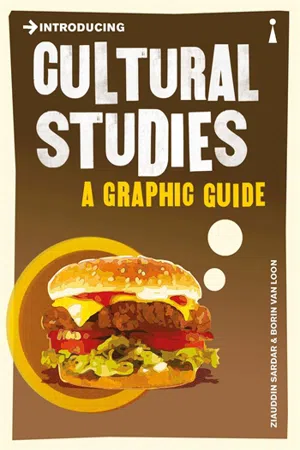 eBook - ePub
Introducing Cultural Studies
A Graphic Guide
- Ziauddin Sardar, Borin Van Loon(Authors)
- 2015(Publication Date)
- Icon Books(Publisher)
What Is Cultural Studies?Cultural Studies is an exciting and “hot” field of study. It has become the rage amongst progressives of all sorts – not least because culture as a theme or topic of study has replaced society as the general subject of inquiry among progressives.Cultural Studies has made its presence felt in academic work within the arts, the humanities, the social sciences and even science and technology. It appears to be everywhere and everyone seems to be talking about it.But what exactly is Cultural Studies? The term “studies” suggests a broad field of inquiry – like business studies or management studies. So is Cultural Studies simply the study of culture?We know what business is. And what management is.But culture? Well, that’s an altogether different thing.What is Culture?
The ambiguity of the concept of culture is notorious. Some anthropologists consider culture to be social behaviour. For others, it is not behaviour at all, but an abstraction from behaviour. To some, stone axes and pottery, dance and music, fashion and style constitute culture; while no material object can be culture to others.Yet for still other, culture exists only in the mind.One of the oldest definitions of culture was given by the British anthropologist, Sir E.B. Tylor (1832–1917) in the opening lines of his book, Primitive Cultures (1871):Culture is that complex whole which includes knowledge, belief, art, morals, law, customs, and other capabilities and habits acquired by man as a member of society.Here are a few more attempts to define culture …American anthropologist Margaret Mead (1901–78)Culture is that learned behavior of a society or a subgroup.Raymond Williams (1921–88), one of the founders of Cultural StudiesClifford GeertzCulture includes the organization of production, the structure of the family, the structure of institutions which express or govern social relationships, the characteristic forms through which members of the society communicate. eBook - ePub
- Ben Agger(Author)
- 2014(Publication Date)
- Spon Press(Publisher)
Chapter 1 What is Cultural Studies? DOI: 10.4324/9781315067438-1American and British university campuses are alive with new forms of interdisciplinary research. Although these activities are diverse and have multiple foci, they can broadly be grouped under the general heading of Cultural Studies. A recent Chronicle of Higher Education article (‘Cultural Studies: Eclectic and Controversial Mix of Research Sparks a New Movement’, January 31, 1990) trumpets this increasingly high-profile interdisciplinary project, depicting it as an important trend in scholarship that will probably leave its mark for many years to come. A later article in the Chronicle (‘Protest at Cultural-Studies Meeting Sparked by Debate over New Field’, May 2, 1990) reports heated controversies aired at a major Cultural Studies conference. Whether carried out in English departments or sociology departments, Cultural Studies challenges traditional assumptions of disciplinary scholars who plow the fields of cultural research in relative isolation from one another. This book is about Cultural Studies, both describing its multiple valences and arguing for a version of it that fits a certain intellectual and political agenda.I devote the first two chapters to a discussion of the multiple forms of Cultural Studies as well as of the historical and sociological reasons for the ascendance of Cultural Studies. In the next five chapters I examine various theoretical approaches to Cultural Studies including Marxist theories of culture, the Frankfurt School, the Birmingham School, poststructuralism and postmodernism, and feminism. My three concluding chapters address the bifurcation between an essentially apolitical Cultural Studies and a Cultural Studies that is more directly engaged in the political contest over meaning and interpretive perspective. In arguing for the latter version of Cultural Studies, I integrate a variety of the aforementioned theoretical approaches that together comprise an interdisciplinary approach to culture. eBook - ePub
International Media Research
A Critical Survey
- John R. Corner, Philip Schlesinger, Professor Philip R Schlesinger, Roger Silverstone(Authors)
- 2004(Publication Date)
- Routledge(Publisher)
et al., 1992). From its financially modest but intellectually ambitious origins in Birmingham in the 1960s and 1970s, Cultural Studies had arrived as an established academic field. This is apparent from the large number of textbooks and anthologies aimed at the student market (e.g. Barker and Beezer, 1992; During, 1993; Gray and McGuigan, 1993; Inglis, 1993).From this brief overview, I want now to go back and look in more detail at some central theoretical strands.THEORETICAL LANDSCAPES: CULTURE, MEANING, POWER
Cultural Studies’ core concern is with culture as a key concept for understanding features of our contemporary historical situation. In recent decades there has also been a deep-rooted concern with culture outside of Cultural Studies, a culturological ‘turn’ in social theory more generally, upon which Cultural Studies has drawn (cf. Chaney, 1994; Alexander and Siedman, 1990; The Polity Reader, 1994). I cannot, of course, retrace all the debates that were generated around the concept of culture, but I do want to highlight a number of interrelated core themes.The first has to do with culture as an aesthetic versus a sociologicalanthropological issue. Certainly within the traditions of literary and artistic humanism, culture—often with an implied capital C—has been seen as something produced by artists and writers, to be analysed aesthetically. From the standpoint of Cultural Studies, it was particularly the work of Raymond Williams which helped extract culture from the literary-aesthetic ghetto and make it a concern for social analysis as well as significantly broadening the range of things which could be regarded as ‘cultural’. Williams and the tradition of British cultural materialism which he represents (see Milner, 1993, for a discussion of the role of cultural materialism in the development of Cultural Studies) took the important step of treating culture as a part of lived experience in society, and not just as a body of texts or as art. This does not mean that the aesthetic dimension became irrelevant. On the contrary, Cultural Studies has paid considerable attention to aesthetic questions, for instance, in respect of popular music, styles of dress, television programmes and film. But the point is that these analyses are placed in sociohistorical contexts in such a manner that aesthetics becomes a tool for illuminating aspects of the social. eBook - ePub
Culture And Critique
An Introduction To The Critical Discourses Of Cultural Studies
- Jere Paul Surber(Author)
- 2018(Publication Date)
- Routledge(Publisher)
Further, semiology has emphasized the counterprocess of how encounters with cultural texts bring about the production of subjects, that is, “imply or construct a position or positions from which they are to be read or viewed.” While both reception theory in literary studies and research on audiences in media studies represent a fruitful step beyond the pure focus on the text itself, such approaches must not lose sight of the facts that readers not only produce interpretations of texts but are produced as subjects by the texts they read, and that this two-sided process requires the recognition of the importance of contextual elements, including prior readings of other texts. 4. Lived cultures: Finally, perhaps the most distinctive contribution of Cultural Studies to this circuit of cultural production, the process by which texts are produced, structured, and then appropriated by actual readers, culminates in what culturalism had already pointed to as “whole ways of life” or “lived cultures.” Just as in reading texts readers at the same time both actively determine textual meanings and are in turn constituted or located as subjects through those textual meanings, so ensembles of variously located subjects sharing complexes of cultural texts can be approached in terms of the lived cultures formed by that sharing of texts. In particular, Cultural Studies has often focused on the relationships and interactions between the private readings of texts and the public forms in which ensembles of texts become institutionalized. Especially fruitful have been studies highlighting the manner in which products of mass culture have been actively appropriated and transformed to reflect the social positions and needs of various subcultural groups, that is, the actual uses to which they are put eBook - ePub
- Francis Mulhern(Author)
- 2002(Publication Date)
- Routledge(Publisher)
Fantasia, Cultural Studies is properly ‘a process, a kind of alchemy for producing useful knowledge; codify it and you might halt its reactions’ (Johnson 1996: 75).‘Institutionalization’ – the inscription of an autonomous project in a formal education system – is among the darker themes of the collective autobiography. It has been overwritten, in the 1990s, by the larger, more portentous narrative of ‘globalization’. Both are regularly invoked in the current phase of self-examination, as Cultural Studies practitioners look to their constitutively ‘political’ beginnings and ends, commitments that must not be scanted in the new environments of production and circulation (Mellor 1992). Yet these reference points are hardly secure. ‘Birmingham’ has been decentred, in a fractious international network now conventionally resistant to all claims of origin, especially where they concern an old colonial heartland. That tradition is specifically British – English, even – and not a template for others, in Australia or the Unites States, say, who affirm the distinct, more or less contemporaneous, beginnings of their own Cultural Studies (Carey 1997; Frow and Morris 1993; Stratton and Ang 1996). Ends are not self-evident either, in a period in which the great emancipationist projects of modernity are said to have lost coherence and authority, and not so much for ill as, in all senses, for good. The story of an academic quarterly is perhaps emblematic. In the middle 1980s, The Australian Journal of Cultural Studies gave itself into the care of a London publishing corporation. It was decided that the leading editorial role would henceforward rotate from Australia to Britain to the United States and so around again. A less limiting address now seemed appropriate, and the journal was re-launched shorn of all locative indication as Cultural Studies. In 1991, a further simplification occurred: editorial roles were stabilized, and assumed by two US academics, Lawrence Grossberg and Janice Radway. This was the second time in a year that Grossberg had taken the rostrum in the general interest of his discipline. With Cary Nelson and Paula Treichler, he had organized the huge international ‘Cultural Studies’ conference at the University of Illinois (1990). Its edited proceedings, published under the same title in 1992, have been perceived as an attempt not merely to illustrate but to be the discipline – a mock-international forum incarnating ‘a new American hegemony in English-speaking Cultural Studies’ (Jameson 1993; Stratton and Ang 1996: 363–5). At Cultural Studies the journal, meanwhile, the new editors’ first visible act of policy was to rewrite its politico-intellectual charter. Marxism and feminism disappeared as tokens of past or future affinity in the new declaration, which, with admirable inclusiveness, committed Cultural Studies to the front lines of equal-opportunities liberalism.1 eBook - ePub
Culture and the Political Economy of Schooling
What's Left for Education?
- John Morgan(Author)
- 2018(Publication Date)
- Routledge(Publisher)
There is certainly a sense that there is less interest in the mainstream of Cultural Studies in schools (though there remains a significant strand of work in the tradition of ethnography). The main focus of this work about schooling shifted in the 1990s and beyond to questions of gender, the body and sexualities. Much of this work sought to ‘deconstruct’ social categories such as gender, ethnicity and sexuality and demonstrate how they are subject to change and contestation, and as such provide valuable context for understanding the construction of ‘youth’ as a category. Contemporary accounts of young people’s lives must also grapple with changing patterns of consumption and young people’s negotiation of identity, and since around the turn of the century, the field has seen a growing interest in young people’s use of new media at home, at play and at school. This was associated with the rise of new technologies that were particularly taken up by children and young people. Early studies pointed to how these created new relations between home and school, children and adults. Like any new development, there was a tension between those approaches that were concerned with the effects of children’s use of technology and those that were broadly positive of their educational potential. Cultural Studies were instrumental in helping to make sense of children and young people’s media use.Some of this work explicitly addresses school learning. Cultural Studies have maintained its interest in youth cultures in a time of change and have responded to the changing contexts. It has insisted on the importance of human agency and tries to look carefully at what young people are doing in specific contexts. At the same time. it has been mindful of developments in social and cultural theory, looking to frame its empirical studies with theories that have gained recognition in the field of contemporary social theory. This can sometimes give the impression that these theories have explanatory power, rather than, as is often the case, serving to dress up traditionally ‘empirical’ texts. The politics of Cultural Studies reflects the position of young academics, many of whom are seeking to challenge the older generation and who possess the type of cultural capital that can allow them to ‘get close’ to young people. A critical edge (very important in terms of the competitive culture of universities which demands productivity and novelty) is maintained through the adoption of ‘theory’. What is missing from many of these discussions is anything more than lip-service to capitalism and where political economy is
Index pages curate the most relevant extracts from our library of academic textbooks. They’ve been created using an in-house natural language model (NLM), each adding context and meaning to key research topics.

