Geography

Cultural Geography
Cultural geography is the study of how human culture and society interact with the natural environment. It examines the ways in which people shape and are shaped by their surroundings, including their beliefs, traditions, and practices. This field explores topics such as cultural landscapes, place attachment, and the impact of globalization on local cultures.
Written by Perlego with AI-assistance
Related key terms
1 of 5
11 Key excerpts on "Cultural Geography"
- Nuala C. Johnson, Richard H. Schein, Jamie Winders, Jamie Winders(Authors)
- 2013(Publication Date)
- Wiley-Blackwell(Publisher)
It is hard to find a key word or topic in Cultural Geography these days that does not enjoy an interdisciplinary constituency. That is a good thing. The contemporary fascination with the “cultural” has generated an enormous body of work on which cultural geographers draw and to which they contribute. Cultural Geography as a subdiscipline brings to the conversations a long tradition, most notably attention to space and place, to the spatiality of everyday life at multiple and fluid scales, to landscapes as the re-suturing of human and physical worlds, and to the politics and epistemological implications of these engagements. In the past decade, these traditional foci have remained intact, even as some have garnered renewed enthusiasm (such as nature–society questions), others have undergone increased conceptual scrutiny (such as the “cultural landscape” concept), and many have engaged new conceptual or theoretical possibilities (such as increased interest in affect and emotion or consideration of the “posthuman”). All of these developments are present in this volume, and this introductory chapter signposts some of these traditional, new, and renewed areas of interest in Cultural Geography and the ways these topics have shifted in the last decade. This chapter is not, however, meant as a comprehensive introduction to the subdiscipline of Cultural Geography. Instead, it is an invitation to examine the field’s ever-changing contours through the ensuing essays.Cultural Geography has been a foundational building block of human geography since the discipline formally was established in the nineteenth century. Documenting spatial patterns in human interaction with, responses to, and transformations of the natural landscape, raising questions about how landscape itself was shaped by and shaped social dynamics, and problematizing the ideas of culture, landscape, and nature have been Cultural Geography’s contributions to the ways that human geographers have thought about the world around them, past and present. Today, the line between human geography as a discipline and Cultural Geography as a subdiscipline is blurred to the point that Cultural Geography is human geography in some corners of our field. Recent intellectual and scholarly developments within geography have drawn cultural geographers closer to the fold and to deeper engagements with colleagues and ideas once thought beyond Cultural Geography’s purview – political, economic, historical, or environmental geography, for example. These connections have been strengthened through Cultural Geography’s embrace of and relevance to the so-called cultural and spatial turns across the human sciences as well as its engagement with social theory and concepts of interest to a broad range of scholars within and beyond the discipline. In short, cultural geographers today study nearly every aspect of human geography and do so in ways that simultaneously reinforce the subdiscipline’s place in geography and question the logic and locations of its boundaries.Cultural Geography is itself deeply geographic in terms of what places and spaces cultural geographers study and how cultural-geographic scholarship is conducted across institutional and national contexts. Although Cultural Geography developed historically and intellectually in relation to other areas of human geography, such as cultural ecology and social geography, it also has developed in relation to its practical and institutional contexts. Cultural Geography means different things in different places and is enacted in different ways, especially between its North American and British variants (see, for example, Audrey Kobayashi’s discussion of this phenomenon in relation to geographic treatments of race in Chapter 9). Where eBook - PDF
Geographies of Love
The Cultural Spaces of Romance in Chick- and Ladlit
- Christian Lenz(Author)
- 2016(Publication Date)
- transcript Verlag(Publisher)
Cultural Geographies Space is to place as eternity is to time. J OSEPH J OUBERT T HE W ORLD A CCORDING TO G EOGRAPHERS The relationship between people and their (created) surrounding(s) is looked at closely in geography and, more precisely, human geography which aims “to explain the spatial patterns and processes that enable and constrain the structures and actions of everyday life.” (Dear and Flusty 2002: 2) Human geography is one of the two great strands of geography, the other being physical geography, which includes for example geomorphology or biogeography (cf. Kirk 1963: 359, 361). In their Introductory Reader in Human Geography , William Moseley, David Lanegran and Kavita Pandit characterise human geography as focusing on “the patterns and dynamics of human activity on the landscape.” (2007a: 3) However, depending on the focus geographers want to apply, they would either narrow the focus on the human activity or stress the “human-environment dynamics (or the nature-society tradition).” (Ibid.) Whereas the latter deals with diverse topics such as political ecology or agriCultural Geography, the former aspect of human geography addresses issues such as urban geography, economic or political geography and cultural geo-graphy (cf. ibid.: 4). Especially Cultural Geography “concentrates upon the ways in which space, place and the environment participate in an unfolding dialogue of meaning. 1 ” (Shurmer-Smith 2002: 3) Cultural Geography “includes thinking about how geographical phenomena are shaped, worked and apportioned according to ideology; how they are used when people form and express their relationships and ideas, including their sense of who they are.” (Shurmer-Smith 2002: 3) This con-firms what Peter Jackson anticipated in his famous Maps of Meaning twenty years 1 See also Knox and Marston: “Cultural Geography focuses on the way in which space, place, and landscape shape culture at the same time that culture shapes space, place, and landscape.” (1998: 191) eBook - ePub
Cultural Landscapes of Post-Socialist Cities
Representation of Powers and Needs
- Mariusz Czepczynski(Author)
- 2016(Publication Date)
- Routledge(Publisher)
New Cultural Geography can then be defined as the study of geographical aspects of human culture as processes and practices of meanings; all possible aspects of different spatial and thematic levels. Based on new and more vibrant and interactive understanding of culture grew humanistic geography or the geography of representations, as a newer aspect of Cultural Geography, where cultural space is wrought on the basis of representation. On this context cultural space is a space of belief in common values structures by ideas or ideologies (see Mitchell 2001, Marcus 2000, Crang 2004). Cosgrove and Jackson’s (1987) concept of new Cultural Geography was raised from criticism of the Berkeley school based on its narrow focus on physical artefacts, as well as a unitary view of culture rather than a constantly negotiated and constituted plurality of cultures. They also argued for a more complex concept of landscape, recognizing it as a cultural construction, a ‘particular way of composing, structuring and giving meaning to an external world whose history has to be understood in relation to the material appropriation of land’ (Cosgrove and Jackson 1987, 96). Landscape has been seen as a social and physical construction, where symbolic and represented landscapes produced and sustained social meanings, visualized in physical forms. In the pursuit of such analyses of landscapes, they highlighted the usefulness of two metaphors: landscape as text and landscape as theatre (see Cosgrove 1998, Cosgrove and Daniels 2004, Kong 2007). Cosgrove and Jackson’s (1987) vision for contemporary Cultural Geography is multi-level and holistic. It would, moreover, assert the centrality of culture in human affairs eBook - ePub
Human Geography
A History for the Twenty-First Century
- Georges Benko, Ulf Strohmayer, Georges Benko, Ulf Strohmayer(Authors)
- 2014(Publication Date)
- Routledge(Publisher)
2 Cultural Geography: place and landscape between continuity and change Paul Claval and J. Nicholas EntrikinGeography has a long history, but human geography was born only in the late nineteenth century, in Germany, with the publication in the 1880s of the first volume of Ratzel’s Anthropogeographie (1881–91). From the outset, culture was thought to be a significant aspect of human geography, but the cultural approach to the discipline was hampered by the dominant naturalist and positivist epistemologies.Geographers held different views of their field. For the majority of them, geography had to explain fundamentally the regional (and local) differentiation of the earth. With the growing influence of evolutionism, the relationship between man and milieu appeared as the most successful challenger of the earlier regional perspective. In order to avoid conflict between the two conceptions, the idea that geography was the science of landscapes began to flourish. It offered a major advantage: a specific field for geographic inquiry.These three conceptions were generally combined: geographers explored the diversity of the earth and prepared maps to show it; they had an interest in the diversity of landscapes, which introduced a large-scale, local component, to their approach; they often focused — either at the global, regional or local level — on man-milieu relationships. Their ambition was to present an objective description of the earth and develop a knowledge of the laws which explained its organization. Generally, they had no interest in the geographical views or interpretations developed by the people they studied. These conceptions evolved, but their epistemological basis remained remarkably stable until the mid-twentieth century. eBook - ePub
Geography and Geographers
Anglo-American human geography since 1945
- Ron Johnston, James D. Sidaway, James Sidaway(Authors)
- 2015(Publication Date)
- Routledge(Publisher)
By localizing social interaction into discrete cultures … contentious activities are abstracted into the partial truth contained in the idea of culture: namely that there are true and deep differences between people. (p. 109) This strategy is crucial in many aspects of life, such as geopolitics (see p. 264, this book) and the promotion of consumerism; indeed, as the essays in Roger Lee and Jane Wills (1997) illustrate (see also Thrift and Olds, 1996; Wheeler, 2002b), it is increasingly difficult to separate the cultural from the economic. For Don Mitchell (1995), therefore: like ‘race’, ‘culture’ is a social imposition on an unruly world. What does exist, and very importantly, is the historical development of the idea of culture as a means of ordering and defining the world…. Culture is an idea that integrates by dividing … (p. 112) As such, many cultural geographers were deeply involved in developments during the 1990s, characterised in Chapter 7 as ‘the cultural turn’. We return to these issues in Chapter 7. For now, it is sufficient to note that whereas traditional cultural geographers paid little explicit attention to methodological concerns, those linked to the more recent developments addressed a range of issues involved in the collection of ‘data’, through the interrogation of both texts and people’s lived experiences. In this respect, Ian Cook and Mike Crang (1995) equated (a renewed) Cultural Geography with humanistic geography in terms of the methods adopted. There is a sense that one of the preconditions for such renewal, however, was the legacy of human-orientated research in geography which came to the fore in humanistic geography’s critique of positivism and spatial science. ‘Doing humanistic, or cultural, geography’ involves a variety of methods often characterised as ethnographic and contrasted to the positivist approach (Cook and Crang, 1995, p eBook - ePub
- Cynthia Metcalf, Rhonda Atkinson(Authors)
- 2017(Publication Date)
- Research & Education Association(Publisher)
CHAPTER 1 Geography Geography is the study of the Earth’s surface, including such aspects as its climate, topography, vegetation, and population.Geography is much more than just memorizing names and places and studying the physical features of the Earth. While geography requires an understanding of the Earth’s surface, it also is concerned with the distribution of living things and Earth’s features around the Earth. Geography focuses on three questions: Where? Why there? What are the consequences of it being there? Geographers look at the Earth’s physical space and investigate patterns. For example, a geographer might look at the space of your bedroom and ask several questions: How are things distributed? Why are they where they are? What processes operate in that space? How does this space relate to other nearby spaces? Geographers call this way of identifying, explaining, and predicting human and physical patterns in space and the interconnectedness of various spaces the spatial perspective . Geography views the Earth through a lens of location and space and seeks to find patterns of place or interactions between places and people. Thus, geography is the science of space and place.Branches of Geography Generally, geography can be divided into four main branches:Human Geography focuses on humans and the cultures they create relative to their space. It encompasses population geography, economics, and political geography and looks at how people’s activities relate to the environment politically, culturally, historically, and socially.Physical Geography addresses Earth’s physical environment: water (hydrosphere ), air (atmosphere ), plants and animals (biosphere ), and land (lithosphere ). Physical geographers study land formation, water, weather, and climate eBook - ePub
- Tim Unwin(Author)
- 2013(Publication Date)
- Routledge(Publisher)
HAPTER 8The place of geographySince antiquity geographers have explored and analysed the earth's surface from two related perspectives: that of the spatial differentiation and associa tion of phenomena with an emphasis on the meaning of space, spatial relations and place; and that of the relationship between man and his physical environment. The two are closely related because the meanings of space and place depend on the interrelationships among physical and human activities located in space, and man's relationships to the environment occur in the context of space and place.(Sack, 1980: 3)One of the most salient characteristics of geographical practice in the last twenty years is that geographers have increasingly accepted the inherent diversity of the discipline and have in general ceased trying to identify a single core to the discipline. Rarely are arguments today promulgated to suggest that the central aim of geographical enquiry is, for example, to create a spatial science, or that systems analysis forms a unifying methodology for the discipline. Some, moreover, have argued that 'there is no need for geography and the other presently constituted fragments of social science, since they must be rejected' (Eliot Hurst, 1985: 60). In particular, this period has been characterized by an increasing division between the human and physical sides of the discipline. Stoddart (1987a: 330) has eloquently described this situation as follows:The result is clear enough. Across geography we speak separate languages, do very different things. Many have abandoned the possibility of communicating with colleagues working not only in the same titular discipline but also in the same department. The human geographers think their physical colleagues philosophically naive; the physical geographers think the human geographers lacking in rigour. Geography - Forster's, Humboldt's, Mackinder's - is abandoned and forgotten. And inevitably we teach our students likewise. Small wonder that the world at large wonders what we are about. eBook - ePub
Greening the College Curriculum
A Guide To Environmental Teaching In The Liberal Arts
- Jonathan Collett, Stephen Karakashian, Jonathan Collett, Stephen Karakashian(Authors)
- 2013(Publication Date)
- Island Press(Publisher)
Under the rubric of environmental perception, geographers address conservation, environmental ethics, and resource management by revealing cultural attitudes to wilderness and wilderness preservation. These perceptions are shaped by religious tradition and socioeconomic conditions (Doughty 1981; Graber 1976; Tuan 1971; Tuan 1974). Human awareness of and experience with natural hazards, for example, vary considerably among different groups of people at local, national, and global levels, hampering the degree to which people can effectively cope with such calamities (Palm 1990).In the field of cultural ecology, geographers examine human interaction with their environment through the process of adaptation. Their studies of subsistence systems in rural areas of developing countries reveal that many aboriginal and peasant societies possess a wealth of information regarding their biophysical surroundings, which enables them to manage local resources in a manner favoring long-term ecological stability (e.g., Brower 1990; Grossman 1984; Nietschmann 1973). Findings from these studies have been used to promote new models of development and conservation that incorporate ecologically sound resource management practices from local groups (e.g., Clarke 1977; Denevan 1980).The political ecology approach evolved out of earlier works in cultural ecology, broadening the focus to explore interactions between local land use and political and economic institutions at regional, state, and international levels (Blaikie and Brookfield 1987; Bryant 1992). For example, Watts (1983) combines environmental and political economy approaches to analyze peasant food production, famine, and desertification in Nigeria. Most of these studies emphasize agricultural systems. Less well studied are the dimensions of human use of terrestrial and marine fauna and whether human activities are compatible with the long-term survival of these biological resources.Environmental Processes and Resources
Geographers who study biogeography, climatology, and geomorphology are distinguished from their colleagues in other natural sciences by their scale of inquiry and their attention to human agency in modifying or altering environmental processes. An introductory course in biogeography will help students understand the relationship between abiotic and biotic elements in the landscape as well as human impact on vegetation (Veblen 1989). Since biogeographers record and explain changing patterns of floral and faunal assemblages across space and time (Veblen 1989), their work is important to the selection of priority areas for protection. Biogeographers provide an alternative to the single species approach to biodiversity conservation, as they are likely to focus on higher taxa or communities at regional scales (Gunderson et al. 1995; Veblen et al. 1992). Biogeography research often explores patterns of vegetation disturbance and succession under varying degrees of human influence, while also documenting the consequences of human-introduced species (Parsons 1972).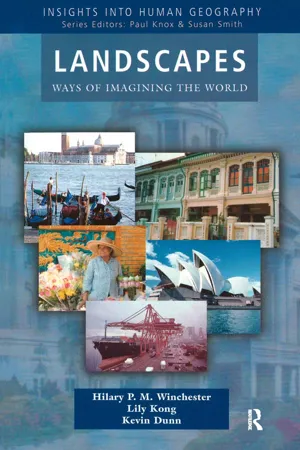 eBook - ePub
Landscapes
Ways of Imagining the World
- Hilary P.M. Winchester(Author)
- 2013(Publication Date)
- Routledge(Publisher)
Newspapers, radio and television images in Australia have had a decisive role in the construction of Islam and have been central to the mediation of negative stereotypes that underpin the opposition to mosque development. Stereotypical portrayals of religious groups such as Muslims, which circulate in the international and national media, feed into the locality, the street and the home (Dunn, 2001). Shared interpretations can lead to organised and common resistances to cultural spatial expressions. 2.5 Approaching the cultural landscape Clearly, studies of cultural distribution and diffusion, and other approaches that could be described as artefactual, are legitimate methods for cultural geographers. However, such work must be cognisant of the power relations that permeate society (Chapters 4 and 5). At the turn of the new millennium, cultural geographers are aware of the dynamic nature of culture and of the contested and fluid nature of meanings that are derived from landscapes and cultural products or texts. The cultural landscape is a complex process that has an important role in the re-production of everyday culture (Chapter 3). The everyday cultural landscape, and the texts of those landscapes, are the stuff of Cultural Geography. As we show in the following chapter, they are revelatory and constituent of our everyday ways of life. eBook - ePub
- J. Andrew Hubbell, John C. Ryan(Authors)
- 2021(Publication Date)
- Routledge(Publisher)
Cresswell (2015) defines the field as an “interdisciplinary endeavor with space and place at its heart that links decades of critical thought following the spatial turn [in the discipline of geography] to new developments in our digital capabilities” (7). The phrase the “spatial turn” refers to greater emphasis on space in geographical theory and practice. The geohumanities reflects conceptual and technical developments—such as geocoding—that enable innovative approaches to data processing and underlie the production of new representations of space and place. The geohumanities emphasizes space and place as unquestionably vital to all forms of knowledge production. After all, all action takes place in a “place.” It is thus informed by the actor’s perception of the space as a “place” for her actions. What we come to know or believe derives from our perceptions and actions in a specific place. As an example of the geohumanities in action, the Welikia Project aimed to reconstruct, in digital form, the original landscape of New York City circa 1609 when Dutch settlers first arrived. Studying this reproduction can give us an understanding of what the first European settlers perceived and how their actions turned that space into a meaningful place for themselves. For more information on the endeavor, see this chapter’s Weblinks section.Waypoint 5.1 Keywords in space and place studies
- Bioregionalism: the design of community structures according to bioregions usually defined by the boundaries of watersheds
- Globalization: the global-scale, capital-driven, free market economy in which economic, commercial, political, and other activities no longer adhere to national boundaries
- Livelihood: a concept outlined by cultural theorist Raymond Williams that opposes the nature–culture opposition and encourages a sustainable approach to making a living from the physical world
- Mobility: the ways in which humans, more-than-humans, technologies, ideas, and ideologies move between spaces and places
- Non-place: a concept proposed by anthropologist Marc Augé to describe places of excessive information and space, such as supermarkets, airports and motorways
- Place: the space that someone identifies with as meaningful and imbued with memories shared by individuals and communities
- Placelessness: a term coined by geographer Edward Relph to refer to the substitution of places of character with homogenized landscapes that lack identity, such as malls
- Sense of place: the distinctive feeling we have for particular places as experienced through our senses, bodies, minds, and memories; a sense of place is essential for a sense of belonging and identity
- Space
 eBook - ePub
- Roderick Adams(Author)
- 2023(Publication Date)
- Routledge(Publisher)
The built environment can be categorised into five specific levels (and scales) of description. The first is driven by the geographical location and urban configuration of the populated landscape. This is usually impacted by large-scale natural features such as rivers, seas, coasts, forests, mountains and valleys. Human settlement and the built environment (city, town, villages, suburbia, parishes, wards) emerge from this landscape and are populated with buildings, avenues, streets, parks and urban spaces. These are the first-level cultural layers that affect and impact the shape of human society and the formulation of communities. These large-scale layers are critical to the development of human civilisation and develop cultural impact; they have been constructed to be permanent and long-lasting, helping to anchor regional identity and cultural sustainability. Their permanence can enhance and restrict cultural development in equal measure by having significant regional cultural influence, but also are difficult to flex in line with the natural changes in human lives. The second level begins to be a little more intimate and understandable and concerns the regions or districts of a city or town. Most large-scale urban developments are actively subdivided, creating districts with their own identity and cultural mix. These are usually anchored geographically to roads, rivers and urban boundaries. They are often territories defined by activity but described as “cultural zones” (E.g., arts, creative economy, business, civic) which act quite differently, depending on the cultural profile of the city. When the zones relate to domestic living, they begin to actively shape the way culture forms within a city. This is where cultural communities are formed around spaces in the built environment. This is where a range of different types (and ranges) of buildings and their activities begin to cohere around certain cultural identities
Index pages curate the most relevant extracts from our library of academic textbooks. They’ve been created using an in-house natural language model (NLM), each adding context and meaning to key research topics.

