Geography

Cultural Landscapes
Cultural landscapes refer to the visible human imprint on the environment, encompassing the physical, ecological, and cultural elements of a place. They reflect the interactions between people and their surroundings, including built structures, agricultural patterns, and symbolic features. Cultural landscapes are shaped by human activities and hold significant historical, aesthetic, and social value.
Written by Perlego with AI-assistance
Related key terms
1 of 5
10 Key excerpts on "Cultural Landscapes"
 eBook - ePub
Cultural Landscapes of Post-Socialist Cities
Representation of Powers and Needs
- Mariusz Czepczynski(Author)
- 2016(Publication Date)
- Routledge(Publisher)
Czepczyński 2006c ).The meaning of landscape is a compromise between the visible and the hidden, between reason and emotion, between morphology and function. The morphologies include historical glory; their monumental magnificence typically accentuated by usually ambitious imaginary (Turnbrige 1998). At the same time, cultural landscape is a picture of symbols rather than facts (Zukin 1993 ). It is also a product of the human values, meanings and symbols of the dominant culture within society. Landscapes as cultural products embody the culture of both the creators and the percipients. The setting can be represented and expressed by many modes of culture, including architecture, habits, literature, thoughts and meanings. Culture, in a very broad and post-modern sense, is central to understanding the landscape in that it frames and symbolizes economic, social and political processes. The compilation of cognitive objects and affective meanings forms the basis of new cultural geography, and are most crucial for the interpreting cultural landscape (Black 2003 , Hall 2002 , Zukin 1993 , Czepczyński 2006b ).Personal attitudes and feelings towards cultural landscape are seen as a crucial component of post-modern culture. The inner landscape or the imprinted setting within us, oriented by a personal ‘cognitive map’, leads us and often determines our spatial behaviour. The liminality of the inner landscape finds an echo in the city’s production of liminal space, incorporating areas that used to be tightly defined by social limits into market culture. The personally defined social landscape, based on private experiences, marks out the meaning and significance of the visible urban scenery. The inner or perceived landscape embodies our point of view. Our cognitive maps, aesthetic forms and ideologies replicate – while being reflected by – the shapes of the inner landscape (Zukin 1993 eBook - PDF
- Murat Ozyavuz(Author)
- 2012(Publication Date)
- IntechOpen(Publisher)
The cultural landscape concept has emerged as a systemic transdisciplinary study object. To understand the present context it is basic to understand the cultural landscape concept, representing an expression of cultural activities in a territory, and as such, it is a key factor for the sustainability study [7]. Cultural landscape is a XXI century integrative concept. Depredating conditions and trends of ecological-territorial systems and their effects on planetary life require an urgent change of the present dominant artificialization style and cultural landscape construction. We are part of the unique and interdepending web of life [8]. Complementary couplings of our construction cultural landscape style and nature organization result in healthy and sustainable Cultural Landscapes [9]. Starting from a historical ecological-territorial footprint and facing the relationship between agriculture, rurality and cultural landscape, the main objective of this work is to state the fundamentals to understand, develop, and construct a sustainable model adaptive of our age. Landscape Planning 152 2. Agriculture from nature 2.1 Nature Nature is the set of all entities and forces that constitute the territory. It is the natural world without mankind or civilization [10]. The natural world is the background matrix where humans have evolved during a long period of time, leading to rurality and urbanity as a complement to wildland [11, 12]. Since the presocratic time of Anaxagoras, it is stated that nothing is born or dies, but that everything emerges from preexisting entities and elements; just as it happens in Nature, which when artificialized, is transformed into a cultural landscape. Natural resources are the supply source of our civilization and act as the life support for our domain of existence [13]. This is the reason why the resources should be sustainably managed and maintained, turning the agricultural activities into a main component. eBook - PDF
- Irving Rouse(Author)
- 2009(Publication Date)
- Yale University Press(Publisher)
PAUL GROTH 1 Frameworks for Cultural Landscape Study Americans are like fish that can't see water. Although hu-man life requires the constant support of complex surroundings, most people in the United States do not consciously notice their everyday environments. 1 Uni-versal schooling in science and dozens of television nature programs have begun to sensitize Americans to animals and ecosystems. Yet, even Americans with ad-vanced degrees rarely have concepts for pondering, discussing, or evaluating their cultural environments. These people are in danger of being poor appreciators and managers of their surroundings. For almost fifty years, several loosely allied groups of writers and scholars have challenged such cultural ignorance in the United States. Most of them have done so under the rubric of cultural landscape studies. This collective enterprise is not a distinct discipline or academic department, but rather a shared enthusiasm for and concern with ordinary, everyday built environments. For writers in cultural landscape studies, the term landscape means more than a pleasing view of scenery. Landscape denotes the interaction of people and place: a social group and its spaces, particularly the spaces to which the group belongs and from which its members derive some part of their shared identity and mean-ing. All human intervention with nature can be considered as cultural landscape: the high-style cathedral or office tower, as well as the Depression-era Hooverville hut, a farmer s barbed-wire fence, or a kitchen garden. Cultural landscape stud-ies focus most on the history of how people have usedeveryday space—buildings, rooms, streets, fields, or yards—to establish their identity, articulate their social relations, and derive cultural meaning. The conviction among cultural landscape 1 FIG. 1. Main Street in Sauk Center, Minnesota, Sinclair Lewis's home town.
- Andreas Vassilopoulos, Niki Evelpidou, Oliver Bender, Alenka Krek, Andreas Vassilopoulos, Niki Evelpidou, Oliver Bender, Alenka Krek(Authors)
- 2008(Publication Date)
- CRC Press(Publisher)
The old dichotomy between culture and nature is nowadays overcome and the interaction and co-dependency between cultural and natural settings is widely accepted. In the context of this book, the term ‘geoculture’ is not used in sense of a system of cultures related to space, or, more defined as by Wallerstein (e.g. 1991), of a global cultural system which is “as a tension established by three ideologies: conservatism (right), liberalism (center) The role of geoinformation technologies in geocultural landscape research 5 and socialism (left)” (cf. Dussel 2002: 239). On the contrary, here, ‘geocultural’ attributes the specific binary characteristic of landscape, or the aggregate combination of cultural and natural environmental aspects in a given spatial scale. It identifies a dialectic relationship between these two components, specifically through the ways in which humans have utilised, exploited or been constrained by landscape/physical patterns. Natural landmarks, geomorphological features as well as environmen-tal parameters affect human life, while human intervention and activities affect the environment. For instance, regional agricultural patterns may reflect a combination of landform shape, slope steepness, river patterns, soil type and drainage (natural features) as well as human customs, ritu-als, preferences, symbols and needs (cultural features). 3 GEOCULTURAL LANDSCAPE CHANGE RESEARCH Landscape refers to a common perceivable part of the Earth’s sur-face (Zonneveld 1995).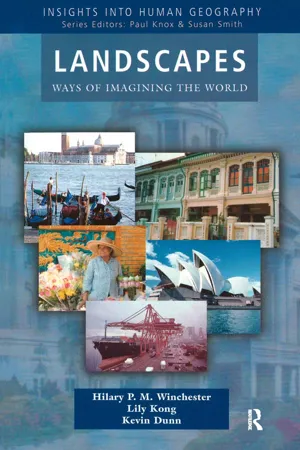 eBook - ePub
Landscapes
Ways of Imagining the World
- Hilary P.M. Winchester(Author)
- 2013(Publication Date)
- Routledge(Publisher)
Change in the landscape will equate with change in culture and vice versa. Landscape change can lag behind cultural change. A major transformation in the cultural look of the landscape is indicative of a major change in culture New tastes in cuisine and the entry of new cultures through migration will manifest spatially. Social disharmony and exclusion will manifest as segregation (see Figure 5.4 ) 2 Cultural landscape equality No specific landscape feature or cultural manifestation of a group is necessarily more or less important than another, better or worse The McDonald's Family Restaurant is as instructive to geographers as an artefact of culture; so is the Eiffel Tower 3 Everyday landscape of common things The ordinary landscape has been little researched. Researchers have been dismissive or disparaging of such common things. If studied with care and without elitism they can tell us a great deal about everyday culture The rapid spread of McDonald's Family Restaurants (see Figure 2.2 ) through Australia is reflective of the uptake of American popular culture, as ate the everyday shop fronts within malls 4 History and landscape To read a landscape properly a researcher needs to know something of the history of a place To interpret graffiti and murals in Belfast properly, one needs to know about sectarianism in Belfast, the Troubles and the historical development of Ireland, especially the north (see Figures 5.3 and 5.5 ) 5 Geographic context A landscape or landscape feature can only be understood with reference to the surrounding places and landscapes A reading of the city of Newcastle (see Figure 2.3 ) should bring an awareness of nearby coalfields and the nearby presence of a navigable port 6 Physical landscape The human landscape is related to the biophysical environment. Aspects such as terrain, climate and geology can be important The tiver, timber and the presence of coal deposits help explain the location and morphology of Newcastle (see Figure 2.3 ) 7 Landscape obscurity The landscape does not speak to us very clearly. Primary messages can be deceiving. Cultural geographers need to ask the right questions and look the right way eBook - PDF
Resilience and the Cultural Landscape
Understanding and Managing Change in Human-Shaped Environments
- Tobias Plieninger, Claudia Bieling(Authors)
- 2012(Publication Date)
- Cambridge University Press(Publisher)
(1) ‘The most easily identifiable is the clearly defined landscape designed and created intentionally by man (sic)’ (UNESCO, 2010). These are often garden and parkland landscapes, in which the materiality of the human effort is most obvious. (2) ‘The organically evolved landscape’ (UNESCO, 2010). This can be either a relict (fossil) landscape or a continuing one. In either case, material form is necessary. In the relict landscape, the distinguishing features are still visible; if continuing, it still exhibits significant material evidence of its evolution over time. (3) ‘The associative cultural landscape’ (UNESCO, 2010). In these cases, their listing is justified ‘by virtue of the powerful religious, artistic or cultural associations of the natural element rather than material cultural evidence, which may be insignificant or even absent’ (UNESCO, 2008). Themes of integration and connection between nature and culture are strong in the World Heritage conceptualisation of Cultural Landscapes: Cultural Landscapes are at the interface between nature and culture, tangible and intangible heritage, biological and cultural diversity – they represent a closely woven net of relationships, the essence of culture and people’s identity. Cultural Landscapes are a focus of protected areas in a larger ecosystem context, and they are a symbol of the growing recognition of the fundamental links between local communities and their heritage, humankind and its natural environment (Ro ¨ ssler, 2006: 334). While it could be argued that ideas of integration just mix culture and nature together without recognising that, as concepts, they may be inherently prob- lematic, it remains the case that the realities of management in most landscapes today involve recognising and dealing with human actions. The cultural land- scape concept appears to be a tool that managers find useful. eBook - PDF
- John A Agnew, David N Livingstone, John A Agnew, David N Livingstone, SAGE Publications Ltd(Authors)
- 2011(Publication Date)
- SAGE Publications Ltd(Publisher)
In doing so, they relied upon, and strongly emphasised, a notion of landscape as a tangible externality – landscape, in fact, as the objective world ‘out there’. However, and crucially, this does not mean that ‘landscape’ was equated with an untouched, non-human ‘nature’. Instead, landscape-as-material-record was most com-monly spoken of in terms of an interacting meshwork of human and natural forces, in which human cultures across the globe were understood in terms of their adaptation both to and of the natural environment. This understanding of landscape as a dynamic milieu in which the human and the natural both shape and are shaped by each other is perhaps most strongly presented in a classic monograph, The Morphology of Landscape (1963 [1925]), by the American geographer THE SAGE HANDBOOK OF GEOGRAPHICAL KNOWLEDGE 304 Carl Sauer. For Sauer, far from being synon-ymous with the natural world, landscape was always already cultural landscape, as defined in the following oft-cited statement: ‘The cultural landscape is fashioned from a natural landscape by a cultural group. Culture is the agent, the natural area is the medium, the cultural landscape the result’ (1963: 343). The work of Sauer and the ‘Berkeley School’ – comprising several generations of his colleagues and graduate students at the University of California, Berkeley – exer-cised a strong influence upon much of American human geography from the 1920s to the 1970s, and remains an important legacy today. With this fact in mind, it is worth delineating several elements of this ‘cultural landscape’ approach. First a key feature of the argument pre-sented in Sauer’s Morphology of Landscape is its stress upon the active role of human culture in shaping the natural world. No longer available |Learn more
Landscape Archaeology between Art and Science
From a Multi- to an Interdisciplinary Approach
- Sjoerd J. Kluiving, Erika Guttmann-Bond, Sjoerd J. Kluiving, Erika Guttmann-Bond(Authors)
- 2012(Publication Date)
- Amsterdam University Press(Publisher)
It is in a continuous process of development or of dissolution and replacement’ (Sauer 1925). Sauer is credited with introducing the concept of the cultural landscape, i.e. a landscape that owes much of its character to human intervention. The cultural landscape became the focus for the Berkeley school of American Cultural Geography, founded in the 1920s. The geog-raphy of this school included studies of the effects of people on the landscape and considered issues such as population density and mobility, the structure and extent of housing and settlement, the nature of produc-tion (e.g. farms, forests and mines) and the communication networks (Sauer 1925). Sauer made the point that landscapes are not static, but are continually changing, and therefore a study of the cultural landscape is a study of landscape history . Sauer said that one of the first steps that ought to be taken in historical geog-raphy is to try to understand ‘the former cultural landscape concealed behind the present one’ (Sauer 1941), a statement which more or less defines the aims of Landscape History and Landscape Archaeology. In fact, Landscape History and Landscape Archaeology are so inextricably linked that they are often regarded as being more or less the same thing (Barker & Darvill 1997; Johnson 2007a; Fleming, this volume). The 20th century has been characterised by the creation of new interdisciplinary studies, the blend-ing of different disciplines and the emergence of new fields of research. Sauer noted that geography was becoming increasingly interdisciplinary; economics were becoming an important element of landscape studies, and ‘sociologists have been swarming all over the precincts of human ecology’ (Sauer 1941). An important step in interdisciplinary thinking was Eugene Odum’s development of the field of Ecology in the 1940s. eBook - ePub
Human Geography
A History for the Twenty-First Century
- Georges Benko, Ulf Strohmayer, Georges Benko, Ulf Strohmayer(Authors)
- 2014(Publication Date)
- Routledge(Publisher)
2 Cultural geography: place and landscape between continuity and change Paul Claval and J. Nicholas EntrikinGeography has a long history, but human geography was born only in the late nineteenth century, in Germany, with the publication in the 1880s of the first volume of Ratzel’s Anthropogeographie (1881–91). From the outset, culture was thought to be a significant aspect of human geography, but the cultural approach to the discipline was hampered by the dominant naturalist and positivist epistemologies.Geographers held different views of their field. For the majority of them, geography had to explain fundamentally the regional (and local) differentiation of the earth. With the growing influence of evolutionism, the relationship between man and milieu appeared as the most successful challenger of the earlier regional perspective. In order to avoid conflict between the two conceptions, the idea that geography was the science of landscapes began to flourish. It offered a major advantage: a specific field for geographic inquiry.These three conceptions were generally combined: geographers explored the diversity of the earth and prepared maps to show it; they had an interest in the diversity of landscapes, which introduced a large-scale, local component, to their approach; they often focused — either at the global, regional or local level — on man-milieu relationships. Their ambition was to present an objective description of the earth and develop a knowledge of the laws which explained its organization. Generally, they had no interest in the geographical views or interpretations developed by the people they studied. These conceptions evolved, but their epistemological basis remained remarkably stable until the mid-twentieth century. eBook - PDF
- James Duncan, Nuala C. Johnson, Richard H. Schein, James Duncan, Nuala C. Johnson, Richard H. Schein(Authors)
- 2008(Publication Date)
- Wiley-Blackwell(Publisher)
Mitchell, M. 2001: The Lure of the local: landscape studies at the end of a troubled century. Progress in Human Geography 25, 269–81. Myers, G. 2002: Colonial geography and masculinity in Eric Dutton’s Kenya Mountain. Gender, Place and Culture 9, 23–38. Nash, C. 1999: Landscapes. In P. Cloke, P. Crang, and M. Goodwin, eds., Introducing Human Geographies . London and New York: Arnold, 217–25. Nash, C. 2000: Performativity in practice: some recent work in cultural geography. Progress in Human Geography 24, 653–64. Nevins, J. 2000: How high must operation gatekeeper’s death count go? Los Angeles Times , Sunday, Nov. 19. Nevins, J. 2001: Operation Gatekeeper: The Rise of the “Illegal Alien” and the Remaking of the US–Mexico Boundary . New York and London: Routledge. Olwig, K. 2002: Landscape, Nature, and the Body Politic: From Britain’s Renaissance to America’s New World . Madison: University of Wisconsin Press. Painter, J. 2000: Pierre Bourdieu. In M. Crang and N. Thrift, eds., Thinking Space . London and New York: Routledge, 239–59. Portillo Jr., E. 2002: Art’s meaning on the border is in the eye of the beholder. Arizona Daily Star , Wed. April 24 (available: http://muralesfrontera.homestead.com/files/arizonadailystar. jpg). Pratt, M. L. 1992: Imperial Eyes: Travel Writing and Transculturation . London and New York: Routledge. Pringle, R. 1999: Power. In L. McDowell and J. Sharp, eds., A Feminist Glossary of Human Geography. London and New York: Arnold, 216–18. Rose, G. 1993: Feminism and Geography . Minneapolis, MN: University of Minnesota Press. Ruddick, S. 1996: Constructing difference in public spaces: race, class, and gender as inter-locking systems. Urban Geography 17, 132–51. Schein, R. 1997. The place of landscape: a conceptual framework for interpreting an American scene. Annals of the Association of American Geographers 87, 660–80. Scott, J. 1986: Weapons of the Weak: Everyday Forms of Peasant Resistance.
Index pages curate the most relevant extracts from our library of academic textbooks. They’ve been created using an in-house natural language model (NLM), each adding context and meaning to key research topics.

