Geography

Physical Environment
The physical environment refers to the natural features and processes that make up the Earth's surface, including landforms, water bodies, climate, and ecosystems. It encompasses the interactions between the atmosphere, lithosphere, hydrosphere, and biosphere. Understanding the physical environment is essential for studying geographical patterns, human interactions with the environment, and the impact of natural phenomena on society.
Written by Perlego with AI-assistance
Related key terms
1 of 5

9 Key excerpts on "Physical Environment"
 No longer available |Learn more
- James Petersen, Dorothy Sack, Robert Gabler(Authors)
- 2016(Publication Date)
- Cengage Learning EMEA(Publisher)
Physical geography is this study of the natural aspects of Earth as our habitat and home. Earth is beautiful and intriguing—a dynamic life- giving planetary oasis of great environmental diversity. It is important for people to gain an understanding of the planet that sustains us—to learn about the components and processes that change and regulate Earth’s environmental conditions. In all fields of study, asking questions is an important step toward acquiring knowledge, explanations, and understanding. In physical geography, many of our questions are directed toward how Earth’s matter, energy, and processes interact to create the environmental diversity that exists on our planet. The Study of Geography Physical geography is a major part of the field of geography, which is the study of all aspects of Earth in its role as the home of people. The word geography comes from the Greek language. Geo refers to Earth, and graphy means picture or writing, thus the word itself designates a broad field of study. Geography as a whole includes the examination, description, and explanation of cultural as well as natural physical variables on Earth. Geography emphasizes how physical and cultural attributes vary from place to place, how places and features change over time, and the pro- cesses and interactions responsible for these variations. Geogra- phy is commonly considered the spatial discipline (the study of locational space) because it includes analyzing and explaining the locations, distributions, patterns, variations, and similarities or differences among phenomena on Earth’s surface. Geography is an integrative discipline that brings together the physical and human dimensions of the world in the study of people, places, and environ- ments. Its subject matter is the Earth’s surface and the processes that shape it, the relationships between people and environments, and the connections between people and places. eBook - ePub
Human Behavior
A Cell to Society Approach
- Michael G. Vaughn, Matt DeLisi, Holly C. Matto(Authors)
- 2013(Publication Date)
- Wiley(Publisher)
Chapter 12 The Physical Environment In the previous two chapters we examined the fundamental roles of technology and demography and how these core infrastructural domains serve to meet the basic needs of a society. In this chapter we examine the third component of a social system's infrastructure, the Physical Environment. The Physical Environment refers to the natural environment and the built environment. It should be noted that the term ecology is often used interchangeably with these forms of environment. Both forms of environment shape and are shaped by the behavior of humans in myriad ways. Technology and demography are highly intertwined with the Physical Environment and often vary in accord with changes in that environment. Future chapters will continue to deepen the triadic relations of technology, demography, and Physical Environment by examining the role of political and economic institutions and ideology. Knowledge of the interaction between humans and the Physical Environment is an interdisciplinary field of study that, although naturally involving geography, also includes biology, environmental psychology, architecture and design engineering, public health, anthropology, social work, and sociology. The interconnectivity of humans within the Physical Environment, both in the long and short run, is the major theme of this chapter. It delineates specific effects of the natural and built environments and the associated spatial determinants that influence the pursuit of satisfying basic needs and well-being by individuals and collectives. Distal Context Geographic Origins of Inequalities In Chapter 11, we noted the work of Jared Diamond and his seminal work Guns, Germs, and Steel (1997) with respect to the role that technological advances played in facilitating the conquest of the Americas by Europeans eBook - ePub
- Simon Catling, Tessa Willy, Author(Authors)
- 2018(Publication Date)
- SAGE Publications Ltd(Publisher)
Physical and human geography appear all around us and are important in our daily lives. The natural world provides us with a wide range of resources that provide the raw materials for bricks, stone, concrete, tiles, wood and glass for buildings, as well as the sources of the metals, plastics and energy from which we manufacture materials and generate electricity. Our mobile phones depend for their materials on the natural environment, but they are also the result of human ingenuity, from design to component manufacture and to sales, supported by the sites of aerials to enable us to keep in touch with each other and with the variety of websites we access. Understanding how our food is grown, the nature and quality of the soil, what optimal agricultural conditions are for different crops and animal husbandry, how food is processed before it reaches us and then the energy we use for cooking, require and integrate many aspects of physical and human geography in describing and explaining what happens, why and with what effect for ourselves and others. Physical and human geographies are key to understanding our everyday lives, just as much as in helping us know about and appreciating the nature, events and activities of the wider world. These two interrelated aspects of geography matter a great deal to us all.Environmental geography
Geographers have always recognised that physical and human geography are inextricably linked and highly dependent upon one another in a dynamic and constantly evolving way. They effect, change and impact on each other continuously and so, within geography, cannot realistically be seen separately, although research on particular topics may give this impression. This interface has been termed environmental geography (Castree et al., 2009), and at times an holistic or unified approach in geography, to describe both the processes and the impact of each aspect on the other (Matthews and Herbert, 2004, 2008). This is indicated in Figure 6.1 . Topics that might be included in environmental geography include climate change and deforestation as well as land reclamation and conservation.An understanding of environmental geography is crucial if we are to appreciate the complexity of the interrelationship of human geography and physical geography and how we can live in a sustainable way on the Earth. While it is important to understand the specific processes in physical and human geography, we also need to help children appreciate the interplay between them, and how that impacts on people’s lives and the Physical Environment in which we live. This can be exemplified through two examples.Figure 6.1 Aspects of physical and human geography and their interface with environmental geographyWhen building a dam to create a reservoir to provide water for settlements, it is crucial to understand the local geology and geomorphology in order to select the best valley site. In the case of a dam built in Andalucía in Spain, the engineers did not appreciate that they were building a dam in a limestone environment and could not understand why it never filled up. The water appeared as a waterfall where the rock type changed over 10km away and the dam became a white elephant and could never be used – it remains there today. Understanding the local geology is fundamental, just as it is essential to know that building a dam directly affects those who live and use the land in the chosen valley site, who will need to be moved out, as well as those who live downstream from the reservoir. It will be essential to do everything to mitigate negative impacts. eBook - PDF
- James Petersen, Dorothy Sack, Robert Gabler, , James Petersen, Dorothy Sack, Robert Gabler(Authors)
- 2014(Publication Date)
- Cengage Learning EMEA(Publisher)
The Environmental Perspective In the broadest sense, our environment can be defined as our surroundings, consisting of all physi-cal, social, and cultural aspects of our world that affect our growth, our health, and our way of living. Physical Environments are systems composed of a wide variety of features, characteristics, and pro-cesses that involve interconnections among weather, climate, soils, rocks, terrain, plants, animals, water, and humans. Physical geography’s holistic approach is well suited to understanding environments, because important environmental factors and pro-cesses are considered both individually and as parts of a functioning system. A tmosphere Atmosphere Biosphere Biosphere Lithosphere Lithosphere Hydrosphere Hydrosphere ■ FIGURE 1.9 Earth’s four major subsystems. Studying Earth as a system is central to understanding changes in our planet’s environments and adjusting to or dealing with these changes. Earth consists of many interconnected subsystems. How do these systems overlap? For example, how does the atmosphere overlap with the hydrosphere, or with the biosphere? All, © Dr. Parvinder S. Sethi; center inset, NASA ■ FIGURE 1.10 This new volcanic island formed in the Red Sea beginning on December 23, 2011 when volcanic eruptions from the seafloor began to reach the surface. The island at this time was about 500 meters long, but growing. Once this volcanic island cools, what other environmental changes could slowly begin to take place? NASA Copyright 2013 Cengage Learning. All Rights Reserved. May not be copied, scanned, or duplicated, in whole or in part. Due to electronic rights, some third party content may be suppressed from the eBook and/or eChapter(s). Editorial review has deemed that any suppressed content does not materially affect the overall learning experience. Cengage Learning reserves the right to remove additional content at any time if subsequent rights restrictions require it. eBook - PDF
- James Petersen, Dorothy Sack, Robert Gabler, , James Petersen, James Petersen, Dorothy Sack, Robert Gabler(Authors)
- 2021(Publication Date)
- Cengage Learning EMEA(Publisher)
Cengage Learning reserves the right to remove additional content at any time if subsequent rights restrictions require it. 4 C H A P T E R 1 • P H Y S I C A L G E O G R A P H Y : P H Y S I C A L , S P A T I A L , A N D E N V I R O N M E N T A L S C I E N C E Earth is beautiful and intriguing—a dynamic life-giving planetary oasis of great environmental diversity. Physical geography is an important means for better understanding the planet that sustains us. Through physical geography, we learn about the critical components and processes that change and regulate Earth’s environmental conditions. As in all fields of study, asking questions is an important step in physical geography toward acquiring knowledge, explanations, and understanding. In physical geography, many of our questions concern how Earth’s matter, energy, and processes interact to create the dynamic environmental diversity that exists on our planet. 1-1 Geography Is Physical, Human, and Spatial Physical geography is one of the two major components of the field of geography, which is the study of all aspects of Earth in its role as the home of people. The word geography comes from the Greek language. Geo refers to Earth, and graphy means pic- ture or writing, thus the word itself designates a broad field of study. Whereas physical geographers analyze the nonhuman ele- ments of Earth’s environments, the other major component of the discipline, human geography, concerns the nature, processes, and variations in space and time of human-generated phenomena, including culture. Human geographers are concerned, for example, with such topics as population distributions, mi- gration patterns, cultural patterns, the spread of ideas, cities and urbanization, industrial and commercial location, natural re- source use, and transportation networks.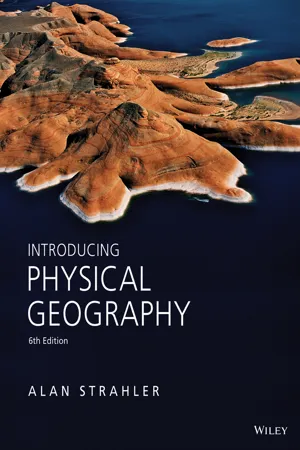 eBook - PDF
- Alan H. Strahler(Author)
- 2013(Publication Date)
- Wiley(Publisher)
6 Physical Geography and the Tools Geographers Use and human patterns of the Earth’s physical and cultural landscape change and interact in space and time. HUMAN AND PHYSICAL GEOGRAPHY Like many other areas of study, geography has a number of subfields, each with a different focus but often overlapping and interlocking with other sub- fields. We can organize these subfields into two broad realms: human geography , which deals with social, economic and behavioral processes that differentiate places; and physical geography , which examines the natural processes occurring at the Earth’s surface that provide the physical setting for human activities. Figure I.3 is a diagram showing the principal fields of physical and human geography. Reading downward from the left, we see five fields of physical geography, from climatology to biogeography, which are illus- trated in Figure I.4. These topics are the main focus of this text. Climatology is the science that describes and explains the variability in space and time of the heat and moisture states of the Earth’s surface, especially its land surfaces. Since heat and moisture states are part of what we call weather, we can think of climate as a description of average weather and its variation at places around the world. Chapters 1–7 will familiar- ize you with the essentials of climatology, including the processes that control the weather we experience daily. Climatology is also concerned with climate I.3 Fields of systematic geography Physical and human geography have many interrelated subfields.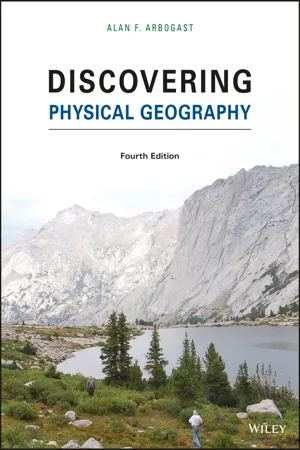 eBook - PDF
- Alan F. Arbogast(Author)
- 2017(Publication Date)
- Wiley(Publisher)
At a secondary level, you will be asked to examine how aspects of physical geography affect human lives and, in turn, how people impact them. This opening chapter outlines the topics discussed in this book and places them in the context of the overall discipline of geography. Then we discuss the various components and features of the book and how they will assist with your learning. Kyu Oh/Getty Images This view of Mt. Hood in Oregon reflects many geographical processes discussed in this text, including the character of the atmosphere, how water is stored and flows within the hydrosphere, the role of climate and its impact on vegetation, and the way landscapes evolve over time. 2 CHAPTER 1 Introduction to Physical Geography The Scope of Geography When most people are asked to describe the nature of geog- raphy, a common response is that the discipline focuses pri- marily on the locations of countries, capital cities, rivers, and oceans. They also assume that most of the work geographers do involves maps in some way. Although such an under- standing of the discipline is accurate to some degree, the field actually encompasses far more than the average person real- izes. In fact, geography is a discipline that is highly relevant to everyday life in myriad ways, ranging from analysis of traffic patterns to importation of economic goods, migration of ethnic groups, cost of gasoline, and earthquake hazards, to name a very few. In addition to maps, geographers use a fascinating array of techniques and technologies to conduct their work, such as computer models, field reconnaissance, personal inter- views, satellite imagery, global positioning systems, and even shovels. Geography, a word derived from the Greek words for “Earth description,” is an ancient discipline that examines the spatial attributes of the Earth’s surface and how they differ from one place to another. eBook - PDF
- Stephen S. Birdsall, Jon C. Malinowski, Wiley C. Thompson(Authors)
- 2017(Publication Date)
- Wiley(Publisher)
19 C H A P T E R 2 Joe Cornish/Getty Images, Inc. GEOGRAPHIC PATTERNS OF THE Physical Environment 20 T he Physical Environment, modified by human effort, impinges on our lives regardless of where we live. Where you live affects how much and what part of the Physical Environment you notice, but the amount of attention is governed by how much the Physical Environment is modified. For example, climate may be the environmental condition most noticed by people who live in North America’s large cities because the original topography and vegetation in many areas have been modified beyond recognition. Residents of smaller towns and rural areas, on the other hand, attend to their local topography, water conditions, and perhaps soils and vegetation as well. As described in this text, regions are expressions of landscape patterns formed primarily through human activity and human organization. Thus, the Physical Environment is only one of several factors that help explain the character of geographic distributions in the United States and Canada. Even so, the physical envi- ronment is integral to the makeup of all regions. T H E P H Y S I C A L E N V I R O N M E N T Topography Compared to a continent such as Europe, where very dif- ferent landforms are close to each other, the topographic regions of Canada and the United States are extensive (Figure 2.1). It is possible to drive an automobile in North America for days and encounter little change in landform appearance. Even so, because most long trips are east‐west and the major topographic features extend north‐south across the two countries, travelers often cut across the continental grain and move through several topographic regions each day. In its most general form, the topography of North America consists of broad lowland plains—some flat and others gently rolling—with long mountain- ous zones paralleling the East and West coasts. eBook - ePub
The Development of Russian Environmental Thought
Scientific and Geographical Perspectives on the Natural Environment
- Jonathan Oldfield, Denis Shaw, Denis J B Shaw(Authors)
- 2015(Publication Date)
- Routledge(Publisher)
Grigor'ev, 1932 , p. 58):- The study of the structures of the physical-geographical process flowing on the earth's surface (within its ‘physical-geographical’ envelope) both as a whole and also in its local modifications.
- The study of the interrelationship between local modifications of the process and the dialectical contradictions of the system and its parts.
- The study of the quantitative expressions of local modifications of the physical-geographical process – namely the study of the balance of substances and energy and equally of those external forms from which the structure of the physical-geographical process derives/derived its external expression.
- Research on the structure of the physical-geographical process and its essence in order to establish the most expedient methods for changing it within the context of the developing socialist reconstruction of the economy.
In April 1933 at the first All-Union Geographical Congress in Leningrad, Grigor'ev restated his argument for a dynamic geography reconstructed on the basis of dialectical materialism and firmly tied the discipline's cart to the horse of the Soviet state and its political priorities (Grigor'ev, 1933 ). By focusing geography on the physical-geographical envelope and, more specifically, the single physical-geographical process, Grigor'ev believed geography could be reconstructed in accordance with the dictates of dialectical materialism by concentrating on a distinct process. Furthermore, unlike Berg's landscape science with its seemingly painstaking, localistic, and conservative vision, this refocused geography would be a dynamic geography reflecting Engels’ view of nature as ‘in ceaseless flux, in unresting motion and change…’ (Engels, 1940 , p. 13; Grigor'ev, 1965
Index pages curate the most relevant extracts from our library of academic textbooks. They’ve been created using an in-house natural language model (NLM), each adding context and meaning to key research topics.
