Literature

Homi Bhabha
Homi Bhabha is a prominent postcolonial theorist known for his work on cultural hybridity and the concept of "third space." His influential ideas have had a significant impact on literary and cultural studies, particularly in relation to postcolonial literature and the representation of identity, power, and difference. Bhabha's work has been instrumental in shaping critical approaches to understanding the complexities of colonial and postcolonial discourse.
Written by Perlego with AI-assistance
Related key terms
1 of 5
9 Key excerpts on "Homi Bhabha"
 eBook - ePub
- Peter Childs, Patrick Williams(Authors)
- 2014(Publication Date)
- Routledge(Publisher)
Bhabha’s hybridityIntroduction
Homi Bhabha, who was born and brought up in India, studied at Bombay and then Oxford, lectured for many years at Sussex University, and now teaches at Chicago, locates his own history as that of someone from a border position: ‘a middle-class Gujarati and English-speaking Parsi, already a minority in the Indian context’.1 Another migrant intellectual, Bhabha has had an effect on post-colonial theory very different from Said’s. Orientalism was one of the most ambitious and influential books in the humanities and social sciences published in the 1970s and it provided academics such as Bhabha with both a critical arena and an intellectual project.2 By contrast, Bhabha came to prominence through a series of seminal essays published in the 1980s. Only in 1994 were a majority of these brought together in one book, The Location of Culture . Also, Bhabha’s approach to colonial discourse is dissimilar to Said’s, which Bhabha sees as too reliant on over-simplifying binaries such as East and West, colonizer and colonized, latent and manifest Orientalism. On the one hand, Bhabha uses Said as a point of departure and an early article of the 1980s opens with a quotation from Said which also states Bhabha’s own intellectual position:To re-integrate himself with worldly actuality, the critic of texts ought to be investigating the system of discourse by which the ‘world’ is divided, administered, plundered, by which humanity is thrust into pigeonholes, by which ‘we’ are human, and ‘they’ are not.3On the other hand, while Said discusses the differences and oppositions between colonizer and colonized, Bhabha often examines their points of similarity and considers, for example, the stereotype as the cardinal point of colonial subjectification for both of them.4In his complex analyses of colonial relations, Bhabha mixes psychoanalysis and deconstruction, but, like Said, one of his starting-points is Foucault. So, while Peter Hulme defines colonial discourse as ‘an ensemble of linguistically based practices unified by their common deployment in the management of colonial relationships’,5 eBook - PDF
- V. Andreotti(Author)
- 2011(Publication Date)
- Palgrave Macmillan(Publisher)
Bhabha suggests that cultural translation based on such principles rejects claims to cultural supremacy and sovereignty by challenging celebrations of “past traditions, seamless narratives of progress and the vanity of humanist desires” (Bhabha 1994, 2) and becomes a site for struggle for “the historical right to signify” (ibid.). Hybridity and the Third Space of Enunciation For Bhabha, the naturalization of a superior fixed and knowable subject who constructs knowledge about another inferior fixed and 30 Actionable Postcolonial Theory in Education knowable subject is based on a radical denial of hybridity, as well as of the relational social construction of self and Otherness (Souza 2004, 122). Bhabha questions the premise of the very possibility of this knowledge. He questions “authentic representations” of both in the sense that any representation—is necessarily already contaminated by multiple systems of representation and, therefore, hybrid (Souza 2004, 114–15). The implication is that no representation can exist in isolation from its cultural or ideological categories— all systems of representation are imbricated in other systems of representation, and not dependent on anchored, objective external referents outside discourse—which makes the idea of authenticity indefensible. This notion is particularly important in the analysis of how ethnic minor- ity cultures are represented or self-represent in education. Bhabha suggests that colonial discourse fails to produce stable and fixed identities, as different systems of representation are involved in this construction, showing the existence of hybridity in the construc- tion of any representation. As Loomba (1998) points out, colonial dis- courses are diluted and hybridized in their process of delivery “so that fixed identities that colonialism seeks to impose on both the masters and the slaves are in fact rendered unstable [ . . . ]colonizer and colo- nized are both caught up in a complex reciprocity” (232). eBook - ePub
- Jane Hiddleston(Author)
- 2014(Publication Date)
- Routledge(Publisher)
The Monolingualism of the Other teaches us that a universalized deconstruction of claims for linguistic mastery reveals colonialism's ethical transgression, but the discussion of the specific exclusion of Algerian Jews operates on another level, and the relation between these two levels remains uneasy. Derrida shows that postcolonialism cannot be a holistic critique; it must continually shift and negotiate between its divergent ethical and political requirements, but it is this dynamism that prevents the field from becoming programmatic and stops the critic from falling into complacency when contemplating an evolving and still traumatized field.Homi Bhabha
The work of Bhabha is perhaps best known for its explicit endeavour to combine poststructuralism and postcolonialism. Bhabha's essays are littered with references to the work of Derrida, and many of his key concepts are taken from the latter's philosophy. Colonial discourse, for example, is conceived as structured in spite of itself by the movement of the “supplement”, by chains of meaning that it cannot possess, and both colonial and colonized cultures are “deconstructed” by means of attention to their complex and deferred significatory processes. Similarly, Bhabha uses the concept of “dissemiNation” to explore how the construction of a national identity always covers over traces and patches of discrepant cultural meanings produced by that nations heterogeneous and plural people. His discussions of colonialism and resistance share with Derrida's work a resistance to binary oppositions and a meticulous attention to the ambivalence underpinning any apparently fixed and assertive subject position. Bhabha adds to Derrida's exploration of the overlap between ethnocentrism and logocentrism a further engagement with the mechanics of colonial power and with the ways in which minority voices trouble the hegemonic cultural and national discourses operating on them. Indeed, more than once he criticizes Derrida for remarking on colonialism only in passing, and for not paying sufficient attention to specific and determinate systems of oppression. Nevertheless, Bhabha's more consistent attention to colonialism scarcely makes his thought more militantly politicized, and his focus remains, like that of Derrida, ethical or at least “ethical political”. Indeed, if much of Bhabha's work is descriptive of the workings of colonial or migrant culture, he also frequently slips into prescription and stresses the ethical requirement that we “elude the politics of polarity and emerge as others of our selves” (Bhabha 1994 eBook - PDF
- Geoffrey P. Nash(Author)
- 2019(Publication Date)
- Cambridge University Press(Publisher)
Yet like Said, Bhabha has always found himself performing theore- tical and critical acrobatics in switching between the deployment of “diffi- cult” theory and engagement in real-world events, participating for example in organizing groups of writers and activists around the fatwah declared on Salman Rushdie after the publication of The Satanic Verses. 4 While facing critics who baulk at his “impenetrable prose,” he was also enthusiastically taken up by artists and writers in the blossoming field of race and postcolonial theory, collaborated with eminent cultural critics such as Stuart Hall, as well as with celebrated artists such as Anish Kapoor, and written many articles relating to transformations in British culture that engaged with the dynamics of race and nation in the contemporary moment. If some of his key critical ideas – ambivalence, hybridity, the Third Space – have swept through the field of cultural theory and post- colonial studies, it is arguably because he named and attempted to con- tribute to the concerns of an emerging discipline. His thinking is marked by an increasing awareness in the fields of postcolonial studies, cultural studies and feminist scholarship of cultural transformations brought about by global postwar migrations and cultural and political interventions by black and ethnic minority groups on a local and global level, and in doing so he helped artists and writers to articulate the positions they found themselves in. Interestingly, whilst one of the major criticisms aimed at his writing has been their perceived lack of relation to real-world politics (a view that he actively challenges in his article “The Commitment to Theory”), his introductory essay in The Location of Culture comes partially from an exhibition catalogue for a pivotal and controversial biennial exhibition at the Whitney art gallery in New York in 1993. eBook - ePub
Reading Postcolonial Theory
Key texts in context
- Bibhash Choudhury(Author)
- 2016(Publication Date)
- Routledge India(Publisher)
The Location of Culture The question of agency: Bhabha’s postcolonial imperativeBy the time Homi Bhabha’s The Location of Culture appeared in print, ‘postcolonial’ as a term had its fair share of currency in critical discourse, articulated either through the historical envisioning of a past that required revision or in surveys that sought to address the subject of difference through a more insistent culture-centric lens. In many of these forays, the givens were quite a few, and as the writings of Frantz Fanon, Albert Memmi, Octavo Mannoni, for instance, demonstrated, the focus was primarily on inviting attention to the pressures exerted on the colonized space by an imperialist apparatus that imposed itself from multiple quarters. As decolonization facilitated more nuanced, as well as, critical responses to the experience of colonialism, thinkers such as Edward Said and Gayatri Chakravarty Spivak offered reading positions that sought to attend to circumstances that were not quite given the attention they were now being subjected to. More than a settled, unwavering condition, colonialism was not confined to an either/or frame alone, but questions of method and other theoretical priorities came to occupy thinkers by the end of the twentieth century. Why is the method of examination as important as the subject itself? That we are now considering such an issue, in fact, owes much to the theoretical intervention of Homi K. Bhabha who, along with Said and Spivak, called for a radical redrawing of disciplinary boundaries for a subject that was only just finding its feet.Homi Bhabha’s placement of characteristics for association with and identification of ‘postcolonialism’ extends beyond the circumstances of its function as a political response to the changed world order. This does not imply that his critical undertaking swerves away from the political conditions that postcolonialism as an ‘agency’ refers to, but, rather, it invites us to attend to the necessity of assessing the terms and what these analytical exercises entail in the very process of questioning. Bhabha is often found to be difficult , or even unnecessarily dense, but such labels fall off the mark when it comes to dealing with the practice of critical theory that he fashioned to address issues which no straight binary arrangement can effectively negotiate. The Location of Culture is a packed book. Heavily wrought in conceptual detail, the book’s density is not its ornament but is a required structural condition whereby Bhabha draws in the complicated but connected threads impinging upon the processes of history making as well as those which are apparently situated outside the limits of the discipline. Bhabha’s departure from the settled channels of early postcolonial thought is, at one level, an indication of the pressures contemporary reading strategies exert upon situations and subjects whereby the seminal importance of the analytical process itself is taken up for examination and scrutiny. Bhabha locates postcolonialism as an intervention, as an argumentative strategy whose potential to unsettle set notions of modernity offers access to situations and circumstances that other critical practices fail to sufficiently address. Postcolonialism’s value derives from its ability to bring to notice conditions of narrative that existing analytical designs do not consider necessary for the purposes of scrutiny. Is it then this interventionist dimension of postcolonial theory that Bhabha situates as its most recognizable characteristic? Certainly, postcolonialism is much more than an instrument of intervention. And spread across the pages of The Location of Culture are insights, and excitingly innovative forays that stretch the theoretical possibilities of postcolonial studies outside the already-confirmed space of colonial experience and its immediate aftermath. Drawing on the recognized trajectories of critical thought, but departing to forge his own line of argument, Bhabha envisions a theoretical roadmap for a postcolonial response to literature and society that not only adjusts to the continually evolving dynamics in the contemporary world but also engages with other analytical methods to examine the potential of the critical exercise itself. A key to Bhabha’s approach emerges in his essay titled ‘The Postcolonial and the Postmodern’, placed midway in The Location of Culture eBook - PDF
Nationality Between Poststructuralism and Postcolonial Theory
A New Cosmopolitanism
- P. Leonard(Author)
- 2005(Publication Date)
- Palgrave Macmillan(Publisher)
If Bhabha does indeed leave this reading of his work open – if theory should place general questions of knowledge and identity over a more situated interrogation of colonial power – then his criticism of Derrida would consequently lose its force, since the disinclination to offer precise readings of colonial inscriptions could no longer be seen as a critical shortcoming. Hybridity and multiculturalism Implied in Young’s claim that two contradictory arguments are at work in Bhabha’s account of cultural hybridity and colonial ambivalence is the idea that this account could be lucid and should make sense – an idea that Young goes on to dismiss in the closing pages of his chapter. White Mythologies ends its reading of Bhabha by arguing that the con- tradictions in his work mimic and deride the contradictions of colonial authority: Bhabha’s ‘use of disparate and conflicting theories produces just that kind of ambivalence which subjects the reader to the effects of colonial discourse’s disconcerting uncertainty’. 40 Inconsistency, Young comes to conclude, is critically provocative because it allows Bhabha’s 140 Nationality Between Poststructuralism and Postcolonial Theory writing to take on a heteroglossic quality, to parade the disjunctive undecidability that is central to colonial discourse, and thus to depart from the principles of reasoned, unequivocal, and transparent exposi- tion that have informed intellectual work in the West. This conclusion not only mitigates the force of Young’s initial criti- cism of Bhabha. It also blunts his assertion that the notion of hybridity disappears noiselessly from Bhabha’s agenda, since the increasing com- plexity of Bhabha’s work would no longer demand a corresponding departure from conceptual ambiguity. eBook - ePub
Politics of Possibility
Encountering the Radical Imagination
- Gary A. Olson, Lynn Worsham, Henry A. Giroux(Authors)
- 2015(Publication Date)
- Routledge(Publisher)
Staging the Politics of Difference: Homi Bhabha’s Critical Literacy Gary A. Olson and Lynn WorshamPostcolonial theorist Homi Bhabha sees writing, composition, as a “highly political” activity. Writing, defined in its broadest sense, is closely linked to the acquisition of agency. This is why it is important that we not treat writing as a simple medium of communication in which there is some transparent mediation between “already pregiven subjects, pregiven objects, and a preconstituted mise en scène .” For Bhabha, writing constitutes, in a dialogic way, new relationships among these elements and is thus a “continually revisionary,” perhaps even “revolutionary,” activity. And, of course, the connection between writing and agency leads to issues of critical literacy. Bhabha believes that critical literacy is intimately connected to the question of democratic representation. For example, he says in the interview below that “literacy is absolutely crucial for a kind of ability to be responsible to yourself, to make your own reading within a situation of political and cultural choice.” Yet, at the same time we must be cautious not to treat literacy as a panacea or to fetishize it. As Bhabha points out, racism often is the “leading ideology” of the most literate people. Thus, critical literacy in and of itself guarantees nothing, but it is an essential step toward agency, selfrepresentation, and an effective democracy. Consequently, the kind of work we do in composition is extremely important socially, and more institutions need to understand that the work of composition is less about linguistic competence than it is about critical intervention in the world.The acquisition of agency and critical literacy is linked to another subject central to Bhabha’s project: the role of theory. Theory enables people, both in the academy and in the public domain, to “break the continuity and the consensus of common sense”—to break it and to break into eBook - PDF
Learning Places
The Afterlives of Area Studies
- Masao Miyoshi, Harry Harootunian, Masao Miyoshi, Harry Harootunian, Rey Chow(Authors)
- 2002(Publication Date)
- Duke University Press Books(Publisher)
These ‘‘certain Black people’’ are too often forgotten in the euphoria of cele-brating the arrival of the postcolonial. It is true that Bhabha does eloquently specify ‘‘the demography of the new internationalism’’ in terms of ‘‘the history of postcolonial migration, the narratives of cultural and political diaspora, the major social displacements of peasant and aboriginal communities, the poetics of exile, the grim prose of political and economic refugees’’ ( 5 ). This account acknowledges that ‘‘the transnational dimension of cultural transformation— migration, diaspora, displacement, relocation—makes the process of cultural translation a complex form of signification’’ ( 172 ). Yet Bhabha’s vista emerges as narrower than the above comments promise; for while this does encompass di-verse ‘‘narratives where double-lives are led in the postcolonial world, with its journeys of migration and its dwellings of the diasporic’’ ( 213 ), what is fore-grounded by Bhabha in prose that can be translucent but is often purple (see, for example, 1 and 139 ) is ‘‘the poetics of relocation and reinscription’’ ( 225 ) known by the cosmopolitan artist, writer, intellectual, professional, financier, and en-trepreneur in the metropolis, rather than the ‘‘grim prose’’ of low-waged workers in Western capitals, and contract laborers in the Gulf states or other centers of capitalist growth within the Third World. Moreover, the claim that ‘‘the contin-gent and the liminal become the times and the spaces for the historical represen-tation of the subjects of cultural difference in a postcolonial criticism’’ ( 179 ), em-phasizes the ‘‘affective experience of social marginality’’—which by intimating the circulation of emotion and desire, registers the experience as one of unmiti-gated pleasure. Indeed assertions about the ‘‘unhomely’’ as paradigmatic of post-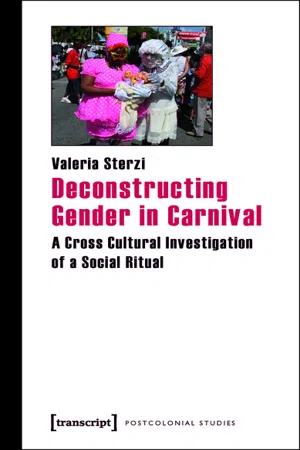 No longer available |Learn more
Deconstructing Gender in Carnival
A Cross Cultural Investigation of a Social Ritual
- Valeria Sterzi(Author)
- 2015(Publication Date)
- transcript Verlag(Publisher)
cit., p. 209 19 Bhabha (1994): op.cit., p. 86 D ECONSTRUCTING G ENDER IN C ARNIVAL 36 The characteristic of its hybridised nature is the mutuality of the process, that is to say the transaction of the postcolonial world is not a one way process, in which oppression obliterates the oppressed, or the colonizer silences the colonized in abso-lute terms. The great peculiarity of postcolonial phenomena consists in its capacity of transforming and »personalizing« ex-pressions of different cultures into a definition of an Own Cul-ture, that is, into a new »own« representation of the »Self« and the »Other«. It emphasises how hybridity and the power it re-leases may allow a means of the replication of the binary cate-gories of the past and develop new anti-monolithic models of cultural exchange and growth. If we assume that all cultural statements and systems are formulated within this contradictory and ambivalent space of enunciation, we will understand the reason why hierarchical claiming of an intrinsic cultural originality and purity are non-sense. The cultural variety and mutuality are recognition of cul-tural contents and habits »already performed«, which, if we consider them within the temporal frame of relativism, produce liberal notions of multiculturalism and cultural interactions of human culture. Indeed, we should now understand and agree with Bhabha’s conclusions on what he calls »Third Space«: » For a willingness to descend in that territory- where I have led you- may reveal that the theoretical recognition of the split-space of enuncia-tion may open the way to conceptualizing an inter national culture, based not on the exoticism* of multiculturalism or the diversity of cul-tures, but on the inscription and articulation of culture’s hybridity , to that end we should remember that it is the ‘inter’- the cutting edge- of translation and negotiation, the in-between space - that carries the bur-den of the meaning of culture.
Index pages curate the most relevant extracts from our library of academic textbooks. They’ve been created using an in-house natural language model (NLM), each adding context and meaning to key research topics.

