Literature

Gayatri Chakravorty Spivak
Gayatri Chakravorty Spivak is a prominent postcolonial theorist known for her work on deconstruction, feminism, and postcolonialism. She is best known for her essay "Can the Subaltern Speak?" which examines the representation of marginalized voices in literature and society. Spivak's work has had a significant impact on literary theory, cultural studies, and postcolonial literature.
Written by Perlego with AI-assistance
Related key terms
1 of 5
11 Key excerpts on "Gayatri Chakravorty Spivak"
 eBook - PDF
From Agamben to Zizek
Contemporary Critical Theorists
- Jon Simons(Author)
- 2010(Publication Date)
- EUP(Publisher)
210 13 Gayatri Chakravorty Spivak (1942–) Stephen Morton Gayatri Chakravorty Spivak is one of the most influential post- colonial intellectuals of the contemporary period. She is best known for her controversial essay ‘Can the Subaltern Speak?’ and for her English translation of the French philosopher Jacques Derrida’s book De la Grammatologie , which was one of the first trans-lations of Derrida’s work to appear in English. But Spivak’s thought is also significant for her deconstructive rereading of Marx’s labour theory of value, her critical contribution to feminist thought, and more recently for her reflections on human rights and globalisa-tion. Spivak’s work has always challenged the authority of western philosophy, literature and culture by focusing on the histories and voices of those constituencies who are excluded from its purview: women, the colonised, the immigrant and the global proletariat. Life and Intellectual Context Gayatri Chakravorty was born in Calcutta on 24 February 1942, the year of the artificial famine in India and five years before India gained independence from British colonial rule. This radical political and cultural context in pre-independence Calcutta shaped Spivak’s earliest childhood experience, providing memories of the economic injustices wrought by British colonial policy and shaping Spivak’s own engagement with the global economic text. Gayatri Chakravorty came from a middle-class Hindu family and attended a missionary school in Calcutta, where she was taught by tribal Christians, who were ‘lower than middle class by origin, neither Gayatri Chakravorty Spivak (1942–) 211 Hindus nor Muslims, not even Hindu untouchables, but tribals – so-called aboriginals – who had been converted by missionaries’. eBook - ePub
- Jenny Edkins, Nick Vaughan-Williams, Jenny Edkins, Nick Vaughan-Williams(Authors)
- 2009(Publication Date)
- Routledge(Publisher)
It is as a postcolonial feminist critic that Spivak has most persistently challenged contemporary Western thought by showing how dominant institutional and cultural discourses and practices have consistently excluded and marginalized the subaltern, especially the subaltern woman. Her focus on subaltern women’s histories and her critique of the Subaltern project have radically challenged the way political identity has been conceptualized in much contemporary thought. Her emphasis on the subaltern’s ability to speak has particularly problematized notions of power, resistance, knowledge, memory and history in international relations theory. By moving deconstruction as a methodology from ethics to global economic and political relations she has also been able to reconceptualize traditional Marxist concepts. And by questioning the role of elite representation she has continually used her own role as an academic to challenge the academic profession. In particular she has been able to rethink feminist thought from the perspective of non-Western women’s lives and histories. These insights have been crucial for creating a global awareness of the local conditions that structure women’s oppression in different parts of the world. Critical debates on globalization, nationalism, identity politics, deconstruction, postcolonialism and gender in international relations theory have thus, more or less explicitly, been informed by much of Gayatri Spivak’s early ideas.Further reading
Spivak, Gayatri Chakravorty (1976) Of Grammatology, Baltimore: Johns Hopkins. This book features an extended ‘Translator’s preface’, that serves both as an introduction to Derrida and to Spivak herself.Spivak, Gayatri Chakravorty (1987) (1998) In Other Worlds: Essays in Cultural Politics, New York: Methuen 1987 and Routledge 1998. This book consists of essays on Dante, Marx, Wordsworth and Mahasweta Devi. It is Spivak’s most well known book and contains important ideas on feminism, Marxism, deconstruction, the subaltern and the literary text. A key text.Spivak, Gayatri Chakravorty (1988) ‘Can the Subaltern Speak?’, in Cary Nelson and Lawrence Grossberg (eds) Marxism and the Interpretation of Culture, Urbana: University of Illinois Press. This is probably Spivak’s most famous essay. Here she combines the theoretical and political insights of Marxism, feminism and deconstruction to show how the subaltern woman is constructed and controlled in paradoxical ways. A key text.Spivak, Gayatri Chakravorty (1990) The Post-Colonial Critic: Interviews, Strategies, Dialogues
- Robert McMurray, Alison Pullen(Authors)
- 2020(Publication Date)
- Routledge(Publisher)
4 Contributions from Gayatri C. Spivak to organizational thinking Rethinking identity, ethics and responsibility in a global context Banu Özkazanç-PanGayatri C. Spivak is an Indian-born scholar and philosopher whose main areas of scholarship are at the intersections of English literature, feminist theory and postcoloniality. Here, postcoloniality refers broadly to the study of the ways in which colonial powers, such as France, Britain and Spain, impacted the economies and societies of colonized nations and people. Spivak is currently Professor of Humanities at Columbia University and co-founder of the Institute for Comparative Literature and Society. Born in 1942 in Calcutta, India, Spivak spent the majority of her intellectual life in institutions in Europe and the United States (for an overview of Spivak’s early career, see Abdalkafor, 2015). Her work has had a major influence on the trajectory of postcolonial studies as a field of inquiry on/about the ‘Third World’ or as she suggests, what was left of the world after the United States and Russia split it up. In all, the multitude of contributions of Spivak to literature, feminist theories, and postcolonial studies are wide-ranging in their subject matter but share a commonality in influencing significantly the kinds of analyses that were being done in academia in relation to the Third World/Global South and specifically South East Asia. It has been difficult to pinpoint Spivak, throughout her career, as belonging to a particular intellectual tradition given the range of theories she deployed to craft arguments and engage in analyses.Despite this observation, Spivak’s major contributions to the field of postcolonial studies arrive from her engagement with the concept of the subaltern through feminist and deconstructive lenses, her use of the concept of ‘strategic essentialism’ and her consideration of the ‘Other’ as an epistemic analytic category for discussions around textual representation and voice. In the next section, I discuss her intellectual contributions in more detail and focus on key concepts, namely the subaltern No longer available |Learn more
- Jennifer Rich(Author)
- 2021(Publication Date)
- Humanities E-Books(Publisher)
This text will be discussed in the forthcoming Insights title, Feminist Theory . Critical Theory 7 Gayatri Chakravorty Spivak Gayatri Chakravorty Spivak is perhaps one of the most intellectually far-reaching postcolonial critics working today. Her work demands a profound understanding of Western philosophy, critical theory, history, and language. As a student of Jacques Derrida and translator of one of his most important works, On Grammatology , Spivak’s work owes much of its intellectual rigor to deconstruction, but her own analyses range far beyond this theoretical paradigm to interrogate that which remains unquestioned in even the most ‘radical’ of critical theory, namely, the notion of trans -parency (that which is self-evident, obvious, and therefore requiring no explication), the ‘knowing’ subject, and most importantly, ‘the subaltern’. Can the Subaltern Speak? Her most widely anthologized essay, ‘Can the Subaltern Speak’? is a virtuoso inter -rogation of Western (imperialist) understandings of the ‘subject’, the ‘intellectual’s’ political positioning, capitalism, and, of course, the ‘subaltern’. Spivak’s definition of the subaltern is subtle and demands an understanding of her critique of the subject formation in Western thought, as well as her complex decoding of the notion of repre -sentation in Marx’s work, particularly, the Eighteenth Brumaire of Louis Napoleon . The first part of her article spotlights a discussion between two intellectual giants of critical theory: Michel Foucault and Gilles Deleuze. While both of these theorists interrogate the notion of the all-knowing subject (the cogito) introduced by Rene Descartes, Spivak critiques them for not extending this discussion into questions of ideology and its implication in the formation of their own critiques of the subject. eBook - ePub
- Peter Childs, Patrick Williams(Authors)
- 2014(Publication Date)
- Routledge(Publisher)
Spivak and the subalternIntroduction
Post-colonial studies has placed critical theory in a new context, challenging its precepts and its applicability outside the West. No critic better exemplifies this practice than Gayatri Chakravorty Spivak.1 Without considering herself a critic of any one of these particular kinds, Spivak intervenes in feminist, Marxist, deconstructive, and psychoanalytic debates by testing their boundaries and foregrounding a post-colonial perspective.2 Of her early essays, she says that she has tried to situate feminist literary criticism in a critique of imperialism. She speaks of imperialism rather than colonialism because one of her aims has been to broaden analyses of colonial discourse from reappraisals of nineteenth-century European territorial expansion into debates over neo-colonial relations, racism in the West, and the international division of labour.3 Suspicious of single theoretical systems, large solutions, or grand narratives, she describes herself as a bricoleur, someone who uses the appropriate tools available to hand, and as an interventionist who focuses on small issues, local concerns. Rarely will she speak of feminism or Marxism without applying a situational label: French, Bengali, Anglo-US. Her most common concern is the position of the subject: the place from which someone addresses or conceives of an issue and formulates its areas of importance. From this perspective she also analyzes the dynamics of teaching and learning: ‘the micro-politics of the academy and the macro-narrative of imperialism’.4 Spivak always foregrounds specificity and maintains that as a teacher she is combating the homogenizing moves of ‘liberal-nationalist-universalist humanism’ together with such claims as the autonomy of art and of the author.5 eBook - PDF
Gayatri Chakravorty Spivak
In Other Words
- Sangeeta Ray(Author)
- 2009(Publication Date)
- Wiley-Blackwell(Publisher)
23 Spivak here is referring to the female suicide bomber, a member of the Liberation Tigers of Tamil Eelam, who blew herself up while simulta-neously killing the Indian Prime Minister, Rajiv Gandhi. She too had a name, Thenmuli Rajaratnam, though she was also known as Gayatri and Dhanu. Cited Works by Gayatri Chakravorty Spivak Books (chronologically) In Other Worlds: Essays in Cultural Politics . New York: Methuen, 1987. [ IOW ] The Post-Colonial Critic: Interviews, Strategies, Dialogues , ed. Sarah Harasym. New York: Routledge, 1990. [ PC ] Outside in the Teaching Machine . New York: Routledge, 1993. [ OTM ] Imaginary Maps . New York: Routledge, 1995. [ IM ] A Critique of Postcolonial Reason: Toward a History of the Vanishing Present . Cambride MA: Harvard University Press, 1999. [ CPR ] Imperatives to Re-imagine the Planet/Imperative zur Neuerfindung des Planeten , ed. Willi Goetschel. Vienna: Passagen, 1999. [ IRP ] Death of a Discipline . New York: Columbia University Press, 2003. [ DD ] Other Asias . Oxford: Blackwell, 2008. [ OA ] Other Works by Spivak (alphabetically) “Acting Bits/Identity talk.” Critical Inquiry 18/4 (1992): 770–803. “Can the Subaltern Speak?” In Marxism and the Interpretation of Culture , ed. Cary Nelson and Lawrence Grossberg. Urbana: University of Illinois Press, 1988, 271–313. “Claiming Transformations: Travel Notes with Pictures.” In Transformations: Thinking Through Feminism , ed. Sara Ahmed et al. London: Routledge, 2000, 119–30. “Displacement and the Discourse of Woman.” In Displacement: Derrida and After , ed. Mark Krupnick. Bloomington: Indiana University Press, 1983, 169–95. “Echo.” New Literary History 24/1 (1993): 17–43. “Ethics and Politics in Tagore, Coetzee, and Certain Scenes of Teaching.” Diacritics 32/3 (2002): 17–31. Bibliography 140 Bibliography “Feminist Literary Criticism.” In Routledge Encyclopedia of Philosophy , ed. eBook - ePub
Reading Postcolonial Theory
Key texts in context
- Bibhash Choudhury(Author)
- 2016(Publication Date)
- Routledge India(Publisher)
8 Gayatri Chakravorty Spivak: In Other Worlds Forms of engagement and cultures of reading Gayatri Chakravorty Spivak straddles many worlds in critical theory. Acts of definition, some of which have gained considerable currency in critical literature over the past several decades, have, it seems, transformed her name into a site that reflects not just the Spivak mind, but more crucially, these overtures have found moulds which project forms of critical engagement, each suggesting some of her preoccupations. Readers of Spivak have acknowledged, irrespective of how they are positioned as readers, her remarkable versatility, and as each foray of hers into critical space is prised open for purposes of scrutiny and critical insight, we see her pointers being drawn into structures that are sometimes considerably removed from the schemes in which they first emerged. The difficulty of reading Spivak stems, at one level, from this pull to which her texts are submitted to by enthusiastic readers; her wide range, and the outstanding variety of critical space that she covers through multiple agencies – interviews, translations, commentaries, essays, theoretical asides, books and critical discourses – this is borne out by the immense weight of her conceptual creativity and engagement with forms of reading. We can perhaps take a cue from Spivak herself in approaching a book like In Other Worlds: Essays in Cultural Politics, a repository of writings that is not only genre-challenging in arrangement but path-breaking in the ways the theoretical pathways are carved and crafted out of settled conventions. The book is an assortment of essays, each written in contexts that were separated from each other, but still threaded through that stamp of creative criticism that we have now come to associate with her writings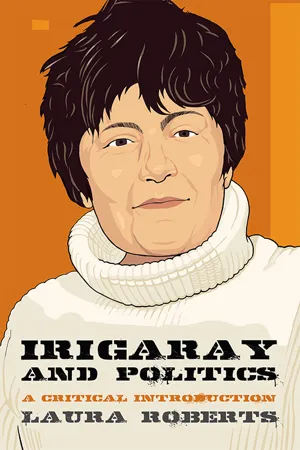 eBook - PDF
Irigaray and Politics
A Critical Introduction
- Laura Roberts(Author)
- 2019(Publication Date)
- Edinburgh University Press(Publisher)
Spivak’s analysis demonstrates, and goes beyond, the valuable lessons that Irigaray’s work teaches us. Not only must we, as women, challenge western metaphysics, but also the phallocentric logic underlying the masters of the crises of metaphysics, for example Heidegger, Levinas and Fanon. Continually moving between these two patriarchal struc- tures, Spivak and Irigaray bring about a heterogeneous sex-analysis that is radically confronting. Spivak continues and returns to her original question. She asks again, ‘How does the postcolonial femi- nist negotiate with the metropolitan feminist?’ (Spivak 1993a: 145). Must we assume that the postcolonial feminist has no use for the metropolitan feminist? The answer is not straightforward. Spivak writes: ‘What of the Irigaray who rereads Plato and Levinas? Can Hélie-Lucas have no use for her? On the contrary. Here again we revert to the task of decolonizing the mind through negotiating with the structures of violence’ (Spivak 1993a: 170–1). Spivak continues and suggests that Irigaray’s work may have relevance to a feminist citizen of a recently decolonised nation. She notes: there will be someone who is in that particular subject position – a femi- nist citizen of a recently decolonized nation concerned with its domes- tic/international political claims, not merely its ethnocultural agenda. To such a person I would say – whenever the teleological talk turns into unacknowledged, often travestied, articulations of the Plato of the Republic or Laws; or, indeed to the rights of the self-consolidating other, Irigaray’s readings must be recalled in detail. If such a person – I must assume her without alterity – holds a reproduction of this page, she will know, alas that such occasions will not be infrequent.
- Kelly Oliver(Author)
- 2013(Publication Date)
- Routledge(Publisher)
Gayatri Spivak, in an interview, urges us to shelve the question of essentialism. 4 Spivak says that she has “no time for essence/anti-essence,” while at the same time claiming to be “repelled by Kristeva's politics.” She “can't read her seriously anymore [ sic ]” because of Kristeva's “long-standing implicit sort of positivism”—her “naturalizing of the chora.” 5 What is it in Kristeva's politics that repels Spivak? Is she repelled according to the same schema within which she objects to the naturalizing of the chora ? Whatever naturalizing means, does it name anything different from the target of essentialist critiques? Is it certain that the outmoded functioning of the essentialist label as a taboo on the body has not left certain kinds of residues? Can the legacy of the essentialist critique be discerned in Spivak's objection to what she regards as Kristeva's naturalizing? The answers to such questions remain obscure so long as we fail to pay attention to the convoluted history of essentialism, and to the ways in which feminism itself, in different ways, is both implicated in essentialism, and generates various critiques of essentialism. We need to examine the ways in which the debate over essentialism is situated in terms of other motifs that have guided the development of feminism. We need to provide a his tory of the various ideological investments feminism has constructed for itself in legislating certain thinkers as essentialist and in attempting to maintain a place for itself outside that alleged essentialism eBook - PDF
Spivak and Postcolonialism
Exploring Allegations of Textuality
- T. Sakhkhane(Author)
- 2012(Publication Date)
- Palgrave Macmillan(Publisher)
Re-echoing the very thematics of origin and repetition, Spivak describes her own procedure as citational. 6 By often repeating herself and revising her earlier positions, she has kept herself active and busy, ready to modify and qualify former theoretical theses. Thus, as one leafs through In Other Worlds, Outside in the Teaching Machine, A Critique of Postcolonial Reason and other miscellaneous writings, one feature lingers flamboyantly plain: many of the essays either have appeared or are now to appear with new adjustments and rearrangements. In a manifest indication of this fact, Spivak confesses that she is still learning and unlearning so much that the earlier things that (she has) written become interpretable (to her) in new ways. 7 To her interviewers’ enquiry about forthcoming publications, Spivak declares in‚ ‘Strategy, Identity, Writing’ that she is more of essayist than book-writer, making of this lack a privilege. 8 Clearly enough, a cursory look at her textual biography as enclosed in The Spivak Reader will shed some light upon Spivak’s trajectory and evolution as a radical critic. Over a period that ranges from 1965 to 1999, Spivak produced over a hundred essays between reviews, interviews and critical essays. Out of the nine publications that dot her book-writing career, only two could be called books: Myself Must I Remake: The Life and Poetry of W. B. Yeats (1977), Thinking Academic Freedom in Gendered Postcoloniality (1992), the remainder are either interviews, essays published elsewhere, translations or editions: Of Grammatology, translation with critical introduction of Jacques Derrida (1976), In Other Worlds: Essays in Cultural Politics (1987), The Postcolonial Critic: Interviews, Strategies, Dialogues (1990), Outside in The Teaching Machine (1993), Imaginary Maps: Three Stories by Mahasveta Devi, translated by Spivak (1995), and Entry on Bookwork: Jamelie/Jamila 112 Revisiting Allegations of Textuality project by J. eBook - PDF
- Mark Sanders(Author)
- 2006(Publication Date)
- Continuum(Publisher)
Interview with Gayatri Chakravorty Spivak Mark Sanders (MS): In writing a book about your work for a series entitled 'Live Theory', what has most occupied me are the changes and develop-ments that have taken place in your thinking over the years. The ques-tions I have for you relate mainly to those changes. Let me open with this one: In the appendix to A Critique of Postcolonial Reason you point to an ethical turn in Derrida: the shift in emphasis from 'guarding the question' to the 'call to the wholly other'. You date this to the Cerisy colloquium of 1980 on 'The Ends of Man', where you heard Derrida, his work under intense discussion, make an unrehearsed response to a paper by Jean-Luc Nancy. This, for you, is a key moment in the 'setting to work of deconstruction'. In the last decade or more, you have explicitly taken up the topic of ethics in a number of texts. Did your work take an 'ethical turn' of its own? Was there an identifiable turning point for you? Does your occupation with the ethical predate your explicit engagement with ethics? Gayatri Chakravorty Spivak (GCS): All these answers are of course in terms of my stereotype of myself. They should be considered a text rather than the authoritative account. Given what I am I am deeply suspicious of one's own understanding of one's own trajectory, so I think as long as I am confident that you and your readers will take this as a text I can really let myself go, as my stereotype of myself. I certainly myself felt Derrida's ethical turn at Cerisy, but since then, especially in Voyous, 1 Derrida has been very careful to say that in fact the ethical was there right from the start. I think therefore both things are true: that it was there right from the start, and that there was a turn. The two earlier texts that he men-tions as being most inclined toward the ethical are the two texts that I also think of. One is 'Differance' 2 and the other is OfGrammatology. MS: And 'Violence and Metaphysics'?
Index pages curate the most relevant extracts from our library of academic textbooks. They’ve been created using an in-house natural language model (NLM), each adding context and meaning to key research topics.

