Literature

Edward Said
Edward Said was a Palestinian-American literary theorist known for his influential work "Orientalism," which critiqued Western representations of the East as a means of asserting power and dominance. He argued that these representations were not objective but rather served political and ideological purposes. Said's work has had a profound impact on postcolonial studies and continues to shape discussions on power, representation, and identity.
Written by Perlego with AI-assistance
Related key terms
1 of 5
12 Key excerpts on "Edward Said"
 No longer available |Learn more
- Jennifer Rich(Author)
- 2021(Publication Date)
- Humanities E-Books(Publisher)
Postcolonial Theory Edward Said Edward Said is most widely recognized for his far-reaching critique of academic and political orientalism which appeared in his best-selling book Orientalism (1978). Orientalism as an academic discipline was a conglomeration of political and linguis -tic studies of ‘the Orient’: an amorphous area that encompassed both the middle-east and Near East, depending upon the interests of the ‘expert’. While some scholars of the ‘Orient’ escaped objectionable biases toward the ‘East’ most of this scholar -ship was informed by the centuries-old distinction between the ‘West and ‘East” that originated with the experience of the Crusades in the Middle Ages. The ‘East’ or the ‘Orient’ was associated in the Western mind with despotism, backwardness, corrup -tion, and sexual immorality. J. A. D. Ingres’ painting Le Bain Turc (1862) is a good illustration of this understanding of the Orient as a place of sensual laziness and luxury. Politically, orientalist attitudes were bound up with and used to rationalize European colonialism. If the Orient was ‘backward’ and ‘despotic’ then its rescue must perforce lay in the wisdom of the Occident. This self-imposed pressure to ‘save’ the orient was understood—in grossly condescending fashion—as the ‘White Man’s Burden’. Of course, the notion of the ‘White Man’s Burden’ was a convenient excuse for the economic and social colonization of the Orient. The British ‘Empire’, for example, colonized India first via commercial interests and then formally from the mid 18th century to 1947, the year of India’s independence. eBook - ePub
- Jenny Edkins, Nick Vaughan-Williams, Jenny Edkins, Nick Vaughan-Williams(Authors)
- 2009(Publication Date)
- Routledge(Publisher)
28 Edward Said Latha Varadarajan Edward Said – the late University Professor of English and Comparative Literature at Columbia University, the music critic for the Nation, the man both widely regarded (by both supporters and critics) as one of the founding figures of the postcolonial tradition in the American academy, the outspoken supporter of the Palestinian cause in the West – was one of the best-known public intellectuals of the twentieth century. In a prolific career spanning nearly four decades, Said authored more than 20 books and 125 articles and inspired innumerable others. His influence – both during and after his life-time – over scholarship in fields ranging from cultural studies and English literature to anthropology and geography has itself been the subject of scholarly scrutiny. The goal of this essay is to draw attention to a few of the key texts and ideas associated with Said’s work in light of their importance for critical international relations scholarship. ‘Beginnings’ One of the most important concepts that Edward Said expounded on in all his writings is that of worldliness (Said 1983). Put simply, Said argued that texts and their authors do not exist in a vacuum. To treat the text simply as an inert object (that is to say for instance, a self-contained book), literature as something divorced from the world in which it is created, or the author as just a writer of a particular book is to miss the crucial fact that the production of the text by the author, a cultural production, is a political act that is deeply embedded in the relations of power in any given society. To understand these relations, one needs to understand the rootedness, the socio-political-cultural contexts that are productive of both the author and the ideas that make up his/her text eBook - ePub
Modern Criticism and Theory
A Reader
- Nigel Wood, David Lodge(Authors)
- 2014(Publication Date)
- Routledge(Publisher)
21 Edward Said
DOI: 10.4324/9781315835488-21Introductory note
Edward Said (1935–2003) was a Palestinian, educated in Palestine and Egypt when those countries were under British jurisdiction, and subsequently in the United States. He was Parr Professor of English and Comparative Literature at Columbia University, New York. Said’s first book was a critical study of Conrad, Joseph Conrad and the Fiction of Autobiography (1966), that took a phenomenological approach to its subject, but was recognizably within the tradition of Anglo–American ‘New Criticism’. Said was one of the first critics in America to respond to the challenge of European structuralist and post-structuralist theory, and his thoughtful, sometimes anxious reflections upon these developments may be traced in his books Beginnings (1975) and The World, the Text and the Critic (1983). Said disliked the increasing hermeticism of deconstructive criticism, and was drawn to Marxist and Foucauldian analyses of literature and culture as sites of political and ideological struggle. In Orientalism (1978) he found a rewarding subject for such an approach, and, in Culture and Imperialism (1993), he examined his earlier premisses in relation to the Western canon. In his later years, he took up the Palestinian cause without being impressed by its political strategies, and in The Politics of Dispossession (1994), Peace and its Discontents: essays on Palestine in the Middle East peace process (1996) and Culture and Resistance: conversations with Edward W. Said (conducted by David Barsamian – 2003), he applied some of the insights advanced in Orientalism to contemporary politics, a direct set of references that was to take in the second Gulf War in his From Oslo to Iraq and the Road Map (2003). Always concerned about the human plight of ideological effects, he turned increasingly to a form of humanism, and in Humanism and Democratic Criticism eBook - ePub
Postcolonial Theory
A Critical Introduction: Second Edition
- Leela Gandhi(Author)
- 2019(Publication Date)
- Columbia University Press(Publisher)
4 Edward Said and His CriticsT he principal features of postcolonialism’s intellectual inheritance—which we covered in the preceding two chapters—are realised and elaborated in Edward Said’s Orientalism (1991, first published in 1978). Here, as elsewhere in his extensive oeuvre, Said betrays an uneasy relationship with Marxism, a specifically poststructuralist and anti-humanist understanding of the contiguity between colonial power and Western knowledge, and a profound belief in the political and worldly obligations of the postcolonial intellectual. This chapter will provide some contexts for understanding the canonisation of this book as a postcolonial classic through a consideration of its academic influence and theoretical limitations.Enter OrientalismCommonly regarded as the catalyst and reference point for postcolonialism, Orientalism represents the first phase of postcolonial theory. Rather than engaging with the ambivalent condition of the colonial aftermath—or indeed, with the history and motivations of anti-colonial resistance—it directs attention to the discursive and textual production of colonial meanings and, concomitantly, to the consolidation of colonial hegemony. While ‘colonial discourse analysis’ is now only one aspect of postcolonialism, few postcolonial critics dispute its enabling effect upon subsequent theoretical improvisations.Gayatri Spivak, for example, has recently celebrated Said’s book as the founding text or ‘source book’ through which ‘marginality’ itself has acquired the status of a discipline in the Anglo-American academy. In her words, ‘the study of colonial discourse, directly released by work such as Said’s, has… blossomed into a garden where the marginal can speak and be spoken, even spoken for. It is an important part of the discipline now’ (Spivak 1993, p. 56). The editors of the influential Essex symposia series on the sociology of literature also invoke the spirit of Spivak’s extravagant metaphor to argue that Said’s pioneering efforts have single-handedly moved matters of colony and empire ‘centre stage in Anglo-American literary and cultural theory…’ (Barker et al. 1994, p. 1).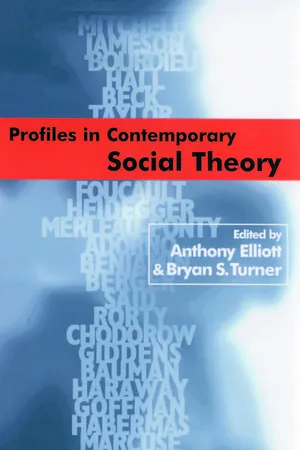 eBook - PDF
- Anthony Elliott, Bryan S Turner, Anthony Elliott, Bryan S Turner(Authors)
- 2001(Publication Date)
- SAGE Publications Ltd(Publisher)
In 1977, Said was elected to the Palestine National Council as an independent intel-lectual and, following the outbreak of the Palestinian Intifada in 1987, Said contrib-uted to the translation into English of the Arabic text of the Palestinian Declaration of Independence in 1988. Throughout the 1990s, Said has remained a critic of American foreign policy, especially the Gulf War, but he has also been a critic of Palestinian corruption and ineptitude. A collection of essays on Edward Said has been edited by Michael Sprinker (1992). Given Said's career as an engaged, cosmo-politan, and public intellectual, it was only ®tting that he should give the 1993 Reith Lectures on `Representations of the Intellectual' (Said, 1994a). Said has made a number of important contributions to social and literary theory. My argument is that his apparently sepa-rate contributions (to literary theory, the history of intellectuals, and to political analysis) converge around a sustained cri-tique of Western assumptions about other cultures, namely around the critique of Orientalism. This pro®le therefore largely concentrates on his Orientalism , the study by which Said's international academic reputation was originally launched. I conclude by suggesting that a major component of Said's discussion of intellec-tuals and Orientalism has been neglected, namely his tentative moves towards what one may call `an ethic of cosmopolitan care', which, by a series of examples, attempts to chart a way out of Orientalism. SOCIAL THEORY AND CONTRIBUTIONS Said's social theory has broadly three principal components. First, he has made major contributions to contemporary lit-erary studies, especially to the analysis of literature and colonialism. His principal contributions have been Joseph Conrad and the Fiction of Autobiography (Said, 1966), Beginnings: Intention and Method (Said, 1975), The World, The Text and the Critic (Said, 1984a), and Culture and Imperialism (Said, 1993a).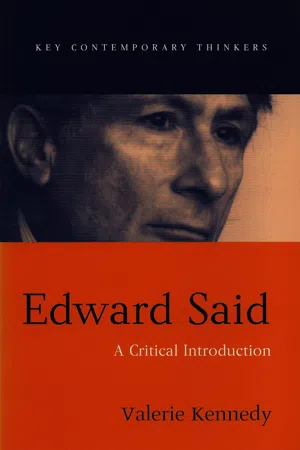 eBook - ePub
Edward Said
A Critical Introduction
- Valerie Kennedy(Author)
- 2013(Publication Date)
- Polity(Publisher)
4 Said and Postcolonial StudiesIntroductionAny appreciation of Said’s achievement needs to include consideration of the role of his works, especially Orientalism , in influencing developments in the fields of postcolonial studies.1 In postcolonial theory, Said’s work has been continued, opened out, modified and challenged by the work of other scholars, notably Homi Bhabha and Gayatri Spivak. Moreover, Orientalism gave new impetus to the two forms of colonial discourse analysis in particular: the study of the literature of empire and the theorization of travel writing. This final chapter will offer a sketch of some of Said’s most important contributions to developments in these areas of postcolonial studies. It will also argue that Said’s insistence on the need for theoretical writing to have an effect on the real world distinguishes his writing from much of the work in the field.Said and the field of postcolonial studiesThe term ‘postcolonial studies’ is now generally accepted as the name of a field of interdisciplinary studies which encompasses a wide variety of types of analysis. What links them is a concern with the imperial past, with the different varieties of colonialism within the imperial framework, and with the links between the imperial past and the postcolonial present. Postcolonial studies can be said to include two main kinds of work: what Moore-Gilbert calls postcolonial criticism, including the study of ‘Commonwealth literature’, and postcolonial theory. These are often approached through various theoretical perspectives including feminist theory, deconstruction, psychoanalysis and minority discourse and cultural studies. The field as a whole assumes a continuity between the colonial and postcolonial periods, and is concerned with all aspects of the relationship between the imperial or postcolonial centre or metropolis and the colonial or postcolonial periphery. eBook - ePub
Postcolonial Theory
A critical introduction
- Leela Gandhi(Author)
- 2020(Publication Date)
- Routledge(Publisher)
4Edward Said and his criticsThe principal features of postcolonialism’s intellectual inheritance—which we covered in the preceding two chapters—are realised and elaborated in Edward Said’s Orientalism (1991, first published in 1978). Here, as elsewhere in his extensive oeuvre, Said betrays an uneasy relationship with Marxism, a specifically poststructuralist and anti-humanist understanding of the contiguity between colonial power and Western knowledge, and a profound belief in the political and worldly obligations of the postcolonial intellectual. This chapter will provide some contexts for understanding the canonisation of this book as a postcolonial classic through a consideration of its academic influence and theoretical limitations.Enter Orientalism
Commonly regarded as the catalyst and reference point for postcolonialism, Orientalism represents the first phase of postcolonial theory. Rather than engaging with the ambivalent condition of the colonial aftermath—or indeed, with the history and motivations of anti-colonial resistance—it directs attention to the discursive and textual production of colonial meanings and, concomitantly, to the consolidation of colonial hegemony. While ‘colonial discourse analysis’ is now only one aspect of postcolonialism, few postcolonial critics dispute its enabling effect upon subsequent theoretical improvisations.Gayatri Spivak, for example, has recently celebrated Said’s book as the founding text or ‘source book’ through which ‘marginality’ itself has acquired the status of a discipline in the Anglo-American academy. In her words, ‘the study of colonial discourse, directly released by work such as Said’s, has. . . blossomed into a garden where the marginal can speak and be spoken, even spoken for. It is an important part of the discipline now’ (Spivak 1993, p. 56). The editors of the influential Essex symposia series on the sociology of literature also invoke the spirit of Spivak’s extravagant metaphor to argue that Said’s pioneering efforts have single-handedly moved matters of colony and empire ‘centre stage in Anglo-American literary and cultural theory . . .’ (Barker et al. 1994, p. 1). No longer available |Learn more
Why the Humanities Matter
A Commonsense Approach
- Frederick Luis Aldama(Author)
- 2009(Publication Date)
- University of Texas Press(Publisher)
Power Politics and Culture 169). Having the key in hand to unlock how nineteenth-century British, French, and American literary, historical, and anthropological texts fix non-Western peoples as Others in Other worlds, he also had the key to unlocking doors that would show the world the humanity of Middle Eastern peoples.Said considered himself, at least academically, a historian of ideas—a historian of ideology.3 This feeds directly into his Idealist conception of language, knowledge, and power, and leads him to perceive colonial/anti-colonial, imperialist/anti-imperialist in Constructivist (Kuhnean) terms. This is expressed in his “Orientalism” as a spatial, geographical/archeological (Foucaultian) method and approach to cultural phenomena like literature (mostly) that not only “create imperial attitudes towards the rest of the world” (The Pen and the Sword 64), but that fix and unfix nations, peoples, lands; it is expressed in his political sense of himself as an intellectual activist driven to destabilize those negative and inhuman representations of Middle Eastern people that would in turn transform for the better their material reality.4 The following discussion thus takes its cue from Said’s worldview: literary analysis and political work are two sides of the same coin.5For the world to be socially constituted, there must be some sense that all perception of reality beyond the mind is filtered; the usual culprit that academics target as the filterer of reality is language. Accordingly, because we can never think outside the prison house of language, then all of reality is formed out of systems of signs. If we can’t think outside of language, then the study of language remains beyond our reach. This isn’t to say that language is not controllable. Indeed, as Said believes, the ingredients that allow for communication to occur—the “signifier” (acoustic image or phoneme) and the “signified” (the mental image) that point arbitrarily to a sign—are slippery and indeterminate, and thus language is manipulatable; it can be used to shape the world to serve ideological interests. Said uses this notion of the manipulation of sign systems as the foundation of his concepts, such as “Orientalism,” which invest texts with the power to create (and contain) peoples, nations, lands.6 eBook - PDF
- Hamid Dabashi(Author)
- 2015(Publication Date)
- Zed Books(Publisher)
I come from a generation of immigrant intellectuals who mark the origin and disposition of their critical intelligence from the publication of Edward Said’s Orientalism (1978). The shape of our critical character, the voice of our dissent, the texture of our politics, and the very disposition of our courage, are all rooted in every nook and cranny of that revelatory text. It was in the year of the Iranian Revolution, 1979, less than a season after the publication of Orientalism , that Samuel Klausner, who taught us theory and method, first introduced me to Edward Said’s spectacular achievement in an utterly prosaic manner. I was a graduate student at the University of Pennsylvania, finishing a dual degree in Sociology of Culture and Islamic Studies. By the time I read Orientalism (inhaled it, rather, in one deep, satisfying swoop – drank it like a glass of freshly squeezed lemonade on a hot summer’s day), I had already read Karl Marx, Max Scheler, Max Weber, and George Herbert Mead on the sociology of knowledge. What Said had argued in Orientalism was presented straight from a sociology-of-knowledge angle, and yet with a globality of vision, a daring, defiant imagination, and such assured audacity that I remember I could not believe my eyes – that I was reading these words in that particular succession of reason and rhetoric. By the mid-1970s, my generation of sociologists at Penn had already started reading Michel Foucault in a systematic and rather unusual curriculum, given that the discipline of sociol-ogy was then being rapidly sold out to federally funded policy research and demography – a downward spiral from which a 47 The Moment of Myth once groundbreaking discipline never recovered. But at that time at Penn, Philip Rieff, Digby Baltzell, Samuel Klausner, Harold Bershady, Victor Lidz, and Fred Block were serious theorists with a relatively universal approach to their sociologi-cal concerns. eBook - ePub
International Relations Theory and Philosophy
Interpretive dialogues
- Cerwyn Moore, Chris Farrands, Cerwyn Moore, Chris Farrands(Authors)
- 2010(Publication Date)
- Routledge(Publisher)
12 Edward Said and post-colonial international relations Mark B.SalterWhile it perhaps seems peculiar to speak of the pleasures of exile, there are some positive things to be said for a few of its conditions. Seeing ‘the entire world as a foreign land’ makes possible originality of vision.(Said 2000:186)Introduction
Whether a cosmopolitan liberal, an abstract and rational realist or a light-footed ironic post-structuralist, too often International Relations (IR) theorists have used a conceit of placelessness, an Archimedean point outside the world and politics from which they can diagnose the dynamics of power.1 The political implications of these inter-national, abstracted and bloodless theories of world politics have been highlighted by Richard Ashley and R.B.J. Walker (1990) among others. This critical turn in IR theory inaugurated a period of reflection of culture, identity and discourses, and while Foucault became central to a certain part of the discipline, other contemporary important critical philosophical voices did not find an audience. Edward Said (1935–2003) was a prominent humanities scholar, founding almost single-handedly the field of post-colonial studies with Orientalism (1978). While he came to the attention of IR scholars during his engagement with Samuel Huntington’s Clash of Civilizations thesis (2000), Said had long been engaged in questions at the heart of the discipline, and there has been recent recognition of this with a special forum in Millennium (2007). This chapter reads Said back into IR through a meditation on his use of exile, experience and the intellectual as critical concepts.Post-colonial studies
Said inaugurated the field of post-colonial studies, which has flourished over the past thirty years (Moore-Gilbert 1997; Gandhi 1998). Although the very term ‘post-colonial’ is itself a site of debate (does ‘post’ mean a transcendence of the colonial or a past historical epoch?), I will use it here to refer to the set of inquiries into historical and contemporary colonial relations of power. In IR theory, the colonial is often all-too-absent. Brian Schmidt and David Long (2005) and Torbjørn Knutsen (1992) have demonstrated the complicity of early IR theory with the projects of European colonialism, but there is a still a radical underestimation of the power, presence and pertinence of colonialism and imperialism to contemporary world politics. Some postwar Realist and English School writings do treat colonialism as a serious problem for IR theory – and indeed treat colonialism as important material, social, political and economic facets of world politics, notably Frederick Schuman, Hans Morgenthau, Arnold Toynbee, Martin Wight, Hedley Bull and Adam Watson. Marxist and Gramscian versions of IR theory, promoted by Robert Cox and colleagues, continued to speak of neocolonialism, driven by their materialist analysis, and some comparativist analysis examined the Non-Aligned Movement; but these were minority voices in the field. While Bull and Watson’s Expansion of International Society (1984) is perhaps the best of this work, decolonization was relegated in IR theory to the analysis of colonialism (or of race) to a historical question.2 Said’s Orientalism (1978) did not have a large impact in IR. The discipline was largely silent on post-colonial theory, until Sankaran Krisha wrote ‘The importance of being ironic: a postcolonial view of international relations theory’ (1993) and Philip Darby and Albert Paolini published ‘Bridging International Relations and Postcolonialism’ (1994). This theme was developed in work by Ahluwalia and Sullivan’s ‘Beyond International Relations: Edward Said and the World’ (2000) and Darby (1998, 2000, 2004), who chiefly focused on third wave post-colonial critics, such as Homi Bhabha and Gayatri Spivak, and on discursive representations of the global south. However, while it cannot be said that Said is at the core of IR, his questions of power, domination, culture, imperialism, identity and territory are at its centre. Darby and Paolini suggest that ‘not only did [Orientalism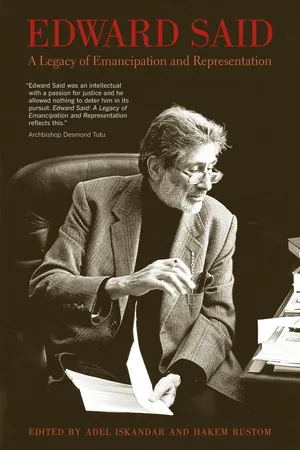 eBook - PDF
Edward Said
A Legacy of Emancipation and Representation
- Adel Iskandar, Hakem Rustom, Adel Iskandar, Hakem Rustom(Authors)
- 2010(Publication Date)
- University of California Press(Publisher)
It is no longer viable to import Western literary theory or apply it blindly to Arabic literary phenomena or texts. Nonetheless, it is easier to reject the tyranny of universalism, as Said has shown us, than to make a lasting contribution to its modification and change. Thus, though many Arab critics have understood Said’s lesson that “no one today is purely one thing,” the task of bringing creativity, originality, and sophistication to literary the-ory while taking into account cultural plurality is still in its infancy in Arabic crit-ical discourse. 48 Many Arab critics also understood Said’s aversion to linear subsuming histories and a unitary sense of identity, as well as his preference for a contrapuntal approach sensitive enough to deal with the complexity of historical experience. “All cultures,” he wrote, “are involved in one another; none is single and pure, all are hybrid, het-erogeneous, extraordinarily differentiated, and unmonolithic. This, I believe is as true of the contemporary United States as it is of the modern Arab world.” 49 Ad-mittedly, practicing contrapuntal criticism without the advantage of Said’s multi-cultural erudition and talent for “musical elaborations” is difficult. Nonetheless, pre-cisely because of Said’s approach, Arab critics are now more confident in using critical notions without being bound by them. The growing sophistication of Ara-bic critical discourse is in part due to Said’s contribution, and this greater sophis-tication in turn generates wider appreciation of his work. CULTURAL CRITICISM It is natural, therefore, that Said’s next major work, Culture and Imperialism (1993), which saw the culmination of his critical project of deconstructing the Western nar-rative, received considerable attention in Arab intellectual circles long before it was translated into Arabic. The book was extensively reviewed in the Arabic press and quoted in academic papers, and it inspired several academic studies. eBook - PDF
- Ella Shohat, Caren Kaplan, Robyn Wiegman, Caren Kaplan, Robyn Wiegman(Authors)
- 2006(Publication Date)
- Duke University Press Books(Publisher)
As a Palestinian, Said evokes colonized and dominated people; as an American literary scholar, he evokes the prestigious field of postcolonial theory. Said’s own Janus-faced position is part and parcel of the contradic-tory passing of his work through diverse checkpoints in Israel. Reading Said in Hebrew condenses an oxymoronic friction between the imagined The ‘‘Postcolonial’’ in Translation 379 geographies of Arabic (as East) and English (as West): In the former, he is a haunting exile from Palestine, while in the latter, he holds the powerful wand of academic America. That Said’s final resting place is in Broum-mana, Lebanon, not Jerusalem, where he was born, not Cairo, which he left, and not New York, where he lived for decades, provides a suitably troubled and inconclusive allegory to the equally ruptured voyages of his ideas across national borders. NOTES I thank Robert Stam, Yigal Nizri, Bashir Abu-Manneh, and Joseph Massad for their comments. Throughout, the translations from the Hebrew are my own. 1 My early dialogue with Said’s work includes ‘‘The Trouble with Hanna,’’ Film Quarterly 38, no. 2 (winter 1984–85) (co-authored with Richard Porton); ‘‘Sephar-dim in Israel: Zionism from the Standpoint of Its Jewish Victims,’’ Social Text 19– 20 (fall 1988); and Israeli Cinema: East/West and the Politics of Representation (Aus-tin: University of Texas Press, 1989). Said’s endorsement on the cover of Israeli Cin-ema further pointed to our a≈liation, seen as negative in the Israeli public sphere. 2 Igal Bursztyn, a professor at Tel Aviv University, suggested that Said and I, unlike Fanon, are products of Western academe and therefore inauthentic Third Worlders, forgetting that Fanon himself was educated in the French academy: Bursztyn, ‘‘The Bad Ashkenazis Are Riding Again,’’ Ma’ariv , 7 February 1992 (Hebrew). 3 ‘‘Statement of Stanley Kurtz: Testimony before the Subcommittee on Select Education, Committee on Education and the Workforce, U.S.
Index pages curate the most relevant extracts from our library of academic textbooks. They’ve been created using an in-house natural language model (NLM), each adding context and meaning to key research topics.

