Literature

Walter Benjamin
Walter Benjamin was a German literary critic, philosopher, and cultural theorist known for his influential work on the concept of the "aura" in art and the impact of technology on literature. He explored the role of mass media and the reproduction of art in shaping modern culture, and his ideas continue to be influential in the fields of literary theory and cultural studies.
Written by Perlego with AI-assistance
Related key terms
1 of 5

6 Key excerpts on "Walter Benjamin"
 eBook - ePub
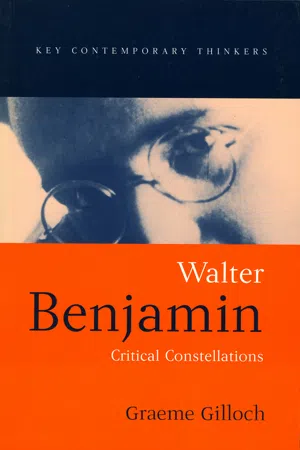
Walter Benjamin
Critical Constellations
- Graeme Gilloch(Author)
- 2013(Publication Date)
- Polity(Publisher)
Introduction: Benjamin as a Key Contemporary Thinker OriginsWriting from Paris to his closest friend, the Judaic scholar Gershom Scholem, on 20 January 1930, the German-Jewish philosopher, literary and cultural theorist Walter Benjamin (1892–1940) makes his intellectual ambition plain:The goal I had set for myself has not yet been totally realized, but I am finally getting close. The goal is that I be considered the foremost critic of German literature. The problem is that literary criticism is no longer considered a serious genre in Germany and has not been for more than fifty years. If you want to carve out a reputation in the area of criticism, this ultimately means that you must recreate criticism as a genre. (COR , p. 359)This is a particularly ironic and peculiarly appropriate statement. It is ironic because of Benjamin’s own precarious, marginal situation at the time of writing: the enforced withdrawal of his Habilitations-schrift 1 a few years earlier had ended any hope of an academic career, and he was now limited to eking out an indigent living as a freelance writer, reviewer and translator, and even as the author and narrator of radio broadcasts for children. Indeed, Benjamin was to return to Paris only a couple of years later in the even more impoverished guise of a refugee fleeing Nazi tyranny. If Benjamin was to become the ‘foremost critic of German literature’, it was to be an expertise in exile.It is an ironic statement, moreover, because Benjamin’s attempt to ‘recreate criticism as a genre’ led him not only far beyond the confines of literary criticism as such, but also to its dissolution as a distinct sphere of endeavour. For Benjamin, traditional bourgeois aesthetic categories and practices were to be imploded, and new modes of representation pioneered, modes inspired by and appropriate to the possibilities created by new forms of media amid the transformed social, political and cultural patterns of the inter-war period. Film, photography, magazines, newspapers, advertising, radio – the importance of these for literature and drama was to be captured not by the conventional literary critic, but by another figure: the experimental, polytechnical aesthetic ‘engineer’. It is in this role that Benjamin undertakes a fragmentary but politically charged critique of modern culture, metropolitan experience, technological innovation and historical change. To ‘recreate criticism as a genre’ means to transform it into a panoramic critique of modernity itself. eBook - PDF
- Anthony Elliott, Bryan S Turner, Anthony Elliott, Bryan S Turner(Authors)
- 2001(Publication Date)
- SAGE Publications Ltd(Publisher)
6 Walter Benjamin GRAEME GILLOCH BIOGRAPHICAL DETAILS AND THEORETICAL CONTEXT A fter a substantial period of neglect, Walter Benjamin (1892± 1940) is now widely recognized as one of the most original and insightful thinkers of his generation and as perhaps the most important German literary the-orist of the twentieth century. Like several of the other ®gures pro®led in this book, Benjamin would not have thought of him-self as a social theorist as such. Neverthe-less, his idiosyncratic and frequently enigmatic writings on literature, aes-thetics, philosophy, and historiography are increasingly seen to have a special resonance with, and relevance for, con-temporary social and cultural analysis. A close friend of the Judaic scholar Gershom Scholem, the Marxist playwright Bertolt Brecht, and the philosopher Theodor Adorno, Benjamin became an associate of the Frankfurt Institute for Social Research and his ideas exist in an intricate interplay with the critical theory of the so-called `Frankfurt School'. Although Benjamin's texts often differ radically in terms of their evaluation of phenomena, they also frequently pre®gure key con-cerns and concepts for critical theory and are, above all, marked by the same catastrophic historical experiences of war, economic ruin, revolution, and totalitarianism. In stark contrast to such traumas, Benjamin's childhood was a time of mater-ial comfort and tedious tranquility. Born on 15 July 1892, the son of an auctioneer and eldest of three children, Walter Benedix Scho È n¯ies Benjamin grew up in the desirable west end districts of Berlin in an af¯uent, assimilated German-Jewish family. eBook - ePub
- Murray Pomerance, R. Barton Palmer(Authors)
- 2015(Publication Date)
- Rutgers University Press(Publisher)
5 Walter Benjamin Afterimages of the Aura COLIN WILLIAMSONWalter Benjamin’s (1892–1940) relationship with cinema studies has long reflected the waves of fragmentation, searching, and (re)discovery which characterized his own experience of modernity. From the 1910s through the 1930s, the German-born cultural theorist and literary critic wrote prolifically in the light of astonishing technological, commercial, and artistic developments, as well as in the shadows of World War I, the rise to power of fascism, and the outbreak of World War II. Some of Benjamin’s most well-known work on mass culture and modern life—including his famous essay “The Work of Art in the Age of Mechanical Reproduction” (1936)—was written under desperate circumstances between his flight from Nazi Germany in 1933, when he began a life in exile, and his tragic suicide in 1940. His writings are sometimes labyrinthine, but his brilliant insights into everything from poetry, politics, and history to architecture, painting, photography, and film have moved fluidly across disciplines, inflecting central discourses in art history, cultural studies, and cinema and media studies.Despite being a prominent figure in classical film theory, Benjamin never offered a rigorous or even sustained “essentialist” theory of film. Nor does his work on film lend itself easily to categorizations like “formalist” or “realist,” which were developing in film theoretical and critical discourses at the time Benjamin was writing. And, although his work bridges the pivotal transition to synchronous sound, he was relatively silent on the acoustic properties of the cinema. Benjamin’s theoretical engagements with film were primarily in the service of a much larger intellectual exploration of the experience of modern life. eBook - PDF
Truth and Compassion
Essays on Judaism and Religion in Memory of Rabbi Dr Solomon Frank
- Howard Joseph, Jack N. Lightstone, Michael Oppenheim, Howard Joseph, Jack N. Lightstone, Michael Oppenheim(Authors)
- 2006(Publication Date)
- Wilfrid Laurier University Press(Publisher)
75 76 Truth and Compassion Institut and was receiving financial support from it, other influences, notably his friendship with Bertolt Brecht, had kept him at a certain distance from it. 2 What would have happened to him and his thought had he succeeded in emigrating to the United States is difficult to say. As it is, we must take his legacy as we find it, the work of a fascinating but difficult, at times esoteric, writer, whom several different groups of interpreters wish to claim for their own. 3 At the time of his death Walter Benjamin was not famous. He was known to the public by his literary essays, but only a few persons, though those of the highest stature, were aware of the originality of his genius. Posthumous fame came to him in Germany with the publication fifteen years after his death of a two-volume edition of his writings. 4 That fame has now spread to the English-speaking world with the successive publication of two selec-tions of translations, Illuminations5 in 1970 and Reflections6 in 1978. An English translation of his early work, Ursprung des deutschen Trauerspiels has also been published under the title The Origin of German Tragic Drama, 1 but the esoteric character of that work will leave it, I should think, inaccessible to all but the most earnest students of his thought. As a first description Benjamin may be called a literary critic. That is to say, he wrote on literature, on art, and on literature and art in relation to politics. His style, too, was literary—indeed, it may be termed lyrical. He was not, then, a philosopher in the technical sense. Nevertheless, Benjamin was a philosopher , as Scholem insists. 8 A first 2 Cf. the remarks of Phil Slater, Origin and Significance of the Frankfurt School: A Marxist Perspective, International Library of Sociology (London: Routledge and Kegan Paul, 1977), xv. eBook - ePub
- Alessandro Giovannelli(Author)
- 2021(Publication Date)
- Bloomsbury Academic(Publisher)
17 Walter Benjamin (1892–1940) and Theodor W. Adorno (1903–1969) Gerhard Richter The thought of Walter Benjamin and Theodor W. Adorno has had a profound impact on the history, politics, and practice of aesthetic theory in the twentieth and twenty-first centuries. While the friendship between these two German-Jewish thinkers was often characterized by tensions and philosophical disagreements—especially over such issues as the applicability of aesthetic theory to media like photography and film, and over the methods of dialectical thinking—they nevertheless shared a deep intellectual connection. This notion is borne out not only by their extensive correspondence, which continued until Benjamin’s death, but also by such empirical data as the fact that Adorno taught the first university seminar on Benjamin as early as the 1930s and that he, in his 1933 book Kierkegaard: Constructions of the Aesthetic, relies heavily on Benjamin’s complex and far-reaching notion of allegory as the latter had developed it in his 1928 Origin of the German Mourning Play. The political philosopher Hannah Arendt, who knew both thinkers personally, once even went so far as to call Adorno Benjamin’s only student eBook - PDF
The Philosophy and Politics of Aesthetic Experience
German Romanticism and Critical Theory
- Nathan Ross(Author)
- 2017(Publication Date)
- Palgrave Macmillan(Publisher)
13. The context of this dissertation within Benjamin’s intellectual development has to be reconsidered along these lines. It is argued by Menninghaus, and repeated by Rudolph Gasché, that Benjamin had very limited grasp of the problems of post-Kantian philosophy, and of the texts of the Romantics, but that he actually ‘got it right’ in some general sense because he was already predisposed to a Romantic way of thinking because of his notion of language, as formulated in his 1916 essay ‘On Language’ (See Rudolph Gasché, ‘The Sober Absolute’ in Walter Benjamin and the Romantics, 51.). But this approach ignores the fact that Benjamin’s views on lan- N. ROSS 179 guage and mimesis actually changed as a result of his encounter with the Romantics. This will be illustrated in what follows. 14. An interesting comparable approach to Benjamin’s concept of crit- icism may be found in Thijs Leijster, ‘The Interruption of Myth: Walter Benjamin’s Concept of Criticism’ in Karin de Boer, ed., Conceptions of Critique in Modern and Contemporary Philosophy (London: Palgrave, 2012), 156–172. Leijster makes an analogous point by demonstrating that the dissertation establishes Benjamin’s commitment to a notion of immanent criticism, while the ‘Critique of Violence’ essay establishes a commitment to the notion that critique is violent. 15. Benjamin Selected Writings 1, 177/Kunstkritik, 100. Although Benjamin develops this thesis on the retreat of the beautiful out of his reading of the Romantics, it has vital implications for his later thought, especially in his essay ‘On the Artwork in the Age of its Technical Reproducibility’, where his famous thesis on the liquida- tion of aura in modern art involves a critique ‘beautiful semblance’. See his text ‘The Significance of Beautiful Semblance’ in Benjamin Selected Writings 3, 137–138. Indeed, this thesis also has vital implications for Adorno’s conception of modern art in Aesthetic Theory.
Index pages curate the most relevant extracts from our library of academic textbooks. They’ve been created using an in-house natural language model (NLM), each adding context and meaning to key research topics.

