Literature

Harold Bloom
Harold Bloom was a prominent literary critic and scholar known for his influential theories on literary criticism and the concept of the "anxiety of influence." He was a proponent of the idea that great literature is characterized by originality and creativity, and he emphasized the importance of individual talent and imagination in the creation of literary works.
Written by Perlego with AI-assistance
Related key terms
1 of 5
5 Key excerpts on "Harold Bloom"
 eBook - ePub
- Eleanor Wachtel(Author)
- 2012(Publication Date)
- HarperCollins Publishers(Publisher)
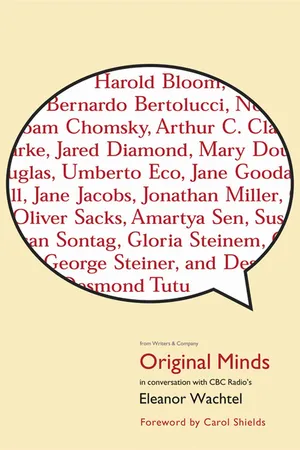
H AROLD B LOOM When I first talked to Harold Bloom, his unique combination of emotion and intellect triggered an enormous response from listeners. It was not long after he had published The Western Canon (1994), an impassioned defence of reading the classics. Initially, because of his reputation as a pugnacious reactionary, disdainful of new movements in contemporary literature, I had expected not to like him. Admire him, yes, but not warm to him. But he was so engaging, erudite and full of enthusiasms that I felt immediately drawn to him. Here was good company. He made me want to read more—more of his own criticism and more of the books he so clearly loves. And to talk to him again, when I came to do the special series Original Minds. For the past thirty years, Harold Bloom has been—as the New York Times put it—“one of the world’s most influential critic-scholar-theorists.” The breadth (and speed) of his reading, as well as his amazingly retentive memory, are famous. He can recite Milton’s Paradise Lost from beginning to end, most of Blake, Spenser’s The Faerie Queene, Shakespeare and so on. He’s published twenty-eight books and written introductions for some six hundred volumes of literary criticism. “Everything about Harold Bloom is outsized,” wrote one critic. (No wonder Shakespeare’s Falstaff is a kind of alter ego to him.) So who more likely to survey all of Western literature and decide what’s important, what constitutes the canon? And then to tackle his great love in the 768-page Shakespeare: The Invention of the Human (1998). Bloom remains astonishingly prolific. Often alternating literary analysis with works on religion—such as his unlikely bestseller The Book of J (1990), where he maintains that crucial passages in the Old Testament were written by a woman—Bloom came out with Omens of Millennium: The Gnosis of Angels, Dreams, and Resurrection (1996)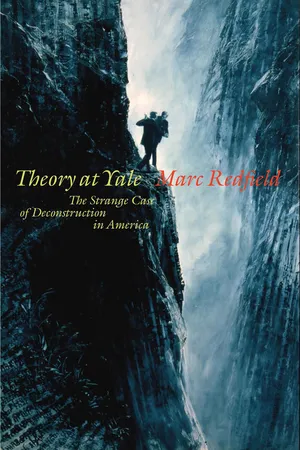 eBook - ePub
Theory at Yale
The Strange Case of Deconstruction in America
- Marc Redfield(Author)
- 2015(Publication Date)
- Fordham University Press(Publisher)
4. Literature, Incorporated Harold Bloom, Theory, and the Canon At the beginning of this book, we focused on the “Yale Critics” in an effort to come to grips with the phantasmatic dimension of the institutional and discursive development called “theory” in the American academy and media. In this chapter and the next, I offer case studies of the two most polarizing and dramatically contrastable members of the Yale quadrumvirate, Harold Bloom and Paul de Man. The case of Harold Bloom is unique in the annals of theory, and for that matter in the history of the modern academy. For a few years he occupied a prominent position in the American theory maelstrom as the intimate, internecine opponent of de Man and Derrida; then, during the mid-1980s, he lost professional visibility in the academy while acceding to the seemingly quite different role that he has played ever since in the national media: that of the antitheoretical, antiprofessional champion of the Western Canon, whose nearly superhuman powers of reading and retention allow him to embody (and underwrite and market) the literary tradition for a postliterate age. This Bloom, the “Yiddisher Doctor Johnson” whose books on Shakespeare, genius and the canon show up in airports, and whose Chelsea House volumes fill yards of shelf space, is at least as remarkable a figure as the theoretician of influence whose gnomic texts for awhile spurred critical discussion in journals like Diacritics. Bloom’s voyage from one end to the other of the discursive galaxy of theory makes his story seem to divide in two, like a conversion narrative; but instead of seeing these two phases or roles as fundamentally opposed, I propose to tease out their affinities eBook - ePub
- Imre Salusinszky(Author)
- 2013(Publication Date)
- Routledge(Publisher)
Harold Bloom3 Harold Bloom “There are no texts. There are only ourselves.”Harold Bloom was born in New York in 1930. He studied at Cornell University and earned his Ph.D. at Yale in 1955. He has been on the Yale faculty since then, and is now Sterling Professor of the Humanities. He is the editor of more than thirty anthologies, and the author of sixteen books, including Shelley’s Mythmaking (1959), The Visionary Company (1961), Blake’s Apocalypse (1963), Yeats (1970), Agon (1982), and an important “tetralogy” of books on poetic influence: The Anxiety of Influence (1973), A Map of Misreading (1975), Kabbalah and Criticism (1975) and Poetry and Repression (1976). Bloom is now preparing more than two hundred introductions for the Chelsea House Modern Critical Views series, of which he is General Editor, and is also working on a full-scale study of all of Freud’s major writings, under the title Freud: Transference and Authority.In Shelley’s Mythmaking and The Visionary Company, the young Bloom joined and extended the campaign against the poetics of Eliot and the New Critics which had been started by Frye in the late 1940s. For Bloom, this particularly involved challenging the New-Critical reduction of all poetic rhetoric to irony, the distrust of the long poem (especially in such poets as Milton, Shelley and Blake), the disparagement of discursive or unambiguous thought in poetry (particularly, again, in such poets as Milton, Shelley and Blake), and the denigration of all of the Romantic poets in favour of a “neoclassical” line.This was the line which, it was said, ran through Jonson and Donne to Pope – skipping Milton – and then conveniently jumped more than a century to comprehend Eliot and Pound themselves. In response, the recanonization of the Romantics was itself brought forward into the twentieth century: just as Frye did a great deal in the 1940s and 1950s to establish the reputation of Wallace Stevens against the claims of the anti-Romantics, so Bloom was later to play the crucial role in establishing the reputations of such followers of Stevens as John Ashbery and A. R. Ammons. However, while Frye’s intention – whatever his effect – had never been to institute a Romantic literary hierarchy (the Fryean sense of tradition is apparently all-inclusive), Bloom was, from the beginning, a fierce proponent eBook - ePub
Borges and Kafka, Bolaño and Bloom
Latin American Authors and the Western Canon
- Juan E. De Castro, Juan De Castro(Authors)
- 2022(Publication Date)
- Vanderbilt University Press(Publisher)
Bloom became the living representation of the Western canon for US media. Redfield, perhaps with some postmodern excess, writes of the Yale critic:By the mid-1980s, Harold Bloom . . . became a unique figure in the American higher-brow mass media: the critic as genius, who personified the internalization of the Western canon. Bloom was the critic as cyborg—almost as monster, insofar as his ingestion of the canon required preternatural reading speed and memory; but he also stood for the embodiment of an aesthetic judgment that, at once omnivorous and discriminating, knew how to ingest, specifically, the canon . (10–11)The variety and prestige of the popular print media that embraced this identification between Bloom and the Western canon—Redfield mentions Newsweek , Time , New York Magazine , and especially New York Times Magazine and the New Yorker —and the impact of US media in the Hispanic world, also helps explain why the region’s cultural networks would see Bloom as the living representative of the Western canon, despite his lack of knowledge about most Spanish-language literature.32 Moreover, his status as a best-selling author added to a visibility that ultimately overshadowed more thoughtful thinkers like Gorak or Guillory, whose books predated Bloom’s.33According to Bloom, “The Canon, once we view it as the relation of an individual reader and writer to what has been preserved out of what has been written, and forget the canon as a list of books for required study, will be seen as identical with the literary Art of Memory, not with the religious sense of canon” (17). This is a perplexing definition, since it embraces an individualistic framework that seems to contradict the notion of the canon as “a book and school of the ages,” in other words, as constituting a kind of unit capable of withstanding fashions and other vicissitudes. However, what Bloom ultimately brings to the discussion of literature is precisely the idea of great books that also belong to a series, of “the strangely intimate family romance of the great writers, who are influenced by one another without regard for political resemblances and differences” (526). For Bloom, “a poem, play, or novel is necessarily compelled to come into being by way of precursor works, however eager it is to deal directly with social concern” (11). Thus, the view of literary works as a continuum is imbricated with the rejection of any social or political concern as alien to literary writing and reading. eBook - PDF
The Late-Career Novelist
Career Construction Theory, Authors and Autofiction
- Hywel Dix(Author)
- 2017(Publication Date)
- Bloomsbury Academic(Publisher)
This last area of critique is particularly striking given the critical backdrop in which The Anxiety of Influence was written. Since the 1970s, the critical assump-tions that there is an easily discernible canon of great works and that these works alone are worthy of critical attention have been increasingly challenged. 17 The Anxiety of Influence evinces little or no critical awareness of this current in literary history and its general tendency is in fact in the opposite direction. This might create the impression of untimeliness in Bloom’s work, a sense of his ideas being out of joint with the emerging critical practices of his own period. However, as I argued in the Introduction, the 1970s was the period in which literary research and scholarship were starting to address the concept of a liter-ary career as a material artefact amenable to theoretical discussion and analysis in its own right. The purpose of this chapter is therefore to suggest that in the specific field of research into literary careers, Bloom was in tune with those nascent criti-cal developments, giving his work a paradoxical timeliness with regard to those Feeding Fiction Forward: Anxieties of Influence 145 145 other currents that he appeared to neglect. This sense of paradoxical timeli-ness has important implications for how the ideas expounded in The Anxiety of Influence might, despite the foregoing critiques of them, be pushed forward in a consideration of fictions of self-retrospect. Although Bloom was not concerned with biographical reconstruction as such, he was interested in the development of the poetic self. The critical ques-tion that the whole of The Anxiety of Influence attempts to answer can be sum-marized succinctly by asking: what makes a poet a poet? Because his answer is that the poet in the poet is positioned by the existing rich tradition of poetry, his conclusion is that this field is the only really appropriate subject for poets to write about.
Index pages curate the most relevant extracts from our library of academic textbooks. They’ve been created using an in-house natural language model (NLM), each adding context and meaning to key research topics.

