Literature

Mikhail Bakhtin
Mikhail Bakhtin was a Russian literary theorist known for his work on dialogism and the concept of the "carnivalesque" in literature. He emphasized the importance of polyphony and the interaction of multiple voices in literary texts, as well as the subversion of traditional hierarchies through humor and parody. Bakhtin's ideas have had a significant impact on literary criticism and cultural studies.
Written by Perlego with AI-assistance
Related key terms
1 of 5

12 Key excerpts on "Mikhail Bakhtin"
 eBook - ePub
Philosophy, Dialogue, and Education
Nine Modern European Philosophers
- Alexandre Guilherme, W. John Morgan(Authors)
- 2017(Publication Date)
- Routledge(Publisher)
The published work on Bakhtin in English alone is now very extensive, and here we can note only those which have been helpful in preparing this chapter, if not necessarily referenced in it. First, there is S. Dentith (Ed.), Bakhtinian Thought: An Introductory Reader. Secondly, two short but valuable general introductions of M. Holquist, Dialogism: Bakhtin and His World, and D. K. Danow, The Thought of Mikhail Bakhtin. Thirdly, the major monographs of K. Hirschkop, Mikhail Bakhtin: An Aesthetic for Democracy ; C. Emerson, The First Hundred Years of Mikhail Bakhtin; G. S. Morson and C. Emerson, Mikhail Bakhtin: Creation of a Prosaics ; and K. Clark and M. Holquist, Mikhail Bakhtin. Finally, there is Mikhail Bakhtin, the invaluable four-volume collection of secondary work edited by M. Gardiner. There are several other edited collections and many journal articles. Mikhail Mikhailovich Bakhtin was an erudite and most original philosopher of language and literature whose work continues to stimulate widespread interest. He is noted particularly for his concepts of dialogue and heteroglossia, of dialogue and polyphony. He emphasised that language acquires meaning only in dialogue which necessarily takes place in a social and cultural context in which many voices take part. Our idea of self is developed in this way, in dialogue with others and shaped by the mutual interpretations each of the Other that emerge and continue to develop. These insights have much to offer the humanities, the social sciences, including the philosophy and practice of education, and indeed the natural sciences. Notes 1 Another possible similarity is a shared interest in the seventeeth-century English philosopher Thomas Hobbes, on whom Oakeshott wrote extensively eBook - ePub
Dialogue and Desire
Mikhail Bakhtin and the Linguistic Turn in Psychotherapy
- Rachel Pollard(Author)
- 2018(Publication Date)
- Routledge(Publisher)
CHAPTER ONEWho was Mikhail Bakhtin?
Although little known during his lifetime, since his death in 1975 this Russian philosopher and cultural theorist has achieved immense popularity among academics in the West as his influence has extended beyond literary criticism and philosophy across the humanities and even further to psychotherapy. In stark contrast to Bakhtin’s penury and relative domestic obscurity, his ideas have become the springboard for many notable Western academic careers. Scholars from diverse perspectives, from Marxists to theologians, from feminists to postcolonial theorists, from sociologists to linguists, and literary theorists to psychologists, have all declared an interest in Bakhtin. As Graham Pechey (1989) observed, one of the interesting characteristics of Bakhtin’s ideas is their capacity to migrate across national and disciplinary boundaries and make themselves at home in very different fields of intellectual endeavour. However, Edward Said (2001) warns that when theories travel beyond their original and temporal context, they can lose some of their radical power. One of the central arguments of this book is that the Bakhtin invoked in psychotherapy is a much tamer and less controversial figure than the Russian Bakhtin and that the radical implications of his thinking for psychotherapy extend far beyond the notion of the “Dialogical Self”. Moreover, outside the field of psychotherapy, Bakhtin’s thinking is highly contested, making any unitary or monologic interpretation problematic.Problems with the use of Bakhtin in psychotherapy
It can be tempting to romanticise or even idealise Bakhtin: compared to many of his relatively comfortable contemporaries in Europe, he can be seen as having led a heroic life in tragic circumstances, enduring persecution and exile under Stalin, while continuing to develop his ideas in isolation from mainstream intellectual life. And where other theorists of the psyche from Freud to the present day have been subject to continual critical debate, Bakhtin or interpretations of Bakhtin used in psychotherapy are rarely challenged. This may be because he never set out to be a theorist of psychotherapy, even less to found a new school or movement, and is not therefore a potential threat to existing models. Another reason could be the apparent simplicity of some of his ideas that can obscure the complexities of interpreting Bakhtin for practitioners of psychotherapy in the West. Bakhtin’s reputation seems in some ways to have eclipsed the content of his work. However, before even beginning to think about a critical engagement with Bakhtin, there is the problem of which Bakhtin to critically engage with, as there is no central or definitive interpretation of his work. eBook - PDF
Dialogue Not Dogma
Many Voices in the Gospel of Luke
- Raj Nadella(Author)
- 2011(Publication Date)
- T&T Clark(Publisher)
Bakhtin, Problems , 33–4. 15. Bakhtin, Problems , 7. 16. Gary Saul Morson and Caryl Emerson, Mikhail Bakhtin: Creation of a Prosaics (Stanford: Stanford University Press, 1990), 231. 17. Katerina Clark and Michael Holquist, Mikhail Bakhtin (Cambridge, MA: Harvard University Press, 1984), 272–3. See also Stuart Kelly, The Book of Lost Books: An Incomplete History of All the Great Books You Will Never Read (New York: Random House, 2006), xv. 18. Morson and Emerson, Mikhail Bakhtin , 231–68. 1. Reading Luke in Light of Bakhtin 13 First Hundred Years of Mikhail Bakhtin. 19 The related concept of dialogism will be dened at a later point in this chapter. It appears that Bakhtin understood polyphony as a literary and ideological phenomenon that has signicant ethical implications. As a literary phenomenon it signies several interconnected aspects. It refers primarily to the presence of multiple, and often divergent, voices in a literary text. Beyond that it describes other aspects such as the unique manner of their interaction with each other and with the author; their autonomous and independent status vis-à-vis other voices and the author; the absence of hierarchy; and a special method of authoring. The multiple voices, which Bakhtin calls the ‘voice-ideas,’ 20 belong to, rep-resent, and express the viewpoints of various characters in a given literary text. These voices are ‘fully valid consciousnesses’ that are capable of expressing themselves freely. 21 A combination of several such consciousnesses, initiated by the author, is the chief characteristic of polyphonic novels. Equally, if not more, important is an intense and continuous interaction among them. As I will discuss later, Bakhtin uses a different term – dialogism – specically to characterize their interaction. Bakhtin claries that the combination of numerous consciousnesses, a cen-tral aspect of polyphonic novels, entails not a direct combination but a meeting of, and encounter between, various elements. eBook - PDF
Shakespeare, Bakhtin, and Film
A Dialogic Lens
- Keith Harrison(Author)
- 2017(Publication Date)
- Palgrave Macmillan(Publisher)
Presupposing at least two individuals differentially situated in time—as well as in space and in angle 1 WILLIAM SHAKESPEARE AND Mikhail Bakhtin … 7 of perception—Bakhtin’s concept of dialogism combines creativity with history, enabling an intellectual grasp of how past utterances link to pre- sent expressiveness. Bakhtin’s dialogic model, although historical in its assumptions and oriented to the future, differs markedly from the dialectical theories of Hegel and Marx, which imply closed systems. His model allows more openness. Although living in the Soviet Union, Bakhtin states unambig- uously: “I was never a Marxist to any degree whatsoever” (Bocharov and Liapunov 1016). The teleological assumptions about history as being pre-ordained and progressive—moving through a clash of thesis with antithesis in order to arrive via a synthesis at a further place of departure, a stage closer to an ultimate goal, the Absolute or a classless society—are incompatible with Bakhtin’s notion of word against word, which is not proleptic of utopian futures and offers nothing in the way of prediction, or even direction: For the word is not a material thing but rather the eternally mobile, eter- nally fickle medium of dialogic interaction. It never gravitates toward a sin- gle consciousness or a single voice. The life of the word is contained in its transfer from one mouth to another, from one context to another context, from one social collective to another, from one generation to another gen- eration. (Problems 202) The Russian, “slovo,” translated as “word,” also has the wider sense of “discourse” (see “Glossary,” Dialogic 427), and is often transposed in this study to signify an entire play-text or film as an individual utterance. As a consequence of his concept of broad and openended dialogism, Bakhtin opposes materialist dogmatism. Instead, he emphasizes “the infinitude and bottomlessness of meaning” (Speech 162).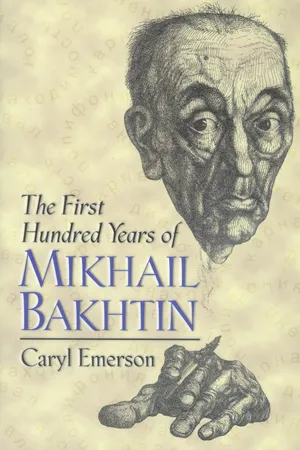 eBook - PDF
- Caryl Emerson(Author)
- 2018(Publication Date)
- Princeton University Press(Publisher)
Bakhtin belongs with the unclassifiable polymaths Veselov- sky, Zhirmunsky, Likhachev, all three boundary-crossers in literature who were drawn to philosophy. Zatonsky is a wholly conciliatory critic. In the end, he too prefers to generalize on the overall value of innovation in the humanities rather than examine, i f only in a few select details, the bene- fits and costs of Bakhtin's framework for literary scholarship. And thus, although the fad for Bakhtin spread wildly in the 1980s, the immediate reception of these Russian essays could not match the later, rapid, almost unconsidered bestsellerdom of The Dialogic Imagination in English- speaking countries. Why this was so is a matter of our respective academies. In Russia D O M E S T I C R E C E P T I O N 117 Bakhtin had a history: he was a dissident, a non-cooperator, an outsider who had been largely ignored by the Soviet literary establishment (on balance a somber, unspeculative body) since the early days of the regime. In the West Bakhtin was a name. By the 1970s the triumph of Structural- ism—and, truth be told, a more modest and increasingly eccentric factual base among students of literary history—had created a receptivity to the large scheme, the grandiose binary, the provocative, easily paraphrasable statement from an intellectual guru. Such indeed were the strengths and intonations of Bakhtin's middle-period essays, as well as of his Rabelais. Bakhtin is accessible. He is so suggestive and in places so imprecise that he gives tertiary critics—you and me—a great deal to do in our own voice, filling in, refashioning, talking back. As we shall see repeatedly in part 2 of this study, it is just this open invitation to the impetuous, under- prepared reader that the anti-Bakhtinians most resent. eBook - PDF
- R. Bracht Branham(Author)
- 2005(Publication Date)
- Barkhuis(Publisher)
The Bakhtin Circle and Ancient Narrative, 107–129 Dialogues in love: Bakhtin and his critics on the Greek novel T IM WHITMARSH University of Exeter Mikhail Bakhtin occupies an extraordinary position in the intellectual uni- verse of the late twentieth and early twenty-first centuries. Though he wrote from the turbulent context of Communist Russia, he nevertheless seems to endorse many of the liberal-leaning West’s most favoured concepts: hybrid- ity, polyphony, openness, multiplicity. Bakhtin’s utopian space (as it is often presented) of open-ended dialogues speaks with real depth and resonance to the increasingly (socially, racially, economically, militarily) stratified worlds of late capitalism. His emphasis, moreover, on the prose novel as the princi- pal literary focus for heteroglossia (speaking with/to/for/in view of ‘the other’) chimes well with the secular materialism of the age. 1 This beguiling seductiveness, though, comes at a cost: too often, his complex thought has been reduced to slogans and ciphers. As the authors of the best recent book on his thought put it, ‘[m]uch of Bakhtin’s fame today rests on a few neolo- gisms and new uses of existing words that have rapidly been reduced to cli- ché’. 2 Bakhtin has proven particularly congenial to scholarship on the Greek novel, my subject in this chapter. 3 This field has been gratifyingly free from the kind of reductive cliché-mongering characterised by Morson and Emer- ————— 1 See esp. DN, EN, FTCN, PDP, Prehistory. RW. A list of abbreviations used for Bakhtin’s work is appended at the conclusion of this chapter. For Bakhtin’s views of the novel, see especially Holquist (1990), 67–106; Morson & Emerson (1990), 306–70. 2 Morson & Emerson (1990), 10. 3 See Fusillo (1989), esp. 17, 21, 26–7; (2003), 279–80; Nimis (1994), 387–8; 398–400; (1998), 106; (1999), 216; Whitmarsh (1998), 94–5. eBook - ePub
Voicing Relationships
A Dialogic Perspective
- Leslie A. Baxter(Author)
- 2010(Publication Date)
- SAGE Publications, Inc(Publisher)
2 Mikhail Bakhtin, Dialogism, and RDTB ecause the concepts developed in this book are largely appropriated from Mikhail Bakhtin’s theory of dialogism, this chapter is devoted to introducing the reader to Bakhtin and his work. As I noted in Chapter 1 , Holquist (2002) has labeled Bakhtin’s work dialogism, out of the belief that dialogue is the master key that guided Bakhtin’s work throughout his career. My overview will not be exhaustive, focusing instead on those concepts that I regard as particularly important to interpersonal and family communication. I will begin with a brief sketch of Bakhtin’s life and selected key works, then turn to a discussion of two phases in Bakhtin’s work: before and after his linguistic turn. I will end the chapter by positioning Bakhtin’s theory of dialogism, and relational dialectics theory (RDT), in the broader intellectual conversation that circulates among scholars of interpersonal and family communication.Bakhtin is widely regarded as one of the most powerful and influential thinkers of the twentieth century (e.g., Clark & Holquist, 1984; Emerson, 1997; Hirschkop, 1999; Holquist, 2002; Morson & Emerson, 1990; Todorov, 1984). Specialists in any number of fields have been informed by his work, including literary critics, film scholars, classicists, theologians, political scientists, anthropologists, and language scholars, among others. Indeed, the “Bakhtin industry,” as Holquist (2002, p. 184) has referred to it, is thriving.BAKHTIN’S LIFE AND SELECTED KEY WORKSBakhtin’s life and work are surrounded by a swirl of uncertainties, ambiguities, and confusions, in large measure the result of the Stalinist political times in which he lived. His work was slow to gain publication in Russia and even slower to reach English translation; later works were generally more accessible in translation before earlier works, posing challenges to understanding the chronology of his thinking; and the authorship of several texts is disputed. Before turning to the substance of his ideas, it is thus worthwhile to take a brief biographical/bibliographical excursion. eBook - PDF
Bakhtinian Perspectives on Language and Culture
Meaning in Language, Art and New Media
- F. Bostad, C. Brandist, L. Evensen, H. Faber, F. Bostad, C. Brandist, L. Evensen, H. Faber(Authors)
- 2004(Publication Date)
- Palgrave Macmillan(Publisher)
I. Kagan, who studied with Simmel, Cassirer, and most importantly, Hermann Cohen. Poole convincingly demonstrated the 50 The Bakhtin Circle adoption of (originally German) terms that became constitutive elements of Bakhtin’s theory. There is another line of Jewish thinking which has been paralleled with Bakhtin’s theorems, that of Emanuel Levinas. (The latter is considered to be, alongside with Gershom Scholem, one of Derrida’s philosophical sources). One could deal with these opaque interdependences by recourse to aspects like memory, hybridization, polyphony. The consonance between the fundamental ideas of these authors is one of the reasons why Bakhtin was so readily adopted by post- modern theorists. Bakhtin develops his concept of memory against the background of a dichotomy between monologism and dialogism. The dialogic word, as the word of ‘culture’, is the storehouse of living memory; ossified mem- ory (the monument), which imposes the monologic word insisting on a single truth, is a memory codified in law (see Grübel, 1979). The concept of dialogism is double-edged: it presupposes a speaking- responding (that is reacting) individual and at the same time the self- acting of the word which reacts to the alien word. Language is to be experienced as an interaction of signs neither neutral nor innocent: the word bears the burden of the contexts through which it passed. And every speaker or listener bears the consequences of signs put into circu- lation, of signs he perceives and answers, of signs he picks up and makes use of for his own ends. He cannot stifle the traces stored in them. He has to face the cultural experience a whole language underwent in its history. Speaking this language and listening to it he unwittingly (or consciously) responds to this experience. The fetters of communication within a given cultural context are rigid. eBook - PDF
Face to Face
Bakhtin in Russia and the West
- Carol Adlam, Rachel Falconer, Vitalii Makhlin, Leslie Pinfield, Carol Adlam, Rachel Falconer, Vitalii Makhlin, Leslie Pinfield(Authors)
- 1997(Publication Date)
- Sheffield Academic Press(Publisher)
This principle affords no access to Bakhtin's thought, other than some form of its 'deconstruction'. In most cases the postmodern interpreter, in his or her expositions and evaluations of Bakhtin's ideas, proceeds from certain reified and finalized notions of the 'picture of the world' we know Bakhtin (following Dostoevski! in this respect) to have opposed throughout his career; this is true even of those who are trying to overcome the idea of a straight-forward 'representation'. Thus we might say that Bakhtin's own pro-grammatic aim and the general aims of 'Bakhtin studies' coincide precisely at the point where the interpreted and his postmodern interpreters differ. That is to say, 'a profound ontological difference in significance within the event of Being' is itself a condition of the possibility of our participatively other 'dialogic' understanding of Bakhtin's legacy, i.e. from our own his-torical place in time. This is in fact analogous to the idea of 'carnivalesque ambivalence', or 'death-rebirth', which currently seems to be so popular, and yet so alien. 50 MAKHLIN Face to Face: Bakhtin s Programme 51 By way of contrast, in the Russian intellectual culture of the 1920s (almost unknown in the West, even to Slavists) we find a socially concrete historical background for Bakhtin, and hence a dialogized background for his programme. I have called this specifically Russian and unofficial dis-cursive manifestation the Third Renaissance' 4 in European culture, and would name in particular people such as Alexei Ukhtomskii, 5 Mikhail Prishvin, Georgii Fedotov, Georgii Florovskii. The intensity of vital expe-rience, and the breadth and perceptiveness of its understanding and articu-lation in these authors have no parallel in Russian culture, before or after the Revolution. eBook - PDF
The Birth of Intertextuality
The Riddle of Creativity
- Scarlett Baron(Author)
- 2019(Publication Date)
- Routledge(Publisher)
65 Bakhtin’s term for the kind of thoroughgoing dialogism in evidence in Dostoevsky’s works is ‘polyphony’, a metaphorical appellation intended to foreground the author’s determination to ‘think in voices’. 66 In Dostoevsky’s hands, opines Bakhtin, ‘[t]he polyphonic novel is dia-logic through and through ’ – its every word, written, spoken, or thought, 61 PDP , 202. 62 PDP , 40. 63 PDP , 40. 64 PDP , 237. 65 PDP , 237. 66 PDP , 93. Bakhtin 277 echoing with voices. An exceptionally developed capacity to endow his characters with their own discourse – with a language of their own which ensures that they are subjects rather than the mere objects of the author’s discourse – makes Dostoevsky ‘one of the greatest innovators in the realm of artistic form’ and his works the site and medium of ‘a com-pletely new type of artistic thinking’. 67 Whereas other writers typically subsume their characters’ speech into their own narrative, Dostoevsky enables his readers to inhabit the minds of heroes whose autonomous ‘consciousness of self lives by its unfinalizability, by its unclosedness and its indeterminacy’. 68 Dostoevsky’s ‘great dialogue’ depicts life as ‘an unclosed whole […] life poised on the threshold ’: the ‘ reification ’ perpe-trated by the incorporation of a character’s discourse into the narrator’s or the author’s own is resisted. 69 In mounting this resistance, in staging a ‘“great dialogue” in which characters and author might participate with equal rights’, Dostoevsky explores consciousness and freedom in prog-ress, and in so doing ‘penetrat[es] into the unfinalizable depths of man’. 70 Bakhtin’s focus in Problems of Dostoevsky’s Poetics is on the way in which the author captures his characters’ ‘intense anticipation of anoth-er’s words’. eBook - PDF
Materializing Bakhtin
The Bakhtin Circle and Social Theory
- C. Brandist, G. Tihanov, C. Brandist, G. Tihanov(Authors)
- 2000(Publication Date)
- Palgrave Macmillan(Publisher)
26 But there is a ‘beyond’ to dialogism strictly speaking, seen in the way a singular expression manages to ‘overcome’ its own time, and contributes to the formation of a higher spiritual form in such a way that its singularity belongs to a larger universality. In showing how Dostoevsky’s poetics disclose a full dialogical dimension, 27 for instance, or in proposing that Rabelais’s medieval world has to be approached much differently than previ- ously for its full contribution to the culture of the Renaissance to be appreciated, 28 Bakhtin not only criticizes some shortcomings of Hegel’s aesthetics, but he also calls for a serious revaluation of some historical judgements, even of the whole philosophy of history that culminated in Hegel’s system of thought. 29 This problem of what Bakhtin calls ‘great time’, 30 of temporality and of historicity, remains on the agenda, since Hegel could not have the last word on the history, and on the conception of history, that came after him. 31 But let us look further at how Bakhtin responds to Hegel on this level. It is according to this that the respective enterprises of Hegel and Bakhtin can again be seen as parallel, and that Bakhtin’s aesthetic analysis (particularly of Rabelais and Dostoevsky) finds its real meaning. It is also in this sense that the historical dialectic that inhabits the creation of aesthetic forms, as is expressed in his ‘theory of the novel’, must be perceived, and that Bakhtin’s contribution to the problematic of the human sciences can finally be evaluated. Aesthetics and ideology from the point of view of a dialec- tical ontology The study of the relations between aesthetics and ideology constitutes, in my view, Bakhtin’s greatest innovation in understanding the histor- ical development of culture. eBook - PDF
Bakhtin and cultural theory
Second edition
- Ken Hirschkop, David Shepherd(Authors)
- 2024(Publication Date)
- Manchester University Press(Publisher)
The more he gets the usual positivistic treatment, though, the more he assumes his place in that not necessarily august company. In their different ways, the four new contributions in this revised edition of Bakhtin and Cultural Theory encourage this new sobriety. Carol Adlam has replaced the earlier bibliographical essay with a sharp and concise overview of changes in Bakhtin scholar- ship since the first edition. By far the most important of these is, of course, the expansion of Russian Bakhtin scholarship and its increasing contacts with Western work. Before the 1990s, Western 6 BAKHTIN IN THE SOBER LIGHT OF DAY scholarship on Bakhtin had, by its own account, passed the point of industrial take-off, its Russian cousin remaining something of a cottage industry (whose craftsmanship, it goes without saying, was generally far superior to that of its 'market-led' counterpart). Now that the native industry has found its feet, however, it has wasted no time in declaring the distinctiveness of its products, occasionally resorting to intellectual protectionism on the part of its native son. In her wide-ranging discussion of Russian and Wes tern criticism, Adlam shows how the two styles both conflict and overlap, each moving in the direction of the kinds of historicising and contextu- alising work I have already mentioned. Since 1992 Nikolai Pan'kov has edited a journal wholly devoted to Bakhtin, Dialog Karnaval Khronotop, and his remarkable even-handedness and good judgement have made it a constant source of valuable information and provocative opinion. Pan'kov's authorial contributions to the journal have consisted of extremely intelligent introductions to archival studies and several important transcriptions of material drawn from institutional archives.
Index pages curate the most relevant extracts from our library of academic textbooks. They’ve been created using an in-house natural language model (NLM), each adding context and meaning to key research topics.

